For most of 2022 to 2025, comparing ChatGPT and Claude was a fairly simple exercise. ChatGPT was the dominant platform — the tool that had brought AI to the mainstream and had a user base large enough to dwarf every competitor. Claude was the thoughtful alternative: more precise, more cautious, more articulate, but a distant second in every metric that mattered commercially.
In 2026, that framing has collapsed entirely.
On 1 March 2026, for the first time in its history, Claude reached number one on the US Apple App Store — overtaking ChatGPT. The reasons were partly ethical, partly political and partly the result of a genuine product quality shift that had been building for months. Understanding both tools now requires understanding not just what they can do, but who is building them and why.
"Is Claude better than ChatGPT?" is one of the most searched AI questions of 2026. The honest answer: it depends entirely on what you need. Claude leads in coding, reasoning and writing quality. ChatGPT leads in ecosystem breadth, image generation and voice. Neither is universally superior.
The QuitGPT movement: when 2.5 million users walked out
To understand where these two tools stand in 2026, you have to understand what happened in the last week of February.
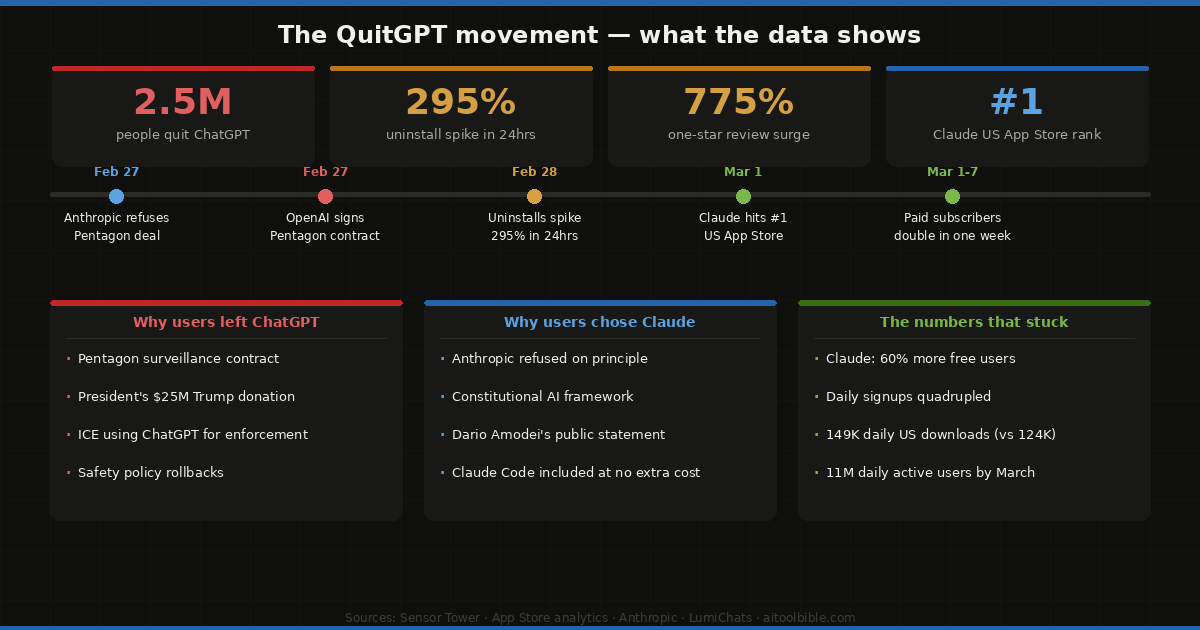
On 27 February 2026, the US Department of Defense — rebranded by the Trump administration as the Department of War — issued Anthropic an ultimatum: remove the safety filters that prevented Claude from being used for mass domestic surveillance and fully autonomous weapons systems, or be blacklisted from all government systems. Anthropic CEO Dario Amodei refused. His public statement read: "I cannot in good conscience accede to the Pentagon's request for unrestricted access to our AI systems. Some uses are simply outside the bounds of what today's technology can safely and reliably do."
Hours later — on the same day — OpenAI CEO Sam Altman, who had earlier posted publicly that he supported Anthropic's position, announced that OpenAI had signed its own Pentagon deal, stepping directly into the void left by Anthropic's refusal. The company had quietly removed clauses banning military use from its safety policies two years prior.
The backlash was immediate and unprecedented. Within 48 hours, ChatGPT daily uninstalls had spiked 295% above their average. One-star App Store reviews surged 775% in a single day. A site called quitgpt.org launched within hours and began accumulating millions of pledges. The movement claimed over 2.5 million people "took action" — a figure that includes social media shares, website signups and verified subscription cancellations.
This was not simply a reaction to the Pentagon deal. OpenAI president Greg Brockman had donated $25 million to a pro-Trump super PAC weeks earlier, and reports had emerged that ChatGPT was being used in US Immigration and Customs Enforcement operations. The Pentagon deal landed on top of existing grievances and triggered a breaking point.
The migration to Claude was measurable and sustained. Claude downloads rose 37% on 28 February and 51% on 1 March. Anthropic confirmed a 60% increase in free active users, with daily signups quadrupling. Paid subscribers more than doubled within a week. Claude reached 11 million daily active users by early March and ranked as the top free app in 16 countries including the UK, Canada, France and Singapore. Sam Altman later admitted in an internal memo that the deal had been "opportunistic and sloppy."
The ethical dimension is now permanently part of how users evaluate these tools. Claude's enterprise market share rose from 18% in 2024 to 29% in 2025, a trend that accelerated further in early 2026. Users are no longer choosing purely on features — they are choosing on trust.
Where things stand in April 2026
Both platforms have evolved dramatically from where they were even twelve months ago. Here is the current state of play.
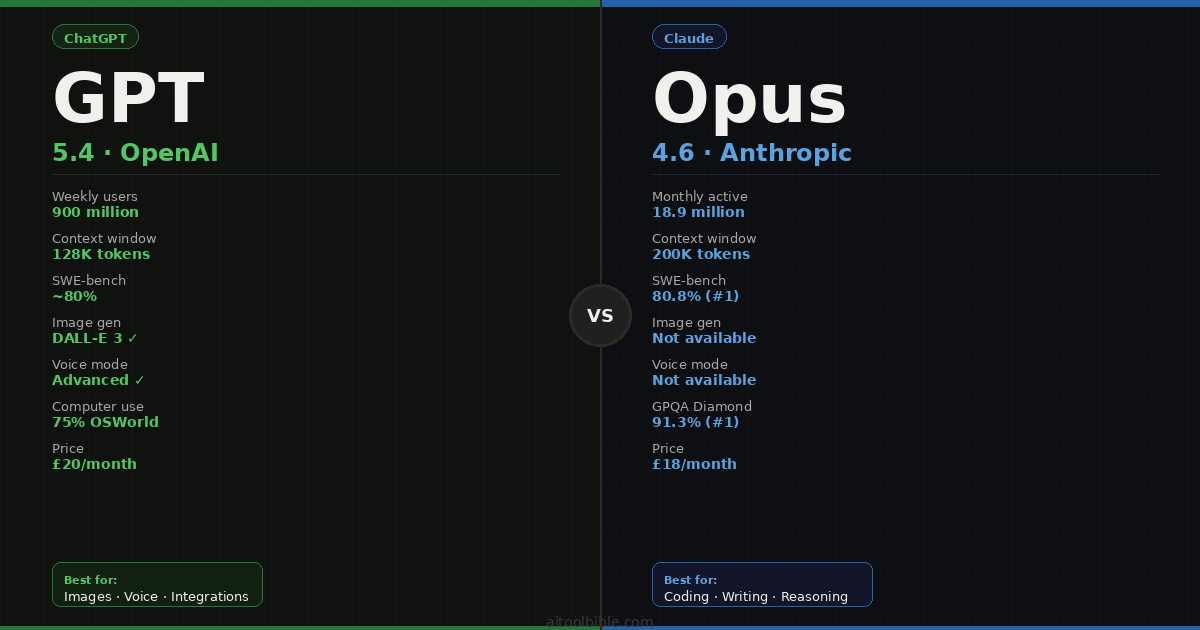
ChatGPT, powered by GPT-5.4, is the world's most-used AI platform with 900 million weekly active users. It has transformed from a text chatbot into a multimodal assistant with image generation via DALL-E, video generation (via the Sora replacement product), Advanced Voice Mode that enables natural flowing conversation, computer use capabilities for desktop task automation and a plugin ecosystem of thousands of integrations. Enterprise now makes up more than 40% of OpenAI's revenue. The platform processes more than 15 billion tokens per minute.
Claude, running on Opus 4.6 and Sonnet 4.6, is positioned as the precision instrument to ChatGPT's Swiss Army knife. It has a 200,000 token context window (versus ChatGPT's 128,000 at the standard paid tier), the highest scores on coding and reasoning benchmarks of any publicly available model, and a focused product philosophy that prioritises depth over breadth. Anthropic's revenue run rate has reached $30 billion, up from $9 billion at the end of 2025. Claude Pro at £18/month includes Claude Code — a full terminal-based coding agent — at no extra charge.
Benchmarks: where the data points
Both companies publish benchmark results and independent researchers verify them. Here is where each model stands as of April 2026.
Coding — Claude leads: On SWE-bench Verified, the industry standard for real-world software engineering tasks, Claude Opus 4.6 scores 80.8% against GPT-5.4's approximately 80%. In Chatbot Arena's coding leaderboard, Claude Opus 4.6 holds the number one spot with an Elo score of 1,561. 70% of developers surveyed prefer Claude for coding tasks. The gap is narrow at the top but Claude has held it consistently since early 2026.
Reasoning — Claude leads: On GPQA Diamond — the benchmark testing graduate-level knowledge in physics, chemistry and biology — Claude Opus 4.6 scores 91.3%, the widest margin of any major benchmark category between the two platforms.
Computer use — ChatGPT leads: GPT-5.4 scores 75% on OSWorld-Verified, the benchmark for autonomous desktop task execution. Claude does not currently offer native computer use capabilities at a comparable level.
General tasks — statistical dead heat: The Chatbot Arena rankings put Claude Opus 4.6 and GPT-5.4 in a statistical tie for general-purpose tasks. The meaningful separation only appears in the specific categories above.
Writing quality: the nuance gap
This is the most subjective category and also one of the most consequential for the majority of users. The consensus among professional writers and content teams who have tested both extensively is consistent: Claude produces more naturally human-sounding prose.
As the team at Morph, which routes production traffic to both platforms, puts it: "Claude produces more natural prose. Sentence length varies. Paragraph transitions flow. Tone matching is more accurate. The consensus among professional writers: Claude's output reads as more human-like, while ChatGPT tends toward a formulaic style that is competent but recognisable."
ChatGPT's writing is often characterised as "obedient" — it does what you ask without question, is fast to produce polished marketing copy and excels at adopting specific personas when prompted. Claude is more likely to push back on a brief it considers under-specified, offer alternatives and produce copy that avoids the patterns AI-detection tools flag as robotic. For long-form content where the writing quality itself is the product — essays, reports, detailed analysis — Claude is the better choice for most users.
For short, fast marketing copy where you are providing detailed style guidance and want the AI to simply execute, ChatGPT is often faster and more compliant.
Coding in depth
The coding comparison has the clearest data. Claude leads on every major benchmark and on developer preference surveys. The practical differentiator for anyone on a paid plan is Claude Code — included in Claude Pro at £18/month. It is a terminal-based agent that reads your entire codebase, edits files across projects, runs commands and operates from your local machine, never uploading code to a cloud container. For developers, this matters both for capability and for privacy.
ChatGPT's Codex-based coding tools are strong and improving rapidly. Codex hit 3 million weekly active users in April 2026, with the number of enterprise Codex users growing 6x since January. The recently launched ChatGPT for Excel add-in and improved spreadsheet and presentation capabilities have expanded its use in business workflows beyond pure software development.
For professional developers working on complex codebases, Claude Code with its 1M token context window (via API) is currently the strongest autonomous coding agent available. For teams working primarily within Microsoft's ecosystem or needing a coding assistant that integrates directly with GitHub Actions and enterprise deployment pipelines, ChatGPT's tooling is more mature.
The multimodal gap: where ChatGPT still dominates
This is the starkest difference between the two platforms in 2026 and the area where ChatGPT maintains the clearest lead.
ChatGPT can generate images (DALL-E integration), produce short video clips, hold voice conversations with low latency via Advanced Voice Mode, browse the web in real time, execute tasks on your desktop via computer use and access thousands of third-party integrations. It is available as a hands-free experience in CarPlay for supported vehicles.
Claude does none of these things. It processes text and images as input, but does not generate images or video, does not have a voice mode and does not have native browser or computer use capabilities. Claude's mobile app is functional but primarily text-focused. If you use AI assistants during commutes, for voice queries, or regularly need image generation as part of your workflow, ChatGPT is the only choice between these two.
This is a deliberate product decision by Anthropic rather than a technical limitation — the company has consistently prioritised reasoning depth and text quality over modality breadth. Whether that trade-off suits your workflow is the single most important factor in choosing between the two.
Context window and long documents
For users who work with long documents — research papers, legal contracts, lengthy code files, book-length manuscripts — the context window is a practical constraint that directly affects what the tool can do. Claude's 200,000 token context window on paid plans compares to ChatGPT Plus's 128,000 tokens. The difference is meaningful when processing a full book, a large legal document or an entire codebase.
Claude's 1M token context is real but currently limited primarily to API access rather than the standard web interface. For most users the 200K context is sufficient. For developers and researchers working with very large inputs, Claude's higher ceiling is a genuine advantage.
Pricing
At the consumer tier, the price is identical: both ChatGPT Plus and Claude Pro cost £18-20/month. What you get for that price differs significantly.
Claude Pro includes access to Claude Sonnet 4.6 and Opus 4.6, priority access during high traffic, and Claude Code — the full terminal coding agent — at no extra cost. ChatGPT Plus includes full GPT-5.4 access, DALL-E image generation, video generation, voice mode, web browsing and usage limits five times the free tier.
At the premium tier, Claude Max at £100-200/month competes with ChatGPT Pro at approximately $200/month. Both tiers are aimed at power users and developers who consistently hit the limits of the standard plans.
At the API level, Claude Sonnet 4.6 is priced at $3 per million input tokens and $15 per million output tokens. GPT-5.4 is $2.50 per million input and $15 per million output. The API cost difference is marginal for most applications; the more relevant factor is which model produces better output on your specific task, since a better model that requires fewer API calls often costs less overall.
Safety and ethics: the philosophical difference
The difference between Anthropic and OpenAI is not just about features. It runs to the founding philosophy of each company.
Anthropic was founded by former OpenAI researchers — including Dario and Daniela Amodei — who left specifically because of concerns about safety practices at OpenAI. The company's entire research agenda is built around Constitutional AI: a framework for training models to behave in accordance with explicit ethical principles. Claude is trained using this framework and the effects are observable: it will decline requests it considers harmful more readily than ChatGPT, it is more likely to add caveats to sensitive topics and its refusals are generally more transparently explained.
OpenAI began as a non-profit AI safety research organisation with a mission to "ensure that artificial general intelligence benefits all of humanity." Its commercial success has inevitably pulled it toward decisions that prioritise growth and revenue. The Pentagon deal, the removal of military use restrictions from its safety policies, and Sam Altman's admission that the deal was "opportunistic" are all data points in a pattern that users evaluated and reacted to in February 2026.
Neither position is simply right or wrong. OpenAI's argument — that having safety-conscious developers inside government AI programmes is better than leaving the field to less safety-focused organisations — has genuine merit. Anthropic's argument — that some applications are simply incompatible with responsible AI deployment at current capability levels — is principled but has its own costs. The QuitGPT movement showed that for millions of users, the distinction matters enough to change their behaviour.
Real-world use cases: which tool for which job
Rather than a single verdict, the most useful framing is task-by-task. Here is where each tool performs best based on current benchmarks, user surveys and independent testing.
Choose Claude for:
- Coding and software development — 80.8% SWE-bench, 70% developer preference, Claude Code included at no extra cost
- Long document analysis — 200K context window, superior at synthesising large inputs and maintaining coherent reasoning across them
- High-quality writing — more natural prose, better tone matching, less likely to sound AI-generated
- Complex reasoning tasks — 91.3% GPQA Diamond, strongest performance on graduate-level problem solving
- Legal, financial and regulated industry work — Constitutional AI framework, stronger compliance posture, more conservative on sensitive data
- Privacy-sensitive development — Claude Code runs locally, no cloud upload of your codebase
Choose ChatGPT for:
- Image generation — DALL-E integration, no equivalent in Claude
- Voice interaction — Advanced Voice Mode, natural conversation, CarPlay support
- Desktop automation — computer use features at 75% OSWorld benchmark score
- Ecosystem and integrations — thousands of plugins, Microsoft Office integration, GitHub workflows
- Research and web browsing — real-time web access built into the standard plan
- Mobile-first users — stronger mobile app with voice capabilities
The in-depth comparison
Here is a complete category-by-category breakdown of every major dimension where the two tools differ as of April 2026.
Models and architecture
ChatGPT runs on GPT-5.4 as its primary model, with GPT-5.4 Thinking for reasoning-heavy tasks. The o-series models (o1, o3) serve as a dedicated reasoning tier. Claude runs on Sonnet 4.6 as its standard model and Opus 4.6 for the most demanding tasks. Claude Haiku 4.5 serves as the fast, lightweight tier.
Context window
Claude: 200K tokens on paid plans (web interface), 1M tokens via API. ChatGPT: 128K on Plus, 1M tokens on Pro and in Codex. The practical gap at the consumer tier favours Claude by a meaningful margin for long-document work.
Image generation
ChatGPT: DALL-E 3 integration, available on Plus and above. Claude: none. Clear win for ChatGPT.
Voice mode
ChatGPT: Advanced Voice Mode with low latency and natural conversation flow, available across platforms including CarPlay. Claude: no voice mode. Clear win for ChatGPT.
Computer use
ChatGPT: desktop automation at 75% OSWorld-Verified. Claude: limited capability in this category. Clear win for ChatGPT.
Coding benchmarks
Claude Opus 4.6: 80.8% SWE-bench Verified, #1 Chatbot Arena Elo (1,561). GPT-5.4: ~80% SWE-bench Verified, ~57.7% SWE-bench Pro. Claude edges ahead, with consistent advantage on complex multi-file tasks.
Reasoning benchmarks
Claude Opus 4.6: 91.3% GPQA Diamond. GPT-5.4: approximately 89.5% GPQA Diamond. Claude's strongest benchmark advantage.
Writing quality
Claude: more natural, varied sentence structure, better tone matching, less formulaic. ChatGPT: faster, more compliant, stronger on short marketing copy. Subjective — but the consensus among professional writers consistently favours Claude for long-form work.
Web browsing
ChatGPT: real-time web access included on Plus. Claude: web search available but less seamlessly integrated. ChatGPT has the edge for research-heavy workflows.
Integrations and ecosystem
ChatGPT: thousands of third-party integrations, Microsoft Office, GitHub, CarPlay, Android Auto. Claude: strong API, MCP server support, Slack, AWS Bedrock, but smaller ecosystem overall. ChatGPT has a significant lead here.
Mobile app
ChatGPT: full-featured, voice mode, available on iOS and Android. Claude: functional but more text-focused. ChatGPT wins for mobile users.
Pricing (consumer)
Identical at £18-20/month for the standard paid tier. Claude Pro includes Claude Code (coding agent). ChatGPT Plus includes DALL-E, video and voice. Value depends entirely on which features you use.
API pricing
Claude Sonnet 4.6: $3/$15 per million tokens (input/output). GPT-5.4: $2.50/$15. Marginal difference — model quality for your specific task matters more than the price differential.
Safety and ethics
Claude: Constitutional AI framework, more conservative refusals, refused Pentagon mass surveillance contract. ChatGPT: more permissive on edge cases, accepted Pentagon contract. Neither position is without trade-offs.
Enterprise features
Both offer enterprise plans with SSO, compliance features and admin controls. Claude Enterprise has SOC 2 certification, strong data residency controls and a 29% enterprise AI assistant market share (up from 18% in 2024). ChatGPT Enterprise has IP indemnification, Microsoft integration and broader Fortune 500 penetration. For Microsoft-heavy enterprises, ChatGPT is the stronger fit. For regulated industries prioritising safety posture, Claude is increasingly the preferred choice.
Memory and continuity
ChatGPT: persistent memory visible in the UI, relatively automatic. Claude: Projects feature provides persistent context but requires more intentional setup. First-time Claude users regularly lose context they expected to carry over.
Developer tools
Claude: Claude Code included with Pro, strong API with MCP support, Claude Code for terminal-native agentic workflows. ChatGPT: Codex (3M weekly active users), Codex Security (vulnerability scanning), ChatGPT for Excel, Canvas for collaborative editing. Both have strong developer ecosystems — choose based on your workflow.
The verdict
The question "which is better" has become less useful in 2026 than it was in 2024. The models are within a few percentage points of each other on most benchmarks. The real differentiation is in focus: Anthropic has optimised Claude for depth, precision and text quality. OpenAI has optimised ChatGPT for breadth, accessibility and multimodal capability.
If your work is primarily text and code, Claude is the better choice. The benchmarks support it, professional users prefer it and the £18/month includes Claude Code — a genuinely powerful tool that ChatGPT charges extra to approximate.
If you need images, voice, desktop automation and integrations, ChatGPT is the only choice. Claude simply does not have these features.
For many professionals, the most productive setup is using both: Claude for complex coding, writing and analysis where quality is the priority, and ChatGPT for image generation, voice queries and tasks requiring web access or external integrations. At £18-20/month each, running both is affordable for anyone where AI is a core part of their workflow.
The ethical dimension, once an abstract consideration, is now a practical one. The QuitGPT movement showed that users are increasingly treating their AI tool choice the way they treat other technology purchases — as an expression of what they value, not just what works. That trend is unlikely to reverse, and it shapes the competitive dynamics between these two platforms in ways that benchmarks alone do not capture.
Both tools are excellent. One is almost certainly better for your specific workflow. The data in this article gives you what you need to decide which one that is.
Sources: LumiChats QuitGPT timeline · NxCode benchmark comparison · Morph production data · Android Headlines download data · Built In switching analysis · OpenAI enterprise report · Tom's Guide App Store report