On 23 April 2026 — yesterday, as this article goes live — OpenAI shipped GPT-5.5, its most capable model to date. Anthropic followed with Claude Opus 4.6 and Sonnet 4.6 in February. Google DeepMind released Gemini 3.1 Pro in late February as well. Three top-tier models, three different philosophies, all available right now at roughly the same £16–£20 per month price point. If you've been putting off deciding which one to subscribe to, 2026 is actually the hardest year to choose — and the easiest to justify trying all three.
This comparison covers the current flagship models from each provider: GPT-5.5 (OpenAI/ChatGPT), Claude Opus 4.6 (Anthropic), and Gemini 3.1 Pro (Google). We'll look at benchmarks, real-world performance, pricing, and the specific scenarios where each one is genuinely the better choice.
Where Things Stand Right Now
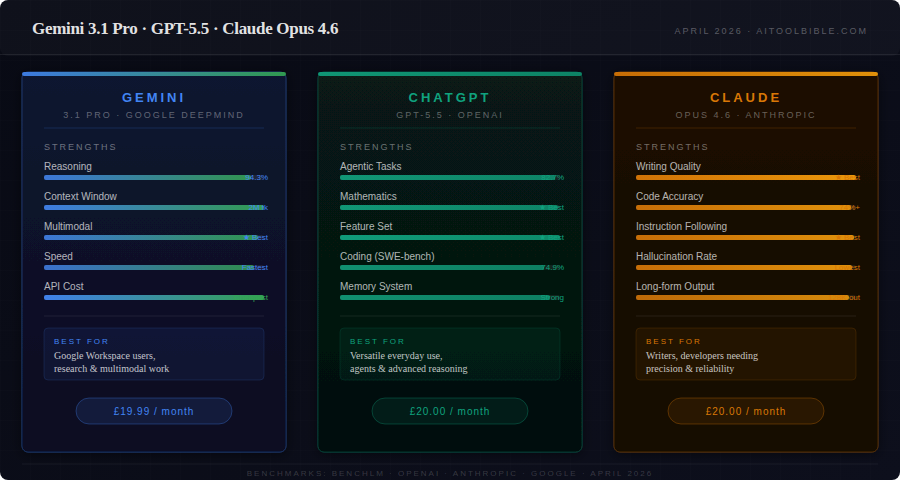
The "one model to rule them all" era is definitively over. Independent benchmarking from BenchLM (updated April 2026) places Gemini 3.1 Pro at an overall score of 93, with GPT-5.5 and Claude Opus 4.6 both sitting at 88. Those numbers are close enough that the task you're running matters far more than the overall ranking.
Here is a quick reference across key categories:
- Coding (SWE-bench Verified): GPT-5.5 leads at approximately 74.9%, Claude Opus 4.6 close behind at 74%+, Gemini 3.1 Pro at 63.8%
- Reasoning (GPQA Diamond): Gemini leads at 94.3%, GPT-5.5 at 92.8%, Claude Opus 4.6 at 91.3%
- Writing quality: Claude Opus 4.6 is consistently rated first by independent reviewers and writing professionals
- Multimodal (images, video, audio): Gemini leads, with native video and audio understanding that neither rival matches
- Context window: Gemini 3.1 Pro at 2 million tokens; GPT-5.5 at approximately 1 million; Claude Opus 4.6 at 200K
- Speed: Gemini is noticeably faster in most user-facing tests
The defining feature of 2026 AI is specialisation. No single model dominates every row. The right answer depends entirely on what you're trying to do.
ChatGPT (GPT-5.5): The Most Feature-Complete Product
What's new in GPT-5.5
GPT-5.5, released on 23 April 2026, is OpenAI's first fully retrained base model since GPT-4.5. It's not an incremental update: on Terminal-Bench 2.0 — a benchmark for real agentic computing tasks — it scores 82.7%, which is state of the art for any publicly available model. On GDPval, a benchmark designed to measure work that economists can actually price (financial analysis, legal drafting, consulting), it scores 84.9%.
Senior engineers who tested the model early reported that it caught issues proactively, predicted testing needs without being asked, and stayed on task through complex multi-step jobs significantly better than GPT-5.4. One NVIDIA engineer with early access described losing access to it as feeling like "having a limb amputated" — which is either compelling testimony or very good PR, depending on your level of scepticism.
The GPT-5.5 integration also unifies the previous split between standard GPT and the separate "o-series" reasoning models — you no longer need to switch between them manually.
ChatGPT's practical strengths
- Breadth: Knows virtually every programming framework, language, and library. Consistently strong across wildly different task types.
- The most mature consumer product: Built-in image generation, web browsing, code execution, voice mode, and the most polished user interface of the three.
- Memory: ChatGPT's persistent memory system remains the most developed, tracking context across sessions without manual setup.
- Agentic performance: GPT-5.5 leads on OSWorld (desktop GUI task completion at 75%) — useful for anyone building or using AI agents that navigate real software interfaces.
- Math: On FrontierMath Tier 4, the hardest mathematical benchmark available, GPT-5.5 Pro scored 39.6% — nearly double Claude Opus 4.7's 22.9%.
ChatGPT's weaknesses
- Message limits on the flagship model can frustrate heavy users on the standard Plus plan.
- Claude consistently produces more natural, literary prose for long-form writing tasks.
- API pricing is mid-range: $2.50 input / $15 output per million tokens — cheaper than Claude Opus but more expensive than Gemini.
Best for
General-purpose use across a wide variety of tasks; anyone who wants a single tool that handles almost everything reasonably well; agentic workflows that require desktop GUI navigation; advanced mathematics and scientific reasoning.
Claude (Opus 4.6): The Precision Tool
What defines Claude in 2026
Anthropic's flagship is Claude Opus 4.6, released in February 2026. Claude's reputation for producing the most accurate, well-reasoned, and readable output has held across multiple model generations — and the developer community has voted with its wallets: Claude powers Cursor, Windsurf, and Claude Code, making it the dominant model inside professional coding environments even when it doesn't always top raw benchmarks.
The architectural choice here matters. Claude's non-reasoning architecture produces more natural responses without chain-of-thought overhead, which is why its prose feels less mechanical than competitors. When you ask Claude to write something, it writes — it doesn't explain what it's about to do, hedge for three sentences, then produce the work.
Claude's practical strengths
- Writing quality: Claude Opus 4.6 is the first choice for long-form writing, editing, and prose. It can output 128,000 tokens in a single pass — useful for long documents, reports, or books.
- Instruction-following: Claude is widely regarded as the most reliable at following precise, multi-part instructions without drifting.
- Code accuracy: Writes the cleanest, most idiomatic code of the three — correct naming conventions, proper structure, better adherence to best practices. Claude Code (a dedicated CLI tool for software engineering) reflects this depth.
- Fewer hallucinations: Independent testing consistently places Claude lowest for confident incorrect answers.
- Safety and reliability: Anthropic's focus on AI safety translates to more predictable, consistent outputs — important for professional and enterprise use.
Claude's weaknesses
- Context window (200K tokens for Opus 4.6) is substantially smaller than Gemini's 2 million, which matters when processing very large documents or entire codebases in a single prompt.
- No built-in image generation and limited audio/video processing compared to Gemini.
- Fewer native integrations out of the box — no direct Google Workspace sync, smaller plugin ecosystem than ChatGPT.
- API pricing is the most expensive of the three: $15 input / $75 output per million tokens for Opus 4.6. Claude Sonnet 4.6, at $3/$15, gives approximately 98% of Opus quality at a fraction of the cost — and is what most professional users should actually be on.
Best for
Developers and coders who need accuracy over speed; writers producing long-form content; professionals who need reliable instruction-following on complex, multi-step tasks; anyone who has been burned by hallucinations in other models.
Google Gemini (3.1 Pro): The Ecosystem Play
What defines Gemini in 2026
Gemini 3.1 Pro is the current Google DeepMind flagship, released in late February 2026. Its headline number is a 2-million-token context window — roughly 1.5 million words, or the equivalent of fifteen average novels in a single prompt. For anyone working with large document sets, massive codebases, or rich media, this is a structural advantage that raw intelligence scores can't overcome.
Gemini also leads on GPQA Diamond reasoning benchmarks at 94.3%, and on multimodal tasks — it has native understanding of images, video, and audio in a way neither ChatGPT nor Claude currently matches. For tasks involving diverse data types, Gemini is operating in a different league.
Gemini's practical strengths
- Google Workspace integration: If your work runs through Gmail, Docs, Sheets, Slides, or Drive, Gemini is embedded natively into all of them. No other AI has the same in-context awareness of your existing Google data. The Gemini for Workspace subscription is the easiest way to add AI to an existing Google-based workflow.
- Massive context window: At 2 million tokens, Gemini 3.1 Pro can process entire large codebases, extensive legal documents, or research archives in a single request. Claude and GPT-5.5 both fall short here.
- Real-time search: Gemini can be grounded in live Google Search results, giving it access to current information that pure closed-context models cannot match. For time-sensitive analytical tasks, this is a genuine differentiator.
- Speed: Noticeably faster responses than ChatGPT and Claude in most user-facing scenarios.
- Price (API): Gemini 3.1 Pro at $1.25 input / $5 output per million tokens is significantly cheaper than GPT-5.5 and far cheaper than Claude Opus. Gemini 2.5 Flash at $0.15/$0.60 is the industry's most cost-effective option for high-volume applications.
- Multimodal: Native video, audio, and image understanding with a 1-million-token multimodal context window. Best-in-class for media-heavy workflows.
Gemini's weaknesses
- Writing tone is often accurate but functional rather than polished. Teams producing brand content or nuanced long-form writing typically prefer Claude.
- Less consistent than Claude on complex reasoning tasks — can give different answers to the same question on repeat runs.
- The conversational experience feels less refined than ChatGPT or Claude. Gemini works better as a drafting and analysis assistant than a finished writer.
- Outside the Google ecosystem, it loses a large part of its structural advantage. If your team runs on Microsoft 365 or standalone tools, consider whether the integrations are actually relevant to you.
- Developer community consensus still rates Claude higher for understanding vague or ambiguous prompts.
Best for
Teams running on Google Workspace; research and analysis tasks requiring current information; workflows involving images, video, or audio; high-volume API use where cost per token matters; anyone who needs to process genuinely massive documents in a single pass.
Pricing: What You Actually Pay
At the consumer level, all three are priced almost identically:
- ChatGPT Plus: $20/month (GPT-5.5 access, with usage limits on the flagship model)
- Claude Pro: $20/month (Claude Sonnet 4.6 standard; Opus 4.6 access included)
- Gemini Advanced (Google One AI Premium): $19.99/month (includes 2TB of Google Drive storage)
For most individuals, price should not drive the decision at the consumer tier — the products cost the same. The real price differences appear at the API level, where Gemini Flash is 20–40 times cheaper than Claude Opus for high-volume applications. If you are building something on top of these models rather than just chatting with them, that gap is significant.
There is also a growing premium tier: ChatGPT Pro, Claude Max, and Google AI Ultra all sit around $200–£250 per month for users who need uncapped access to the most powerful versions of each model.
A Practical Multi-Model Workflow
The smartest approach in 2026 is not picking one AI and ignoring the others — it is using each where it genuinely excels. Here is a workflow used by many professional users:
- Brainstorm and ideate with ChatGPT. Its conversational style, memory system, and broad knowledge make it the best starting point for open-ended thinking, outlines, and first drafts across varied subject matter.
- Build and code with Claude. When accuracy matters — writing code, reviewing pull requests, creating technical documentation, or following complex multi-step instructions — Claude's precision and lower hallucination rate make it the safest choice.
- Research and analyse with Gemini. For tasks involving large document sets, Google Workspace data, multimodal content, or anything requiring live web information, Gemini's context window and integrations are unmatched.
- Cross-check critical decisions. For anything where being wrong has real consequences, run the same question through two or three models and compare. Disagreement between models is useful signal.
The Verdict
Use ChatGPT if you want the most feature-complete consumer product, need strong agentic performance, work across a wide variety of tasks, or are dealing with advanced mathematics and scientific reasoning. GPT-5.5 is genuinely impressive — and if you haven't tried it since the update dropped yesterday, it is worth revisiting.
Use Claude if writing quality, instruction-following precision, or coding accuracy is your primary concern. Claude is the tool professional writers and developers consistently return to. The Sonnet 4.6 tier, at the same price as the others, gives almost all of Opus's capability at far lower API cost.
Use Gemini if you live in Google Workspace, need to process very large documents, work with images, video, or audio, or need real-time web-grounded answers. The context window advantage alone makes it the only sensible choice for certain workflows.
The free tiers of all three have improved substantially in 2026. Before committing to any subscription, spend a week with all three free plans running the exact tasks you actually do at work. The difference will be clearer than any benchmark article — including this one.