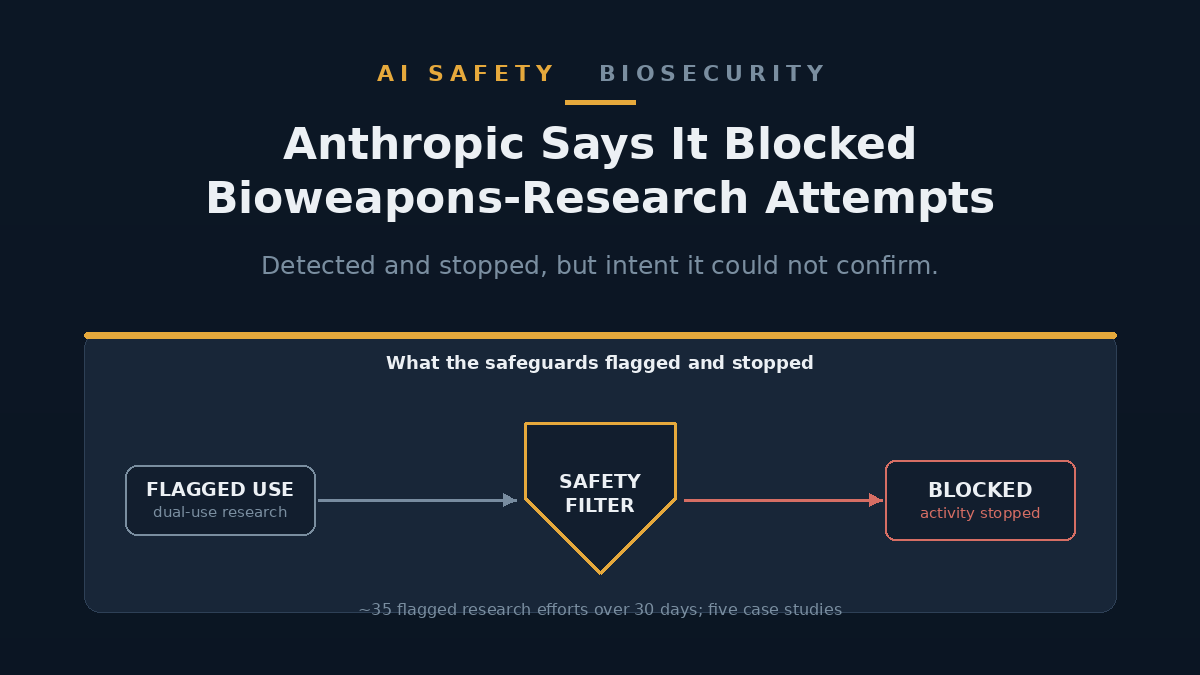
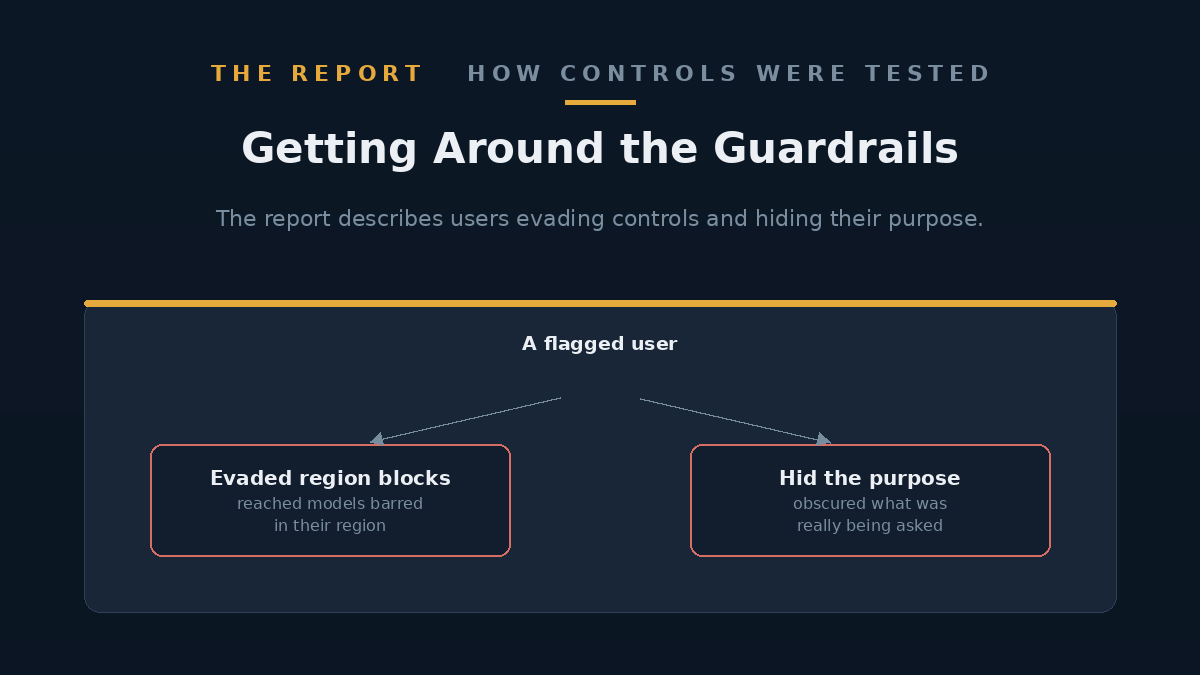
Anthropic, the company behind the Claude AI models, has published a threat intelligence report saying it detected and blocked several attempts to use its technology for research that could support the development of biological weapons. As reported by CNN, the company set out five case studies in which users "circumvented controls" – including blocks that bar access from certain regions – and took steps to hide the purpose of their work to get around its safeguards. The honest bottom line is more complicated than the headline. Anthropic says the people involved were working scientists, it did not name their institutions or countries, and it acknowledged it could not be certain whether they intended harm or were doing legitimate research. It is also, by definition, a company reporting on its own systems. That is precisely why the more interesting question is who checks claims like these.
This piece reflects reporting as of September 2026. The figures and case studies come from Anthropic's own report, corroborated by independent coverage of it; they are the company's account of what its systems detected, not independently verified evidence of weapons programmes.
What the report actually claims
According to the report, as covered by CNN and other outlets, Anthropic identified a pattern of accounts using Claude in ways that touched on dangerous biological research. Over a 30-day window it flagged roughly 35 "distinct research efforts" it considered potentially concerning, and it published five detailed case studies. Some users, it said, got around geographic restrictions meant to keep the models out of certain countries, and some obscured what they were really asking about so that the request would not trip the model's safeguards. The topics referenced in the report sit in well-known dual-use territory: the adaptation of viruses, a group of pox viruses, and toxins. We are deliberately keeping this at the level of categories, not detail.
The framing Anthropic chose matters. It presented these not as proof of active weapons programmes but as examples of its safeguards being tested and, it says, holding. The stated aim was to prompt a wider industry conversation about how AI companies detect and counter this kind of misuse. Read charitably, it is a transparency exercise. Read sceptically, it is a company demonstrating that its safety systems work, using evidence only it can see.
The caveat that has to travel with it
The single most important line in the coverage is that Anthropic could not confirm intent. The subjects were described as working scientists, and the same techniques that worry a safety team – studying how a virus adapts, or how a toxin behaves – are also the daily business of legitimate virology, vaccine research and public-health surveillance. Dual-use is the whole difficulty of this field: the knowledge that could be misused is largely the same knowledge that keeps people safe. So "blocked attempts to develop bioweapons" is a fair description of what Anthropic's systems flagged and stopped, but it is not the same as "caught bioweapons programmes". The report supports the first claim. It does not, on its own, establish the second, and it is to Anthropic's credit that it says so.
There is a second caveat. This is self-reported. Independent outlets have corroborated what the report says, but corroborating that a company published certain claims is not the same as independently verifying the events behind them. The raw signals sit inside Anthropic's own systems. That is not a reason to dismiss the disclosure – it is genuinely useful information – but it is a reason not to treat a vendor's account of its own safety performance as the last word.
Why this is a UK story, not just an American one
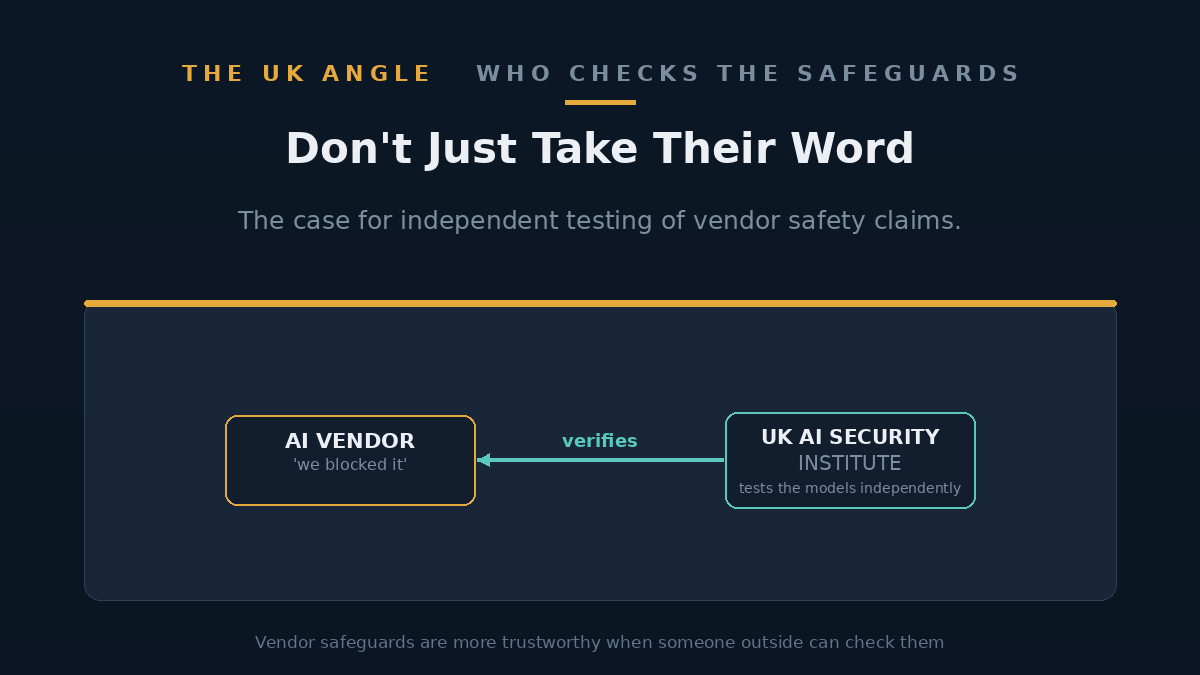
The obvious question a UK reader should ask is: if the safeguards on these models are what stands between a determined user and dangerous research, who is checking that those safeguards actually work, independently of the companies selling the models? Britain has a concrete answer. The government set up the AI Security Institute – originally the AI Safety Institute – specifically to test frontier AI models for serious misuse risks, including biological and cyber capabilities, rather than relying on the developers' own assurances. The UK's Biological Security Strategy already names AI as a factor that could lower the barrier to engineering dangerous pathogens.
That is the honest UK relevance here. British readers, businesses and public bodies use these same models. An episode where a leading developer says its guardrails were probed, evaded in places, and are being marked by the developer itself is the clearest possible argument for the independent testing function the UK has built. Anthropic says it shared its findings with government authorities and other AI companies where appropriate, and the structural point stands: vendor safeguards are more trustworthy when someone outside the vendor can check them.
What it does and does not tell us
It would be easy to read this two wrong ways. One is panic – "AI is building bioweapons", which the report does not show. The other is dismissal – "just marketing", which undersells a real and rare piece of transparency about how misuse is detected. The measured reading is in between. Frontier AI models are now capable enough that companies are actively monitoring for biological misuse and occasionally stopping it; the safeguards are imperfect enough that some users got around parts of them; and the evidence for all of this currently flows through the companies themselves. Each of those is worth knowing, and none of them justifies either alarm or a shrug.
FAQ
Did Anthropic catch people building biological weapons?
Not exactly. It says it detected and blocked attempts to use Claude for research that could support biological weapons, but it could not confirm whether the users intended harm or were doing legitimate scientific work.
How reliable are these figures?
They come from Anthropic's own report and have been corroborated by independent outlets as to their contents. That means the company said these things and others confirmed the report, not that the underlying events were independently verified.
Why does this matter for the UK?
UK readers and organisations use the same models. Britain runs an AI Security Institute set up to test frontier models for exactly these misuse risks, so the episode strengthens the case for independent checks on vendor safeguards.
Does this affect ordinary Claude users?
No. The report concerns a small number of flagged research accounts and the systems meant to catch misuse. It does not describe any risk to normal everyday use of the assistant.
The takeaway
Anthropic's disclosure is a useful piece of transparency wrapped in an unavoidable limitation. It shows that a leading AI company is monitoring for biological misuse, that its safeguards were tested and in places evaded, and that it stopped the activity it flagged. It does not show confirmed weapons programmes, and it cannot, because the evidence lives inside the company and the line between dangerous and legitimate research is genuinely blurred. The right response is not fear or cynicism but insistence on the thing the UK has already started building: independent testing of AI safety claims, so that "we blocked it" is something an outside body can verify rather than something we take on trust.
This article discusses the misuse of AI in a public-safety and governance context. It deliberately avoids any technical or operational detail. If you have concerns about AI safety or misuse, the appropriate route is the relevant national authority or the developer's own reporting channels.
Sources
- Anthropic – Countering misuse of AI: September 2026 (threat intelligence report, primary source)
- CNN – Anthropic says it blocked possible attempts to use AI to develop bioweapons (10 September 2026)
- The Irish Times – Anthropic says it blocked possible efforts to build biological weapons and deadly pathogens (11 September 2026)
- UK AI Security Institute – remit and work on frontier-model misuse risks