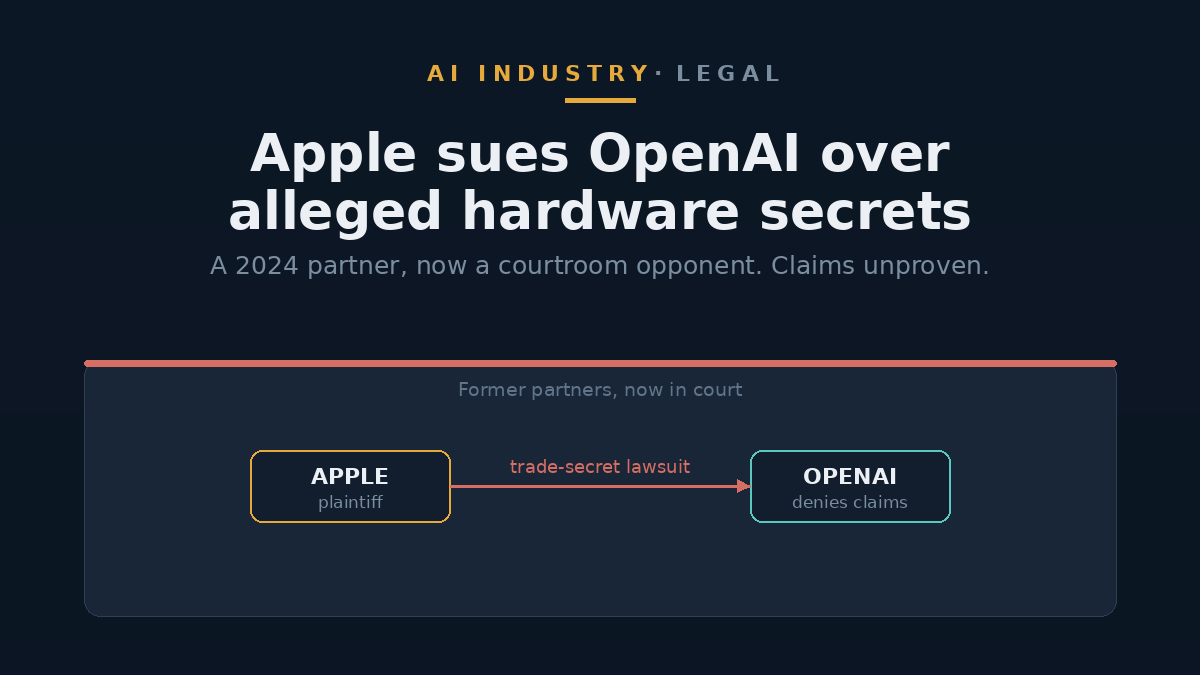
Apple has sued OpenAI in federal court in Northern California, alleging that former Apple employees who now work at the AI company stole trade secrets "for the benefit of OpenAI." The complaint also names IO Products — the hardware startup founded by former Apple designer Jony Ive that OpenAI bought in 2025 — along with OpenAI's hardware chief Tang Tan and engineer Chang Liu, both ex-Apple. Apple says it has found a pattern of theft aimed at OpenAI's forthcoming consumer device. The essential caveat up front: these are unproven allegations in a civil filing. OpenAI has publicly denied wrongdoing but has not yet filed a formal response in court, and Apple's account is one side of a dispute.
This piece reflects reporting as of July 2026. It describes allegations in a civil complaint, not findings of fact; details may shift as the case proceeds.
What Apple alleges
According to the complaint as reported by TechCrunch and Axios, Apple claims Tang Tan — a former Apple vice-president now leading OpenAI's hardware effort — encouraged Apple staff interviewing at OpenAI to bring company secrets with them. Apple's filing says candidates were asked to bring "actual parts" from Apple for "show and tell" sessions. It separately alleges that Chang Liu, who spent eight years at Apple before leaving for OpenAI in early 2026, failed to return an Apple-issued laptop and had used it to download confidential technical documents.
Apple frames these as part of a deliberate effort to shortcut the years of engineering that go into a new piece of consumer hardware. OpenAI publicly rejected the accusations: a company spokesman said it has "no interest in other companies' trade secrets" and remains focused on its own technology. It had not, as of writing, filed a formal response in court. Nothing in the complaint has been tested, and an allegation of a "pattern" is a claim to be proven, not an established fact.
How two partners became opponents
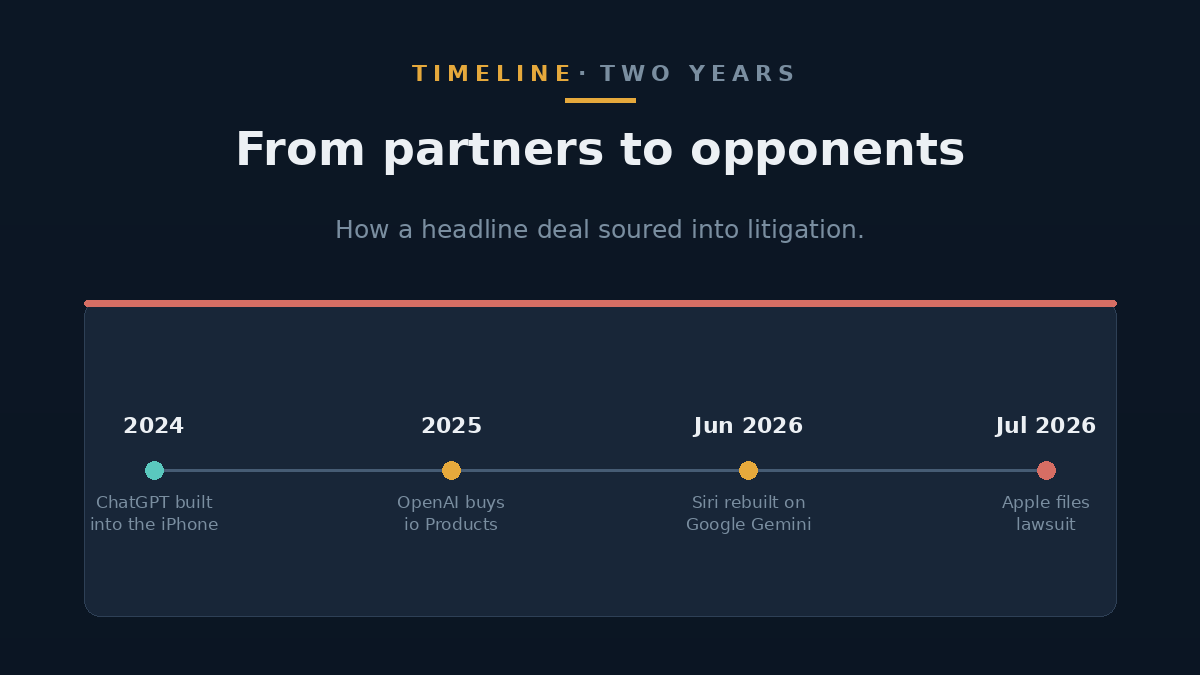
The striking thing is how recently these companies were on the same side. In 2024 they struck a high-profile deal to build ChatGPT into the iPhone's operating system — the kind of partnership that signals alignment, not litigation. The relationship cooled as OpenAI moved into hardware, buying Ive's IO Products in 2025 in a deal reported at around $6.5 billion. OpenAI reportedly grew frustrated with how Apple surfaced ChatGPT inside its products, and in June 2026 Apple said a rebuilt version of Siri would run on Google's Gemini rather than OpenAI's models. A lawsuit accusing the other side of stealing your secrets is about as complete a reversal of a partnership as exists.
Why this matters beyond the two companies
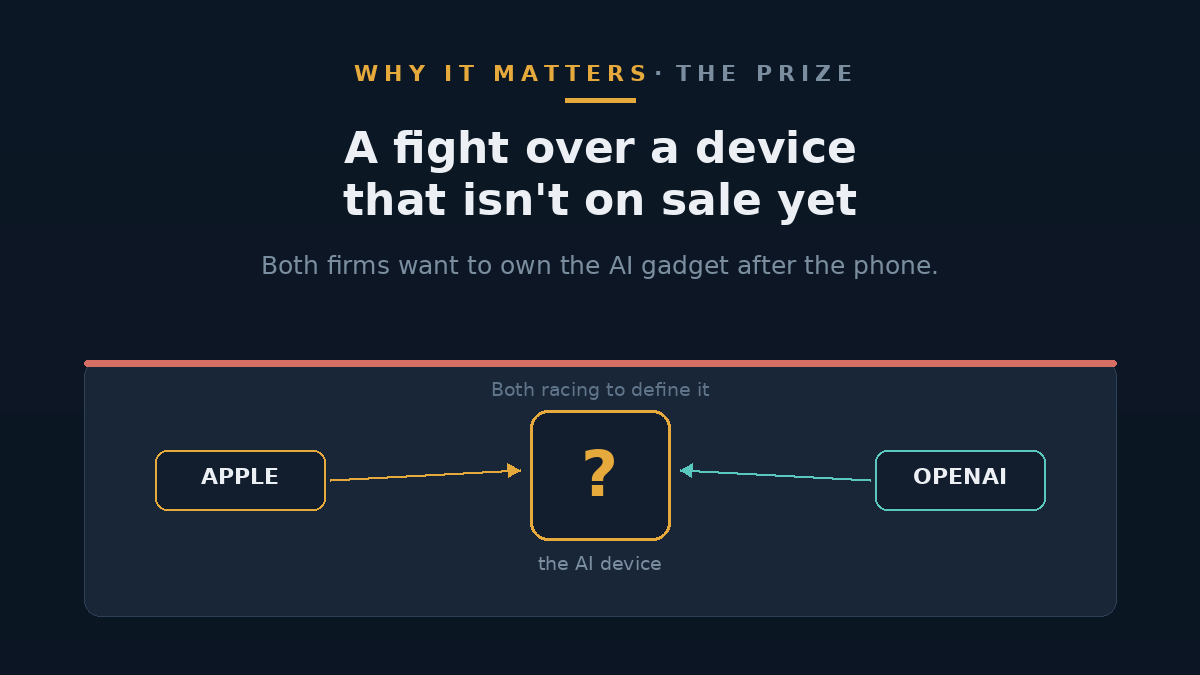
For a non-technical reader, the interesting part is not the courtroom procedure — it is what the fight reveals. Both companies believe the next big consumer product is some form of AI-first device, a thing you talk to rather than tap, and both are willing to spend and litigate heavily to own it. When a company as protective and deep-pocketed as Apple goes to court over hardware trade secrets, it is telling you where it thinks the value is heading. The pocket AI gadget that OpenAI and Ive are building does not exist in shops yet, but it is already valuable enough to sue over.
It is also a reminder that the AI industry's map of allies and enemies is redrawn constantly. The same two names can be partners, competitors and courtroom adversaries inside two years. If you are choosing tools for the long term — a Siri that now leans on Gemini, a ChatGPT that once lived inside your iPhone — it is worth remembering how quickly those arrangements can change, and that today's integration is not a promise about next year's.
FAQ
Has Apple proven that OpenAI stole its secrets?
No. Apple has filed a civil complaint setting out allegations. They are unproven, OpenAI has the opportunity to contest them, and courts often take a long time to resolve trade-secret cases — many settle before any finding is made.
Who exactly is being sued?
OpenAI, the hardware startup IO Products (founded by Jony Ive and acquired by OpenAI), and two named individuals who moved from Apple to OpenAI — hardware chief Tang Tan and engineer Chang Liu.
Does this affect ChatGPT or Apple products I use today?
Not directly or immediately. This is a dispute about hardware development and personnel, not a shutdown of any current service. The more visible recent change for users is Apple's decision to base a rebuilt Siri on Google's Gemini rather than OpenAI.
What happens next?
OpenAI has already publicly denied wrongdoing and will now be expected to file a formal response to the complaint, after which the case moves through the usual pre-trial stages. Expect months, not weeks, and expect both sides to say very different things about the same events.
The takeaway
Read past the drama and this is a fight about a product that isn't on sale yet. Apple's allegations are serious and, for now, unproven; OpenAI has denied wrongdoing, and its detailed court response is still to come. What's already clear is that the race to build the first genuinely mainstream AI device has turned two former partners into legal opponents — and that the companies involved think the prize is worth the fight. Watch what OpenAI files in response before drawing any firm conclusions.
Sources
- CNBC — "Apple sues OpenAI alleging trade secret theft" (10 July 2026)
- TechCrunch — "Apple sues OpenAI over alleged trade secret theft" (10 July 2026)
- Axios — "Apple sues OpenAI for trade secret theft" (10 July 2026)
- CNN Business — Apple's lawsuit over OpenAI's upcoming AI devices (10 July 2026)
- Fortune — Apple accuses OpenAI and Jony Ive's io Products of stealing hardware secrets (10 July 2026)
- 9to5Mac — "OpenAI responds to Apple's trade secret theft lawsuit" (10 July 2026)