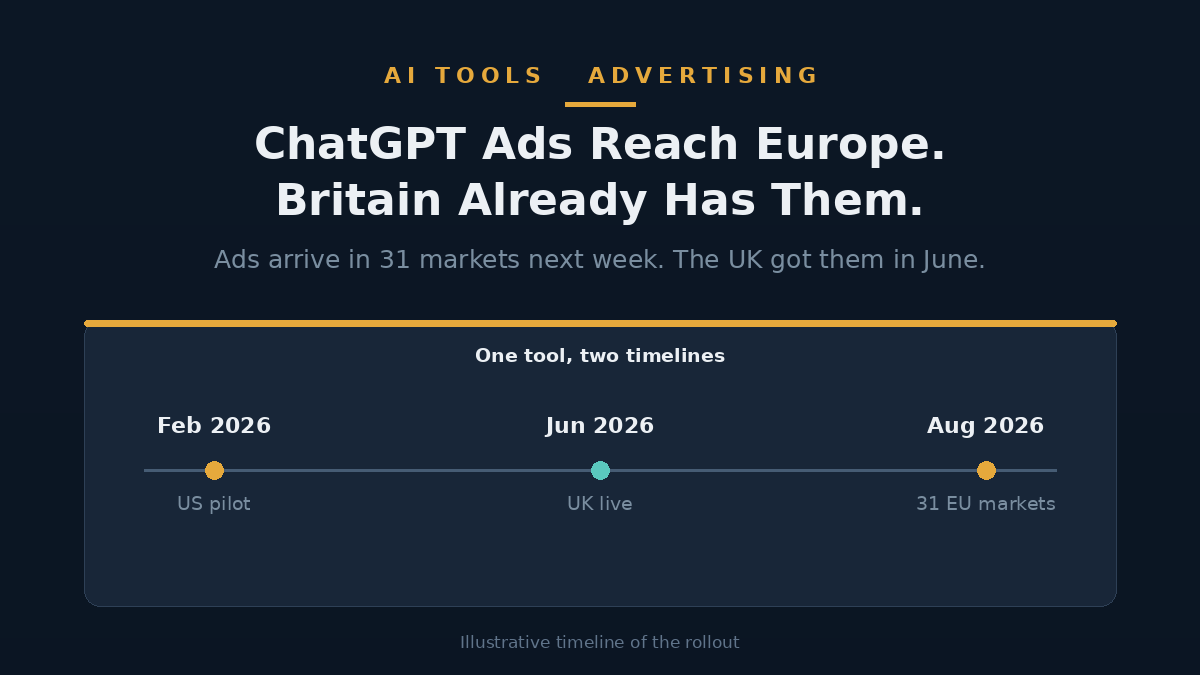
OpenAI is expanding ads inside ChatGPT to 31 European markets, with the rollout beginning next week. The UK is not on that list, and the reason is not that Britain has been skipped. It is that ChatGPT ads already reached the UK earlier in 2026, as part of the eight-market expansion that followed the US pilot, alongside countries like Canada and Australia. Reporting by Digiday puts the UK launch in June, as OpenAI's first European market. So the real story for readers here is not about missing out. It is that if you use the free version of ChatGPT, you may already be seeing ads, and this expansion is a good moment to understand how they work. The European Union is only getting them now largely because of its stricter data-consent rules.
This piece reflects reporting as of August 2026. Rollout dates and market lists can change, and several details below rest on OpenAI's own description of its system.
What "ChatGPT ads" actually means
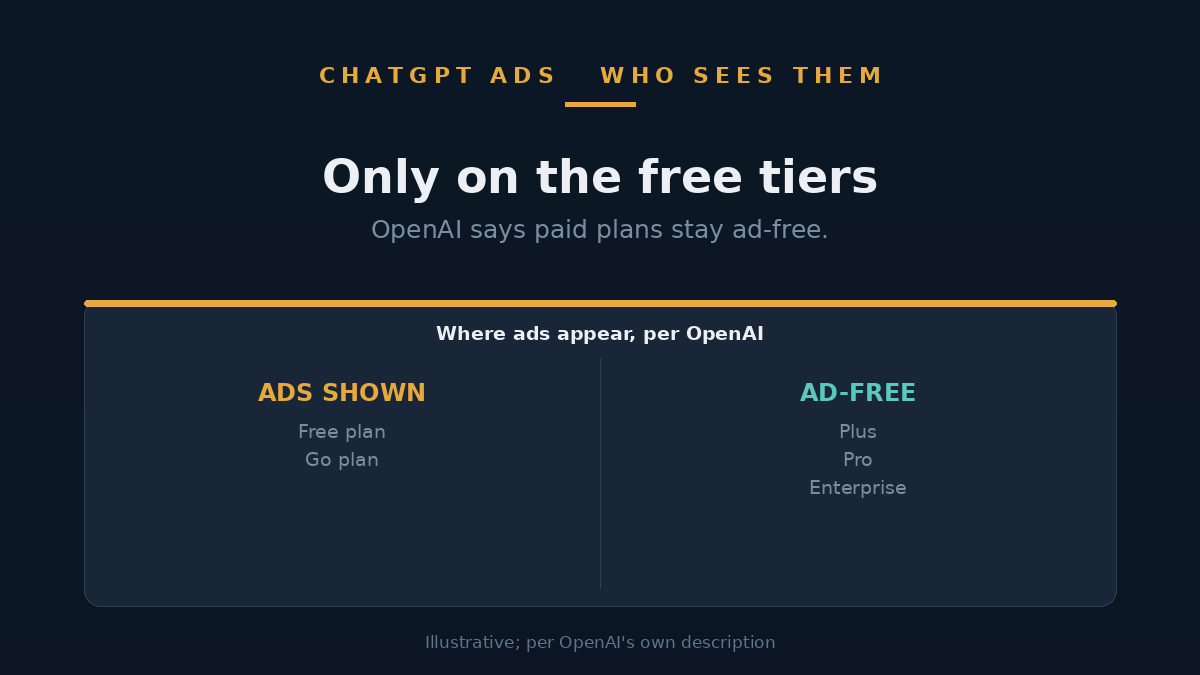
OpenAI began testing ads in ChatGPT with a US pilot in February 2026, and has spent six months building the machinery behind them. The idea is that when you use ChatGPT to plan a trip, choose software or research a purchase, advertisers can appear alongside the conversation, aimed at the moment you are actively deciding. OpenAI says ads are shown only to people on its Free and Go plans, and that Plus, Pro and Enterprise subscriptions stay ad-free.
The company sets out several promises about how this works. It says conversations are kept private from advertisers, that it does not sell customer data, that ads are clearly labelled and kept separate from ChatGPT's answers, and that advertising does not change the answers the model gives. These are OpenAI's own commitments rather than independently audited facts, and they are the right things to watch as the system grows.
Why the UK got them first and the EU had to wait
After the US pilot, OpenAI says it expanded to eight further markets over six months. Digiday and Dataconomy report those included the United Kingdom, which launched in June 2026 as OpenAI's first European market, alongside Canada, Australia, New Zealand, Mexico, Brazil, Japan and South Korea. The 31 European markets being added next week are the EU and wider European countries that were not in that earlier group, including Germany, France, Spain, Italy and the Netherlands.
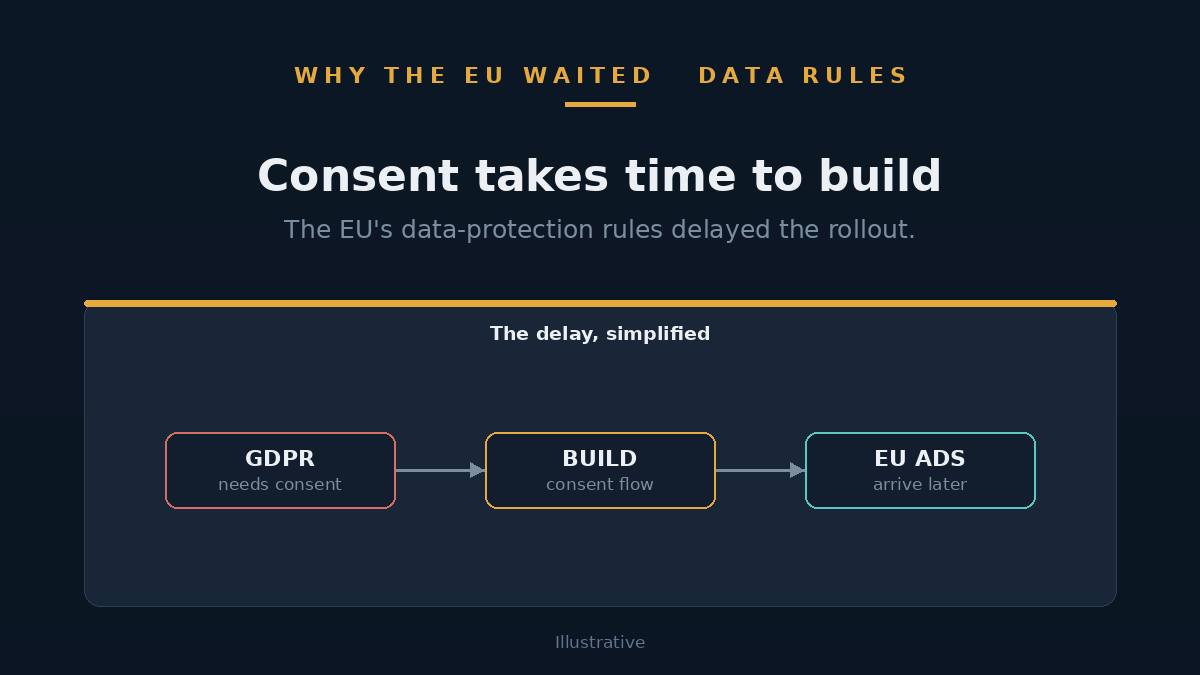
The delay in the EU is not an accident. Personalised advertising in the bloc runs into the General Data Protection Regulation, which generally requires clear consent before a company targets ads using personal data. Building a compliant consent flow takes time, which is why Digiday and others note Europe came later than markets with lighter rules. Post-Brexit, the UK has its own version of these rules but sits outside the EU's process, which is part of why it was grouped with countries like Canada and Australia rather than with the EU rollout.
What it means for you
If you pay for ChatGPT, nothing changes: the paid tiers remain ad-free. If you use the free version, the practical takeaway is to treat sponsored content the way you would treat ads in a search engine. Look for the label, and remember that a recommendation which happens to be paid for is not the same as a neutral answer, even when it sits right next to one. OpenAI insists the two are kept separate and that ads do not influence its answers; that is a claim worth holding it to rather than taking on trust.
There is a bigger picture too. Ads are how OpenAI plans to support free access to ChatGPT, and, as Marketing Brew notes, they are becoming a serious revenue line as the company eyes a possible public listing. A free tool funded by advertising is a familiar model. It also creates a familiar tension: the incentive to blur the line between what is useful and what is paid for. How well OpenAI holds that line is the thing to judge it on.
FAQ
Does ChatGPT show ads in the UK?
According to Digiday, the UK got ChatGPT ads earlier in 2026, launching in June as OpenAI's first European market, before this wider European expansion. If you use the free tier, you may already be seeing them. Paid plans are advertised as ad-free.
Can I turn the ads off?
OpenAI says paid tiers (Plus, Pro and Enterprise) are ad-free, and that users have some control over ad personalisation. If you want no ads at all, a paid plan is the route the company offers.
Do advertisers see my chats?
OpenAI says conversations are kept private from advertisers and that it does not sell customer data. That is the company's stated policy; it has not been independently audited, so it is a commitment to watch rather than a verified fact.
Which European countries are getting ads now?
OpenAI names 31 markets, with the rollout starting on 24 August 2026. Reported countries include Germany, France, Spain, Italy, the Netherlands, Poland, Ireland, Sweden, Norway, Denmark, Austria and Switzerland. The full list is OpenAI's.
The takeaway
The headline is a European expansion, but the useful point for UK readers is quieter: ads are already part of free ChatGPT here, and this is a good moment to notice them. OpenAI has made sensible-sounding promises about keeping ads labelled and separate from answers. Those promises, not the map of new markets, are what matter, because the whole value of an AI assistant rests on trusting that its answers are not quietly for sale.
Sources
- OpenAI – ChatGPT Ads expands across Europe (18 August 2026)
- Digiday – OpenAI's ads business hits Europe at the six month mark (19 August 2026)
- Dataconomy – OpenAI to launch ChatGPT ads in 31 European markets on August 24 (19 August 2026)
- DPA via Yahoo Finance – OpenAI to expand ChatGPT ads to 31 European markets (August 2026)
- Marketing Brew – ChatGPT Ads to roll out in 31 new markets (August 2026)