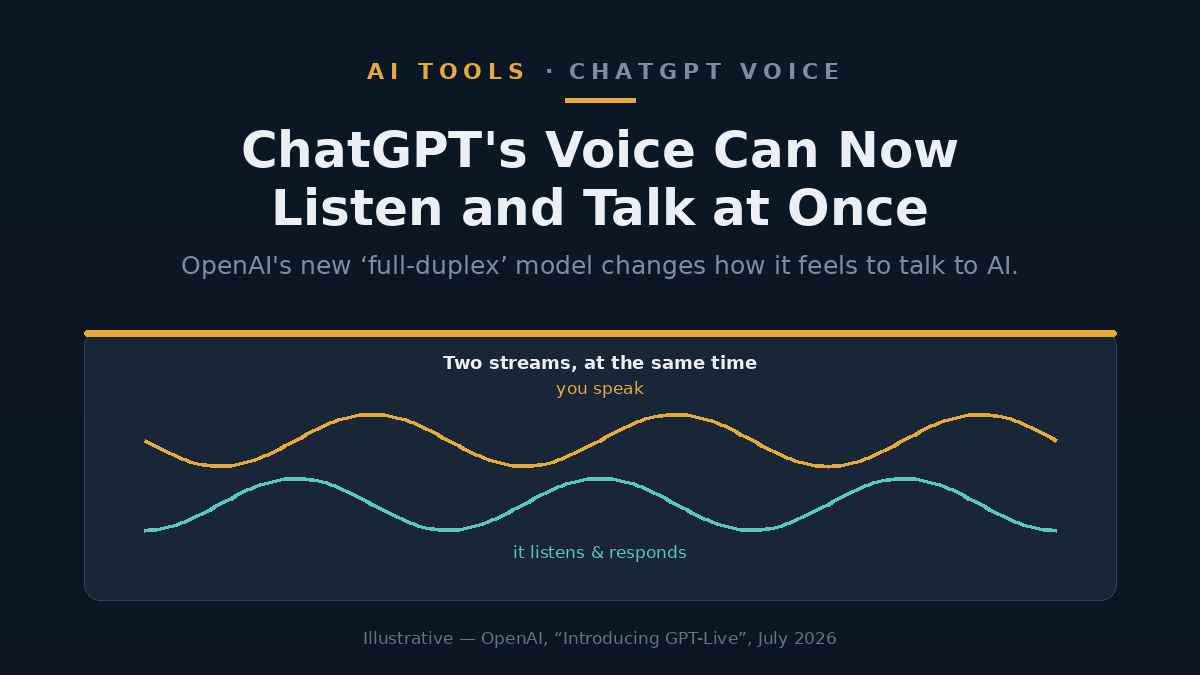
OpenAI has replaced the model that powers ChatGPT's voice with a new one it calls GPT-Live, and the headline change is simple: the assistant can now listen and speak at the same time, rather than waiting politely for you to finish. Announced on 8 July 2026 and rolling out to ChatGPT users worldwide, it comes in two versions — GPT-Live-1 and a lighter GPT-Live-1 mini — and replaces the older Advanced Voice Mode as the default. In practice it is a genuine step up in how natural a spoken conversation feels. The honest caveat: the bigger performance claims are OpenAI's own, and anything that needs real reasoning is still handed to a separate model behind the scenes.
This piece reflects reporting as of July 2026. Rollout timing, tier availability and model names change quickly, and the performance figures below are OpenAI's own unless stated otherwise.
What "full-duplex" actually means
Until now, talking to ChatGPT worked in turns. You spoke, it waited for a pause, then it replied. That is why it sometimes cut in when you were only pausing to think, or sat silently a beat too long. OpenAI describes GPT-Live as "full-duplex", meaning it processes what you say while it is also producing sound — so it can decide many times a second whether to talk, keep listening, pause or jump in. The upshot, in OpenAI's telling, is small acknowledgements like "mhmm" while you speak, the ability to interrupt it mid-sentence, and it waiting instead of talking over you when you stop to gather your thoughts.
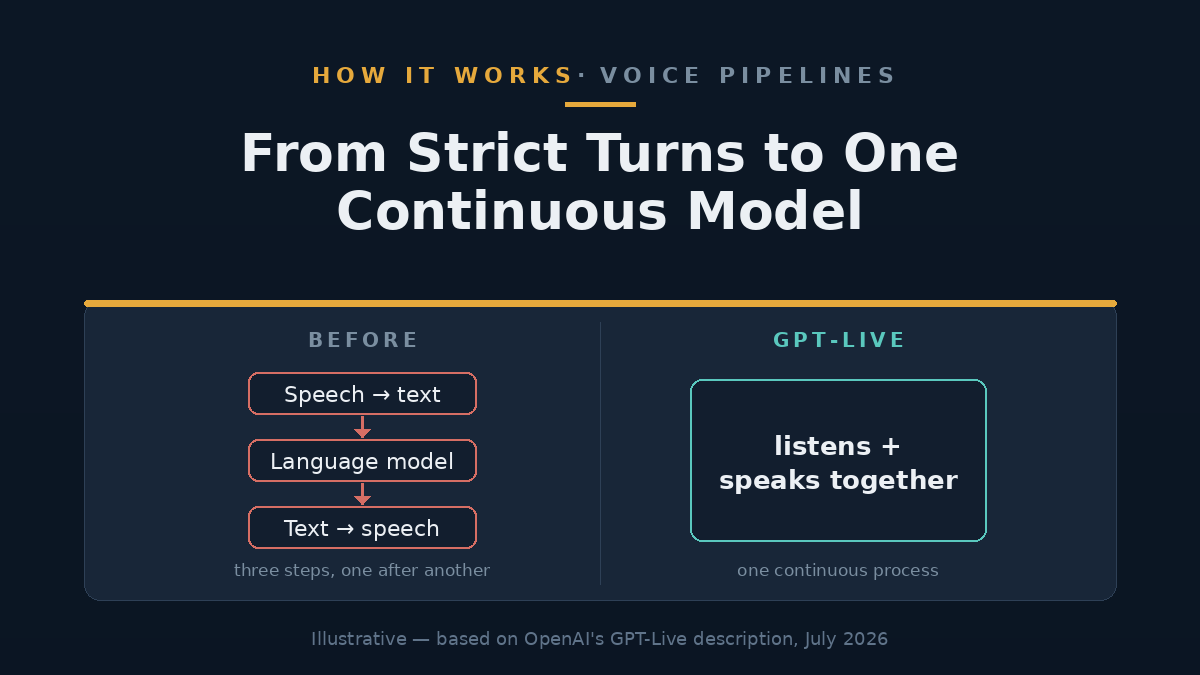
Independent write-ups broadly back the description. VentureBeat and The Decoder both frame it as the successor to Advanced Voice Mode built to sound more like a person and to handle overlapping speech. What none of us can independently measure yet is how much better it feels day to day — that will depend on your accent, your language and how noisy your surroundings are, all of which OpenAI concedes still vary.
The clever part: it hands the hard work to another model
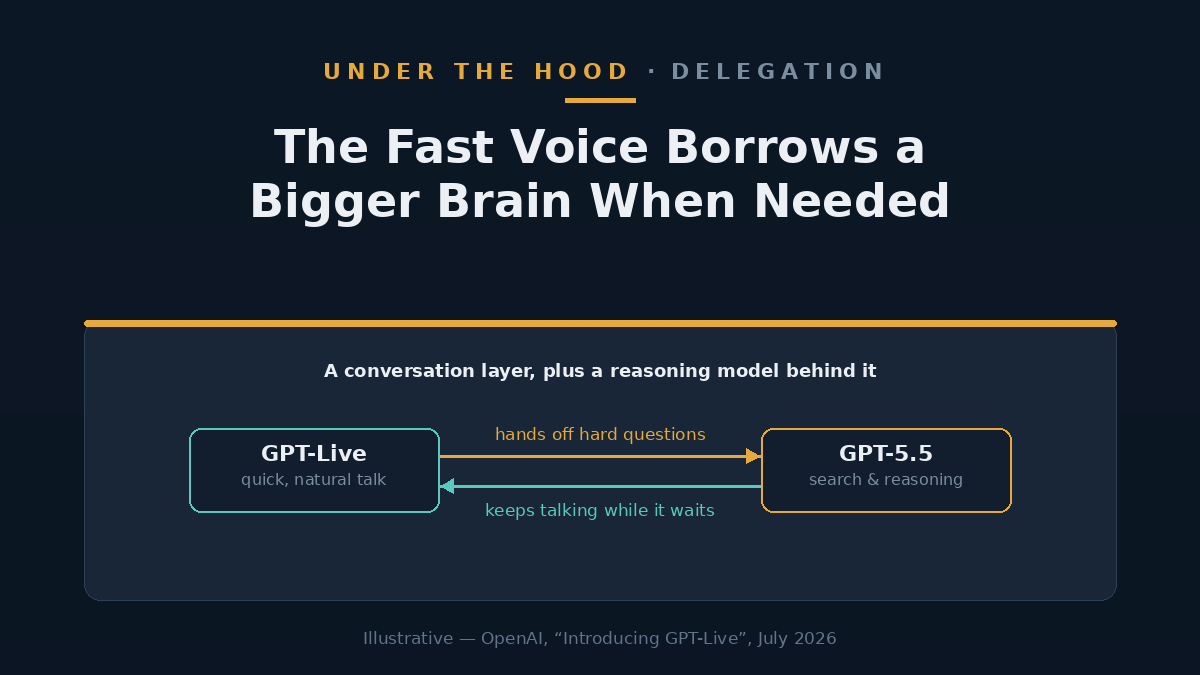
The second design change matters more than it sounds. GPT-Live is built for the back-and-forth of conversation, not for deep thinking. When you ask something that needs a web search, careful reasoning or a multi-step task, it passes that job to a larger model — GPT-5.5 at launch — and keeps chatting while the answer is prepared, then reads it back when it is ready. OpenAI says GPT-5.5 is the model it uses at launch and that it will swap in newer frontier models over time.
This is a sensible split, and it is also the honest limit. The voice you are talking to is quick and fluent, but the substance of a demanding answer comes from a different system entirely. If that background model gets something wrong, a smooth, confident voice will still deliver it. Fluency is not the same as being right, and GPT-Live is designed to be very fluent.
What you actually get in the app
OpenAI says the new experience is live now across iPhone, Android and ChatGPT.com. GPT-Live-1 becomes the default voice for paid Go, Plus and Pro users, while the lighter mini version powers the free tier. The company has re-recorded its nine built-in voices for the new model, and voice can now show visual cards for things like weather, sport and stocks while you talk. There is no voice impersonation: OpenAI says the model uses a fixed set of voices and is designed not to mimic a real person.
On numbers, OpenAI says more than 150 million people a week already talk to ChatGPT through voice and dictation. It also reports that testers preferred GPT-Live over the old voice mode in head-to-head conversations, and that it scores better on internal reasoning and web-search evaluations. Treat those as the maker's claims until independent testing catches up.
Safety, and why voice is a special case
Voice raises risks text does not, because it feels personal and unfolds in real time. OpenAI says it built new audio-specific safety tests and live safeguards that can steer the model to a safer answer, surface a helpline, or end a higher-risk conversation while it is happening, with added protections for teenagers and parental controls. The company also says it is monitoring for signs of emotional over-reliance after launch, building on its earlier research into how people bond with chatbots. These are reasonable measures, but they are the company's own account of its own testing; the real test is how the system behaves in millions of unscripted conversations.
FAQ
Do I need to do anything to get GPT-Live?
No. OpenAI says it becomes the default when you tap the voice button in ChatGPT, rolling out globally from 8 July 2026. You can still switch back to the older Standard or Advanced Voice Mode if you prefer.
Is it free?
Voice itself is available to free users through GPT-Live-1 mini, while the fuller GPT-Live-1 is the default for paying Go, Plus and Pro subscribers. Exact limits vary by plan and change often, so check OpenAI's help pages for the current position.
Can it do everything the old voice mode did?
Not quite at launch. OpenAI says GPT-Live does not yet support voice with live video or screen sharing, and points people to the legacy voice modes for those features for now.
Does it work well in every language?
OpenAI has optimised it for its most popular languages and admits that others may have a non-native accent or gaps in fluency. If you use ChatGPT Voice in a less common language, expect a rougher experience for now.
The takeaway
GPT-Live is one of the more noticeable consumer AI upgrades of the year, because it changes something people actually do every day: talking to an assistant. The interaction genuinely feels more human, and the design — a fast conversational layer that borrows a bigger brain when needed — is a smart way to balance speed and depth. Just keep the two things separate in your head. A more natural voice makes ChatGPT easier to talk to; it does not make it more likely to be correct. The claims about how much smarter it is remain OpenAI's own for now, and are worth revisiting once independent testers have had a proper go.
Sources
- OpenAI — "Introducing GPT-Live", official launch post (8 July 2026)
- VentureBeat — "OpenAI launches GPT-Live, a full-duplex voice upgrade…" (8 July 2026)
- The Decoder — "ChatGPT can now listen and talk at the same time…" (9 July 2026)
- OpenAI — Affective use and emotional well-being research (background)