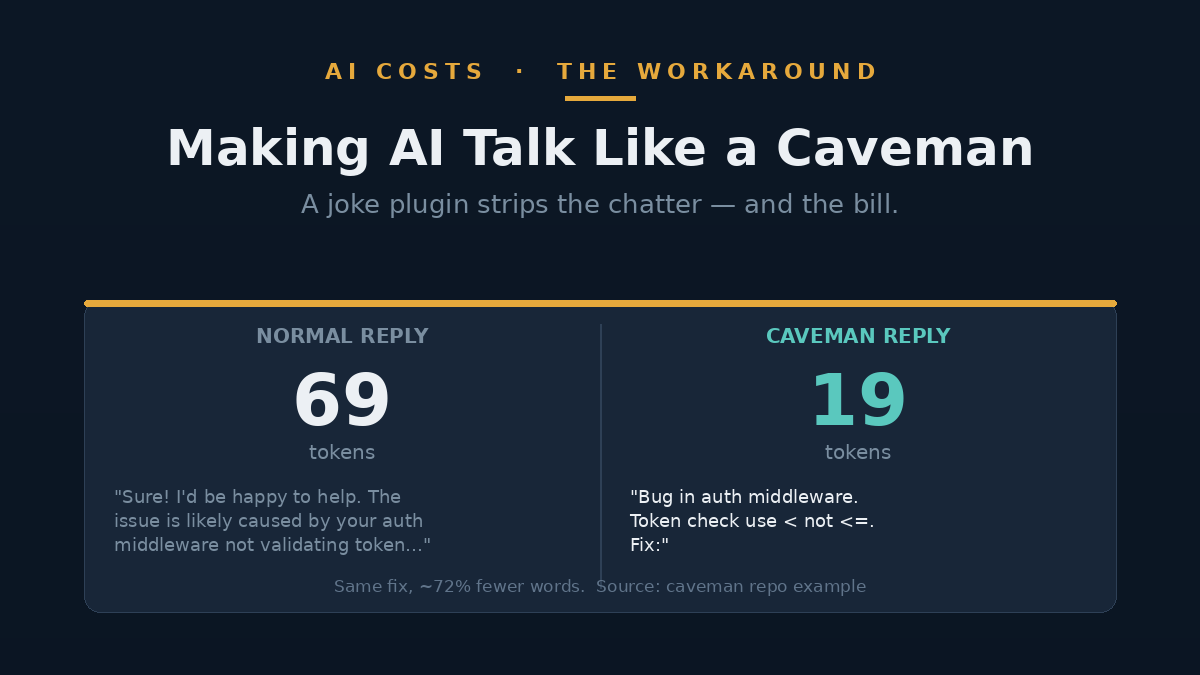
Some companies are now telling their AI assistants to talk like cavemen — on purpose. A free plugin called "caveman" rewrites the output of coding tools such as Claude Code, OpenAI's Codex and Google's Gemini so they drop the pleasantries, hedging and chatty filler and answer in blunt fragments instead. Think less "you're right to push back" and more "bug in auth check. fix:". According to investigative outlet 404 Media, staff at firms including an infrastructure giant called Legrand have started using it to stop burning through their AI budgets. The gag is real — and so is the cost problem behind it.
This piece reflects reporting as of June 2026. AI pricing, tool features and the figures below are moving quickly and may have changed since publication.
What the caveman plugin actually does
Most AI chat tools are wordy by default. They open with "Sure, I'd be happy to help", hedge with "it might be worth considering", and wrap a one-line answer in a paragraph of polite scaffolding. Every one of those words is made of tokens — the small chunks of text an AI model reads and writes — and when a company pays its AI provider per token, that politeness has a price.
The caveman plugin attacks the waste directly. Once installed, it instructs the assistant to keep the substance — code, commands, file paths, numbers, technical terms — exactly as before, and compress only the surrounding language. The result reads like a telegram. Its creator, software developer Julius Brussee, told 404 Media he built it after noticing that much of his own AI spend was going on "pleasantries, hedging, transitions" rather than anything useful. Users can even pick a level of bluntness, from a light trim up to an "ultra" mode — and, as a joke, a setting that answers in classical Chinese to squeeze the word count further.
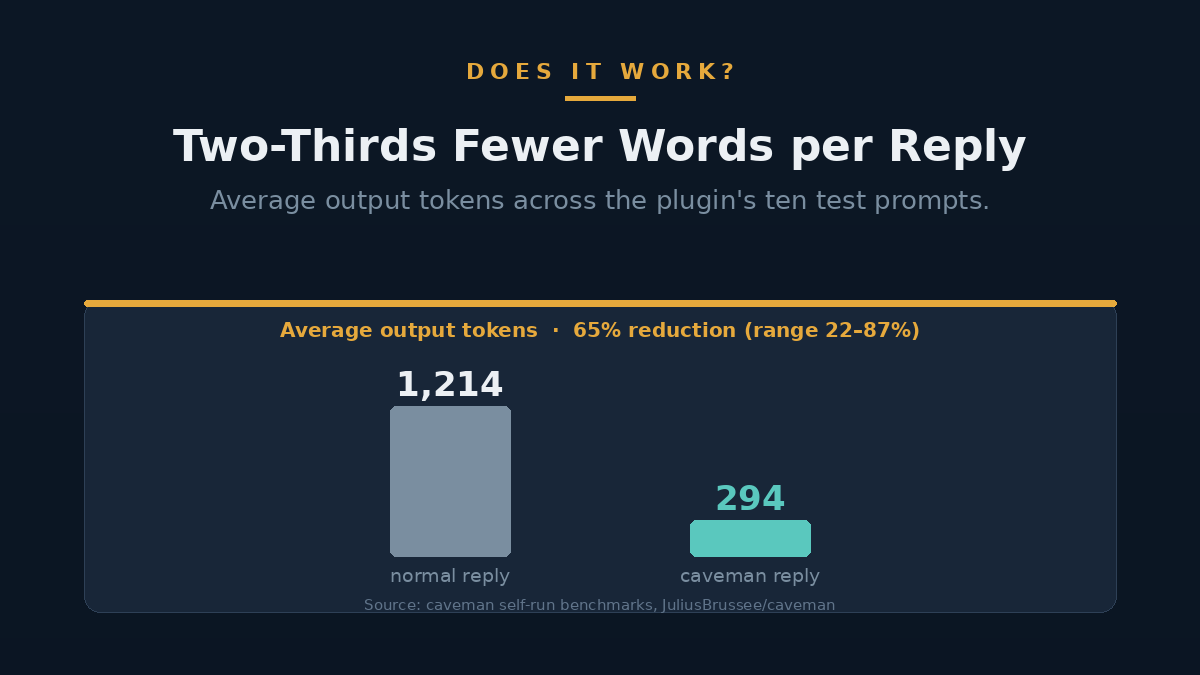
Does it work? On the plugin's own published benchmarks, caveman cut output tokens by an average of about 65% across ten coding tasks, with individual results ranging from 22% to 87%. These are the creator's own self-run tests, not an independent measurement. The author is careful about one thing: the plugin only shortens what the model says, not how hard it "thinks", so it is not meant to make the answers worse. That claim — same accuracy, fewer words — is the creator's, and is exactly the sort of thing a buyer should test on their own workflow rather than take on trust.
Why a joke plugin became company policy
On its own, a meme plugin with a dancing-rock logo would be a curiosity. What makes it a story is who is reportedly using it. 404 Media reports that developers at OpenAI, Nvidia and GitHub have used or tested caveman, and that public records on GitHub show an OpenAI director of engineering even contributed code to add support for the company's own Codex tool — a claim that rests on 404 Media's reporting together with a matching GitHub fork. That fork, which adds "Codex plugin support", is publicly visible on GitHub, which lines up with the account.
More telling is the corporate paper trail. 404 Media quotes an internal memo at Legrand — an electrical and digital infrastructure company that, ironically, has moved into the data-centre business — warning employees that "since the billing system changed and the new quotas were implemented", they must be mindful of usage so they "don't use up our entire budget allowance too quickly". The memo lists ways to cut consumption, including using the caveman skill. When a plugin built as a joke turns up as a line item in a company's cost-saving guidance, it has stopped being a joke.
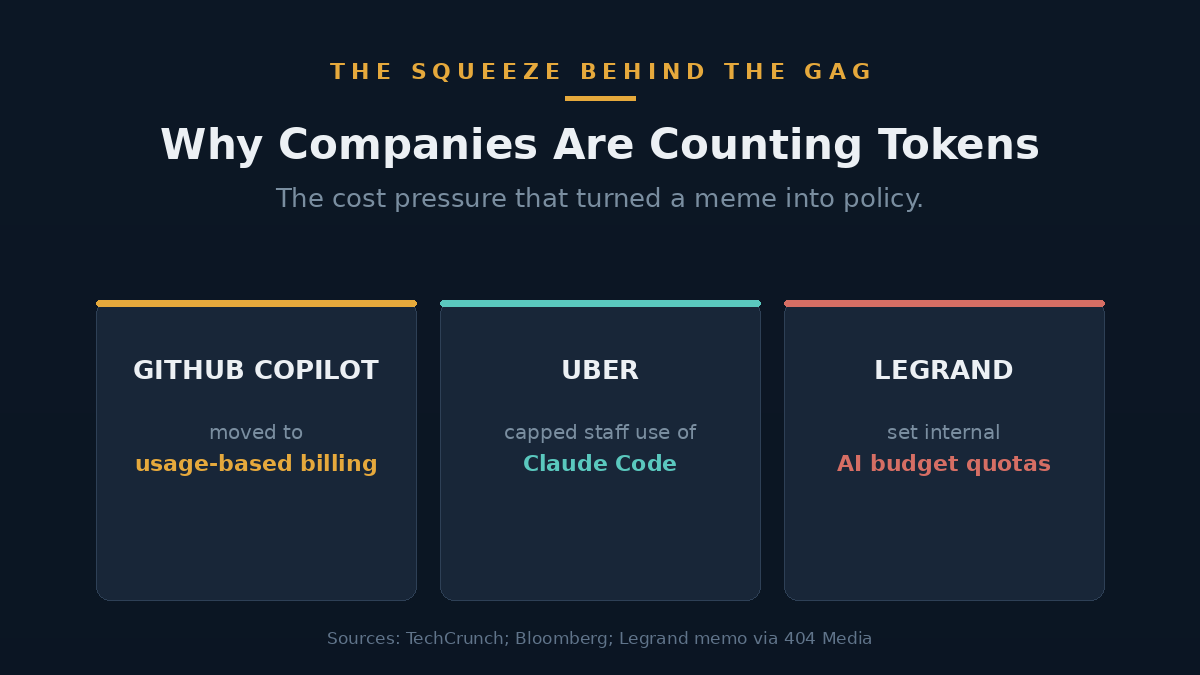
That shift makes sense against the backdrop of what 404 Media has dubbed the "Tokenpocalypse": a scramble across large employers to rein in AI spending that grew faster than anyone budgeted for. GitHub moved its Copilot product towards usage-based billing in 2026, charging by consumption rather than a flat monthly fee. Uber capped staff use of tools including Claude Code, after its technology chief reportedly said the company had run through its entire AI budget in four months — a figure attributed to reporting by The Information. Walmart reportedly limited access to an in-house AI tool after unexpectedly high demand. The caveman plugin is what grassroots cost-cutting looks like once those caps reach the people actually using the tools.
What this means if you use AI tools at work
You do not need to install anything called "caveman" to take the useful lesson from this. The underlying point is that the friendly, verbose style of most AI assistants is a default, not a law of nature — and that default has a cost when usage is metered.
Verbosity is now a billable habit. If your employer has moved to usage-based AI pricing, long rambling exchanges, repeatedly pasting big documents, and asking the tool to "explain that again in more detail" all add up. You can get most of caveman's benefit for free by simply asking your tool to "be concise" or "answer in bullet points" — the plugin's own creator notes it was tested against a plain "be concise" instruction, not just the chatty default.
Shorter is sometimes better, not just cheaper. Concise answers are faster to read and easier to act on. There is even early research, cited by the plugin, suggesting that forcing models to be brief can in some cases improve their accuracy rather than harm it. That comes from a single paper, cited by the tool's author, so treat it as a reason to experiment rather than as settled fact.
Watch the trade-off on complex tasks. Stripping out a model's explanations is fine when you already know the subject. If you are a non-technical user relying on the assistant to teach you why something works, an "ultra-terse" mode can remove exactly the context you needed. Brevity is a setting to match to the task, not a switch to leave on forever.
FAQ
What is a token, and why does talking style affect cost?
A token is roughly a chunk of a word — most words are one to three tokens. AI tools charge based on how many tokens they read (your prompt) and write (the reply). Because pleasantries and hedging are made of tokens too, a wordier reply literally costs more when you pay per use. That is the gap caveman exploits.
Is the caveman plugin safe to use?
It is an open-source project released under a permissive MIT licence, and it is designed to leave code, commands and technical details untouched while compressing only the surrounding language. As with any tool that plugs into your AI assistant, the sensible course in a workplace is to check it against your organisation's software policy before installing it, rather than adding it to a work machine on your own initiative.
Do I need it, or can I get the same effect for free?
You can get much of the benefit without any plugin by telling your AI tool to be concise, answer in bullet points, or skip the preamble. The plugin automates and standardises that across a whole team, which is why companies — rather than individuals — are the ones adopting it.
Will making AI "talk like a caveman" make its answers worse?
The plugin is built to shorten the wording without touching the technical content, and its creator reports no loss of accuracy in his own tests. But those are the creator's tests. If you depend on an AI tool for explanations rather than just answers, try a terse mode on low-stakes work first and see whether you lose anything you needed.
The takeaway
A plugin that makes Claude and Codex grunt like cavemen is funny precisely because it is a serious response to a serious problem. The era of treating enterprise AI as effectively free is over, and the cost pressure is now visible all the way down to how individual replies are phrased. For most people the practical lesson is smaller and duller than the headline: the chatty default of AI tools is optional, concise prompting is free, and brevity is worth choosing deliberately — sometimes to save money, occasionally because the shorter answer is simply the better one.
Sources
- 404 Media — "Companies Are Making Claude and Codex Talk Like Cavemen to Stop AI's Soaring Costs" (Joseph Cox, 30 Jun 2026)
- GitHub — JuliusBrussee/caveman (project repository and benchmarks)
- 404 Media — "The Tokenpocalypse Is Here: Companies Are Scrambling To Stop Spending So Much on AI" (Joseph Cox, 24 Jun 2026)
- TechCrunch — "GitHub Copilot's new token-based billing spurs consternation among devs" (Lucas Ropek, 30 May 2026)
- Bloomberg — "Uber caps usage of AI tools like Claude Code to cut costs" (2 Jun 2026)