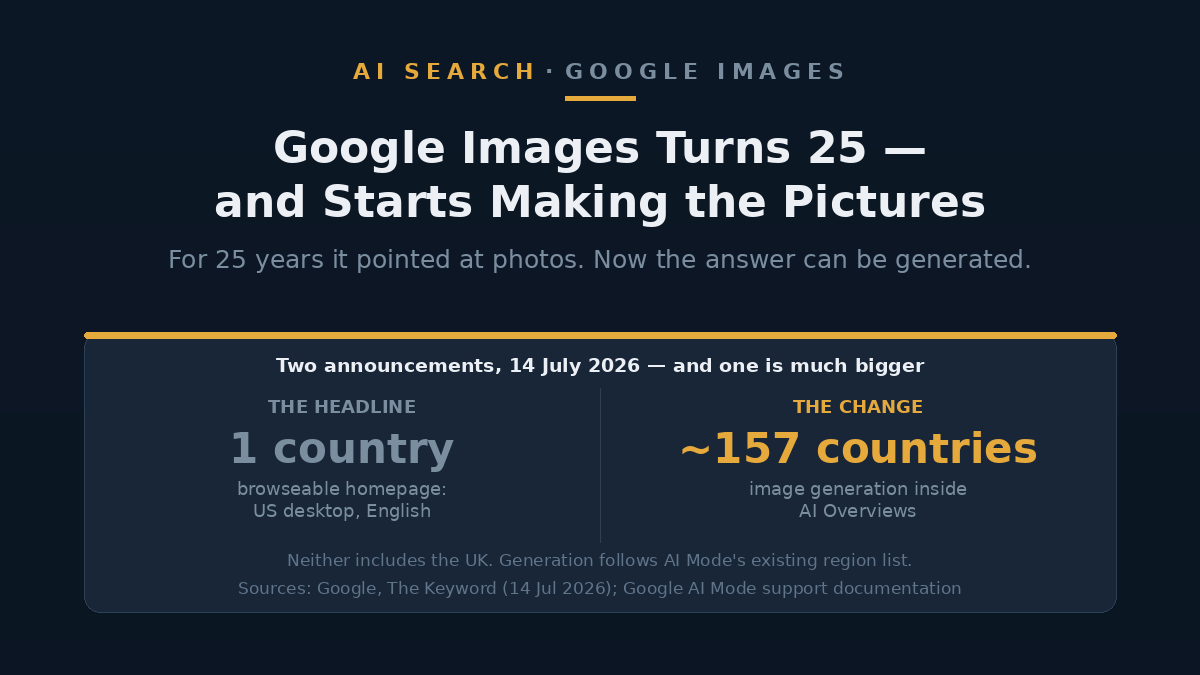
Google Images turned 25 this week, and Google marked it with two changes. The one making headlines is a rebuilt homepage: instead of a search box, you get a scrolling gallery of pictures chosen for you. The one that actually matters got a shorter paragraph. Google is putting image generation inside AI Overviews, so a search that for 25 years pointed you at somebody's photograph can now produce a picture that didn't previously exist. That is a change to what a search result is, and it ships wider than the redesign does — though not, as it turns out, to the UK.
This piece reflects reporting as of July 2026. Both features are described by Google as rolling out over the coming weeks, so availability will change.
The two announcements, in the right order
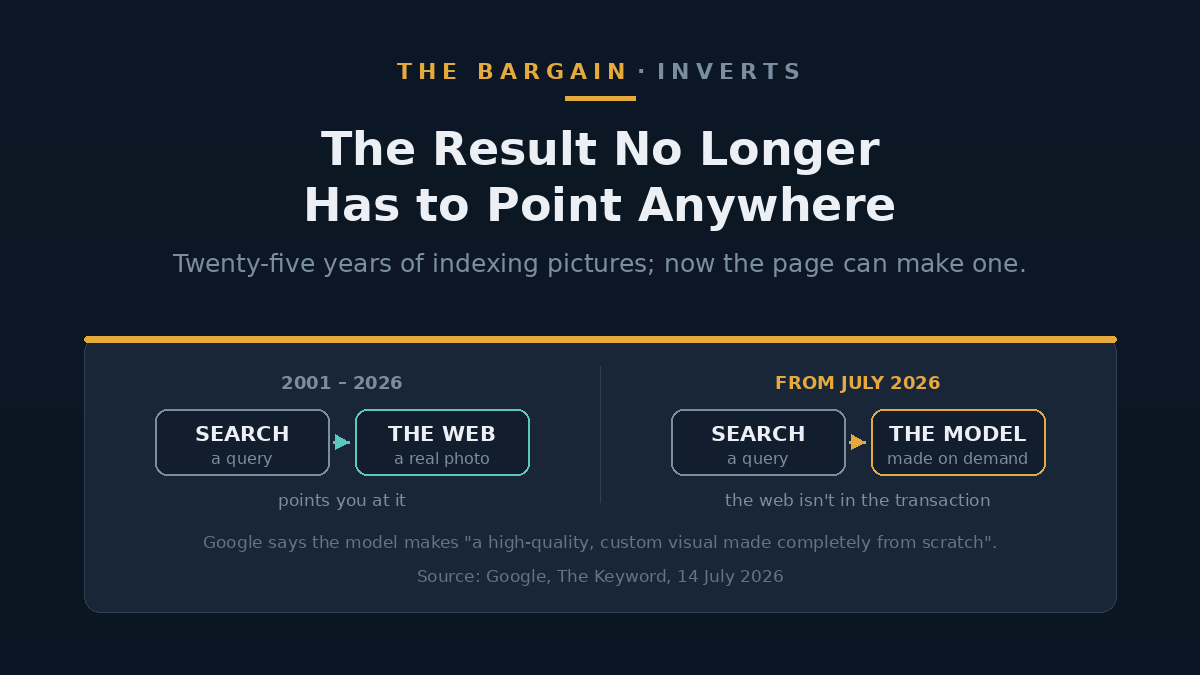
Image generation in AI Overviews. Type a search, and where you'd get an AI-written summary you may now also get a picture generated on the spot. Google describes the output as "a high-quality, custom visual made completely from scratch". It rolls out over the coming weeks, in English, in every region that already supports image creation in AI Mode. Google doesn't list those regions in the announcement — it links to its support page, which does. That list runs to more than 150 countries and territories, and it includes neither the United Kingdom nor any EU member state. Google gives no reason for the omission, and we're not going to guess at one.
The browseable homepage. Google Images gets a gallery front page, which Google pitches as a live feed of web imagery picked to match your interests, with saved collections appearing as tabs. TechCrunch called it a Pinterest-like redesign — the comparison Google carefully doesn't make itself — and reckons Google is copying the Pinterest playbook outright. This is desktop-only, US-only, English, and requires you to be signed in.
Note the asymmetry. The visually striking change is confined to American desktops. The change to how results work follows AI Mode's existing map, which is more than 150 times larger by country count — while still, pointedly, having a UK and EU-shaped hole in it. Most coverage led with the redesign because it screenshots well.
What "from scratch" is doing in that sentence
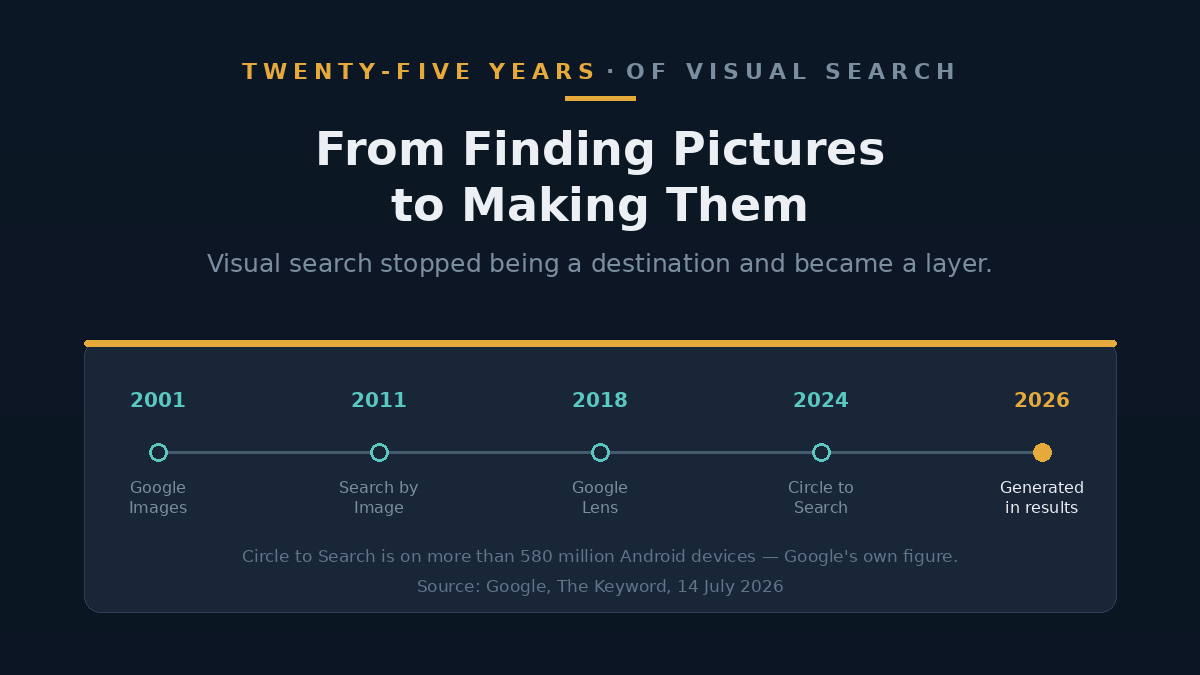
Google Images was built on a simple bargain. In 2001 — after, by Google's own telling, the internet melted over Jennifer Lopez's green Versace dress and a list of blue links proved inadequate — Google started indexing pictures so it could send you to them. Everything since has been an elaboration on that: Similar Images in 2009, Search by Image in 2011, Lens in 2018, Circle to Search in 2024. Each one made it easier to find a picture that someone, somewhere, had made and published.
Generation inverts the bargain. The result no longer has to point anywhere. If you search for something visual and Google manufactures an adequate image inside the results page, the photographer, the illustrator, the stock library and the blog that hosted it are all simply not part of the transaction.
Now the honest part: nobody knows how big that effect is. There is no study, no Google figure, and no independent measurement of what generated images in AI Overviews do to click-through for the people who make images. Plenty has been measured about what AI Overviews' text summaries do to organic clicks, but that is a different mechanism and those numbers don't transfer. We are not going to invent one, and you should be wary of anyone who quotes you a figure this week about a feature that hasn't shipped yet. The mechanism is obvious; the magnitude is genuinely unmeasured.
What can be said is narrower and still worth saying: the queries most likely to be satisfied by a generated picture are precisely the generic ones — "a cosy reading nook", "a minimalist kitchen", "a golden retriever in autumn leaves" — which are also the queries that have been sending traffic to stock libraries and lifestyle blogs for two decades. The specific ones ("what does the Elizabeth Tower look like"), where you need the real thing, are the ones generation can't touch.
If you publish images, what changes
Not much this week, and possibly quite a lot over a year. And note that not seeing the feature in the UK is not the same as not being affected by it: your images are found by people searching from the countries where generation is switched on. Three things worth doing rather than panicking about:
- Work out which bucket your images sit in. If your visuals are generic and interchangeable, a model can approximate them. If they're specific — your products, your premises, your people, real photographs of real things — they're the ones a generated image cannot substitute for. That distinction is now commercially load-bearing.
- Watch your own numbers, not the discourse. Google Search Console will tell you what's happening to your image impressions and clicks long before anyone publishes a credible study. If you publish images at any scale, that's the measurement worth starting now, while there's still a before to compare against.
- Don't rebuild anything yet. Neither feature lands in the UK on this announcement, and generation rolls out over weeks elsewhere. There is no emergency, and the people selling you an urgent response to this are ahead of the evidence.
The other 25-year story
Buried in Google's timeline is a figure worth pausing on: Circle to Search, the gesture that lets you select anything on an Android screen and search it, is on more than 580 million devices. That is Google's own count, self-reported in the anniversary post with no methodology attached, so treat it as the company's claim rather than an audited number.
That is the real arc of the last 25 years, and it isn't about pictures. Visual search stopped being a destination you visit and became a layer over everything you look at — your camera, your screen, a live video feed. The Images homepage getting a redesign is almost nostalgic by comparison: Google is prettifying the front door of a building most people now enter through the walls.
FAQ
Can I use the new Google Images homepage in the UK?
Not yet. It is rolling out on desktop, in the US, in English, over the coming weeks, and you need to be signed in to a Google account. Google has not announced other markets.
Will I see AI-generated images in my search results?
Not in the UK. Generation follows Google's existing list of regions that support image creation in AI Mode, and that list — more than 150 countries and territories — leaves out the UK and the whole of the EU. If you're in the US, Canada, Australia, India, Japan or most of the rest of the list, then over the coming weeks, yes, in English. Google's support page also puts the feature at 18-plus, signed-in, with daily caps starting at 20 images.
Which model generates the images?
Google's announcement says only "our latest Nano Banana model", but it links to its Nano Banana 2 Lite launch post, which is the newest model in that family and which says it is rolling out to AI Mode in Search. So: Nano Banana 2 Lite, on the strength of Google's own link rather than a version number it chose to print.
Does this mean Google will stop showing real photographs?
No. This adds generation to AI Overviews; it does not remove image search. The open question is behavioural — how often people stop clicking through once an adequate picture appears in front of them — and there is no evidence on that yet.
Will generated images be labelled?
The anniversary announcement doesn't address labelling. The Nano Banana 2 Lite post it links to says the model uses SynthID watermarking, which is an invisible marker you can check with Google's own tools rather than a label on the page. Whether AI Overviews will visibly mark generated images, Google hasn't said.
The takeaway
The redesign is the announcement; the generation is the change. For 25 years Google Images has been an index — a machine for pointing at pictures other people made. Adding a generator to the results page means the answer to a visual question no longer has to come from the web at all. Whether that dents the people who make images for a living is an empirical question that nobody has answered, and the useful response is not alarm but measurement: know which of your images a model could plausibly replace, and start watching your impressions now, while you still have a baseline.
Sources
- Google, The Keyword — Celebrating 25 years of visual search innovation, the official announcement of both the browseable homepage and image generation in AI Overviews (14 July 2026)
- Google Search Help — Create and edit images in AI Mode, the support page defining the countries and territories where image generation is available (retrieved 14 July 2026)
- Google, The Keyword — Start building with Nano Banana 2 Lite and Gemini Omni Flash, the model post linked from the anniversary announcement (30 June 2026)
- TechCrunch — Google Images gets a Pinterest-like redesign focused on discovery (14 July 2026)
- The Verge — The Google Images homepage will recommend photos even before you search (14 July 2026)
- Ars Technica — Google revamps image search for its 25th anniversary with more images and more AI (14 July 2026)