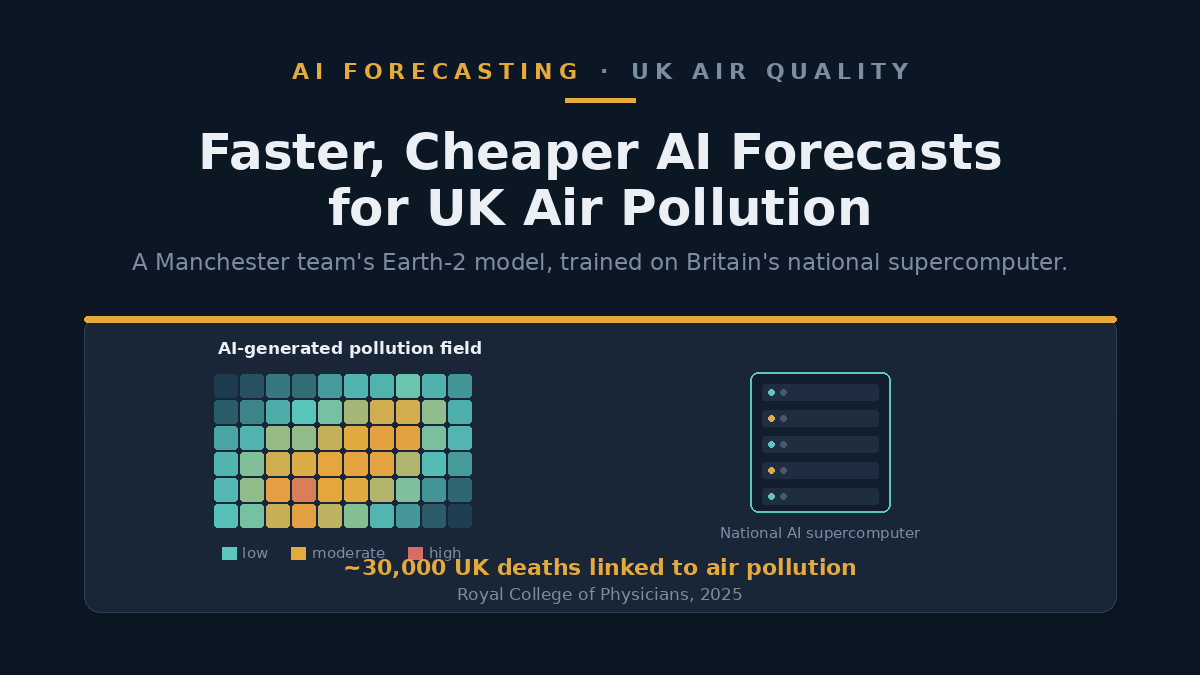
Researchers at the University of Manchester have used NVIDIA's Earth-2 generative AI models to build a UK-wide air pollution forecast that runs far faster and more cheaply than the chemistry-based models normally used for the job. NVIDIA says the model was trained in about two days on Isambard-AI, Britain's national AI supercomputer in Bristol, and can now run on a desktop machine. The promise is genuine: air pollution is linked to an estimated 30,000 UK deaths in 2025, and cheaper forecasting could one day warn asthma patients of bad-air days. The honest caveat: this is a research model, not a validated public-health tool.
This piece reflects reporting as of September 2026. The technical figures below are largely NVIDIA's own; where a claim rests on the vendor alone, we say so.
What the Manchester team actually built
Forecasting air quality is hard for a boring but important reason: it is expensive to compute. Traditional models simulate the chemistry of the atmosphere, and once you add that chemistry the models get very slow to run. That cost limits how detailed the forecasts can be and how often they can be produced.
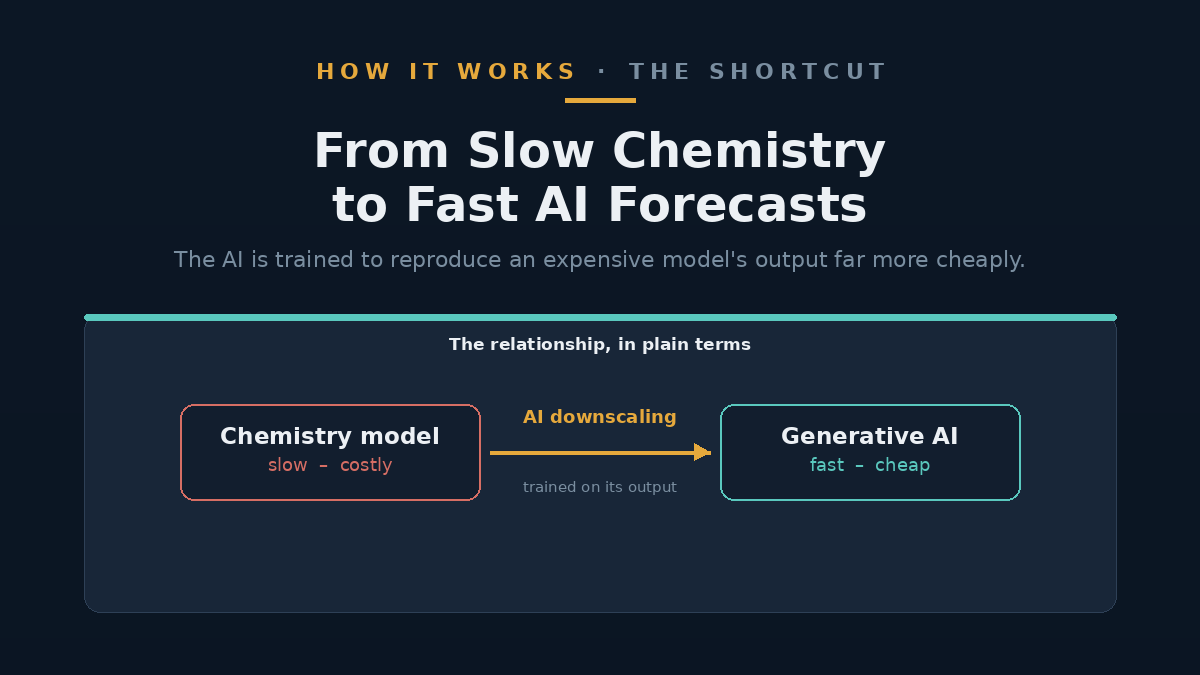
Professor David Topping, in Manchester's department of Earth and environmental science, took a different route. NVIDIA's Earth-2 family of AI models had already sped up weather forecasting, so his team asked whether the same approach could work for pollution. Rather than simulate the chemistry each time, they trained an AI model called CorrDiff on data produced by existing chemistry-climate simulations, in effect teaching the AI to reproduce the expensive model's output far more cheaply.
According to NVIDIA, the result is a UK-wide pollution model at a resolution of two to three square kilometres, trained on a year of hourly UK pollution data. A second model, StormCast, was added to produce time-based forecasts that use real air quality observations. NVIDIA also says the model "worked on the first attempt", which is the kind of tidy line vendor write-ups like and worth treating with mild scepticism.
"The biggest challenge is the compute required to forecast air quality," Topping is quoted as saying. That is the real point of the work: not a new kind of forecast, but a much cheaper way to produce one.
Why speed and cost matter here
Cheaper and faster is not a technical nicety in this case. If a forecast is expensive, you run it rarely and at coarse resolution. If it is cheap, you can run it often, at fine detail, and potentially act on it in something close to real time.
That opens up uses that were previously impractical. NVIDIA's write-up describes the team envisaging health services contacting patients with conditions like asthma to warn them when local pollution is likely to spike; modelling what different government policies would do to air quality; and pairing the model with cheap sensors to respond to events such as wildfires as they happen. The team also plans to release the training data and workflows as open source so other countries and cities can build their own versions.
None of that exists as a running public service today. These are the researchers' stated ambitions, and they are reasonable ones, but they are ambitions rather than deployed products. It is worth holding the two apart.
Where the honest caveats are
Two things temper the excitement, and neither is a reason to dismiss the work.
First, this class of AI model has a known weakness with extremes. Generative "downscaling" models learn to turn coarse data into fine detail, and the research literature shows they can smooth away the peaks and underrepresent the most extreme values. For pollution, the extreme peaks are exactly what matters for health. A model that is excellent on average but soft on the worst days would be the wrong tool for warning vulnerable patients, so how it handles peaks is the question that decides whether it is useful.
Second, the model is trained on the output of chemistry-climate simulations, not directly on measured air. That means it inherits whatever assumptions and errors those simulations carry, and it still needs validation against real, ground-level measurements before anyone should act on it clinically. At the time of writing there is no published, peer-reviewed evaluation of this specific model's accuracy. Until there is, the sensible reading is: a promising efficiency breakthrough whose real-world accuracy is not yet demonstrated in public.
Built on British infrastructure
One part of the story is not in doubt: where it ran. The model was trained on Isambard-AI, the UK's most powerful AI supercomputer, which went live in Bristol in 2025 with £225 million of government backing. NVIDIA reports it houses 5,448 of its GH200 Grace Hopper Superchips and delivers around 21 exaflops of AI performance, and it is run as a national asset by UK Research and Innovation.
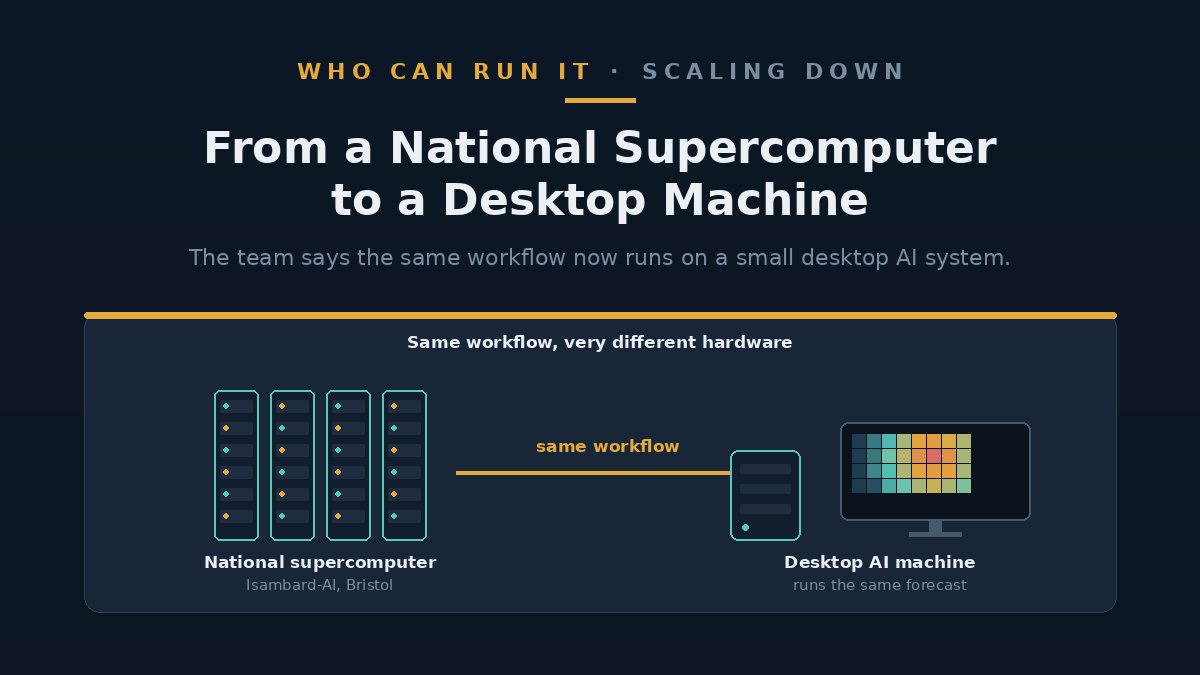
The efficiency claim is striking if it holds: NVIDIA says the training used just a single eight-GPU node for about two days. Simon McIntosh-Smith, who directs the Bristol Centre for Supercomputing and co-founded Isambard-AI, noted that a climate project using relatively few GPU hours is a fitting use of the machine. The team also says the same workflow now runs on a desktop AI system costing a few thousand dollars, which, if accurate, genuinely changes who can do this kind of research.
"[It] changes who can do this science and how quickly," said Niall Robinson, NVIDIA's developer relations manager for weather and climate. Doctoral student Hao Zhang, who trained the StormCast model, described being able to switch between NVIDIA's frameworks as the impressive part of the work.
FAQ
Is this something I can use right now to check my local air quality?
No. It is a research model, not a public service or an app. The uses described, such as alerting asthma patients to high-pollution days, are what the team hopes to build towards, not features that exist today.
Is it more accurate than existing forecasts?
Unproven in public. The headline is that it is much faster and cheaper to run, not that it is more accurate. There is no published, independent evaluation of its accuracy yet, and models of this type can struggle with extreme peaks, which matter most for health.
Who paid for it and who owns it?
The work was done by University of Manchester researchers with NVIDIA's Earth-2 team, using Isambard-AI, a government-funded national supercomputer run by UK Research and Innovation. The team says it plans to release the training data and workflows as open source.
Why does forecasting cost matter so much for pollution?
Because traditional models are slow and expensive to run, they are produced infrequently and at coarse detail. A cheaper model can be run more often, at finer resolution, and potentially fast enough to respond to events as they happen.
The takeaway
This is a real and useful piece of engineering: a way to produce UK air pollution forecasts at a fraction of the usual cost, trained on British public infrastructure, with a credible open-source plan behind it. That deserves attention on its own terms. It is also, for now, a research result whose accuracy has not been independently validated, built by the vendor whose hardware and software it showcases. Both of those are true at once. The measure of whether it becomes a genuine public-health tool will not be the training time or the exaflops. It will be whether it can be trusted on the bad days, and that is the part still to be proven.
Sources
- NVIDIA Blog – University of Manchester uses NVIDIA Earth-2 to forecast air pollution across the UK (15 September 2026)
- Royal College of Physicians – Air pollution linked to 30,000 UK deaths in 2025 (19 June 2025)
- NVIDIA Blog – Isambard-AI, the UK's most powerful AI supercomputer, goes live (17 July 2025)
- Geoscientific Model Development – Inter-comparison of generative AI models for downscaling, on the treatment of extremes (2026)