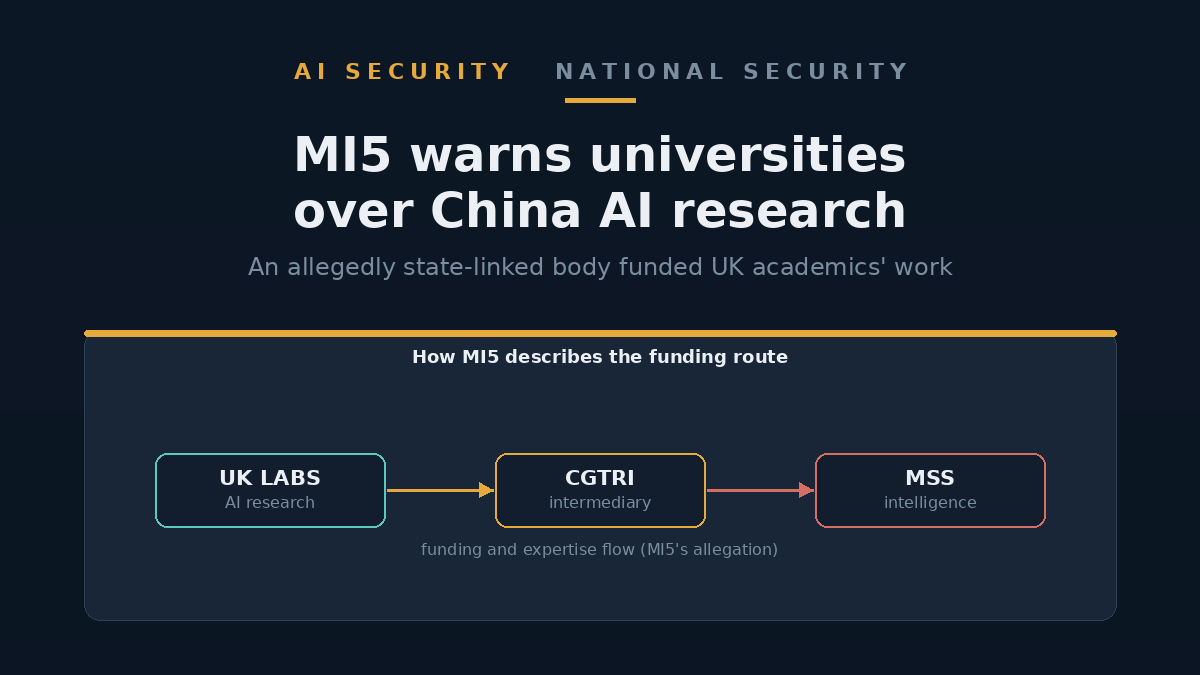
MI5 has issued a formal security alert telling UK universities that a Chinese state-owned body, the China General Technology Research Institute (CGTRI), has quietly funded the work of more than 100 British academics, in fields including artificial intelligence, cybersecurity and covert communications. The agency alleges CGTRI has very strong ties to China's Ministry of State Security (MSS) and that its purpose is to fund research that improves the MSS's technical capability for espionage. MI5 says the academics were very likely acting in good faith, unaware of the alleged intelligence links, and has told institutions to review any current or planned CGTRI collaboration at once. The alert was issued on 30 September 2026.
This piece reflects reporting as of October 2026. MI5's statements about CGTRI are allegations by the security service; they describe the agency's assessment, not findings tested in court.
What MI5 actually said
The alert names the China General Technology Research Institute, also reported as the China Academy of General Technology, as the body of concern. According to reporting on the alert, MI5's assessment is that CGTRI is linked to the MSS, which runs both domestic and foreign intelligence, and that funding routed through the institute has reached UK academic projects whose results could strengthen Chinese intelligence capabilities.
The scale is the part worth pausing on. MI5 puts the number of UK-affiliated academics who have contributed to CGTRI-funded work at more than 100. The research areas it flags are not fringe: artificial intelligence, cybersecurity, covert communications systems and steganography, the practice of hiding messages inside ordinary-looking files. These are exactly the capabilities a modern intelligence service wants, and three of the four sit squarely inside what the UK now calls its AI growth agenda.
Crucially, MI5's framing is not that the academics did anything knowingly wrong. The agency said it is highly likely universities engaged with the organisation in good faith, without knowing about the alleged links. The security minister, Dan Jarvis, said the alert exposes attempts by Chinese intelligence to "covertly benefit from the expertise and research of our academics".
Why AI research is the target, not just the backdrop
It would be easy to read this as a generic "China spying" story with AI tacked on. The detail does not support that reading. The institute's alleged job, as MI5 describes it, is to fund research that improves a specific set of technical capabilities, and AI is named first among them. For an intelligence service, modern AI is not one tool among many: it is what turns intercepted data into usable intelligence, automates surveillance, and sharpens the cyber and covert-communications work the alert also lists.
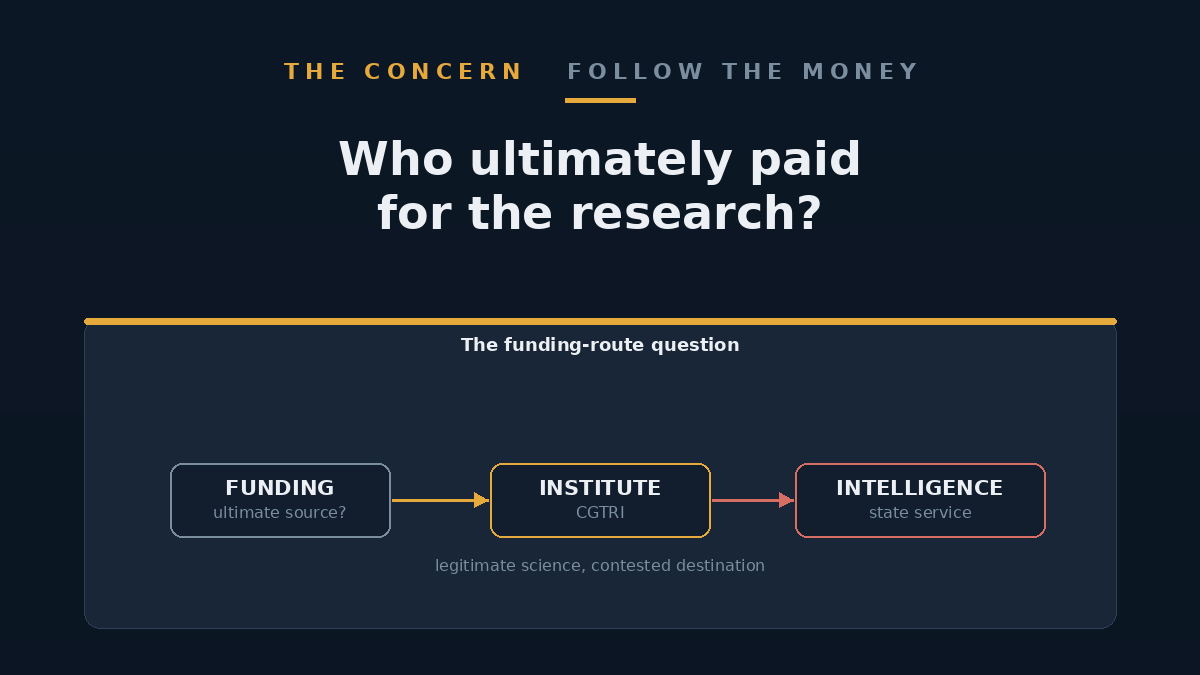
That is why the funding route matters more than any single project. A university lab working on, say, machine learning for image analysis or network security is doing legitimate, publishable science. The concern MI5 raises is about who ultimately paid for it and who benefits from the output, not about the quality or intent of the work itself. The agency has asked institutions to establish the ultimate source of funding behind research partnerships, which is a harder question than it sounds when money arrives through intermediaries.
A second warning the same week
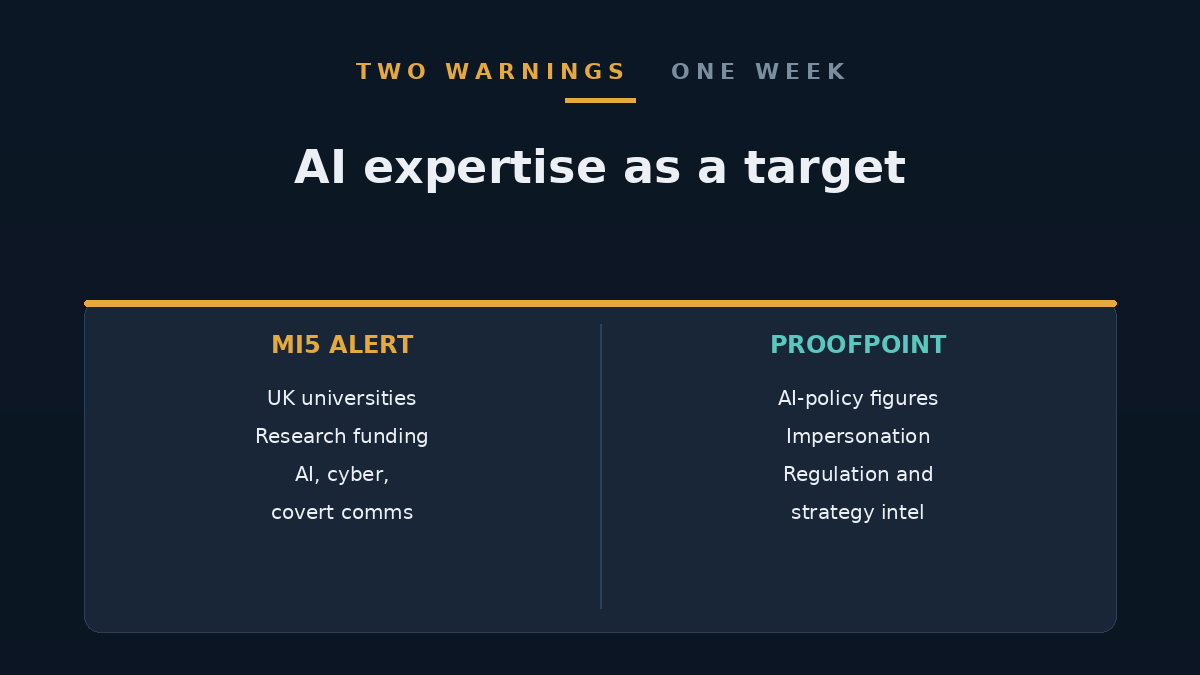
The MI5 alert did not land alone. In the same stretch, the cybersecurity firm Proofpoint described a China-aligned group it tracks as TA419 that impersonated prominent AI-policy figures to try to reach the accounts of people working on AI regulation, export controls and national AI strategy, largely at think tanks and universities in the United States. The reported aim was intelligence about how AI is being governed, rather than theft of the technology itself. These are two separate events, and should not be run together as one operation, but the pattern is hard to miss: both treat AI expertise, whether it is the research or the people shaping the rules, as something worth targeting.
For a UK reader the combination is the point. One warning is about the research going in; the other is about the policy and strategy conversation around it. Together they describe AI as a field where the interesting material is no longer only the model weights, but the know-how and the governance debate.
What it means if you work with, fund, or buy AI research
Most readers are not running a university lab. But the read-across is wider than higher education. Any UK organisation that sponsors academic AI work, hires from it, or licenses tools that spun out of it now has a named reason to ask where the underlying research money came from. MI5's instruction to universities, to review collaborations and trace ultimate funding, is a reasonable due-diligence question for a company too.
The alert also carries a legal edge. It reminded institutions of potential criminal consequences under the National Security Act 2023 for assisting a foreign intelligence service. In practice that raises the stakes on knowing your research partners, and it is likely to make universities and their commercial collaborators slower and more cautious about certain overseas funding, which has its own cost for open science.
The honest limits of what we know
This is MI5's account. The agency has named the institute and set out its assessment, but it has not published the underlying evidence, and CGTRI has not, at the time of writing, responded in any way we can verify. The figure of more than 100 academics comes from the security service, not from an independent audit, and the specific projects have not been listed publicly. None of that makes the warning less serious; it does mean the sensible posture is to treat the allegations as a serious government assessment to act on, not as proven facts in every particular.
FAQ
What is CGTRI?
The China General Technology Research Institute, also reported as the China Academy of General Technology, is a Chinese state-linked research body. MI5 alleges it has very strong ties to China's Ministry of State Security and funds research that improves the MSS's technical capabilities. That characterisation is MI5's.
Did UK academics do anything illegal?
MI5's own framing is that institutions very likely engaged in good faith without knowing of the alleged links. The alert is a warning and a call to review partnerships, not an accusation against the academics. It does, however, remind universities of the National Security Act 2023.
Why single out AI?
AI is the first research field MI5 names, alongside cybersecurity and covert communications. For an intelligence service these are force multipliers, and the overlap with the UK's own AI priorities is what makes the funding route sensitive.
Is this the same as the Proofpoint AI-policy story?
No. They are separate events reported in the same week. The MI5 alert concerns research funding; the Proofpoint disclosure concerns a group impersonating AI-policy experts. We have kept them distinct deliberately.
The takeaway
The useful signal here is not "China spies on universities", which is not new. It is that AI research and the expertise around it are now treated, explicitly and at the level of a formal MI5 alert, as an intelligence target in their own right. For anyone doing, funding or commercialising AI work in Britain, the practical lesson is dull but real: knowing exactly where your research money and your research partners come from has become part of the job.
Sources
- Times Higher Education – MI5 issues China espionage warning to UK universities (30 Sep 2026)
- SC World – UK security agency warns academics of China's espionage efforts (Oct 2026)
- TechRound – AI, espionage and startups: the latest security warnings (2 Oct 2026)
- legislation.gov.uk – National Security Act 2023
- Proofpoint – Hallucinating Credibility: China-aligned TA419 impersonates its way into US AI policy circles (1 Oct 2026)