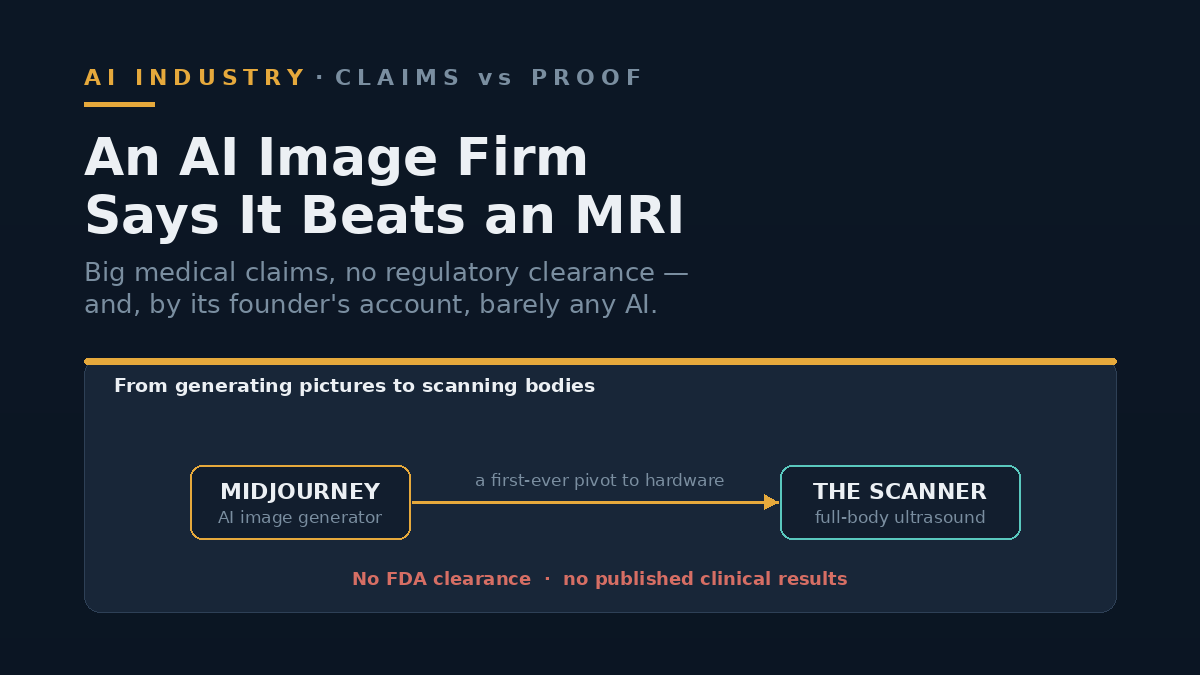
Midjourney, the company best known for turning text prompts into pictures, has announced something it has never built before: hardware — and not a gadget, but a full-body medical scanner. At an event in San Francisco on 17 June 2026, founder David Holz unveiled "The Midjourney Scanner", a device he says is in some ways better than an MRI, alongside a new Midjourney Medical division and plans for a spa. The honest bottom line: the company has never made a physical product, the scanner has no regulatory clearance, it currently produces only body-composition maps rather than diagnoses, and — by Holz's own account — it barely uses AI. The ambition is real; the proof is not here yet.
This piece reflects reporting as of June 2026. Midjourney's targets, pricing and regulatory status are likely to move; treat the figures below as the company's stated goals, not delivered results.
What Midjourney says it has built
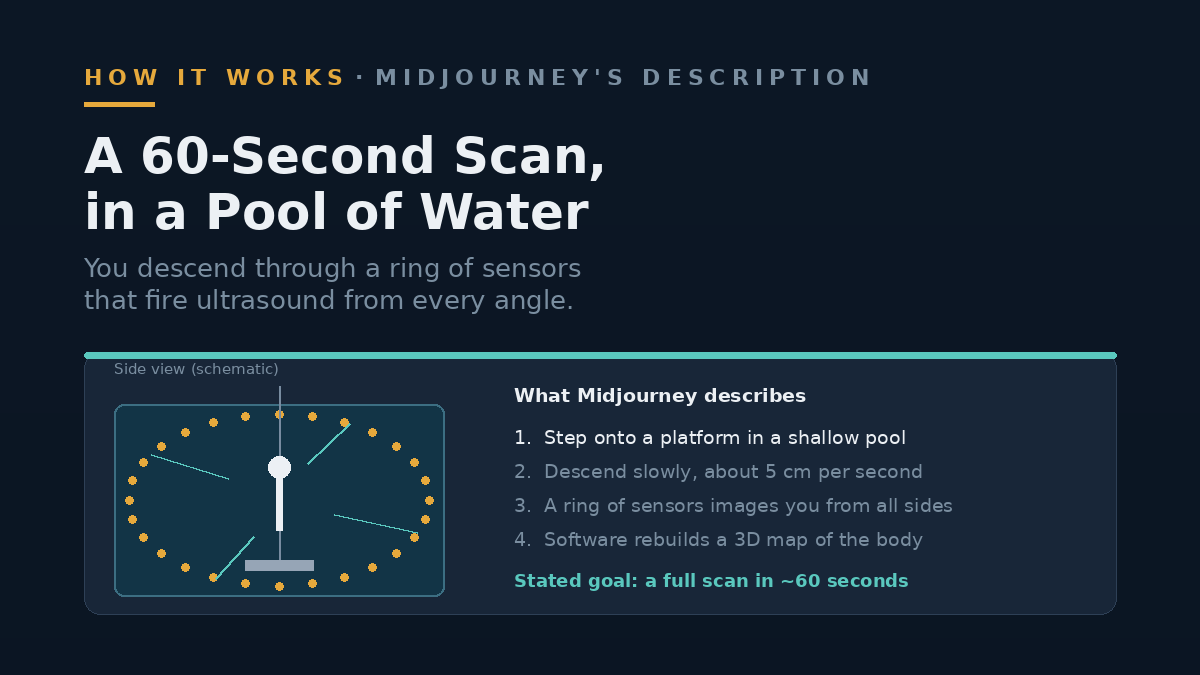
The pitch is striking. Midjourney describes a machine that is "as powerful as MRI, and as casual as a trip to the spa". You step into a shallow pool, a platform lowers you into the water, and as you descend you pass through a ring of roughly half a million tiny sensors that fire ultrasonic waves through your body from every angle. Software reconstructs those waves into a 3D map of muscle, fat, bone and organs — a method the company calls "Ultrasonic CT". The stated goal is a complete scan in about 60 seconds, against the 60 to 90 minutes a full-body MRI can take, with no radiation and none of the heavy magnets an MRI needs.
The hardware was not built from scratch alone. The scanner was developed with Butterfly Network, an established ultrasound firm whose technology Midjourney licensed in November 2025. Butterfly has confirmed that the current prototype uses 40 of its "ultrasound-on-chip" modules per machine, and that it filed the deal terms with regulators on 17 November 2025, disclosing up to $74 million in expected payments over a five-year term.
The twist: an AI launch that barely uses AI
Here is the part that sits oddly. Midjourney's whole reputation rests on generative AI, yet the imaging itself is ultrasound and signal processing, not a neural network dreaming up your insides. Holz told Bloomberg, "We're not even using any AI in this yet". The company does use AI to label and segment what a scan shows — to mark where one tissue ends and another begins — but the act of seeing inside the body is physics, not machine learning. That matters because the brand name is doing a lot of persuasive work here. A claim that lands as "the AI company that revolutionised images is now revolutionising medicine" is, on closer reading, "an image company has licensed someone else's ultrasound chips and added labelling software".
What has actually been demonstrated
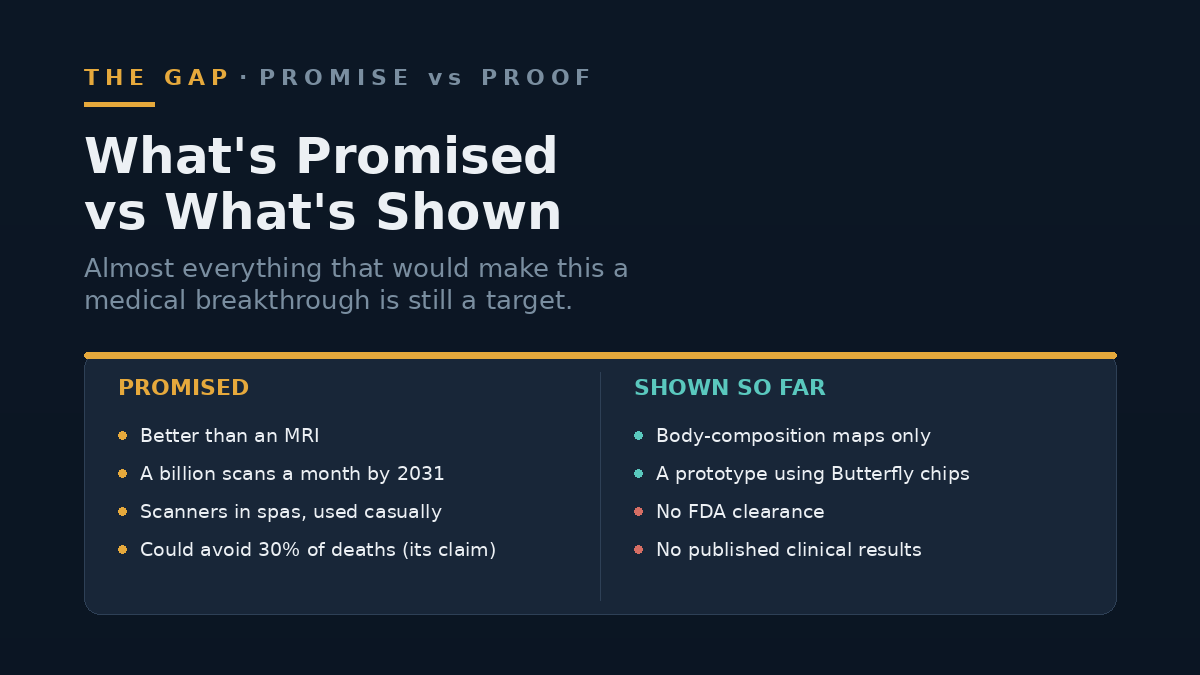
Very little of the grand vision is shipping. By Midjourney's own account, the device currently produces only "detailed body composition maps" — useful for tracking fat, muscle and rough structure, but a long way from diagnosis. Anything diagnostic, the thing that would make it a genuine rival to an MRI, needs clearance from the US Food and Drug Administration, which the company says it has not yet obtained and intends to pursue over time. No independent clinical results, peer-reviewed validation or accuracy figures have been published. The reconstructed scan images on Midjourney's site are presented by the company itself, not verified by outside radiologists.
The headline targets are larger still. Midjourney says it wants a fleet of more than 50,000 scanners worldwide by 2031, with capacity for "a billion scans a month", and suggests that enough early imaging could one day "avoid 30% of all deaths and 50% of all healthcare costs". These are Midjourney's own projections, not findings, and the company has published nothing to support them. Holz has not said what a scan will cost. As The Next Web put it, for now the most accurate description is "an ambition with a launch event attached".
Why doctors are wary of scanning healthy people
Set aside whether the machine works as advertised, and a second problem remains: scanning large numbers of healthy people is genuinely contested in medicine, and not because doctors lack ambition. Whole-body screening of people with no symptoms tends to surface "incidentalomas" — harmless lumps, cysts and shadows that look alarming and trigger further, sometimes invasive, tests. The result can be anxiety, cost and risk with no benefit, a pattern clinicians call overdiagnosis. The US Food and Drug Administration, writing specifically about whole-body CT screening, says it knows of no disease for which scanning people without symptoms has been shown to do more good than harm. Midjourney's device uses ultrasound rather than X-rays, so the FDA's radiation warning does not apply to it — but the deeper concern, that screening healthy bodies turns up more false alarms than real disease, is about screening itself, not the imaging method. A service promising a billion scans a month would amplify that debate, not resolve it — which is why the casual, do-it-whenever-you-like spa framing is exactly the part medical experts find hardest to accept.
And then there is the spa
The detail that captures how early all this is: Midjourney plans to open a "Midjourney Spa" in San Francisco around the end of 2027, reported to be a roughly 23,000 sq ft space across several floors near Union Square fitted with around ten scanners alongside hot tubs, saunas and cold plunges. The idea is that the scan becomes a pleasant side-effect of a day out. It is a vivid vision. It is also a long way from a cleared medical device, and it arrives while Midjourney is fighting intellectual-property lawsuits from Disney and Warner Bros. Discovery over its image generator. The company has no outside investors and calls itself a "community-backed research lab", which means there is no external funder applying the usual scrutiny to medical claims.
FAQ
Can I get a Midjourney scan now?
No. There is no commercial scanner, no clinic and no spa open to the public. Midjourney describes research trials and a first "research spa", with a public San Francisco spa targeted for around the end of 2027.
Is it approved as a medical device?
No. The scanner has no FDA clearance. Midjourney says it currently offers only body-composition maps and that diagnostic capabilities would require regulatory approval it has yet to obtain.
Does it actually use AI?
Mostly not, for the imaging itself. The scan relies on ultrasound and signal processing; Holz said the system does not yet use AI for that part. AI is used to label and segment the resulting images.
Is it really better than an MRI?
Unproven. Midjourney claims greater speed and no radiation, but no independent clinical comparison with MRI has been published. Speed is not the same as diagnostic accuracy, which is what an MRI is trusted for.
The takeaway
There is a real idea buried here — cheaper, faster, radiation-free imaging would matter to a lot of people, and licensing Butterfly's proven ultrasound chips is a more grounded starting point than the spa renders suggest. But almost everything that would make this a medical breakthrough is still a promise: no clearance, no independent results, no published accuracy, no price, and a founder candidly admitting the AI part is not really there yet. For now, treat the Midjourney Scanner as a bold prototype with a slick launch, judge it on results when they arrive, and be especially careful with any service that offers to scan a healthy body "whenever you want" — that is the claim with the weakest evidence behind it.
Sources
- Midjourney — "A New Era of Midjourney" announcement of Midjourney Medical and the Scanner (June 2026)
- The Next Web — "Midjourney's full-body scanner: big claims, no track record" (18 June 2026)
- Bloomberg — "AI Startup Midjourney Pivots to Health With Ultrasound Machine" (18 June 2026)
- Butterfly Network — commentary on the Midjourney scanner: 40 modules per prototype and up to $74m over five years (18 June 2026)
- The San Francisco Standard — on the planned Union Square spa (19 June 2026)
- US FDA — "Whole-Body CT Screening — Should I or shouldn't I get one?"