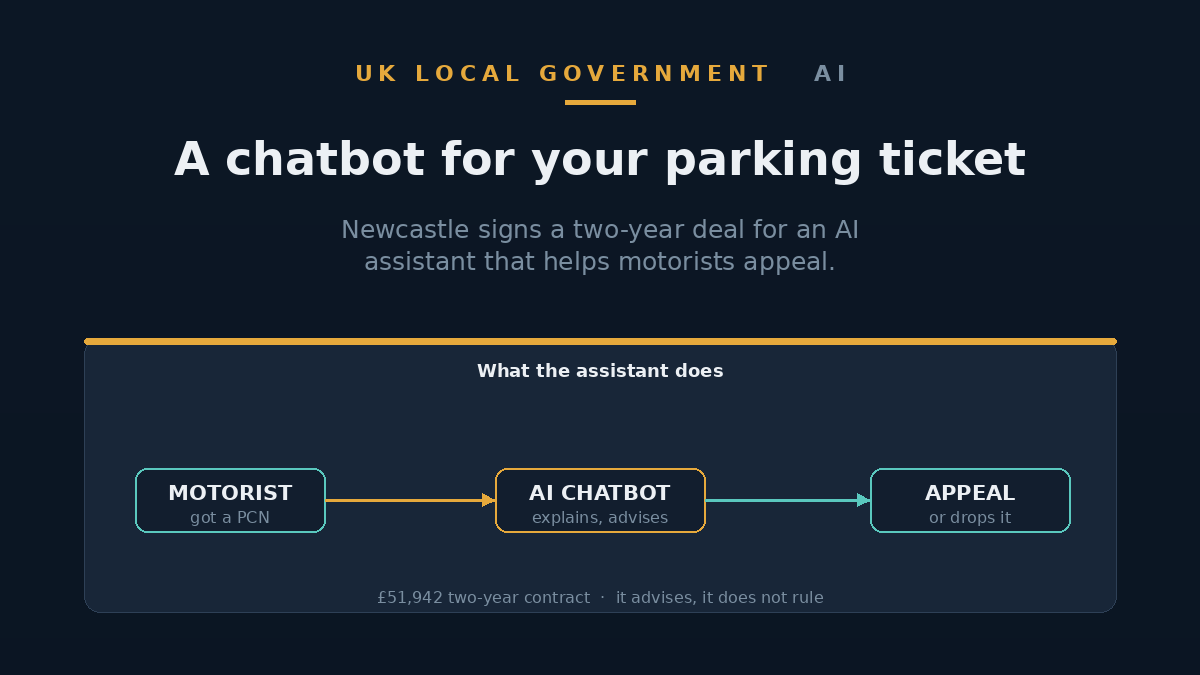
Newcastle City Council has signed a two-year contract for an AI chatbot to help motorists who want to challenge a parking fine, according to a government contract notice published on 26 August 2026. The deal goes to Barbour Logic Limited, a West Sussex software firm whose assistant already talks drivers through penalty charge appeals for a string of UK councils. It is a small award, worth £51,942 before VAT over two years, and it was made directly without a competition because of its size. On its own it is minor council housekeeping. As a signal, it is more interesting: this is AI quietly arriving in the kind of everyday public service that ordinary people actually bump into.
This piece reflects the contract notice as published on 26 August 2026. Figures and dates are taken from the notice; product capabilities described below are the supplier's own account.
What the contract covers
The notice is a UK7 contract details notice under the Procurement Act 2023. The buyer is Newcastle City Council; the supplier is Barbour Logic Limited. The value is £51,942 excluding VAT, or £62,330.40 including VAT, and the term runs from 1 November 2026 to 31 October 2028. It was awarded below threshold without competition, which is a legitimate route for lower-value contracts, and the described purpose is simply a "parking appeals chatbot" for the council's area on Tyneside. The notice does not spell out how the tool works, so for that we have to look at what Barbour Logic says it sells.
What the tool actually does
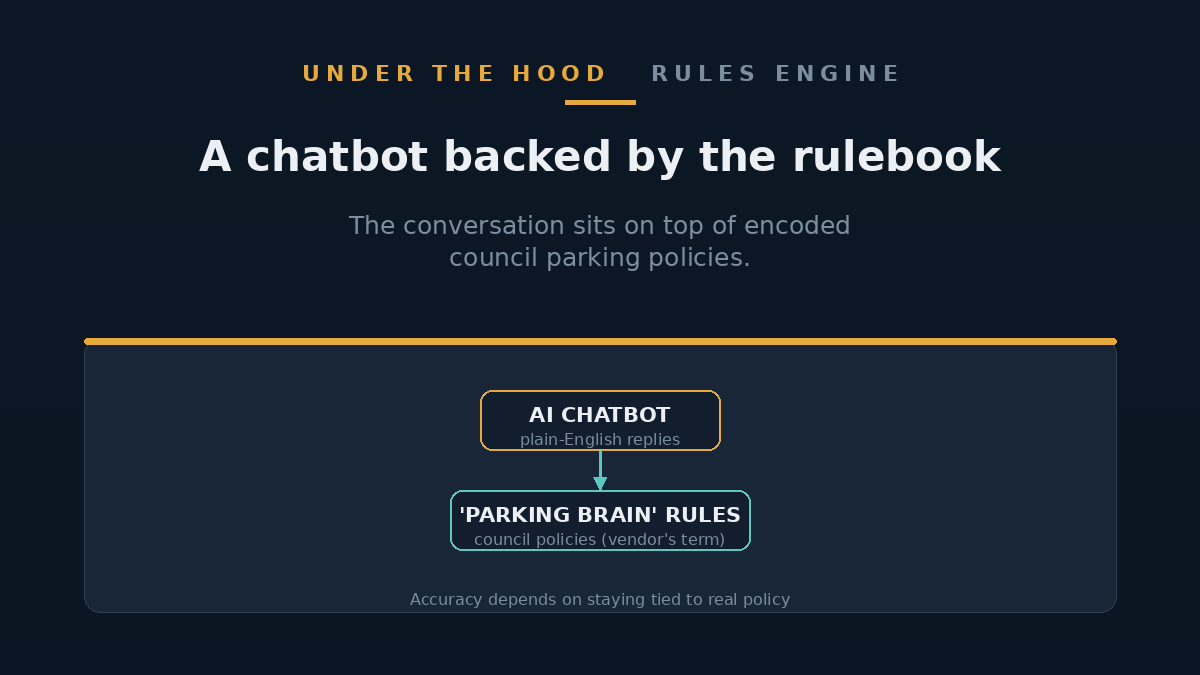
Barbour Logic markets an AI-powered, multilingual chatbot that live-chats with motorists who are thinking about appealing a penalty charge notice, alongside a phone-based companion service for people who would rather not use a screen. By the company's own account, the chatbot sits on the council's website, is available around the clock, and is meant to feel like chatting to a knowledgeable human who can give personal advice on a specific ticket. Underneath the conversational layer, the company describes a proprietary rules engine that encodes council-specific parking policies and generates plain-English responses. Barbour Logic says the system works with roughly 60 UK councils and encodes more than 800 policies, though those are the firm's own figures rather than independently audited numbers, so treat them as marketing claims rather than settled fact.
The pitch, in other words, is not a robot that decides your appeal. It is a front-door assistant that explains why a ticket was issued, tells you whether the grounds you are thinking of are likely to hold, and either helps you put an appeal together or, in many cases, talks you out of one that will not succeed. For a council, the appeal is obvious: fewer avoidable letters and phone calls landing on a small parking team, and quicker answers for residents.
The fair questions
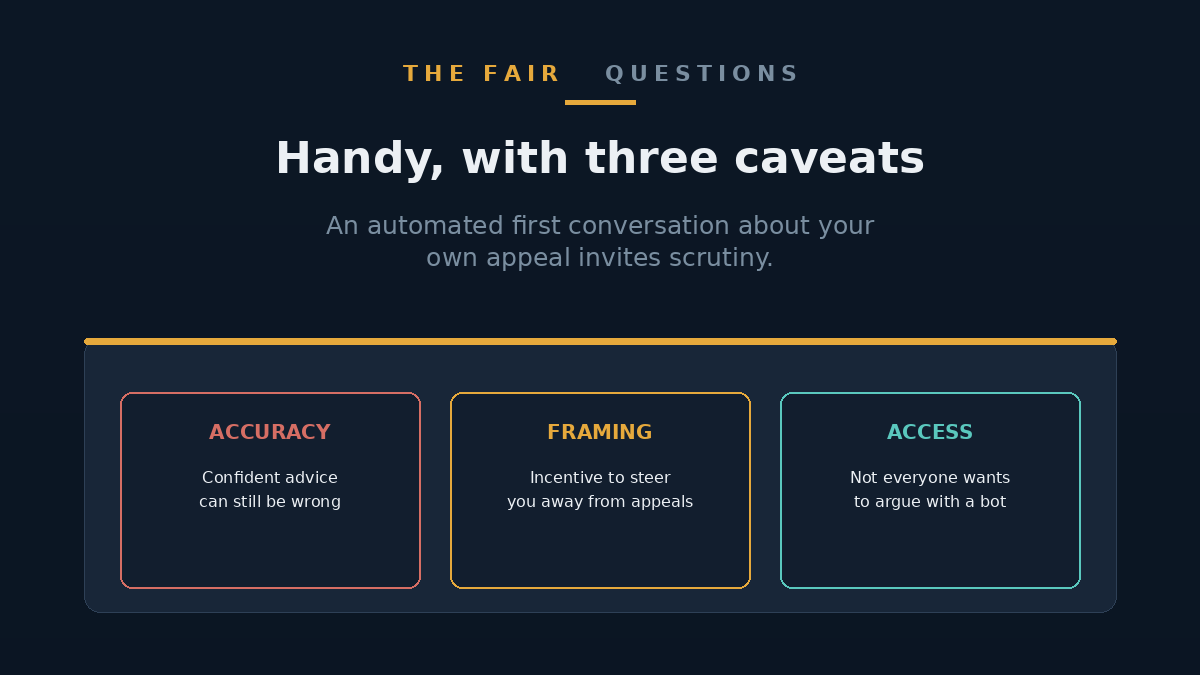
An assistant that never sleeps and answers in seconds is genuinely useful, especially if you have ever tried to work out whether a confusing sign is grounds for appeal. But handing that first conversation to an automated system raises reasonable questions worth stating plainly. The first is accuracy. Parking rules are fiddly and local, and an AI chatbot that gives confident, plausible-sounding advice can still be wrong, so the quality of the outcome depends heavily on how tightly the underlying rules engine is kept to real policy rather than free-form generation. The second is fairness of framing. A tool paid for by the council to reduce appeals has an obvious incentive to steer marginal cases toward "do not bother", and a motorist with a weak-looking but legitimate case deserves not to be quietly discouraged from exercising a right to challenge.
The third is access. Not everyone wants to argue with a chatbot, and the people most likely to be hit hardest by an unfair ticket are not always the most comfortable online. To its credit, Barbour Logic offers a telephone version of the service aimed at exactly this group, which suggests the digital-exclusion problem is at least recognised. None of these concerns is a reason not to use the tool. They are the things a resident, or a councillor signing off the deal, ought to keep an eye on once it is live.
Why a small contract is worth noticing
Fifty thousand pounds is a rounding error in a council budget, and a single parking chatbot will not change anyone's life. The reason to flag it is the pattern it fits. British councils are under real financial pressure, AI vendors are pitching automation of exactly the high-volume, low-complexity correspondence that eats staff time, and appeals handling is a textbook target. Newcastle is not first and will not be last. The interesting question is not whether this one chatbot works, but whether "an AI talks to you first" becomes the default way residents interact with their council, and whether the safeguards on accuracy, fairness and access keep pace with the rollout.
FAQ
Will a chatbot decide my parking appeal?
Based on the supplier's description, no. The tool is pitched as a front-door assistant that explains a penalty and helps you decide whether and how to appeal, not as the body that rules on the appeal itself. Formal appeals still run through the council and, ultimately, the independent adjudication process.
How much is Newcastle paying?
£51,942 excluding VAT, or £62,330.40 including VAT, over two years from 1 November 2026 to 31 October 2028, according to the contract notice.
Can I still speak to a person?
The supplier offers a telephone version of the service for people who would rather not use an online chat, and your statutory right to appeal a penalty charge notice through the normal channels is unaffected.
Is the "60 councils" figure reliable?
That is Barbour Logic's own marketing figure, not an independently verified number, so it is worth treating as a claim rather than a confirmed fact.
The takeaway
Newcastle's parking chatbot is a small, ordinary contract that happens to show something larger: AI is moving into the routine machinery of local government, starting with the dull, high-volume tasks. Used well, a tool like this saves residents time and frees up a stretched council team. The risks are not dramatic but they are real, and they sit around accuracy, the incentive to discourage appeals, and making sure people who are not comfortable online are not left behind. Handy, worth watching, and not something to wave through unexamined just because the sum is small.