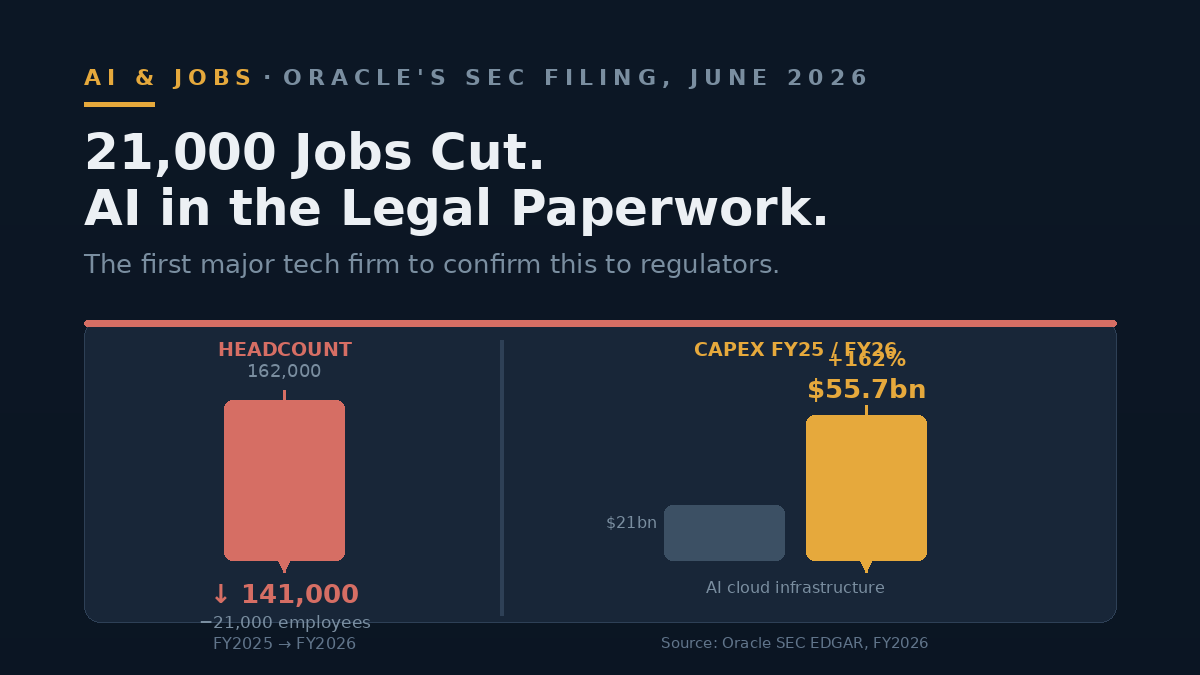
Oracle ended fiscal year 2026 with roughly 21,000 fewer employees than it started with — a 13 per cent reduction — and told the US Securities and Exchange Commission exactly what drove the cuts. The company's annual regulatory filing states that AI deployment across its operations "resulted, and may continue to result, in reductions to our workforce." That sentence is not a press release. It is a legally obligated disclosure to financial regulators, and it carries a different weight than the reassurances about AI and jobs that tend to dominate earnings calls.
This piece reflects reporting as of June 2026. Workforce and financial figures come from Oracle's FY2026 earnings materials and are reported by the company; they may be revised. The 10-K annual report language is cited as reported by multiple independent outlets including The Next Web, TechSpot, Bloomberg, and CNBC.
What the filing actually says — and why it matters
Oracle's global headcount fell from 162,000 full-time employees at the end of May 2025 to 141,000 at the end of May 2026. The annual 10-K lists several contributing factors: management and product changes, performance issues, strategic shifts, and acquisitions. AI adoption is also explicitly named.
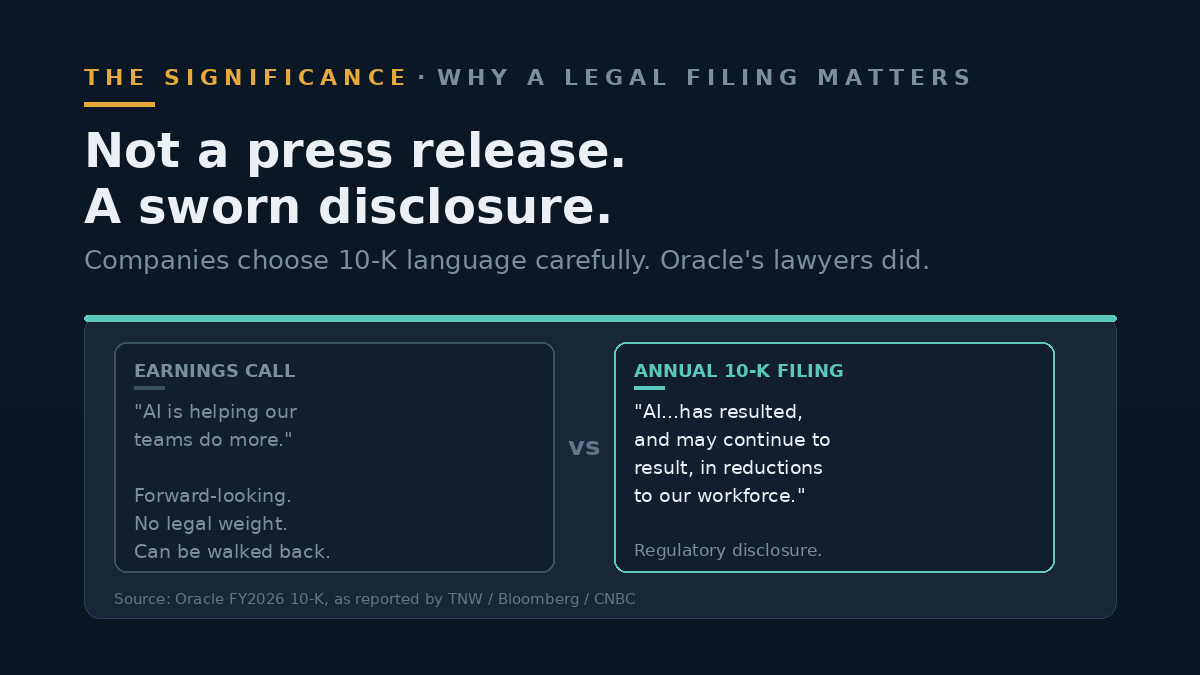
The significance is in the legal context. Annual 10-K filings are sworn disclosures to the SEC. Companies choose this language carefully: an earnings-call comment can be framed as aspirational and walked back at the next quarter; a 10-K disclosure cannot easily be retracted. When Oracle's legal team approved language stating AI "resulted" in workforce reductions — past tense, definitive — they were signalling that the company was comfortable staking its regulatory credibility on that statement.
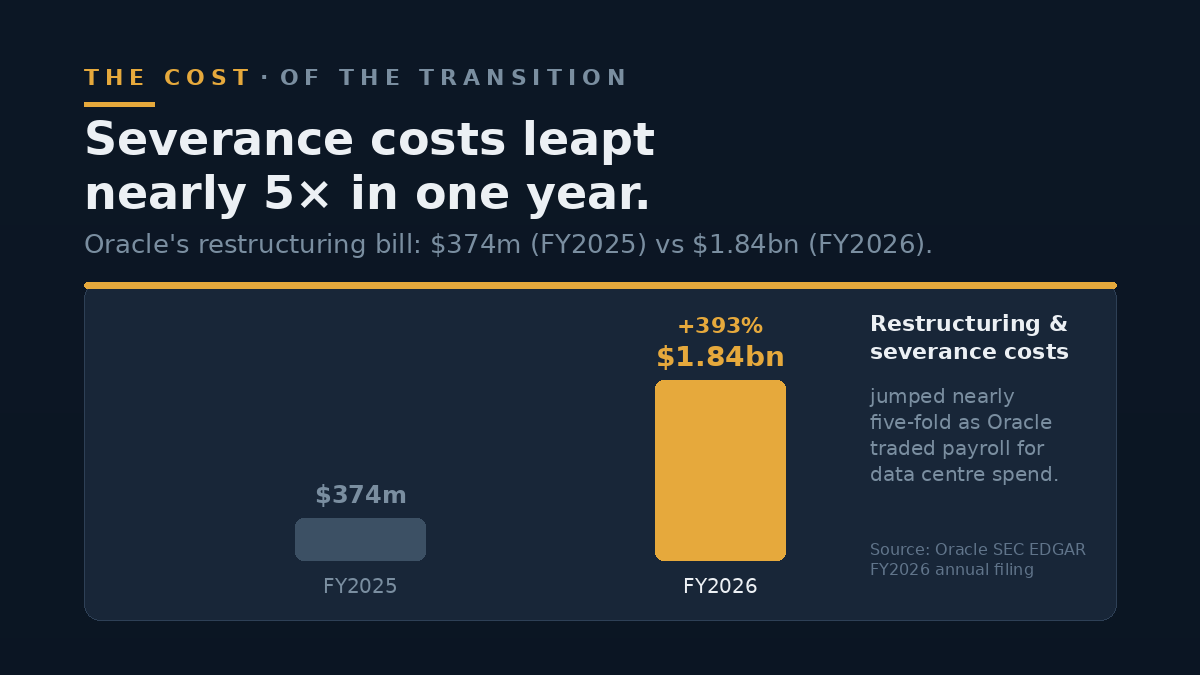
The restructuring bill reflects the scale of the transition. Oracle spent approximately $1.84 billion on severance and related exit costs in fiscal 2026, confirmed in its financial statements — up from $374 million the previous year.
Where the money went instead
Those jobs were not simply eliminated; they were traded. Oracle's capital expenditure for fiscal 2026 reached $55.7 billion, almost entirely for AI cloud infrastructure and data centre capacity — more than doubling the $21.2 billion spent the year before. Chairman Larry Ellison told analysts the company intended to build more cloud infrastructure than all its competitors combined. The scale of that ambition produced negative free cash flow of $23.7 billion for the year, funded by $43 billion in new debt and equity financing raised during fiscal 2026.
The near-term returns support the strategy. Cloud infrastructure revenue grew 93 per cent to $5.8 billion in the fourth quarter alone. Total cloud revenue for the full year reached $34 billion, up 39 per cent. Contracted future revenue stood at $638 billion by the end of Q4, up $85 billion in a single quarter — a figure driven largely by large-scale AI contracts where customers have prepaid for GPU capacity.
The deepest headcount reductions fell on Oracle Health, the division built around the $28.3 billion acquisition of electronic health records company Cerner, where an estimated 8,000 to 10,000 employees were cut, according to TD Cowen analyst estimates cited by The Next Web — a figure not stated in Oracle's own filing. Legacy software sales and some professional-services teams also took significant cuts.
A pattern across the industry
Oracle is the most prominent case but not an isolated one. According to TechSpot, citing the tracking site Layoffs.fyi, more than 121,000 tech employees had been laid off at nearly 200 companies in 2026 by late June — already close to the entire 2025 total. Several other companies have cited AI in disclosures or public communications: Workday attributed an 8.5 per cent workforce reduction in early 2025 to reallocation toward AI investment; Snap's chief executive referenced AI-driven efficiency in an SEC-filed memo in April 2026; Atlassian announced a 10 per cent reduction in March 2026 citing the demands of the "AI era." These figures are drawn from secondary reporting; primary filings were not independently fetched for this piece.
What distinguishes Oracle is the directness. Most companies frame workforce reductions as "restructuring" or "efficiency measures" and describe AI as augmenting rather than replacing workers. Oracle's filing puts the substitution in writing, making it harder to treat the correlation between AI investment and headcount reduction as coincidental.
The counterweight
It would be wrong to treat Oracle's filing as settling a broader economic argument. Apollo economist Torsten Sløk stated publicly in 2026 that there was "zero evidence" AI was destroying jobs, citing aggregate labour market data that has not collapsed in the way some earlier predictions implied. Headline unemployment has not surged despite tech-sector cuts, which suggests displaced workers are finding other employment — or that the scale of displacement has been overstated at the macro level.
There is also an early corrective signal: TechSpot reported that a proportion of companies which replaced workers with AI have since rehired some of them or expressed regret about the decision, based on a study it cited though did not name in full. That pattern, if it holds, would suggest the business case for aggressive substitution is not as clear-cut as the investment cycle implies.
The honest reconciliation is that both things can be true simultaneously. Aggregate employment can hold steady while specific roles disappear faster than they are replaced within the same organisations. Reports — including a Time magazine account that could not be verified against Oracle's own disclosures — describe teams of database administrators having their workload taken over by AI agents supervised by a small number of senior staff. Oracle's formal filings do not confirm the specifics of individual team changes beyond the workforce-level figures. The jobs most at risk appear to be concentrated in repetitive, process-driven functions: database administration, legacy software support, certain administrative and revenue operations roles.
FAQ
Why does an SEC filing matter more than an earnings call?
Companies have legal obligations around the accuracy of annual 10-K reports filed with the SEC. An earnings call remark is forward-looking guidance and can be framed with caveats; a regulatory filing must reflect what the company believes to be materially true about its business. When Oracle's legal team approved language saying AI "resulted" — past tense — in workforce reductions, that was a deliberate choice with regulatory consequences attached.
Were all 21,000 job cuts caused by AI?
No. Oracle's filing cites multiple factors including management changes, performance, strategic shifts, and acquisitions. The Oracle Health restructuring following the Cerner acquisition was also a major driver. The filing does not disaggregate AI-related cuts from the rest; it names AI as one contributing factor among several.
Does this mean AI will eliminate most jobs everywhere?
This piece does not support that conclusion. What Oracle's disclosure shows is that specific roles in one large organisation — particularly in database administration and legacy operations — are being replaced at scale. Whether this pattern spreads across the broader economy, and at what pace, is genuinely uncertain. The macro employment data do not currently show an economy-wide collapse.
What types of roles were most affected?
Based on available reporting, the largest cuts were in Oracle Health, legacy SaaS support teams, and administrative functions. Technical teams working on Oracle Cloud Infrastructure were largely unaffected and in some cases expanded. The pattern is consistent with a company pivoting from software licensing — which requires large sales and support teams — to AI cloud infrastructure, which does not.
Should Oracle customers be concerned?
Oracle's revenue figures suggest strong and growing demand — cloud revenue rose 39 per cent for the full year, and contracted future revenue reached $638 billion. The cuts appear concentrated in legacy-product support and internal operations rather than cloud infrastructure services. Service quality for cloud customers will become clearer over subsequent quarters.
The takeaway
Oracle's annual filing is the clearest piece of official documentation yet that AI deployment is directly reducing headcount at a major technology firm. That does not mean a broad economic jobs crisis is under way — the macro data do not support that reading. What it does mean is that the line often heard in corporate communications — that AI only creates jobs, never replaces them — has now been explicitly contradicted in a legally binding regulatory disclosure. For professionals in roles that involve repetitive information processing, system administration, or legacy software support, Oracle's experience is documented evidence of a real pattern, not a prediction.
Sources
- Oracle Corporation — Q4 and FY2026 Financial Results (SEC EDGAR, Exhibit 99.1, June 10 2026)
- The Next Web — "Oracle cut 21,000 jobs this year and its SEC filing explicitly blames AI" (June 23 2026)
- TechSpot — "Oracle cuts 21,000 jobs, admits AI is reducing its workforce" (June 23 2026)
- Bloomberg — "Oracle Layoffs Fueled by AI, Reduces Workforce by 21,000" (June 22 2026)
- CNBC — "Oracle sheds 21,000 roles over the past year amid wave of AI layoffs" (June 23 2026)
- TechSpot — "Economist says there's 'zero evidence' AI is killing jobs" (2026)