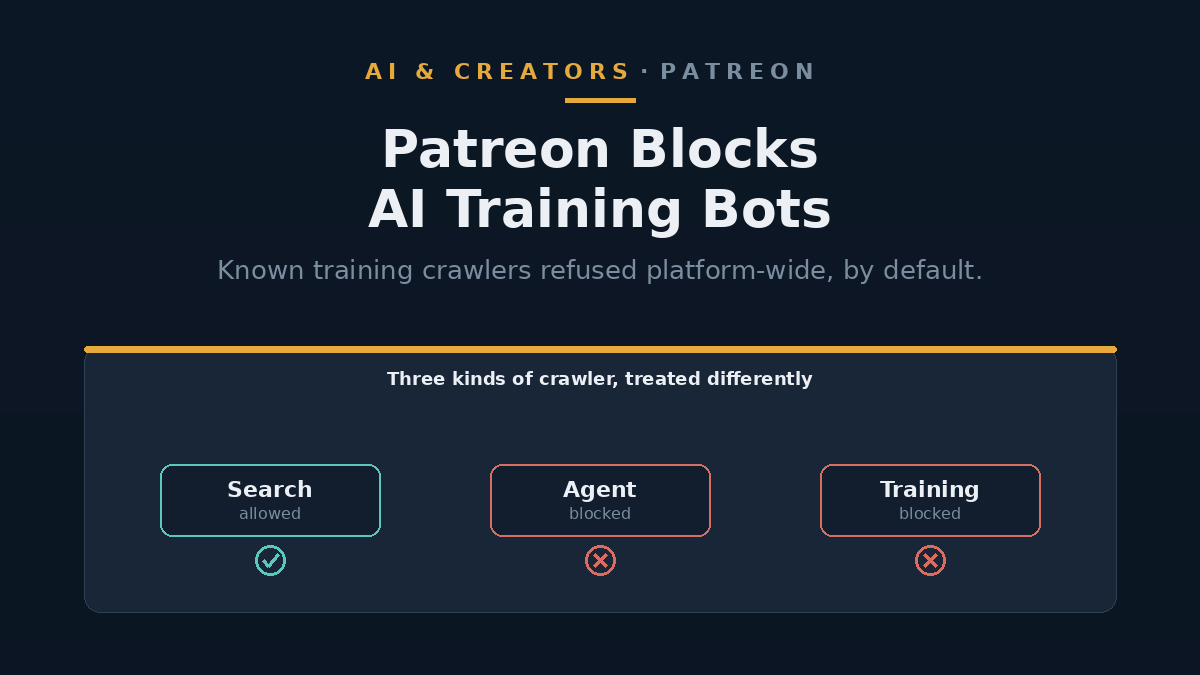
Patreon has partnered with Cloudflare to block known AI training crawlers from harvesting creators' work across the entire platform, the company announced on 9 July 2026. According to Patreon, the block runs at the "network level" on all posts, meaning creators do not have to switch anything on themselves. Crucially, it targets crawlers that scrape content to train AI models, while still allowing the search crawlers that help creators get discovered. It is a concrete, opt-out-by-default protection for the people who earn a living on the platform — but, as with any crawler block, its reach has real limits worth understanding before you treat your work as safe.
This piece reflects reporting as of July 2026. The details of what is blocked, and by whom, may change as Cloudflare and AI companies adjust their systems.
What Patreon has actually done
Patreon is using Cloudflare — an infrastructure company that sits between websites and their visitors — to identify and block bots that crawl the web to gather training data for AI models. Because it operates at the network level, the protection applies to all posts published on Patreon by default, rather than being a setting each creator has to find and enable. Patreon's product lead framed the aim plainly: creators should be able to grow an audience and keep control of how their work is used, rather than accepting AI training as the price of being online.
The company's chief executive, Jack Conte, has been vocal on the theme, arguing that creators deserve "credit, compensation, and consent" when their work is used — and that, right now, they largely get none of the three. This move turns that argument into a default setting.
The distinction that matters: training vs search
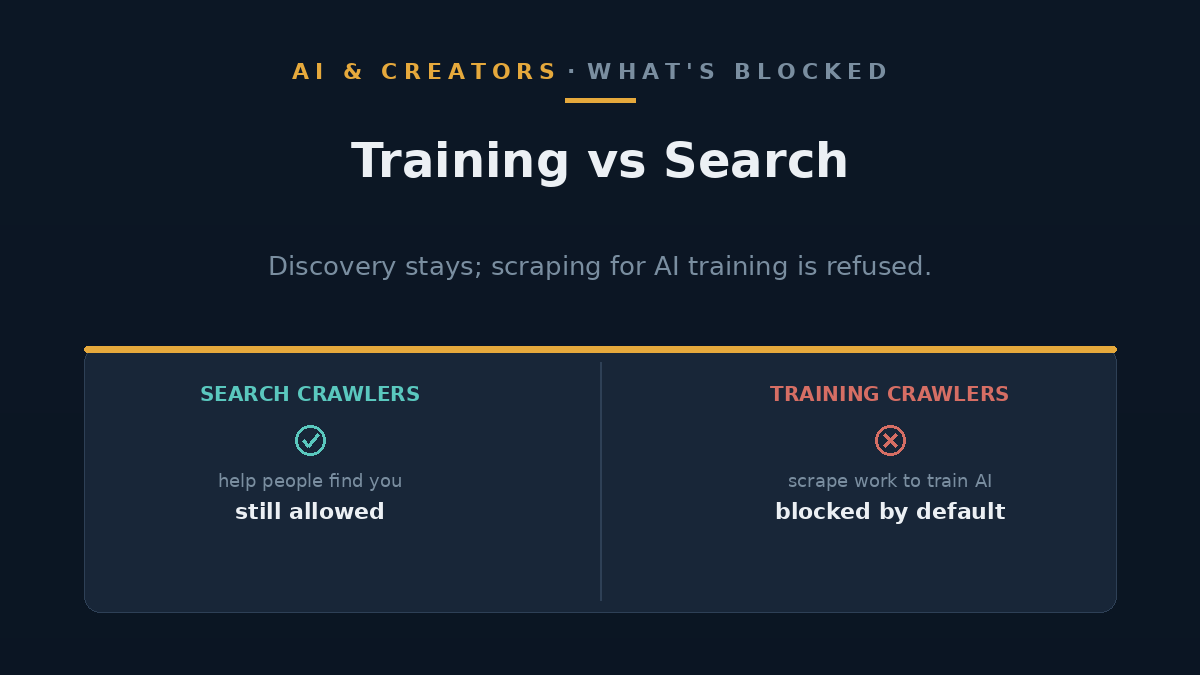
Not all crawlers are the same, and the block is deliberately selective. Search crawlers — the ones that index your page so people can find it on Google — are still allowed, because creators generally want that discovery. What is being blocked are the crawlers whose purpose is to scrape content into AI training datasets. Cloudflare has increasingly split web bots into categories — search, "agent", and training — so site owners can allow some while refusing others.
That separation is the useful part for creators: you keep the traffic that helps you get found, and refuse the crawling that feeds models with your work for free.
Part of a bigger shift at Cloudflare
Patreon's move sits inside a broader change in how a large slice of the web treats AI crawlers. Cloudflare, which serves a big share of internet traffic, has moved from allowing AI crawling by default to blocking it by default in more cases. By its own account, new websites signing up to Cloudflare will have training and "agent" bots blocked by default on pages that show ads, while search crawlers stay allowed. Patreon applying this across its whole platform is one of the most visible examples yet of a mainstream creator platform using those controls at scale.
The limits — read these before relaxing
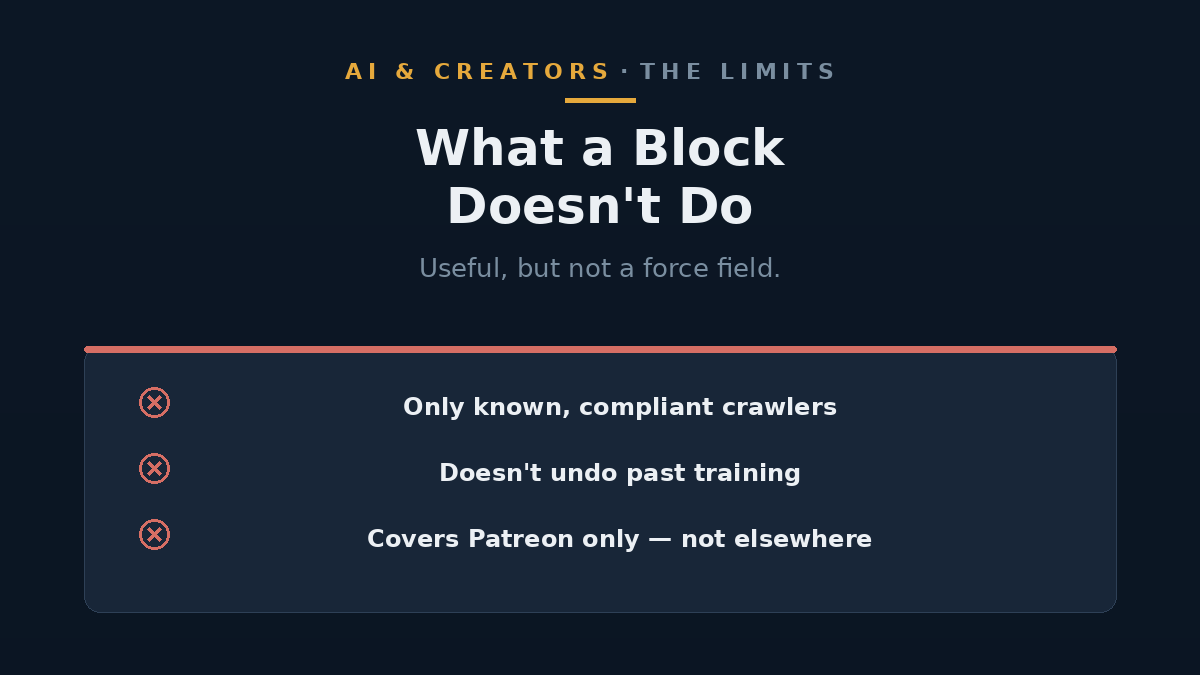
A crawler block is real, but it is not a force field. Three limits matter:
- It only stops known, compliant crawlers. Blocking depends on Cloudflare recognising a bot and on that bot respecting the block. Bad actors can disguise crawlers or ignore the rules, and detection is an ongoing cat-and-mouse.
- It does not undo past training. Work already scraped and used to train existing models is not clawed back by a block that starts today. This protects future crawling, not the past.
- It only covers Patreon. The same image, video or post shared elsewhere — your own site, social platforms, a newsletter — is governed by whatever those services do, which may be nothing.
There is also a fair-question note on consistency: Patreon still permits AI-generated content on the platform under its terms, so this is a stance on how creators' work is taken, not a blanket position against AI on the site.
FAQ
Do I need to turn this on?
No. Patreon says the block runs at the network level across all posts by default, so creators do not have to change a setting to be covered.
Will this stop my Patreon work being used to train AI?
It blocks known AI training crawlers going forward, which raises the barrier significantly. It cannot guarantee that every crawler is caught, and it does not affect models already trained on previously scraped data.
Will it hurt my discoverability?
It is designed not to. Search crawlers that index your page for Google and similar are still allowed; only training-focused crawling is blocked.
What about my work on other platforms?
This protection is specific to Patreon. For work you publish elsewhere, whether AI crawlers are blocked depends on that site's settings — often through a service like Cloudflare, or via a robots.txt file and similar controls.
The takeaway
For creators, this is a genuinely useful, no-effort protection: Patreon is refusing known AI training crawlers across the platform by default, while keeping the search traffic that helps people find you. It is also part of a wider move — led largely by Cloudflare — to flip the web's default from "AI can crawl unless you stop it" to "AI is blocked unless you allow it". Just keep the limits in view: it guards future crawling of your Patreon posts, not the past, not disguised bots, and not the same work posted elsewhere. A meaningful step for creator control, not a final answer.