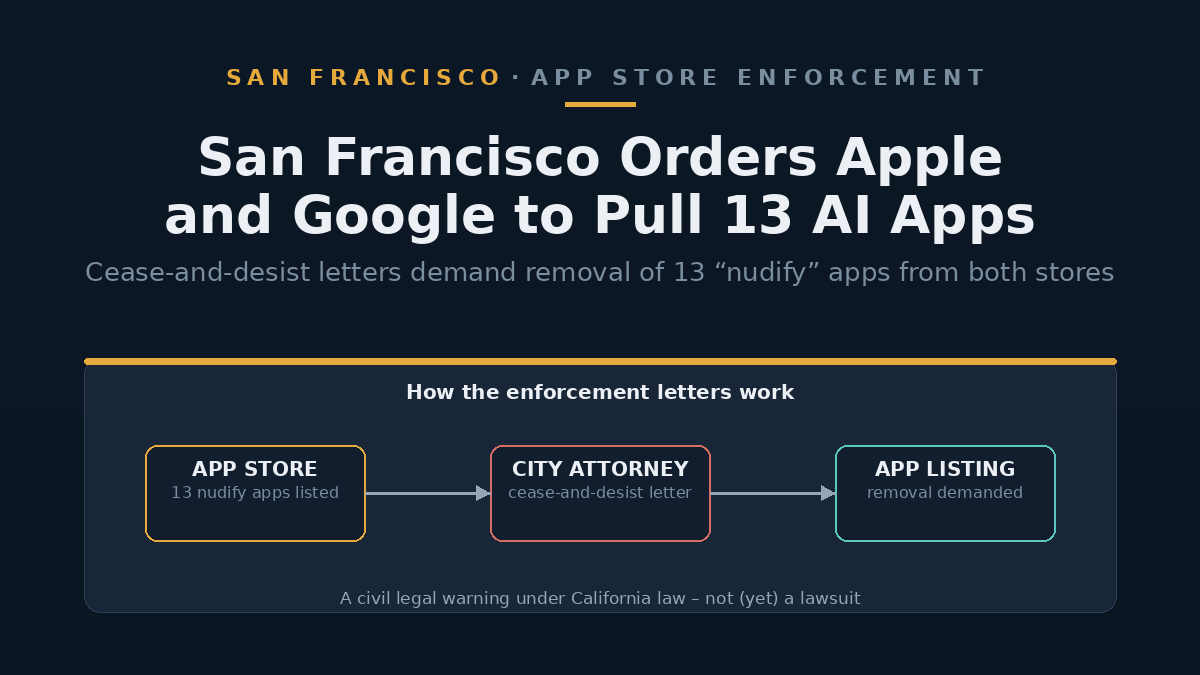
San Francisco's City Attorney, David Chiu, has sent cease-and-desist letters to Apple and Google demanding they remove 13 AI "nudify" apps, tools that let someone upload an ordinary photo of a real person and generate a fake sexual image of them without consent. The letters argue the app stores are breaking California law by hosting and profiting from these apps. Google says it has already pulled the five apps named on its platform; Apple has not publicly responded to this specific letter. It is a legal warning, not (yet) a lawsuit.
This piece reflects reporting as of 17 July 2026. The cease-and-desist stage is an opening move, and both the companies' response and any further legal action may change quickly.
What the letters actually demand
According to the letters, Chiu's office wants Apple and Google to remove eight and five apps respectively from their stores, and to cut off the developers behind them entirely. The legal theory rests on a California statute covering "supporting services" that facilitate non-consensual intimate imagery: because Apple and Google host these apps, process their subscription payments and take a cut of the revenue, Chiu's office argues they are "aiding and abetting" the abuse, not merely hosting it passively. Chiu told WIRED that "generating non-consensual intimate images is illegal, harmful, and completely unacceptable," and his office says the two companies have likely made millions of dollars in fees from these apps over time, an estimate from Chiu's office rather than an independently audited figure.
How big is the problem, really
The 13 apps named in July are a small slice of a much larger pattern. A January 2026 investigation by the nonprofit Tech Transparency Project found 55 "undressing" apps in the Google Play Store and 47 in Apple's App Store (38 of them listed in both), collectively downloaded more than 705 million times and generating an estimated $117 million in lifetime revenue, a figure TTP attributes to the app-analytics firm AppMagic rather than to Apple's or Google's own disclosures. Because both companies take a cut of in-app purchases, that revenue estimate is also, indirectly, a rough guide to what the platforms themselves may have earned. A follow-up investigation reported in April by 404 Media found the two stores' own search and advertising systems actively surfaced these apps to users searching relevant terms, rather than the apps simply slipping through unnoticed.
Apple and Google's response so far
Google has confirmed it investigated the five apps named in San Francisco's letter and removed all of them, and says it regularly removes apps that breach its explicit-content policy. Apple has not issued a statement responding directly to this cease-and-desist letter, though the company has previously said nudification apps have no place on its store and has blocked certain related search terms in the past. Both companies' developer policies already ban pornographic and sexually exploitative content; the recurring problem, as outlined by TTP and 404 Media's research, is enforcement rather than the wording of the rules themselves.
Not San Francisco's first move on this
This is a continuation of a broader campaign by Chiu's office, which sued the operators of 16 of the most-visited AI deepfake pornography websites in August 2024 and reached a settlement with one operator, Briver LLC, reported in June 2025, that included a permanent injunction and a $100,000 civil penalty. The app-store letters extend that campaign from the websites that generate these images to the mobile platforms that distribute the tools which create them.
What UK law already does about this
For UK readers, it's worth knowing the law here is not hypothetical, and in some respects goes further than what San Francisco is currently asking Apple and Google to do voluntarily. Since 31 January 2024, sharing (or threatening to share) a non-consensual intimate image, including an AI-generated one, has been a criminal offence in England and Wales under section 66B of the Sexual Offences Act 2003, inserted by the Online Safety Act 2023. Since 6 February 2026, simply creating one, or asking someone else to create one, without the subject's consent has also been a standalone criminal offence under section 138 of the Data (Use and Access) Act 2025, which was also designated a priority offence under the Online Safety Act, putting platforms under a proactive duty to prevent and remove this content. Most relevant to this story: since 29 June 2026, the Crime and Policing Act 2026 has made it a criminal offence in its own right to make, adapt, supply or offer to supply a "nudification" tool or service. Where San Francisco is asking two private companies to voluntarily cut off developers under a civil legal theory, UK law has already made building or distributing the tool itself a crime.
FAQ
Is this a lawsuit against Apple and Google?
Not yet. A cease-and-desist letter is a formal legal warning that typically precedes a lawsuit if the recipient doesn't comply. Chiu's office has escalated to lawsuits against other targets in this space before, so it's a credible next step if the letters are ignored.
Have the apps actually been removed?
Google says it has removed the five apps named in its letter. Apple has not confirmed removals in response to this specific letter, though it has removed individual nudify apps in the past following media and researcher pressure.
Is making one of these images illegal in the UK?
Yes. Sharing a non-consensual intimate image (including an AI-generated one) has been a criminal offence since January 2024, creating one without consent has been a separate offence since February 2026, and supplying the tool used to make one has been a criminal offence since June 2026.
Why can San Francisco go after Apple and Google rather than just the app developers?
Because many of the developers are difficult to reach, often based overseas. Chiu's legal theory targets the app stores as "supporting services" that host, distribute and take payment for the apps, arguing that gives them legal responsibility too.
What can someone do if they're targeted by one of these apps?
In the UK, options include reporting the content to the platform it was shared on, contacting the Revenge Porn Helpline, and reporting to police, since both the creation and sharing of such images are now criminal offences.
The takeaway
This is a serious escalation in a long-running enforcement campaign, but it is still a warning letter, not a court ruling, and the headline scale figures come from a single nonprofit's research rather than Apple or Google's own disclosures. What's genuinely notable for UK readers is the comparison: San Francisco is trying to use a civil "aiding and abetting" theory to pressure two private companies into voluntary action, while the UK has already gone further and made both creating these images and supplying the tools that make them criminal offences outright. Enforcement of any of this, on either side of the Atlantic, still depends on regulators, platforms and police actually acting on the powers they have.
Sources
- WIRED – original reporting on the cease-and-desist letters and Chiu quote (17 July 2026)
- Android Headlines – corroborating coverage with Apple/Google response detail (17 July 2026)
- MacTech/AppleWorld.Today – corroborating coverage citing the California statute (17 July 2026)
- California Civil Code §1708.86 – the statute underpinning the "supporting services" legal theory
- Tech Transparency Project – investigation into nudify app prevalence and revenue estimates (27 January 2026)
- 404 Media – follow-up reporting on app stores surfacing nudify apps via search and ads (16 April 2026)
- legislation.gov.uk – Sexual Offences Act 2003, section 66B (sharing intimate images without consent)
- legislation.gov.uk – Data (Use and Access) Act 2025, section 138 (creating purported intimate images)
- GOV.UK – Crime and Policing Act 2026 overarching factsheet, Home Office (updated 19 May 2026)