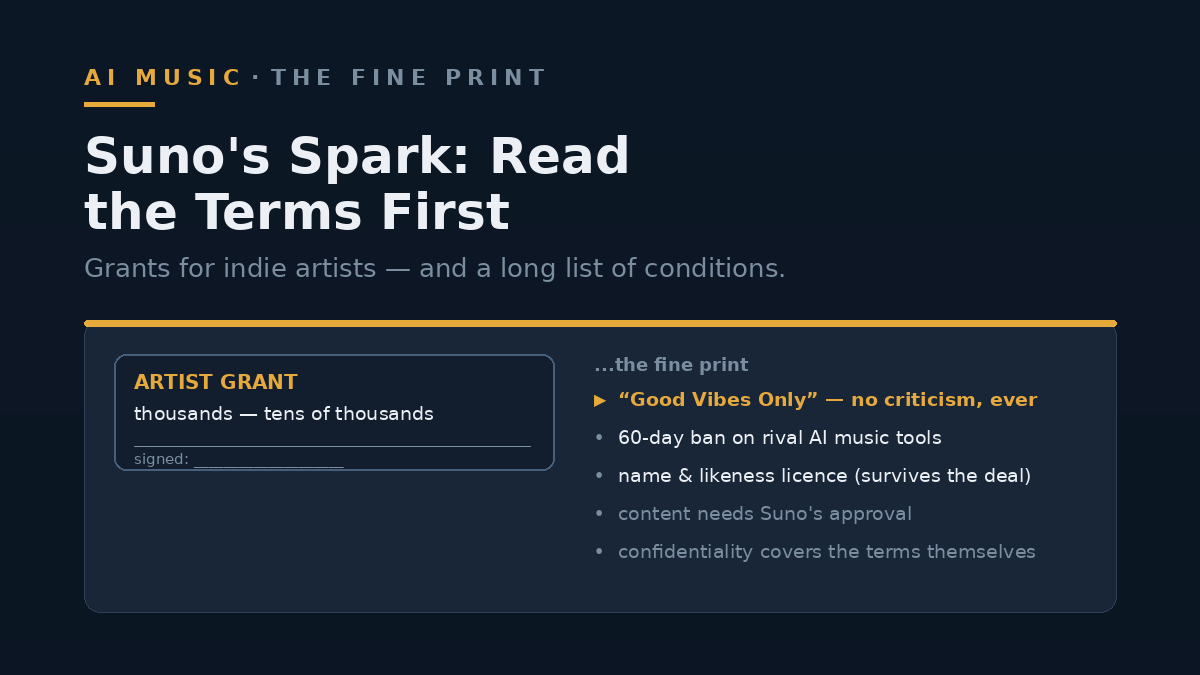
AI music company Suno has launched "Spark", an incubator that offers unsigned artists cash grants, marketing support and invitations to its songwriting camps. The money is real — a Suno spokesperson told Billboard grants run from the thousands into the tens of thousands, scaled to where an artist is in their career. But the offer comes with a binding "Fine Print" the cheerful announcement skips over: artists agree never to portray Suno negatively, to stay away from rival AI music tools for 60 days, and to license their name and likeness to Suno beyond the end of the deal. If you make music and are tempted, the honest advice is to read the terms before the press release.
This piece reflects reporting as of June 2026. Programme terms and the litigation around Suno are moving quickly and may change after publication.
What Spark actually offers
Spark, announced on 25 June 2026 by Suno chief music officer Paul Sinclair and head of creative economy Rosie Nguyen, is pitched at emerging musicians who lack the resources or connections to take a next step. In the company's words, the aim is to help artists turn ideas into finished projects and "build sustainable creative careers". To apply you must be at least 18, releasing music under your own name, and unsigned.
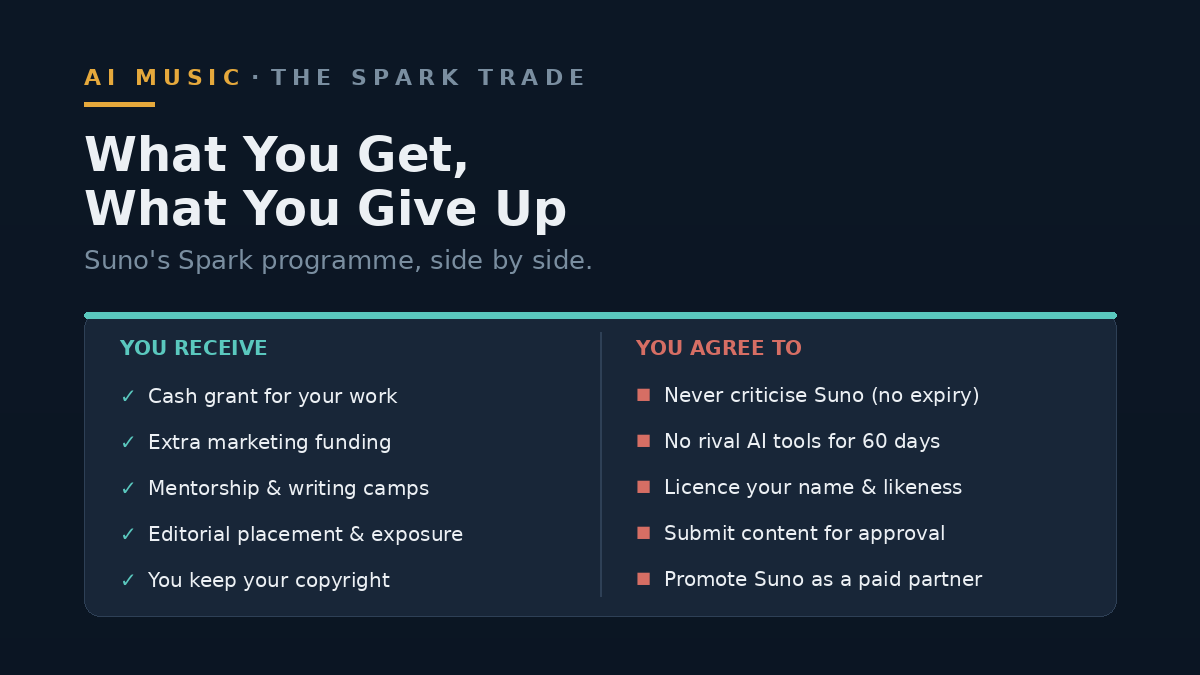
Selected artists are promised a creative grant, extra money for marketing, a dedicated Suno partner manager, free access to Suno's top tier and song credits, early access to unreleased tools, editorial placement on the platform, and the chance to work with established directors and writers. Suno says participants keep the copyright in what they make and choose their own distributor. On its face, that is a more generous package than most AI platforms offer the people who feed them.
The catch is in the "Fine Print"
The detail that drew immediate attention — first flagged by Music Business Worldwide — sits in a separate terms document the blog post does not link. Under a clause headed "Good Vibes Only", participants agree that during the programme "and thereafter" they will not make any statement that portrays Suno, its staff or its products "in a negative light". Breaking it is treated as grounds for termination. In plain terms: take the grant, and you agree never to criticise Suno — with no expiry date.
There is more. An exclusivity clause bars participants from working "in a paid or formal capacity" with any other AI music company for 60 days after their final post, naming rivals including Udio, ElevenLabs, Riffusion and others. A name, image and likeness clause lets Suno use an artist's content, name and likeness for marketing "during the Term and thereafter", including in derivative works. Content must be submitted for written approval before recording, and Suno can ask an artist to remove, re-shoot or modify it. A confidentiality clause covers the terms of the agreement itself. That last point is worth sitting with: the document tells participants not to discuss the document.
None of this is unusual for an influencer or brand-ambassador contract — disclosure rules (#SunoPartner), approval rights and exclusivity windows are standard there. The friction is the framing. Spark is presented as artist support; the binding terms read like a marketing deal in which the artist is the channel.
How the offer compares to the pitch
| What the announcement says | What the Fine Print adds |
|---|---|
| Grants, marketing and mentorship for indie artists | Artists promote Suno across their social channels, disclosed as a paid partner |
| Artists "retain creative control" | Content needs Suno's written approval; Suno can demand re-shoots or removal |
| Artists keep commercial rights to their work | Suno gets a name/likeness licence that continues after the deal ends |
| A supportive programme | A 60-day ban on paid work with rival AI tools, and a no-criticism clause with no end date |
Keeping copyright and having "creative control" are not the same thing, and the gap between them is the whole story here.
Why the timing matters
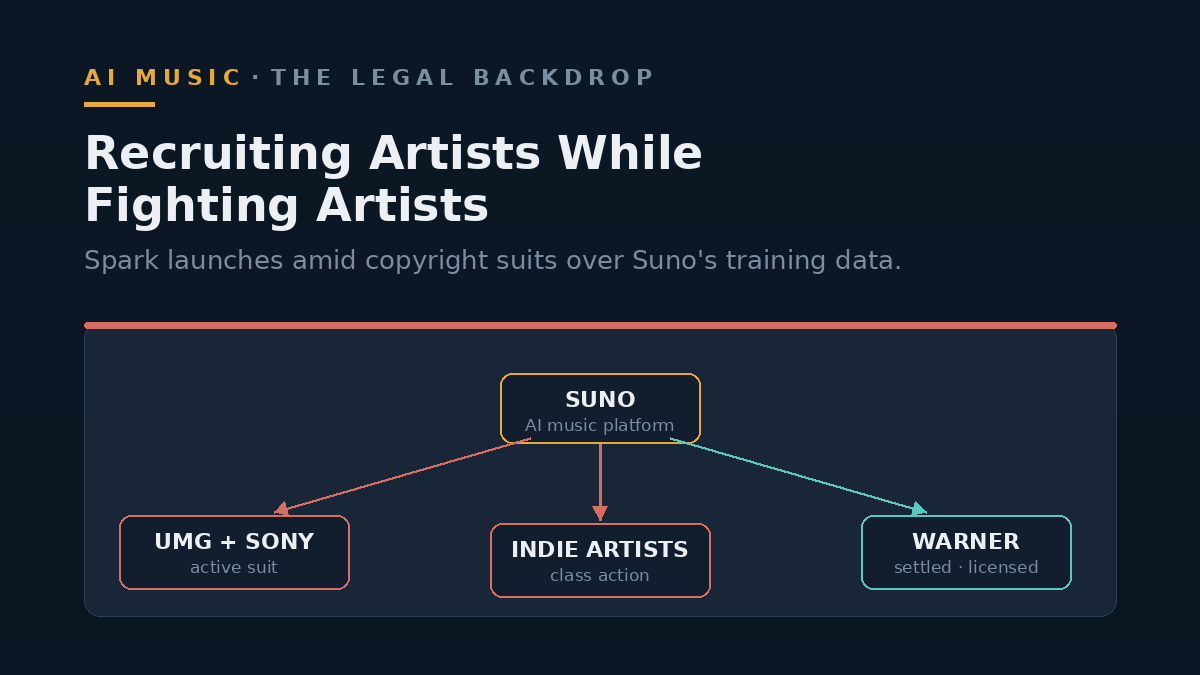
Spark arrives while Suno is fighting copyright claims on several fronts. Universal Music Group and Sony Music are pursuing a lawsuit that Billboard reports seeks around $500 million, alleging Suno trained on their recordings without permission; Warner settled and signed a licensing deal in late 2025. The German and Danish collecting societies, GEMA and Koda, are also in active litigation. And a proposed class action brought by independent artists — the same category Spark recruits from — recently gained the heavyweight plaintiffs' firm Hagens Berman.
That backdrop sharpens two clauses. Suno's general Terms of Service, which Spark participants must also accept, include a class-action waiver and arbitration agreement — separate from the Spark document, whose own disputes are pointed to Massachusetts courts. Whether agreeing to those terms would affect an artist's ability to join the existing case against Suno is a question for a lawyer, not a blog. But signing a no-criticism clause with a company you might also have a copyright grievance against is the kind of decision worth understanding fully first.
The launch also follows a fundraising run: Suno closed a Series D of more than $400 million led by Bond Capital, at a reported $5.4 billion valuation. This is not a company short of money to spend on goodwill.
FAQ
Is Suno's Spark grant money real?
Yes. A Suno spokesperson told Billboard grants range from the thousands into the tens of thousands of dollars, depending on the artist's career stage, with separate marketing funding on top. Selection is at Suno's discretion and not guaranteed.
What is the "Good Vibes Only" clause?
It is a term in Suno's Spark Fine Print under which participants agree not to portray Suno, its staff or its products in a negative light, during the programme "and thereafter" — effectively a permanent no-criticism clause. Breaching it is grounds for termination.
Can Spark artists keep using other AI music tools?
For personal use, the terms do not stop you. But you cannot work "in a paid or formal capacity" with another AI music company for 60 days after your final Spark post — the terms name rivals such as Udio, ElevenLabs and Riffusion.
Do artists keep the rights to their music?
Suno says participants retain copyright and choose their own distributor. Separately, artists grant Suno a licence to use their name, likeness and content for promotion that continues after the programme ends, and content needs Suno's approval before release.
The takeaway
Spark is a genuine offer of money and exposure, and for an unsigned artist with no other backing that can matter. It is also a marketing arrangement with durable strings: a no-criticism clause that does not expire, a short non-compete against rival tools, and a name-and-likeness licence that survives the deal — extended, pointedly, to independent artists at a moment when independent artists are suing Suno over how its models were trained. None of that makes Spark a trap. It makes it a contract. Anyone considering it should weigh the grant against the obligations with the same care they would give a record deal, ideally with someone who reads contracts for a living.
Sources
- Suno — "Introducing Spark" announcement blog (25 June 2026)
- Suno — Spark Program Fine Print, the binding terms (effective 21 June 2026)
- Music Business Worldwide — report on the "Good Vibes Only" clause and litigation context (25 June 2026)
- Billboard — grant range, valuation and copyright-suit context (25 June 2026)
- Suno — general Terms of Service (referenced for the arbitration/class-action clause)