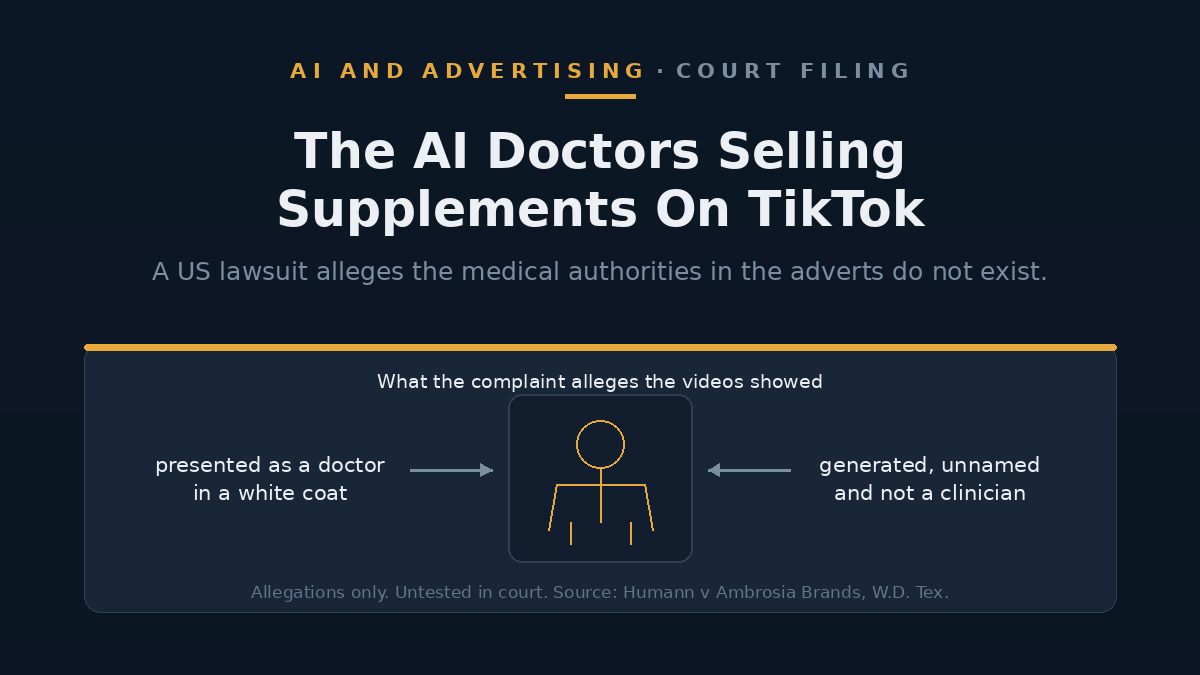
A lawsuit filed in a Texas federal court has put on the public record, in detail, an account of how AI-generated medical authority is being used to sell things. The complaint alleges that a supplement brand's TikTok marketing relied on AI-generated "doctors" making health claims it could not substantiate, coordinated through a private Discord that supplied creators with scripts and paid them commission on sales. None of it has been tested in court, the defendant disputes that it is responsible, and the party bringing the case is a competitor. What is not in dispute is a separate matter about a different product: the same brand recalled moringa capsules in February after an antibiotic-resistant Salmonella outbreak, and that product had reached the UK.
This piece reflects reporting as of July 2026. The lawsuit is at an early stage and every allegation described below is unproven.
Who is suing whom, and why that matters
The case is Human Power of N Company v. Ambrosia Brands, LLC, filed in the Western District of Texas. Humann makes SUPERBEETS, a beetroot supplement. Ambrosia Brands sells a competing beetroot product under the brand Rosabella. The first amended complaint, case number 1:26-cv-00374-ADA-ML, filed on 4 June 2026, brings four counts: federal false advertising and federal unfair competition, both under section 43(a) of the Lanham Act, contributory false advertising, and unfair competition under Texas common law.
Note what this is not. It is not a regulator acting to protect consumers, and it is not a class action by people who bought the product. It is one supplement company suing another over advertising, and its stated harm is that misleading claims about beetroot damage confidence in beetroot products generally, including its own. That commercial motive should colour how you read the allegations. It also explains why the complaint is so detailed: a competitor with resources and a Lanham Act claim has every reason to document the other side's marketing operation exhaustively.
Ambrosia's position, reported by 404 Media from its court filings, is that Humann has not alleged facts plausibly showing that Ambrosia induced or materially contributed to what third-party creators did. That is the crux of the case: the argument is less about whether the videos exist than about whether the brand is legally responsible for them. Ambrosia Brands did not respond to 404 Media's request for comment, and neither did the consultant named in the complaint. Rosabella has previously told the same outlet, for an earlier story, that it does not use AI-generated accounts to promote its products and that its TikTok popularity came from real customers and creators.
What the complaint describes
The allegations are specific and dated. The complaint says that across a series of TikTok posts, figures presented as doctors, surgeons or medical authorities promoted the products' benefits, and that all or nearly all of these "doctors" are AI-generated and fictitious. It cites posts from June 2025 onwards, including one where a speaker in surgical scrubs appears on screen before the "doctor" begins.
Other alleged posts push further. One is described as showing an AI-generated couple who lost a significant amount of weight in ninety days, alongside an AI-generated practitioner claiming twenty-one years in holistic healing. Another allegedly tells viewers they need neither clean eating nor any medication a doctor might push on them. Several are alleged to make sweeping claims aimed at specific ethnic groups, some of which the complaint characterises as racist.
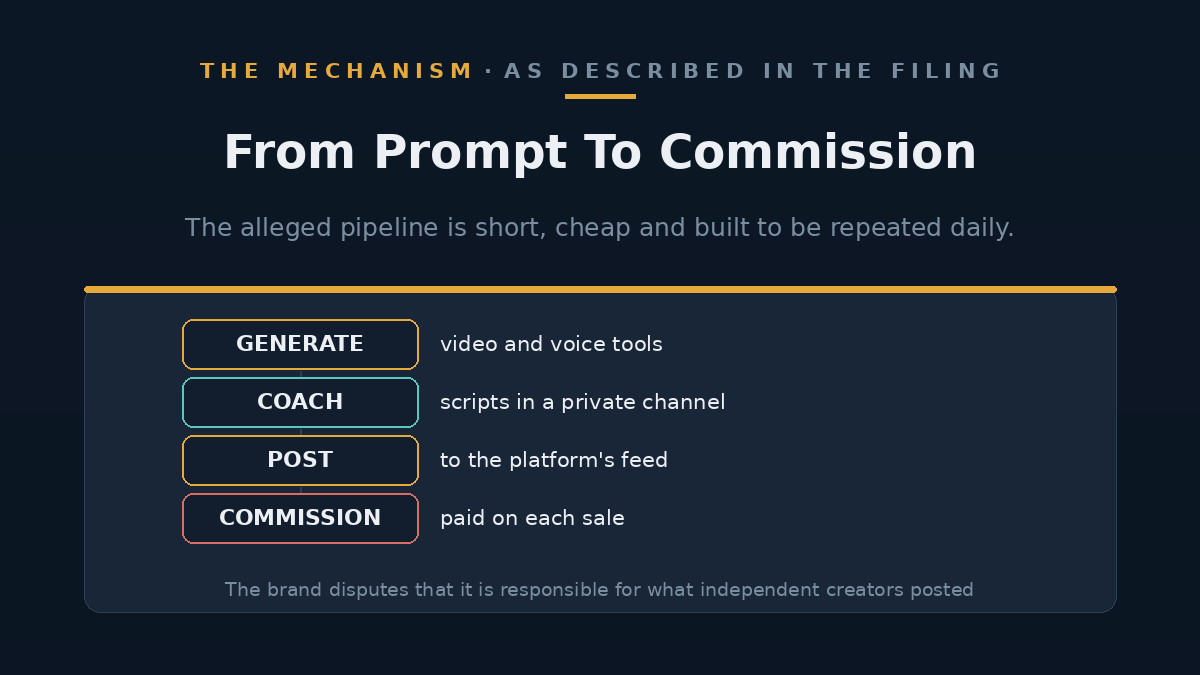
The mechanism alleged behind all of this is the part worth understanding, because it is replicable. According to the complaint, Ambrosia ran a private Discord channel for creators offering a ten-hour course on advertising its products, supplied advertising scripts and messaging guides, paid commission on sales, and retained the ability to demonetise posts that did not follow its guidelines. The complaint's framing is that the brand was "orchestrating a misinformation campaign on TikTok through its network of influencers". Most of this section of the filing is pleaded on information and belief, the standard formula for claims a plaintiff expects to prove in discovery rather than ones it can already evidence.
It names a marketing consultant, Luca Washenko, as organising and coaching that network, and quotes a May 2025 recruitment video in which, according to the filing, he says the company paid out around $400,000 to creators in a single month, with one individual receiving over $300,000. Treat those numbers as promotional rather than audited: they are recruitment claims by an interested party, repeated by an opposing party in litigation. 404 Media reports that Washenko is not simply a coach for hire but Rosabella's founder, describing him telling a creator meetup that he started the brand himself, and says trademark filings list him as a cofounder. On that account the "creator coach" and the brand are not at arm's length at all.
Why the avatars are old, and why they wear lab coats
The most useful material comes not from the lawsuit but from the creators themselves, who have been explaining the method publicly on YouTube. 404 Media's reporting documents a creator walking through the production pipeline: a video generation model for the scene, a separate avatar tool for the presenter, a voice cloning service for the delivery, and ordinary consumer editing software to assemble it. Several of the videos were deleted after 404 Media asked for comment. The outlet also reports that hundreds of further videos promoting the brand sit on TikTok beyond those named in the lawsuit, many of them with hundreds of thousands of views.
The targeting logic was stated openly. Older-looking synthetic presenters were chosen because audiences read age as credibility, and because health products aimed at older buyers convert well. Presenting them on a stage in a conference format was chosen because it reads as expertise. The lab coat does the same job in one frame.
Mallory DeMille, who studies the wellness and supplements industry and reported a podcast episode on this operation, told 404 Media that the people behind these accounts have "proven that they don't care", and care more about money than health. Her broader observation is the sharper one: the scripts are lifted from successful human wellness influencers, fed through generation tools, and re-emitted with different faces attached. The content has no author in any meaningful sense.
The part that is not an allegation
Separately from the lawsuit, and about a different product, the US Food and Drug Administration has a closed outbreak investigation on file involving the same company.
On 13 February 2026, Ambrosia Brands recalled certain lots of Rosabella-brand moringa powder capsules. The FDA's investigation record documents ten illnesses across eight states, with three hospitalisations and no deaths, and onset dates from late September 2025 to early January 2026. An unopened sample collected from a sick person's home tested positive, and whole genome sequencing matched it to one of the outbreak strains. Those strains were resistant to all first-line and alternative antibiotics commonly recommended for treating Salmonella. The FDA could not determine the source of contamination but traced the affected moringa powder to a single supplier. The investigation is closed.
Two things about that record matter here. The first is the sales channels: the FDA lists eBay, TikTok Shop, Amazon, Shein, Etsy and the brand's own website. The second is that the recalled product was distributed internationally, and the FDA's list of destination countries includes the United Kingdom.
To be clear, the recall concerns moringa capsules and the lawsuit concerns beetroot marketing. Nobody has alleged that the AI videos caused the outbreak, and this article does not suggest it. The connection is simpler and more relevant: a brand marketed heavily through synthetic social video was also a brand whose physical product reached households in dozens of countries, and whose safety record only surfaced through a public health investigation rather than through anything a buyer could have seen in the feed.
The regulatory gap
Supplements sit in a permissive corner of consumer regulation on both sides of the Atlantic, and AI marketing has found it.
In the UK, the CAP Code section covering food and food supplements permits only health claims authorised on the official register, and separately rules out health claims that rest on the recommendation of an individual health professional. The Advertising Standards Authority applies the same code to influencer content, and publicly names influencers who keep failing to label their ads. On paper, a synthetic doctor making an unauthorised health claim in a paid post is already a breach several times over. In practice, enforcement runs case by case, and the volume here is the problem: a job listing quoted in 404 Media's reporting sought a video editor able to produce ten AI videos a day to preset scripts.
That is the shape of the challenge. Individual adjudications against individual posts cannot keep pace with an operation designed to generate content faster than anyone can review it. TikTok's AI-generated content label appears on some of the posts described in the complaint, which counts in the platform's favour, and equally did not stop those posts from working.
How to spot this in your own feed
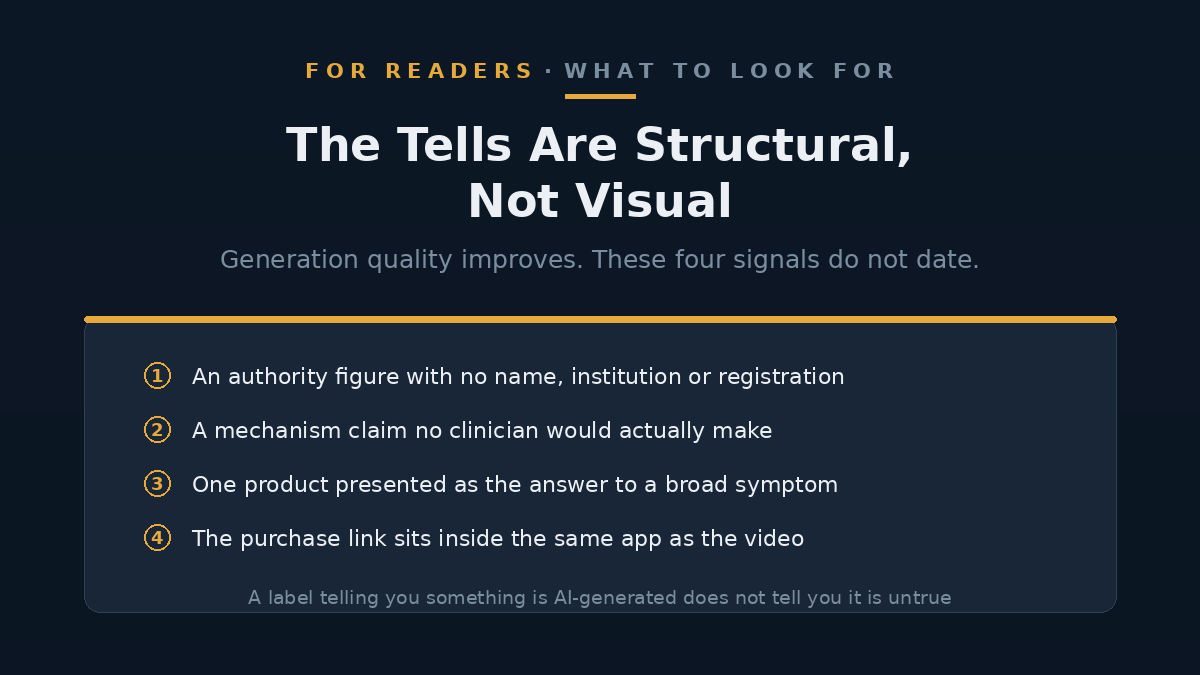
Visual tells are a trap. Generation quality improves every few months, and learning to spot last year's artefacts breeds exactly the wrong kind of confidence. The durable tells are structural.
- An authority figure with no name. Real clinicians making public health claims have names, institutions and registration numbers. A white coat and a stethoscope are set dressing.
- A mechanism claim no doctor would make. Single foods that reverse inflammation, secrets from a named country or culture, one ingredient that explains a symptom you have. Genuine clinical claims are narrower and duller.
- The purchase is inside the app. When the shop link, the video and the commission all live on one platform, the person filming has a direct financial interest in the claim being believed.
- An AI-generated label or a paid partnership tag. These are present more often than people notice, and they are the single fastest check available.
- Any medical claim aimed at your age or your ethnicity. The age targeting was described openly by the creators themselves; the targeting by ethnicity is alleged in the lawsuit and untested. Both work because they feel personal.
Frequently asked questions
Has anything been proven in this case?
No. The complaint is a set of allegations by a competing supplement company. Ambrosia Brands disputes that it is responsible for what independent creators posted. The case is at an early stage.
Is it illegal to use an AI-generated presenter in an advert?
Not in itself. What is regulated is what the advert claims and whether it is clear that it is an advert. Presenting a fictional person as a qualified doctor to lend authority to a health claim is where the legal exposure sits, in the US under false advertising law and in the UK under advertising codes and consumer protection rules.
Was the recalled product sold in the UK?
The FDA's outbreak record lists the United Kingdom among the countries the recalled moringa capsules were distributed to, alongside dozens of others. That recall concerned moringa capsules specifically and is a separate matter from the advertising lawsuit.
Why supplements, rather than any other product?
Because the category combines high margins, permissive regulation of both the product and its marketing, and buyers motivated by health worries. A researcher who has studied the sector told 404 Media the choice was deliberate for exactly those reasons.
Do platform AI labels solve this?
They help and they are not sufficient. Several posts described in the complaint carried AI-generated labels, and 404 Media found videos of this kind running to hundreds of thousands of views. A label tells you how something was made. It does not tell you whether the claim is true.
The takeaway
The interesting thing about this case is not that someone used AI to make adverts. It is that the litigation has forced a documented account of the whole apparatus into public view: the tools, the coaching, the payment structure, the targeting rationale, stated openly by the people doing it.
Whether Humann wins is a narrow question about who is liable for a creator network's claims. The wider question is what happens when producing a plausible medical authority costs almost nothing and enforcement still runs one case at a time. Nothing in this case resolves that, and the practical defence available to a reader today remains an unsatisfying one: treat any health claim delivered by a face you cannot name as marketing, because that is what it is.
Sources
- CourtListener – Human Power of N Company v. Ambrosia Brands LLC, First Amended Complaint, W.D. Tex. No. 1:26-cv-00374 (filed 4 June 2026)
- US Food and Drug Administration – outbreak investigation of extensively drug-resistant Salmonella linked to Rosabella-brand moringa powder capsules (record current as of 1 April 2026)
- US Food and Drug Administration – Ambrosia Brands LLC recall notice for Rosabella moringa capsules (13 February 2026)
- 404 Media – "Inside an AI TikTok Shop Slop Factory That Shills Supplements Recalled By the FDA" (30 July 2026)
- Committee of Advertising Practice – CAP Code section 15, food, food supplements and associated health or nutrition claims
- Advertising Standards Authority – non-compliant social media influencers, on how the CAP Code is applied to influencer advertising