
A University of Edinburgh spin-out, Singular Photonics, has raised an oversubscribed $2.15m (about £1.6m) to build a new kind of image sensor: one that can detect individual particles of light and carry out some processing on the chip itself. The round was led by ACF Investors, with Scottish Enterprise, Wren Capital, Cambridge Angels, Quantum Exponential and the University of Edinburgh's own venture fund taking part. It is a small round by AI standards, but it sits at a part of the field that gets little attention and matters a great deal: the sensors that let machines see well enough to act.
This piece reflects reporting as of August 2026. Funding and commercial figures move quickly, and the company's sales claims below are self-reported.
What the company makes
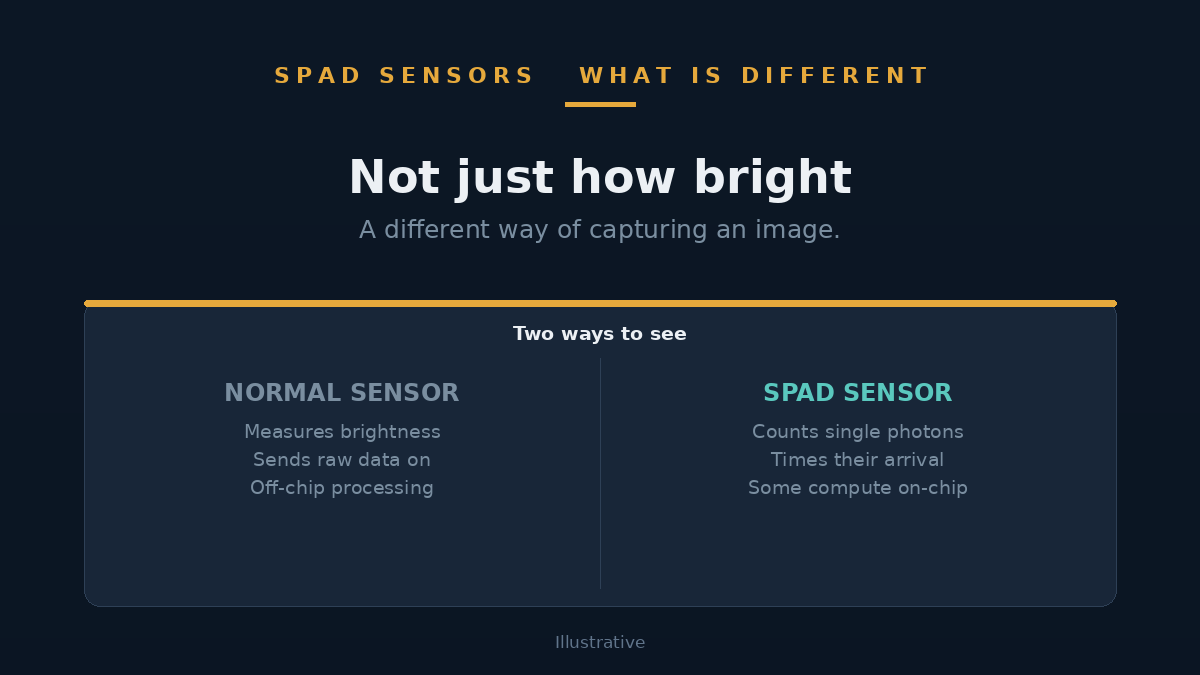
Singular Photonics is a fabless semiconductor company, meaning it designs chips and has them manufactured elsewhere rather than owning a factory. Its speciality is the single photon avalanche diode, or SPAD, sensor. A conventional camera sensor measures how much light lands on it. A SPAD sensor can detect and time single photons, the smallest units of light. That precision lets it capture information ordinary cameras miss, such as very faint signals or the exact distance to an object measured by how long light takes to return.
The company's second claim is that it does computation on the sensor itself, so some analysis happens before the data is shipped off to a separate processor. In machine vision, moving less raw data and doing more work at the point of capture can mean faster, lower-power systems, which is exactly what small robots, drones and industrial cameras need.
Where this fits in "physical AI"
Most AI coverage is about software: chatbots, models, data centres. "Physical AI" is the less-discussed side, where machines act in the real world, and it depends on sensing. A self-driving system, a warehouse robot or an automated inspection line is only as reliable as the data its sensors feed it. Better eyes, quite literally, raise the ceiling on what the software can do. Singular Photonics lists machine vision, industrial automation, scientific instruments and medical imaging as target markets.
The commercial signs it points to are encouraging, with the caveat that they come from the company. Chief executive Shahida Imani said the firm has "doubled our 2025 sales" in 2026 so far and is approaching break-even, and the company has named a collaboration with the British engineering firm Renishaw. It has also added Dipesh Patel, a former chief technology officer of the chip designer Arm, to its board, which is a notable signal of confidence for a company this size.

Why a small round is still worth noting
£1.6m will not trouble the headlines that greet billion-pound AI data-centre deals, and it would be easy to dismiss. That would miss the point. The UK has a real cluster of photonics and semiconductor expertise, much of it around universities, and it competes in specialist sensing rather than trying to out-spend the giants on general-purpose chips. Edinburgh in particular has a long track record in SPAD research. Backing from Scottish Enterprise and the university's venture fund is the kind of patient, regional support that turns academic work into companies. Whether Singular Photonics becomes a significant supplier depends on execution over years, not on this round. But it is a concrete example of the UK building a piece of the AI stack that others will need.
FAQ
What is a SPAD sensor in plain terms?
It is an image sensor sensitive enough to detect a single particle of light and record precisely when it arrived. That makes it useful for seeing in very low light and for measuring distance by timing how long light takes to bounce back, which matters for robotics and 3D imaging.
What does "on-chip computation" mean here?
It means the sensor does some of the data processing itself, rather than sending everything raw to a separate chip. Done well, that can make a vision system faster and more power-efficient, which is valuable in small or battery-powered devices.
Is this a big funding round?
No. At about £1.6m it is an early-stage round, modest even by UK deep-tech standards. Its interest is in what the company is working on and where it sits in the supply chain, not the sum raised.
How is this different from Singular Machines?
They are unrelated companies with similar names. Singular Photonics makes image sensors; Singular Machines, a separate UK spin-out we have covered, works on agentic AI for engineering. The shared word is a coincidence.
The takeaway
Singular Photonics is a reminder that a lot of the AI that will matter in the physical world runs on unglamorous hardware. Sensors that see more, and think a little for themselves, are a genuine bottleneck for robotics and automation, and this is a UK team working on exactly that. The round is small and the strongest commercial claims are the company's own, so the honest read is early promise rather than proof. It is still the kind of quiet, specialist bet that a serious tech economy needs.
Sources
- UKTN – University of Edinburgh spinout Singular Photonics secures £1.6m (19 August 2026)
- EU-Startups – Scotland's Singular Photonics secures €1.85m (August 2026)
- The Scotsman – Edinburgh image sensor start-up gets £1.6m funding boost (August 2026)
- TechFundingNews – Edinburgh spinout Singular Photonics lands $2.15m (August 2026)