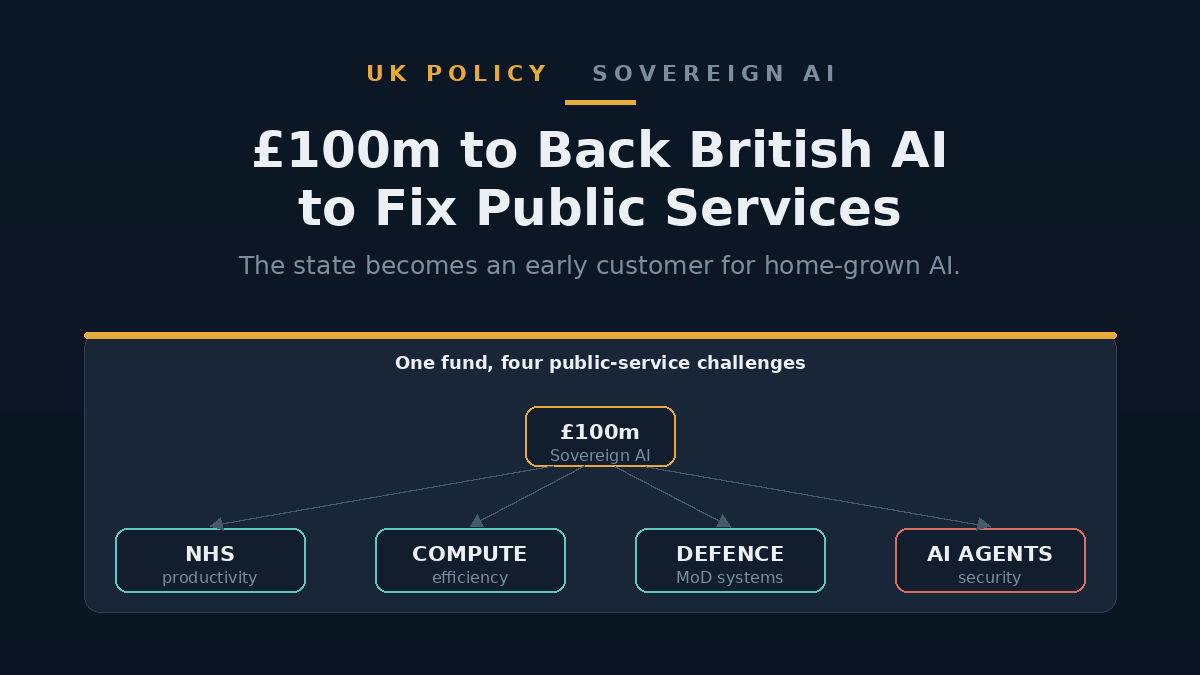
The UK government has opened the first competitions under a new £100 million Sovereign AI R&D Procurement Scheme, which pays British AI companies to build tools for public services rather than simply funding research. Announced by Chancellor John Healey at the G20 finance ministers' meeting in North Carolina on 31 August, the first four challenges cover NHS productivity, AI computing efficiency, defence, and testing the security of AI agents. The idea is that the state becomes an early paying customer for home-grown AI, helping start-ups cross from prototype to a product with a real deployment behind it. It is described as first-of-its-kind, and the delivery model is untested.
This piece reflects the government's announcement and independent reporting as of September 2026. The scheme has only just opened and its details may change as each competition's criteria are published.
What the scheme actually does
Most government AI money so far has gone into grants and research funding. This scheme is different: it is a procurement route, meaning the government commits to buying and testing what firms build. The Treasury frames Sovereign AI as acting like a venture capital fund with the resources of the state behind it, backing companies to "start, scale and succeed" in the UK, in the Chancellor's words.
The focus is deliberately on what officials call demonstrator-stage technology: tools that have moved past early research but need a real customer and environment to prove themselves. Successful firms work with a government department to build something that could then scale across the public sector. Crucially, companies keep the intellectual property they create, so they can turn a pilot into a commercial product sold elsewhere.
The first four competitions
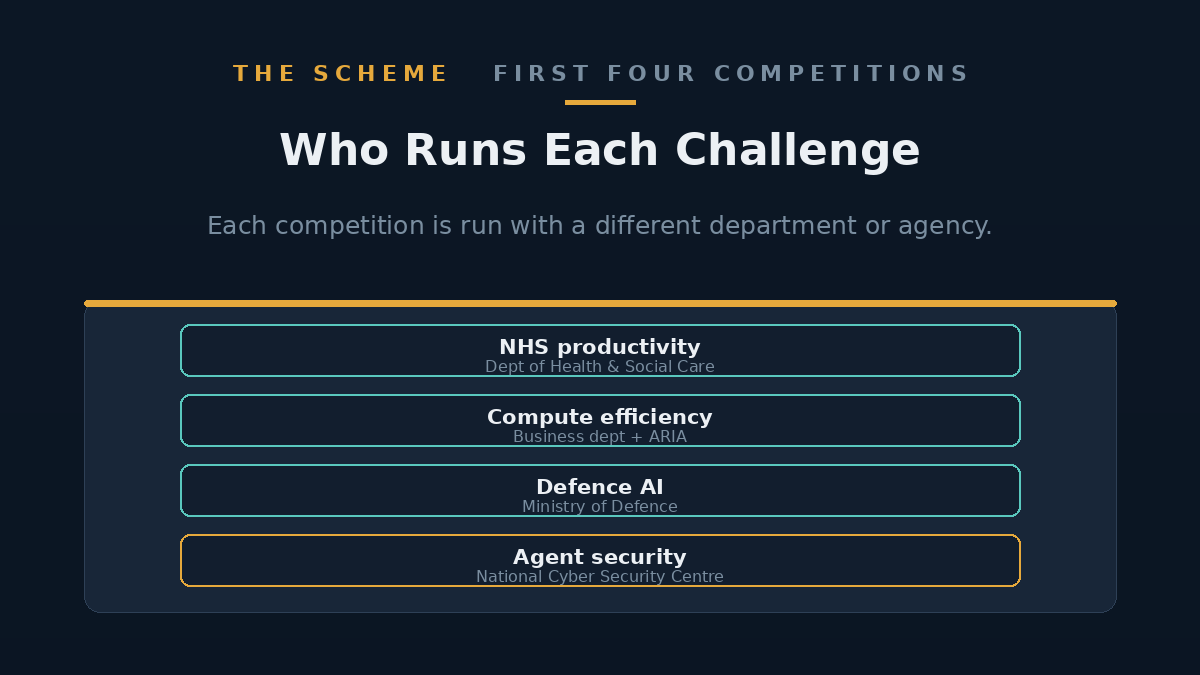
Each of the opening challenges is run with a different part of government:
- NHS productivity, with the Department of Health and Social Care: AI to automate workflows, coordinate care and support decisions across health services, tied to the NHS 10 Year Health Plan.
- Compute efficiency, led by the business department and ARIA's Scaling Inference Lab: technology to make AI computing infrastructure cheaper and more efficient as the UK expands its public compute capacity.
- Defence, with the Ministry of Defence: securely connecting data and frontier AI across defence systems.
- Agent security and resilience testing, with the National Cyber Security Centre: ways to understand and reduce the risks of increasingly capable AI agents, so they can be adopted safely.
That last one is notable. It puts the country's cyber-defence agency behind the problem of AI agents doing things they should not, a risk that has moved up the agenda over the past year amid reported incidents of AI models acting outside their intended limits.
The government has not put a figure on individual contracts or published application deadlines in its announcement. It says only that applications will be assessed by the Sovereign AI team, the participating department and independent technical experts against published competition criteria, so the specifics for each challenge sit in those criteria rather than the headline release.
Why this is aimed at smaller firms
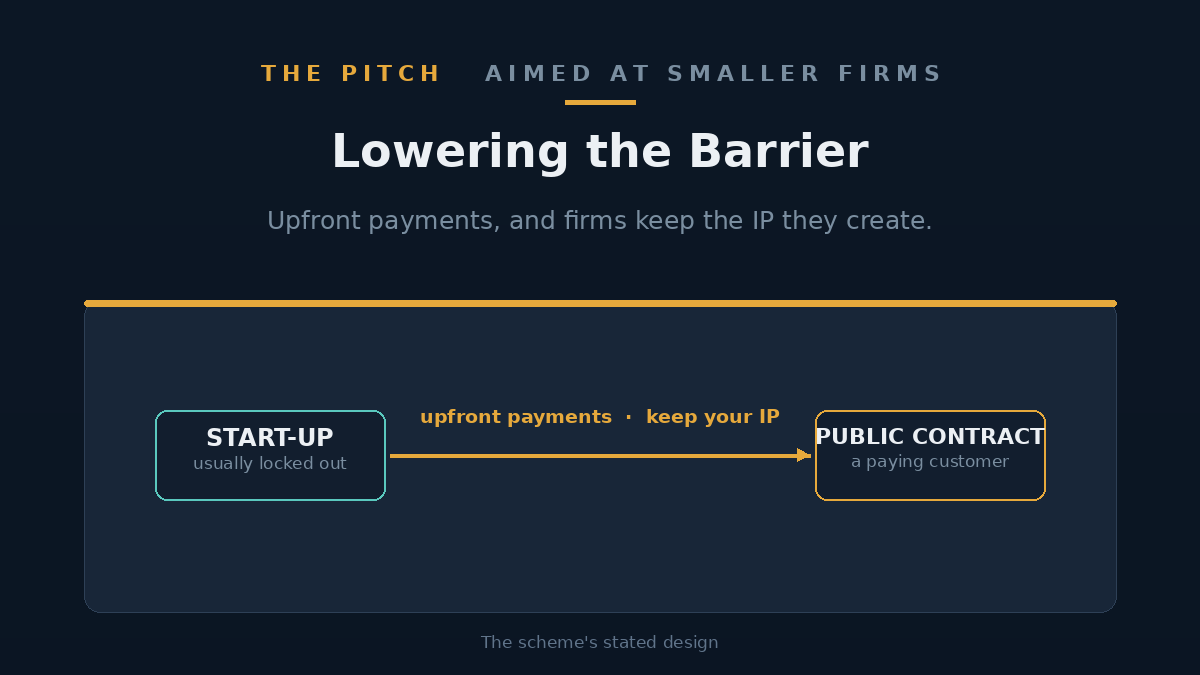
The government's stated pitch is that small companies with good ideas are usually locked out of public contracts because they lack the turnover, cash reserves or track record that tenders demand. The scheme tries to remove those barriers, with upfront payments available "where appropriate" and firms keeping their IP. Whether it works in practice depends on how the buying is actually run, which is the part no press release can settle.
Alongside the competitions, the government pointed to its AI Economics Institute, described as the first government-backed institute of its kind, set up to study AI's economic effects. The Chancellor said the UK now plans to open the Institute to cooperation with other G7 countries on sharing evidence.
The honest caveats
This is an announcement of a mechanism, not a set of results. The competitions have only just opened, the delivery model is explicitly a first test, and the government itself says the initial round is intended to see whether the approach works before it expands. "Demonstrator-stage" means these are pilots, not deployments: nothing here is yet running in a hospital or a defence system.
There is also a tension worth naming. Backing sovereign AI capacity is popular across the political spectrum, but "the state as venture capitalist" has a mixed history, and picking demonstrator projects well is hard. The scheme's success will be judged not on the £100m headline but on whether any of these pilots turn into tools the public sector actually keeps using, and whether the firms behind them grow. Those answers are years away.
FAQ
Who can apply?
The scheme is aimed at UK-based AI start-ups and smaller companies building AI capabilities in the UK. Applications run through competitions tied to each government department, assessed against published criteria by the Sovereign AI team, the participating department and independent experts.
Is this free money or a contract?
It is procurement, not a grant. Firms are paid to build and demonstrate technology for a government customer, with upfront payments available in some cases, and they keep the intellectual property they create.
How much can a firm win?
The government has not published a per-contract figure. The £100 million is the total fund; how much any single firm receives will depend on the competition it enters and the published criteria for that challenge, with upfront payments available in some cases.
What are the four opening challenges?
NHS productivity, AI compute efficiency, integrating AI in defence, and testing the security and resilience of AI agents, run respectively with the health department, the business department and ARIA, the Ministry of Defence, and the National Cyber Security Centre.
The takeaway
For UK AI founders, this is a concrete new route to a paying government customer, with the useful twist that firms keep their IP. For everyone else, it is a signal of where the government wants AI applied: hospitals, defence, the cost of compute, and the safety of AI agents. The design reads well on paper. Whether it delivers depends entirely on execution, and on that the honest answer is that it is too early to say.
Sources
- GOV.UK / HM Treasury — £100 million competition to back British AI companies to fix public services (31 August 2026)
- BusinessCloud — £100m competition backs British AI firms to fix public services (1 September 2026)
- Startups Magazine — £100M competition launched to back UK AI innovators (1 September 2026)
- IT Pro — Government launches AI competition to help UK firms improve public services (1 September 2026)