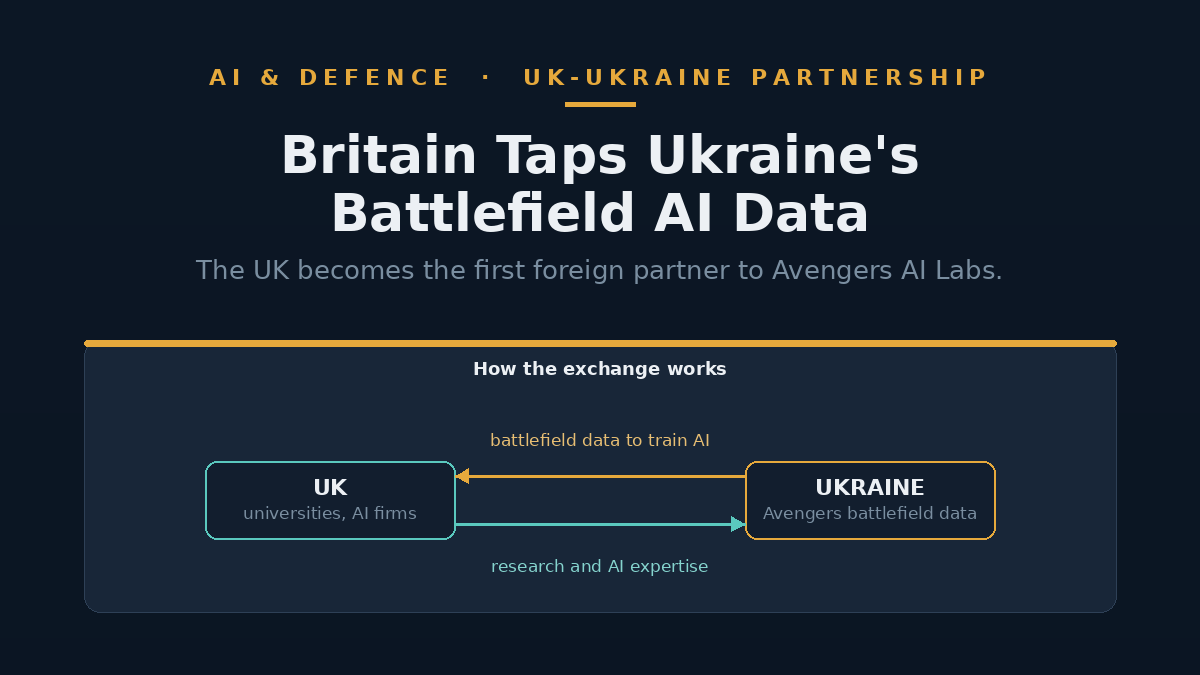
The UK government has signed an agreement making Britain the first foreign partner to access Ukraine's "Avengers" AI Labs database, a store of real-world battlefield data used to train artificial-intelligence models. Announced on 24 August 2026 and signed in Kyiv by President Volodymyr Zelenskyy and Prime Minister Andy Burnham, the deal lets British researchers and companies draw on data collected by thousands of cameras and sensors across the front line. Three UK startups are already running pilot projects. The headline is real, but it is a government announcement rather than a finished capability, and several of the details worth watching are not yet public.
This piece reflects reporting as of August 2026. It rests mainly on the government's own announcement; the governance and oversight terms of the data-sharing had not been independently published at the time of writing.
What Britain is actually getting access to
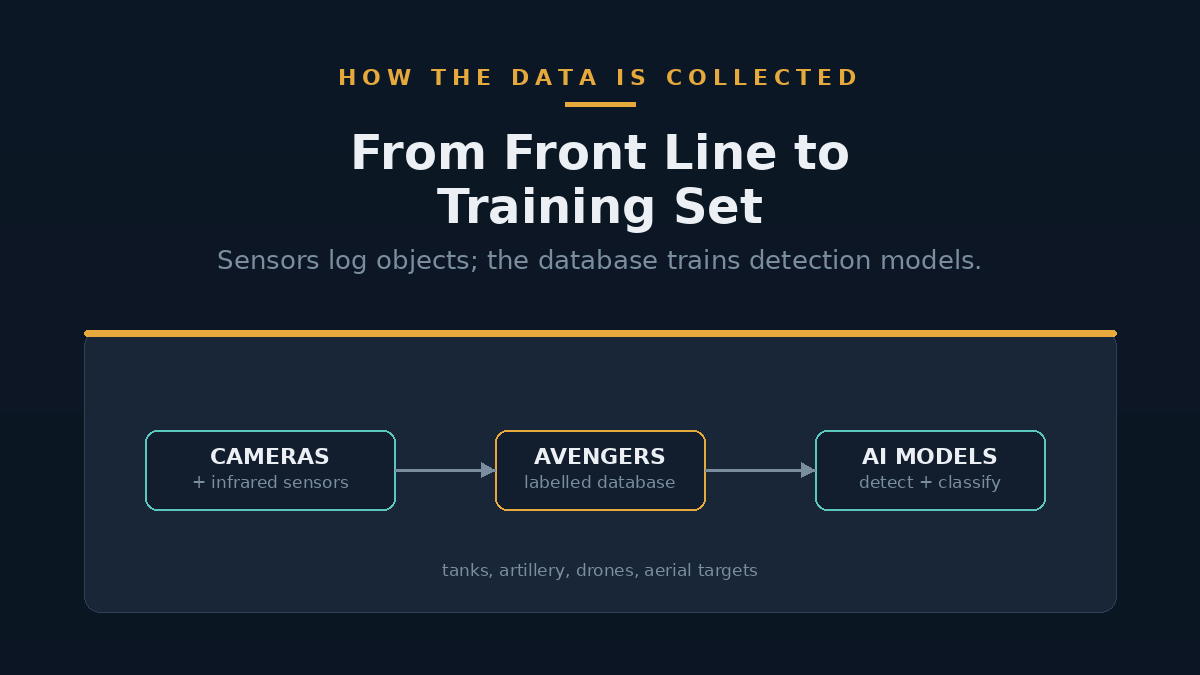
Avengers AI Labs is a Ukrainian platform that turns front-line surveillance into training data. According to the government, thousands of daylight cameras and infrared sensors across the battlefield log millions of objects, from tanks, artillery and air-defence systems to infantry and aerial targets such as Shahed drones and reconnaissance UAVs. That stream of labelled, real-world imagery is what makes it valuable: models that detect and classify objects need vast quantities of examples, and combat footage of this kind is difficult to obtain anywhere else.
The agreement gives UK innovators what the announcement describes as "plug and play" access to that database. In return, Britain says it will back Ukraine with its universities, researchers and technology companies. The deal forms part of the two countries' 100 Year Partnership, and the first focus is defence and national security, run through what the government calls a joint "AI cell" of engineers, academics and military staff from both nations. The government also describes Britain's own AI ecosystem as the third largest in the world, the capability the UK says it will put behind Ukraine in return, though that is a government characterisation rather than an independently verified ranking.
The three UK pilots
Rather than being purely a future promise, the partnership arrives with pilot projects already assigned to three British startups: Mind Foundry of Oxford, Sintela of Bristol and Skyral of London. Two specific projects were named.
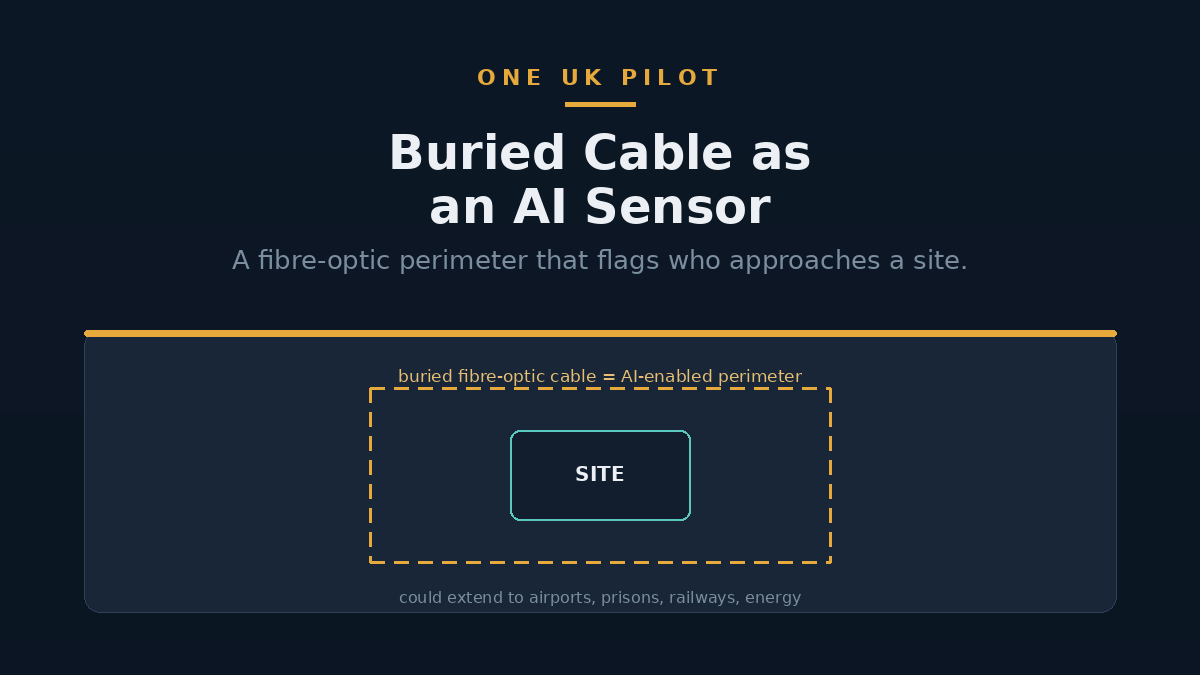
The first turns buried fibre-optic cable into a giant AI-enabled sensor. The stated purpose is to protect UK defence sites from, in the government's words, protestors and hostile actors trying to gather intelligence, and the technology could later extend to airports, prisons, railways and energy plants. That civilian read-across is the part most likely to touch ordinary readers, and it cuts both ways: the same sensing that guards a military base could, in principle, monitor a much wider set of places and people. The announcement frames this as protection; it does not set out what oversight would govern a system that flags who approaches a site.
The second project explores next-generation low-power AI chips to run future drones, robots and other autonomous systems. If it works, the government says, such chips could let intelligent machines operate for longer and respond faster in conditions where conventional hardware struggles. That remains an "if": it is described as an exploration, not a delivered product.
Why the UK is doing this now
The logic is straightforward. Ukraine has years of hard-won operational experience and a flow of live data that no laboratory can simulate. Britain has the research base, the universities and the AI companies. The partnership tries to pair the two: Ukrainian data and battlefield lessons on one side, British engineering and computing on the other. The government also positions it as part of a broader deepening of defence ties, noting it comes alongside a separate decision to let missile-maker MBDA share classified information on UK components for the long-range SCALP missile so it can be assembled in Ukraine.
Prime Minister Burnham said the partnership would combine Ukraine's operational experience with Britain's AI ecosystem to develop the "technologies of the future". Defence Secretary Wes Streeting framed it as standing with Ukraine while strengthening both countries' security, and the Minister for AI, Kanishka Narayan, described it as sovereignty in practice: building domestic capability from front-line experience. Those are the government's framings, and they are worth reading as ambition rather than settled fact.
The questions the announcement leaves open
Three things are worth holding in mind. First, this is training data drawn from an active war, which raises real questions about accuracy, bias and the ethics of building commercial or civilian AI on combat footage. Second, the domestic uses floated in the announcement, from bases to railways to energy plants, would put battlefield-derived sensing into everyday British infrastructure, and the announcement says nothing about the privacy or oversight framework for that. Third, the specifics that determine whether this is transformative or incremental, such as how much data UK firms can actually use and under what terms, have not been published. None of that makes the deal insignificant. It means the honest summary is that Britain has secured access and started pilots, not that a new capability is proven.
FAQ
What is Avengers AI Labs?
It is a Ukrainian platform that collects battlefield sensor and camera data and uses it to train AI models to recognise objects such as vehicles, weapons systems and drones. The UK is now the first foreign partner with access to it.
Which UK companies are involved?
Three startups have pilot projects: Mind Foundry (Oxford), Sintela (Bristol) and Skyral (London). More partners may follow as the "AI cell" develops.
Does this affect civilians in Britain?
Potentially, yes. One pilot turns buried cable into an AI perimeter sensor for defence sites, and the government suggests it could later protect airports, prisons, railways and energy plants. The oversight and privacy terms for any such civilian use have not been set out.
Is the technology working yet?
The data access is real and pilots have started. The named projects are early-stage: the first sensor trial is described as about to be rolled out at a UK defence site, and the low-power-chip work is described as exploratory.
The takeaway
This is a substantive move: rare, real-world data is one of the scarcest inputs in AI, and Britain has just secured a channel to a great deal of it, with three domestic firms already building on it. It is also, for now, an announcement with pilots attached rather than a delivered system, and the parts that matter most for accountability, from data governance to how battlefield-trained sensing might be used at home, are the parts still missing from public view. Worth watching closely, and worth judging on the terms rather than the billing.