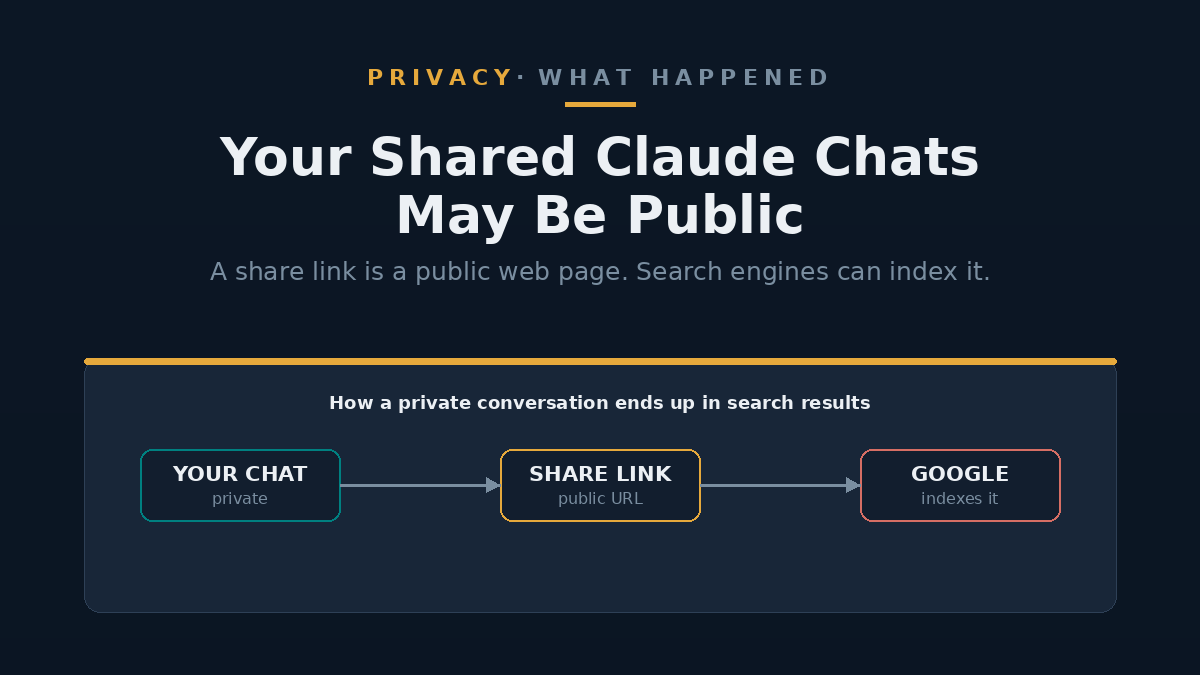
If you have ever used the "share" button on a Claude conversation, it is worth a two-minute check. The independent technology outlet 404 Media reported on 27 July 2026 that Claude users' shared chats and creations have been turning up in Google search results, where strangers can read through them. The exposed material reportedly included meeting notes, a therapy app someone had built with AI, and a dashboard apparently made to analyse medical billing data. This is not a hack. It is the predictable result of a feature working as designed, combined with search engines doing what they always do. The good news is that the fix is entirely in your hands, and it takes seconds.
This piece reflects reporting as of July 2026. Which specific searches surface these links changes quickly as companies mitigate them, but the underlying issue – public share links being indexable – is the durable point.
What actually happened
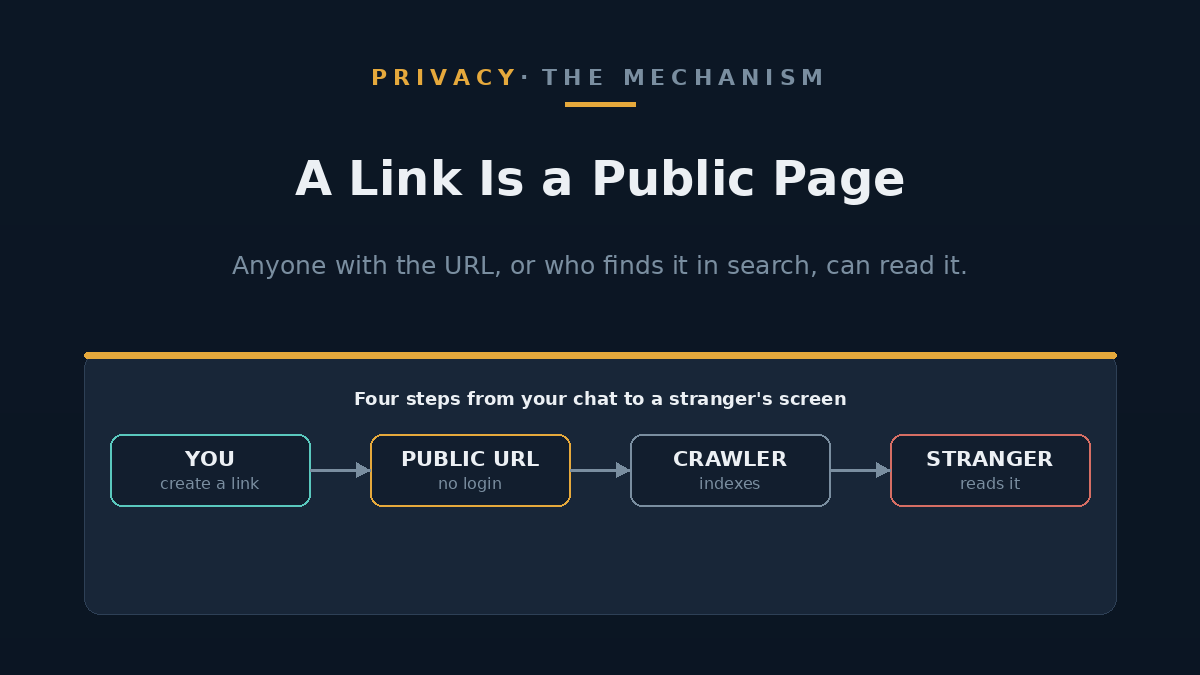
Claude, like most chatbots, lets you turn a conversation into a public link so you can send the full thread to a friend or a colleague. Creating that link publishes the conversation to a web address that does not require a login to view. The problem is that a public web address can be found, and not only by the person you sent it to. Search engines crawl and index public pages, so some of these shared conversations began appearing in ordinary Google results.
404 Media reported that a "Google dork" – a very specific search designed to surface a particular kind of page – had been returning shared Claude chats, according to a post on the Claude subreddit. That post said some of the surfaced chats contained API keys, login credentials, and personal details such as names, addresses and phone numbers. By the time 404 Media tested the same search, it no longer returned results on either Google or DuckDuckGo, suggesting the specific query had been mitigated. A separate search for Claude's Artifacts – the interactive workspaces people use to try out apps they have built – was still returning results when the piece was published. 404 Media also reported, second-hand, that some exposed chats included private cryptocurrency wallet keys and personal details such as addresses. That specific claim is relayed as reported rather than independently confirmed, so it is worth treating cautiously.
Why deleting it later does not fully fix it
The uncomfortable part is that mitigation after the fact is incomplete. This exact pattern hit OpenAI's ChatGPT last year, when 404 Media reported that close to 100,000 conversations were searchable on Google. A researcher was able to scrape those exposed chats, which means that even once a company or a search engine removes the results, copies may already exist elsewhere. And crucially, removing a link from Google's index does not delete the page: if someone has the direct URL, they can still open it. Forbes reported a similar episode with Claude in September 2025, so this is a repeat of a known issue rather than a one-off.
The lesson is not that sharing is broken, but that a share link should be treated as genuinely public. If a conversation contains anything you would not paste into a public forum – a password, a client's data, a private health note, a wallet key – it should not go into a shareable link in the first place.
How to check and lock down your Claude chats
You do not need to wait for Anthropic, which had not responded to 404 Media's request for comment at the time of writing. You can manage this yourself:
- Review what you have shared. In Claude, open your account and look for shared links or sharing history. Any conversation you turned into a link is potentially public.
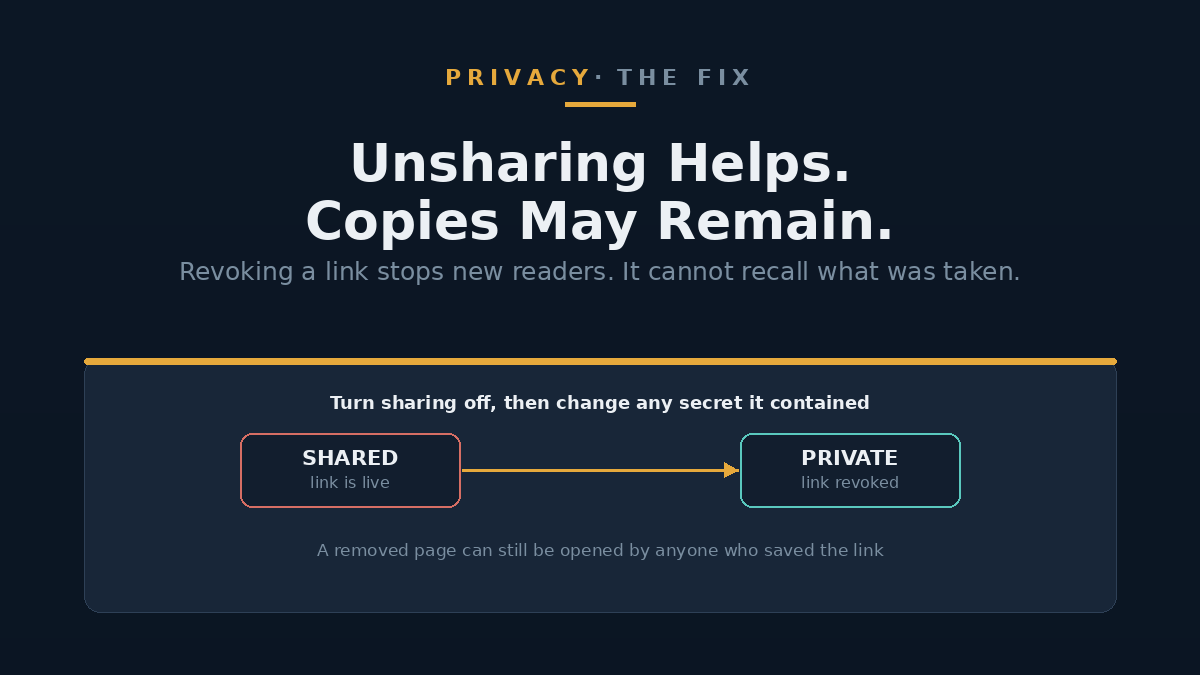
- Unshare anything sensitive. Anthropic's own support guide on sharing and unsharing chats explains how to revoke a public link so the conversation is no longer accessible at that address.
- Assume anything already public may be copied. If a shared chat held a real secret – a password, an API key, a wallet key – rotate or change it rather than relying on unsharing to contain it.
- Share by other means when it is private. For genuinely sensitive threads, copy the relevant text into an email or message to the specific person instead of creating a public link.
FAQ
Does this mean Claude was hacked?
No. There is no evidence of a breach of Anthropic's systems. The conversations that appeared in search were ones users had chosen to turn into public share links, which search engines then indexed like any other public page.
Are my private Claude chats that I never shared at risk?
Based on the reporting, this affects conversations that were made into public share links, not private chats you kept to yourself. If you have never used the share feature, there is nothing here to surface. It is still worth checking your sharing history to be sure.
If I unshare a chat now, am I safe?
Unsharing removes the public link so new people cannot find it, which is the right thing to do. But if a conversation was exposed for a while, someone may already have saved or scraped it, so treat any real secrets it contained as compromised and change them.
Is this only a Claude problem?
No. The same thing happened with ChatGPT and with Claude in 2025. It is a general risk with any chatbot that offers public share links, so the habit of treating a share link as fully public applies everywhere.
The takeaway
This is a useful reminder that "share" and "public" mean the same thing more often than people expect. The exposed Claude conversations were not stolen; they were published by their own users, who reasonably assumed a link they sent to one person would only be seen by that person. If you use Claude or any similar tool for anything approaching sensitive work, spend two minutes reviewing your shared links today, unshare what should not be public, and change any credentials that may have been caught up in it. The tools will keep patching individual searches, but the safe habit is yours to keep.
Sources
- 404 Media – Tons of Peoples' Claude Chats and Creations are Exposed on Google (27 July 2026)
- r/ClaudeAI – community post on shared conversations appearing via search (July 2026)
- 404 Media – Nearly 100,000 ChatGPT Conversations Were Searchable on Google (2025)
- Forbes – Hundreds of Anthropic Chatbot Transcripts Showed Up in Google Search (8 September 2025)
- Anthropic Support – Share and unshare chats