A London company has raised $20m, roughly £15m, to make it cheap enough to stage concerts by performers who are not there, including ones who have died. Unit1 Studio, co-founded by former EMI and Universal Music digital executive Barney Wragg, has taken an oversubscribed equity round led by Balderton Capital plus production financing for shows in development. Its claimed advance is not better-looking avatars. It is that a production can be moved between ordinary venues instead of being welded to one purpose-built arena. Unit1 says it has now done exactly that once, with a showcase rather than a full production. If the trick holds at commercial scale, avatar concerts stop being a spectacle and become a touring format, and a consent problem that UK law barely addresses becomes a routine booking decision.
This piece reflects reporting as of September 2026. Reported round sizes vary between outlets, and the portability claim at the centre of the story has so far been demonstrated on a showcase, not on a full touring production.
What is actually new here
Digital performances by dead artists are not new. Tupac appeared at Coachella in 2012. Roy Orbison and Maria Callas have both toured as projections, staged by Base Hologram. Michael Jackson performed at the Billboard Music Awards in 2014, five years after his death. These were one-off stunts or bespoke tours, engineered around a single headline act and priced accordingly.
ABBA Voyage is the exception that proves the point. It has been a genuine commercial success, passing four million visitors in April 2026 after launching in 2022. But it was also extraordinarily expensive. UK trade coverage routinely calls it a £140m show, while the New York Times put the budget nearer $175m; neither figure comes from a public filing, and ABBA Voyage has not published one. It also lives in a custom-built arena in east London. It is not a tour. It is a building.
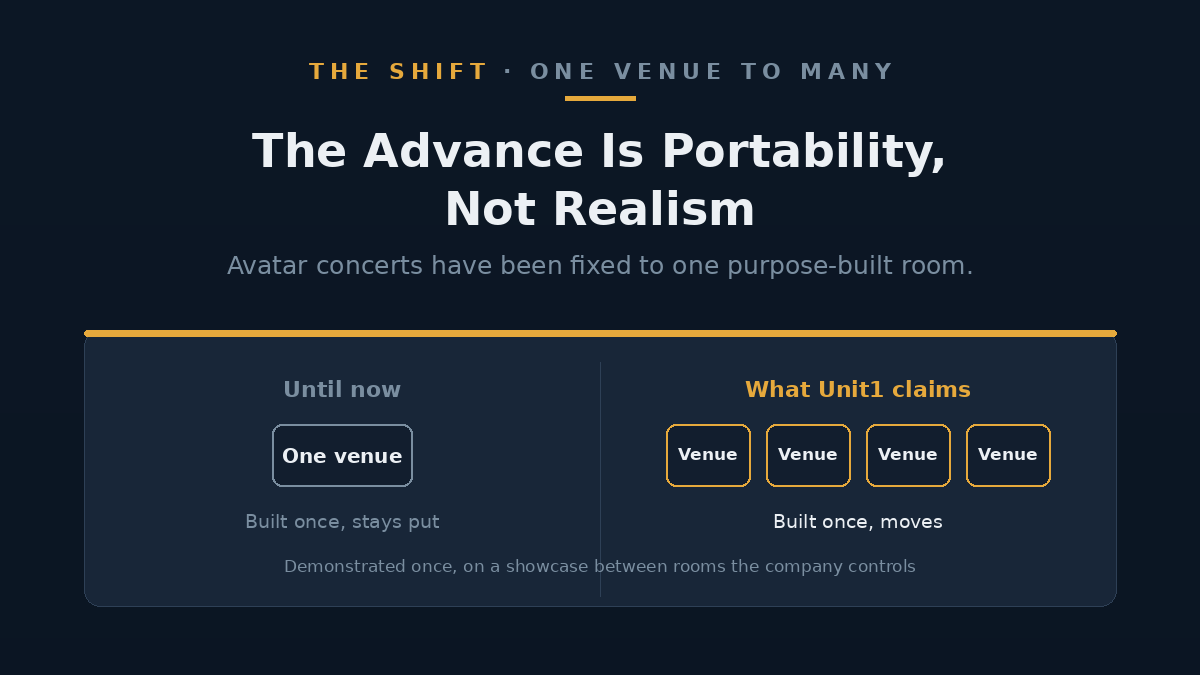
Unit1's pitch is the opposite: strip the setup cost far enough that the same production can run in a normal concert hall, then another one, then another. Balderton's general partner framed the existing economics as the constraint, saying avatar concerts had been "locked behind the economics of ABBA Voyage". That is the whole bet, and Unit1 has now put a first data point under it. It says it has moved its KT Tunstall avatar showcase out of a west London demonstration space into a purpose-built studio at Tileyard London, a transfer it says took four days. That is a showcase moving between two rooms the company controls, not a ticketed production touring commercially, and no Unit1 tour dates have been announced.
The money, accurately
Round sizes reported in the trade press differ, and it is worth being precise rather than picking the biggest number. Balderton, as lead investor, says in its own announcement that Unit1 has secured a further $20m, and Music Business Worldwide independently reports the figure as USD $20m. Music Week and Tech.eu rendered the sum as £20m; Digital Music News reported $26.7m and one aggregator €23.3m. Those larger numbers are what you get by treating the total as £20m and converting it, which looks like a currency slip rather than a different view of what was counted.
One thing nobody has published is the split. The $20m covers both the equity round and the production financing for shows in development, and Unit1 has not broken out how much is which. Anyone modelling this as a conventional venture round should hold that loosely.
The investor matters as much as the number. Balderton is a generalist London venture firm rather than a specialist entertainment backer, though it is not new to the sector: it first backed Kobalt Music Group in 2008 and led a seed round in music startup Mozart AI in February 2026. Daniel Waterhouse, the general partner on the deal, joined Balderton in 2013, and his Balderton biography credits him with work on Wellington Partners' investment in Spotify before that. Existing backers Mercuri, Gilston Music and long-time U2 manager Paul McGuinness joined the round. The signal is not that money has discovered the category. It is that people who have priced music assets for years think repeatable avatar touring is a business rather than a novelty.
Where UK law leaves this
Here is the part that should give readers pause, and it is specifically a UK problem.
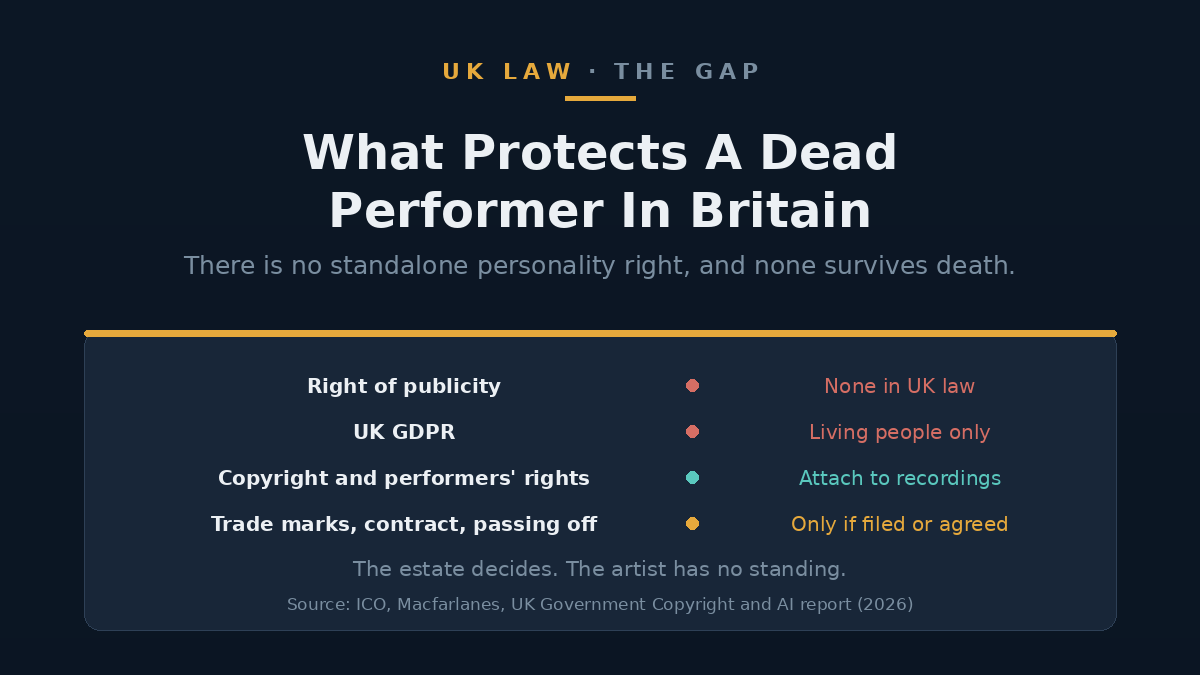
Britain has no general right of publicity, and certainly no post-mortem one. As the law firm Macfarlanes put it in August 2026, English law does not recognise standalone personality rights: there is no freestanding entitlement to control the commercial use of your own face, voice or performing identity in the way US states such as California provide. Data-protection law does not help either. The Information Commissioner's Office is explicit that UK GDPR applies only to living individuals and that information about a deceased person is not personal data, so it stops protecting a performer at the moment they die. What remains is a patchwork built for other jobs: copyright in the underlying compositions and recordings, performers' rights in the captured performances, trade mark registrations where an estate has bothered to file them, contract terms, and the tort of passing off, which requires goodwill, misrepresentation and damage and was designed for misleading endorsement rather than digital performance.
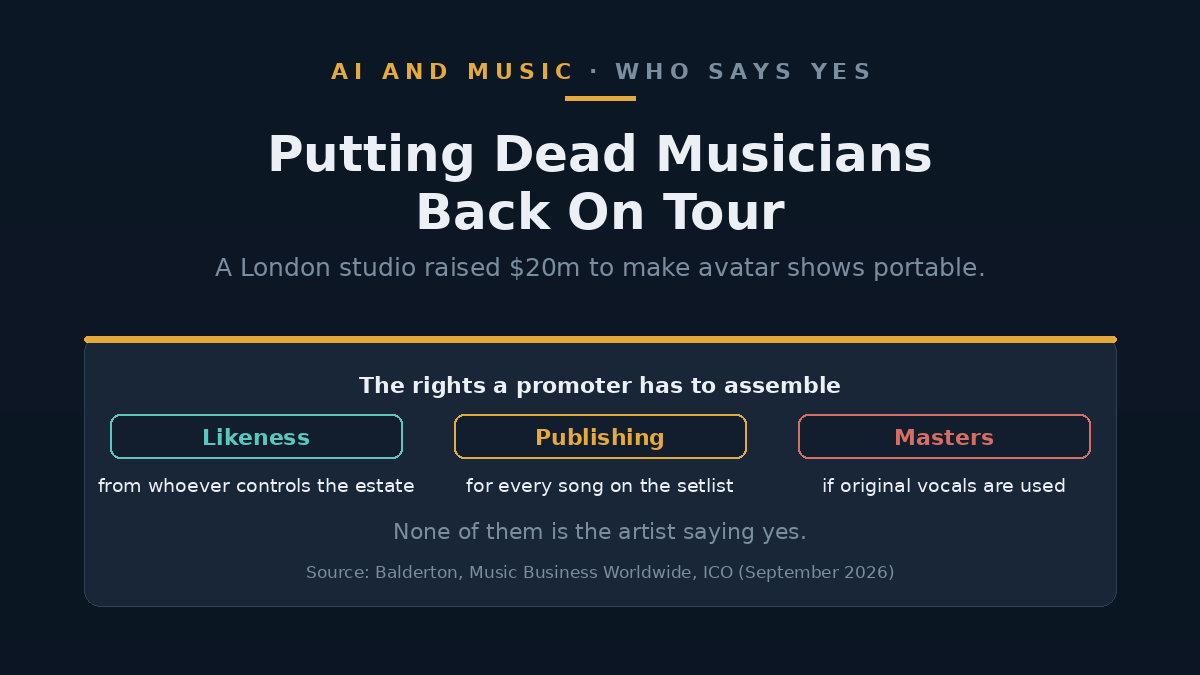
The practical consequence is that clearing an avatar show in the UK is an exercise in assembling rights that were designed for other purposes. A promoter needs likeness permission from whoever controls the estate, publishing clearances for every song, and separate permissions if original master vocals or archival footage are used. Each of those is obtainable. None of them is the artist saying yes.
Estate approval is not consent
This is the distinction that gets collapsed in coverage, and it should not be. An estate can lawfully license a likeness. It cannot tell you what the person would have wanted. A performer who refused certain venues, declined certain sponsors, or retired a song in their lifetime has no mechanism to bind anyone after death.
Parliament has at least noticed the hole. The House of Lords Communications and Digital Committee recommended new statutory protection against unauthorised digital replicas in a report published in March 2026, and the government's own report on copyright and artificial intelligence, published on 18 March 2026, accepted that existing tools may not cover digital replicas of a person's voice and likeness and committed to exploring further protection, potentially a new personality or digital replica right. A dedicated consultation was trailed for summer 2026. None of it is law yet, and none of the options published so far is specifically about the dead.
So the honest summary is that whether a given avatar concert is acceptable is currently settled by heirs, lawyers and promoters, with no legal role for the artist's own expressed wishes unless they happened to write them into a contract while alive.
Why this is arriving now
Two separate curves have crossed. Photorealistic avatars and motion-capture pipelines that used to require film-studio budgets are now within reach of a venture-funded startup, and audience appetite has been demonstrated commercially rather than assumed. Once both are true, the constraint stops being technical and becomes contractual.
That is a familiar pattern in AI generally, and it is the reason this story is worth a non-technical reader's attention. The interesting questions in AI music have moved on from whether the output is convincing. They are now about who authorised it, who is paid, and who can object. The same shift is visible in the platform work on detecting AI versions of a person's face and voice and in the litigation between record labels and AI music generators.
FAQ
Is an avatar concert the same as AI-generated music?
No, and conflating them muddles the issue. An avatar concert typically uses real recordings and a digitally rendered performer. AI-generated music creates the audio itself. The rights questions overlap but the products are different.
Does the artist's family have to agree?
In the UK, whoever controls the estate effectively holds the practical veto, because they control the recordings, trade marks and any contractual rights. That is different from a legal right to control the likeness itself, which UK law does not provide after death.
Could an artist prevent this while alive?
Partly, by writing explicit terms into recording and management contracts and by lodging trade mark registrations, though lawyers are blunt that trade mark law protects marks rather than identity. There is no simple legal instrument for it, which is precisely the gap the government has now said it will consult on.
Has Unit1 announced any shows?
Not a ticketed one. The company has an avatar showcase built around KT Tunstall, unveiled when it launched in October 2025, and says it has a roster of concerts in development funded partly by this round. No tour dates, venues or further artists have been announced.
The takeaway
The technology story here is modest: someone has worked out how to move a production between venues without rebuilding it, and has shown it once at showcase scale. The consequence is not modest. Cheap, repeatable avatar touring turns a question that has been debated at conference panels into a booking decision that London promoters will make routinely, under a legal framework that offers a dead performer no standing at all. Whether you find that unsettling probably depends on the artist. Whether UK law has anything useful to say about it does not.
Sources
- Balderton Capital, announcement of Unit1 Studio's $20m investment and venue-transfer breakthrough (21 September 2026)
- Music Business Worldwide, report on the round, its structure and the KT Tunstall showcase transfer (22 September 2026)
- TheTicketingBusiness News, report on Unit1 Studio's investment and portability claim (21 September 2026)
- Digital Music News, report on the funding round at a higher figure (21 September 2026)
- TechRound, analysis of avatar concerts and post-mortem likeness rights (22 September 2026)
- NME, ABBA Voyage passing four million visitors (April 2026)
- Information Commissioner's Office, guidance confirming UK GDPR does not apply to deceased individuals
- Macfarlanes, analysis of the UK's legal gap on digital replicas and personality rights (6 August 2026)
- UK Government, Report on Copyright and Artificial Intelligence (18 March 2026)
- AIToolBible, TikTok's tool for finding AI versions of a creator's face and voice (2026)
- AIToolBible, Sony's second lawsuit against Udio over training data (2026)