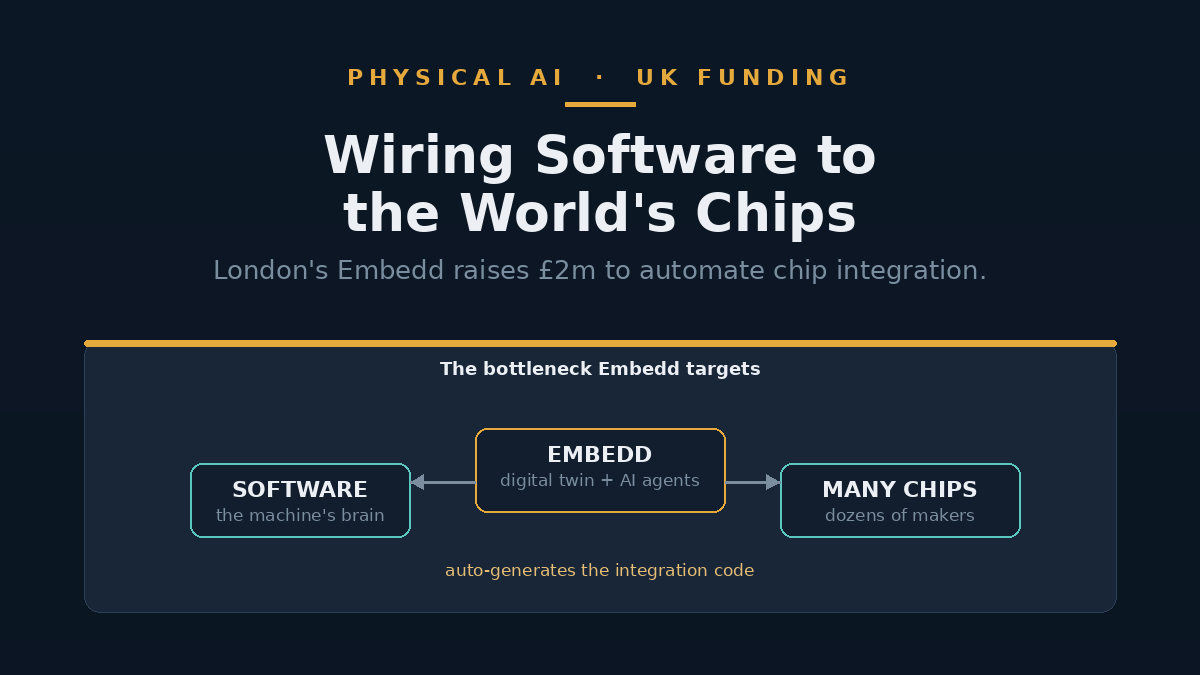
London deep-tech startup Embedd has raised £2m (about $2.7m) in pre-seed funding to automate one of the least visible but most stubborn problems in robotics and "physical AI": getting software to communicate with the many different chips inside a machine. The round was led by early-stage investor Seedcamp. Founded by three Ukrainian engineers, Embedd builds a "digital twin" of a chip and uses AI agents to generate the integration code that engineers would otherwise write by hand. It is a small raise for an unglamorous problem, but it is a genuine bottleneck, and the company already has paying semiconductor customers. The headline claim of being six times faster, though, is the company's own.
This piece reflects reporting as of August 2026. Funding figures and performance claims come from the company and its investors; where a number is self-reported it is flagged as such.
What "physical AI" means, and where it gets stuck
"Physical AI" is the industry's term for AI that acts in the real world rather than on a screen: robots, autonomous vehicles, drones, medical devices, factory machines. Every one of these runs on a stack of computer chips, often from a dozen different manufacturers, and, as Embedd's backers put it, none of those chips naturally speak the same language. Before a machine can do anything clever, its software has to be wired to each chip reliably, and that wiring is done by engineers reading long technical manuals and writing custom "integration" code for every component, by hand.
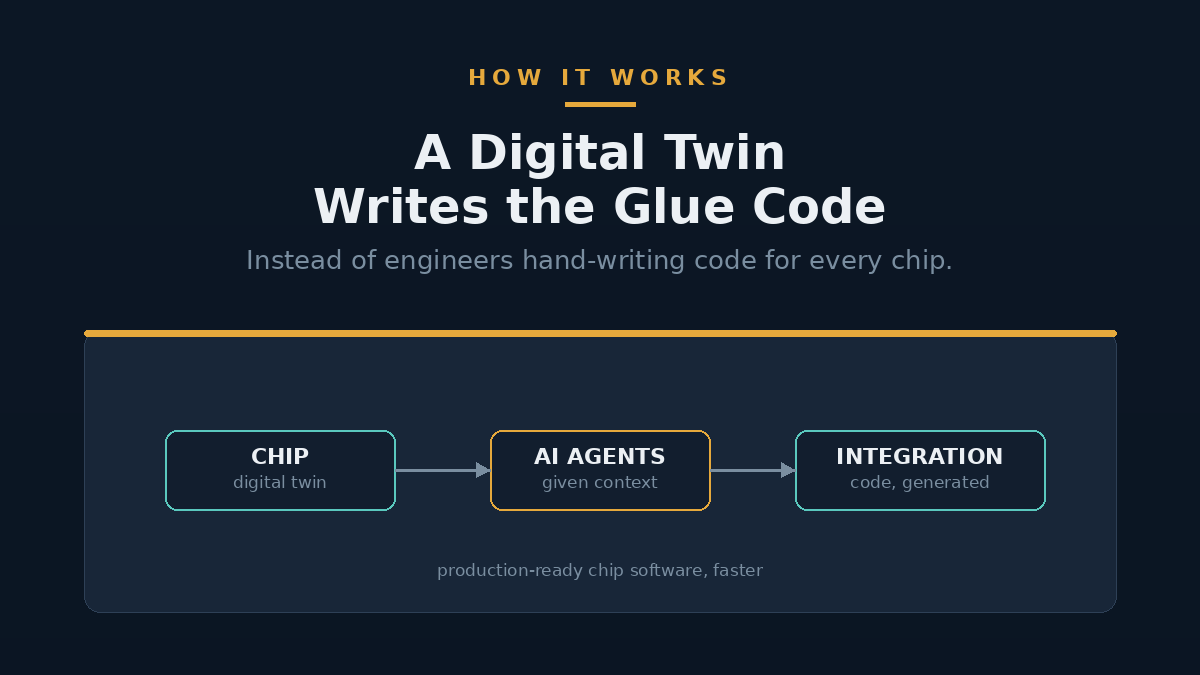
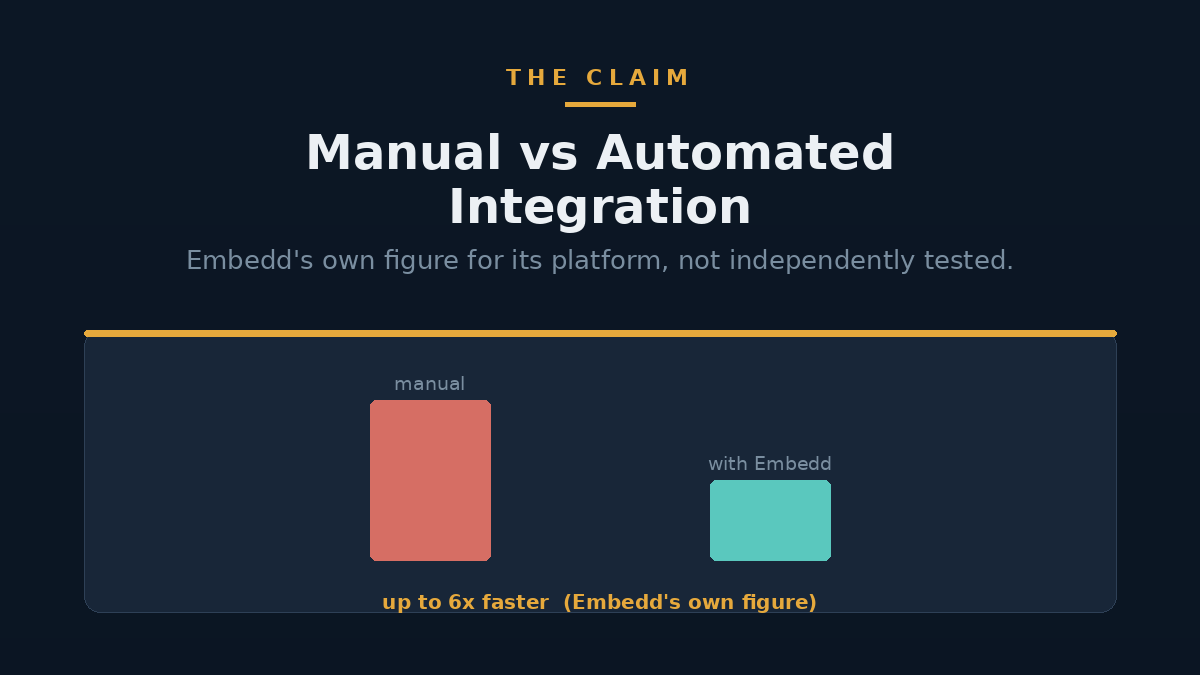
That is slow, repetitive work, and it has to be redone every time a chip changes. Embedd's pitch is that this is exactly the kind of task worth automating. Its platform creates a digital twin of the hardware, gives its AI agents the context they need, and generates the connecting code, so that engineers spend less time on plumbing and more on the product. The company says this lets manufacturers ship production-ready chip software up to six times faster, a figure that is self-reported and not independently tested.
Founded on a problem the team lived
Embedd's origin story is unusually concrete. Its founders, Michael Lazarenko, Maxim Gorinov and Valentin Gololobov, were running a hardware company when Covid-era shortages forced them to buy whatever chips they could find and rewrite their software from scratch each time. Russia's invasion of Ukraine disrupted their supply chain again. Each new component meant weeks of manual integration, and that repetition convinced them the problem would only grow as AI moved into physical devices. The company is based in London and, according to BusinessCloud, launched commercially in April 2026.
It is not just a slide deck. Embedd says it has signed contracts with several semiconductor companies, including Microchip Technology, where it is enabling support for Zephyr, a widely used open-source operating system for small connected devices. Having a named, established chipmaker as a customer is the detail that separates this from a pure concept raise: someone in the industry is paying for the thing.
What the raise proves, and what it does not
A £2m pre-seed round led by a respected investor, with paying customers and a clear problem, is a healthy early signal. Seedcamp, the lead backer, frames the bet as being about the infrastructure under the next wave of intelligent machines, and one of the world's larger economies has been pushing hard on exactly this "physical AI" theme. BusinessCloud cites a figure of nearly $19bn invested in robotics and physical AI so far this year, which gives a sense of the money flowing in, though that number is quoted without a clear primary source and is best treated as an indicator rather than a precise fact.
The honest caveats are the usual ones for a pre-seed. The round is small, the company is young, and the marquee performance claim (six times faster) rests on the company's own account. What makes Embedd worth noting anyway is that it is attacking a real, boring, expensive bottleneck rather than chasing a flashier headline, and that it has commercial traction to point to. For a UK reader, it is also a reminder that a good chunk of the country's AI strength sits in this kind of deep-tech infrastructure, not only in chatbots.
FAQ
What does Embedd actually sell?
Software that automates "chip integration": the code that lets a machine's software work with each of its chips. It builds a digital model of the hardware and uses AI agents to generate that connecting code.
Who backed the round?
Seedcamp led the £2m pre-seed. Co-investors named by the company include Cocoa, Connect Ventures, 2100 Ventures, Vesna Capital, U.ventures, Underline Ventures, Common Magic and Roosh Ventures.
Is it a UK company?
Yes. Embedd is based in London, though its three founders are Ukrainian engineers who started the company after their previous hardware business was hit by chip shortages and the war.
Is the "six times faster" claim verified?
No. It is the company's own figure for its platform. It is plausible for automation of highly repetitive integration work, but it has not been independently tested, so treat it as a vendor claim.
The takeaway
Embedd is a small raise aimed at a real problem: the fiddly, manual work of connecting software to hardware that quietly slows down every robot and smart device. Paying customers and a named chipmaker partner make it more than a concept, and the founders clearly understand the pain first-hand. The performance numbers are the company's own and unproven, and £2m buys ambition rather than a finished platform. But as a signal of where useful UK AI work is happening, away from the headlines, it is a good one.