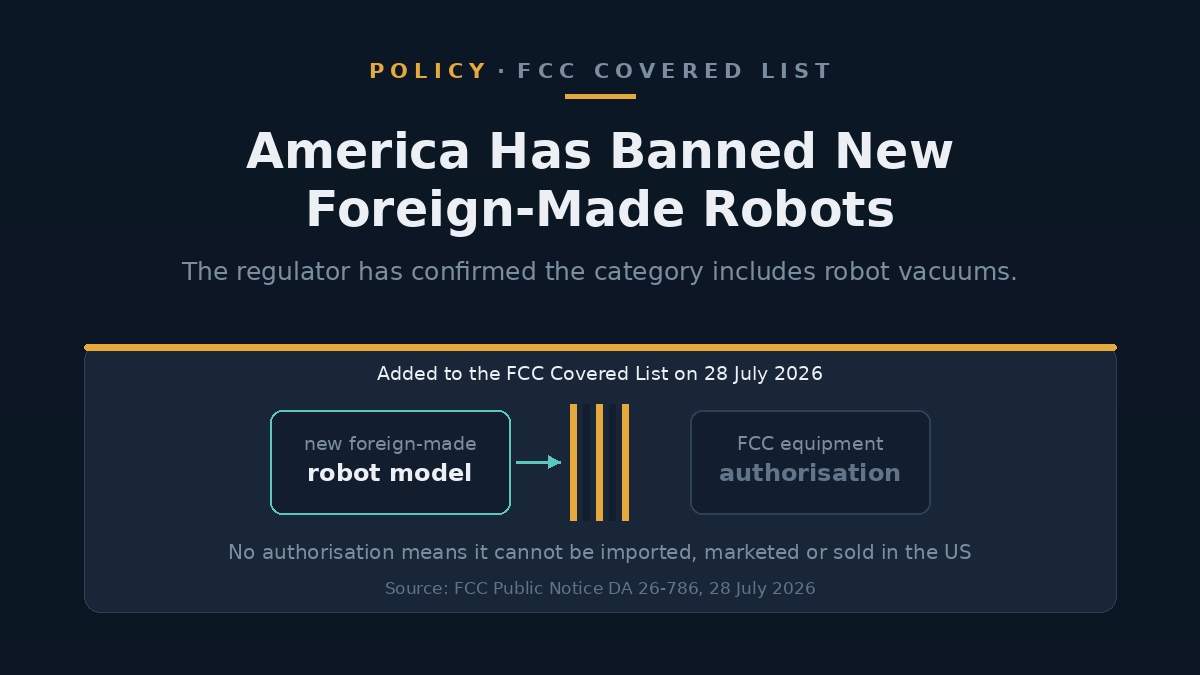
On 28 July 2026 the US telecoms regulator added "foreign-produced advanced robotic devices" to its Covered List, the register of equipment that cannot receive the approval most electronics need before they can be imported, advertised or sold in the United States. The FCC's own summary defines the category as mobile robots such as humanoids and quadrupeds, and the coverage has followed that framing. The regulator has since confirmed to reporters that it also catches robot vacuums. The rule applies by place of manufacture rather than by company, bites only on new models seeking approval, and leaves everything already authorised or already bought alone.
This piece reflects the position as of 30 July 2026. The FCC's own announcement gives only a one-line description of the category. The operative definition, including the weight and connectivity thresholds that decide whether a given machine is caught, sits in the National Security Determination behind it, and is set out below.
What the FCC actually did
The mechanism is the Secure and Trusted Communications Networks Act of 2019. It gives the FCC a list of equipment deemed to pose an unacceptable risk to US national security, and it is worth being clear about who decides what goes on it. The Commission cannot add to the list on its own initiative. It is required to implement determinations made by national security agencies.
In this case, a White House-convened interagency body sent the FCC two determinations on 27 July. One covered power inverters, the devices that connect solar panels and batteries to the grid. The other covered advanced robotic devices. The Public Safety and Homeland Security Bureau published both the following day in Public Notice DA 26-786.
The wording added to the list is short: foreign-produced advanced robotic devices, except those granted a Conditional Approval by the Department of War. The determination's stated reasoning is that networked robots create attack routes that can manipulate both their data and their physical operation, and that they collect data which could be used to surveil Americans and, in the determination's own words, "enhance the capabilities of foreign intelligence services, or to remotely commandeer the robots".
FCC Chairman Brendan Carr framed the move as supply-chain security, saying the Commission is "acting in lock step with our national security agencies".
Two details in the notice matter more than the rhetoric. First, the FCC states explicitly that this equipment is identified by place of production, not by entity. This is not a list of banned Chinese companies in the way the Huawei and ZTE entries from 2021 were. A robot made in Japan, Germany or South Korea is inside the category on the same terms as one made in Shenzhen. Second, there is an exit: manufacturers can apply to the Department of War for a Conditional Approval that would exempt a device or a class of devices, with applications going to the FCC.
What it does not do
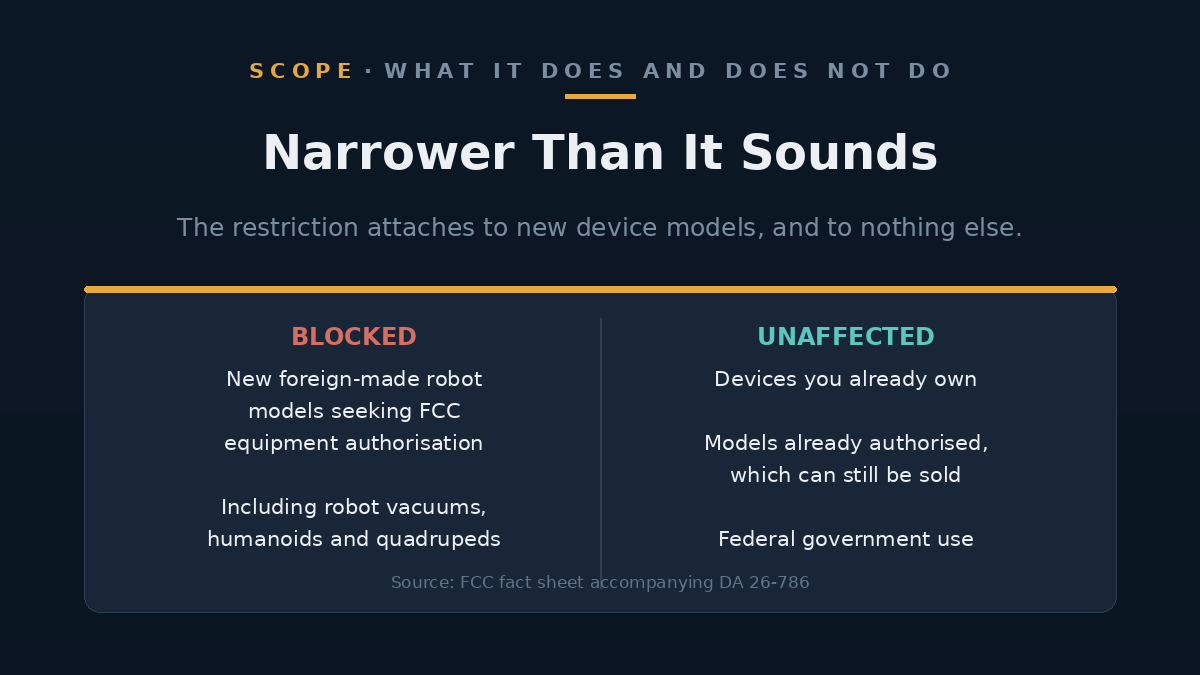
The FCC's fact sheet is unusually careful about scope, and the limits are real:
- Your existing device is fine. The action does not affect anything previously purchased.
- Existing models can still be sold. Retailers can continue to import, market and sell models that already hold an FCC authorisation. The restriction attaches to new device models.
- The federal government is exempt. The action does not affect purchase or use by federal agencies at all.
- There is an appeal route. Conditional Approval from the Department of War restores eligibility.
So the practical effect is not that robots disappear from American shops. It is that the pipeline of new models stops, unless a manufacturer secures an exemption. In a product category where refresh cycles tend to run to about a year, that is a slow puncture rather than a blowout, which is arguably a more difficult thing for a business to plan around.
The robot vacuum problem
The reason this reached the consumer press at all is that the category is broader than humanoids. 9to5Google reported that the FCC confirmed robot vacuums fall within the definition. A modern robot vacuum moves autonomously, carries LiDAR and often a camera, connects to an app, and builds a map of the inside of your home. On the determination's own logic that is precisely the profile being described.
The market consequence is straightforward, because almost nobody makes these devices in the United States. Roborock, Ecovacs, Narwal, Dreame and their competitors are overwhelmingly based in China. "Foreign-produced" is not defined loosely either. It means anything that would fail the Buy American test for a domestic end product, which requires both that the article is manufactured in the United States and that the cost of its US-made components exceeds 65 per cent of the cost of all its components for goods delivered between 2024 and 2028, rising to 75 per cent from 2029. That is a bar essentially nobody in this category clears.
The determination also sets out what is not caught, and those exclusions are broad: connected vehicles of any weight, anything that runs only on a rail line, uncrewed aircraft and uncrewed underwater vehicles, items regulated as medical devices under the Federal Food, Drug and Cosmetic Act including surgical instruments and mobility aids such as wheelchairs, and fixed, non-mobile robot arms built for industrial or medical use. A robot vacuum falls outside every one of those carve-outs.
The boundary itself is more specific than the headlines suggest. An advanced robotic device is a mechanical mobile device that can move across the ground, that operates at a distance from a human operator on commands or sensor data, that weighs more than 4.4lb (about 2kg) including any ground or docking station, and that carries all three of a sensor able to perceive its surroundings, a network connection of at least 200kbps, and software controlling its navigation, data collection or remote command. A robot vacuum and its dock clear every one of those tests, as do a great many warehouse and delivery machines. One housekeeping point: the determinations bound into the public notice are scanned images, so the searchable copies are the ones the FCC has posted separately alongside its FAQ.
Does any of this reach the UK?
Not directly, and it is worth resisting the temptation to pretend otherwise. This is a US equipment authorisation rule. It has no effect on what can be sold in Britain, no effect on the robot vacuum in your kitchen, and no counterpart currently proposed by Ofcom or the Department for Science, Innovation and Technology.
The indirect effects are the ones to watch, and they are genuine:
- Product roadmaps are global. Manufacturers design for their largest markets. If a flagship model cannot launch in the US, the economics of developing it change, and that shows up eventually in what reaches the UK and at what price.
- Divergence in model line-ups. The most likely near-term outcome is that the newest hardware appears in Europe and Asia while the US market runs on older approved models. That is an unusual reversal.
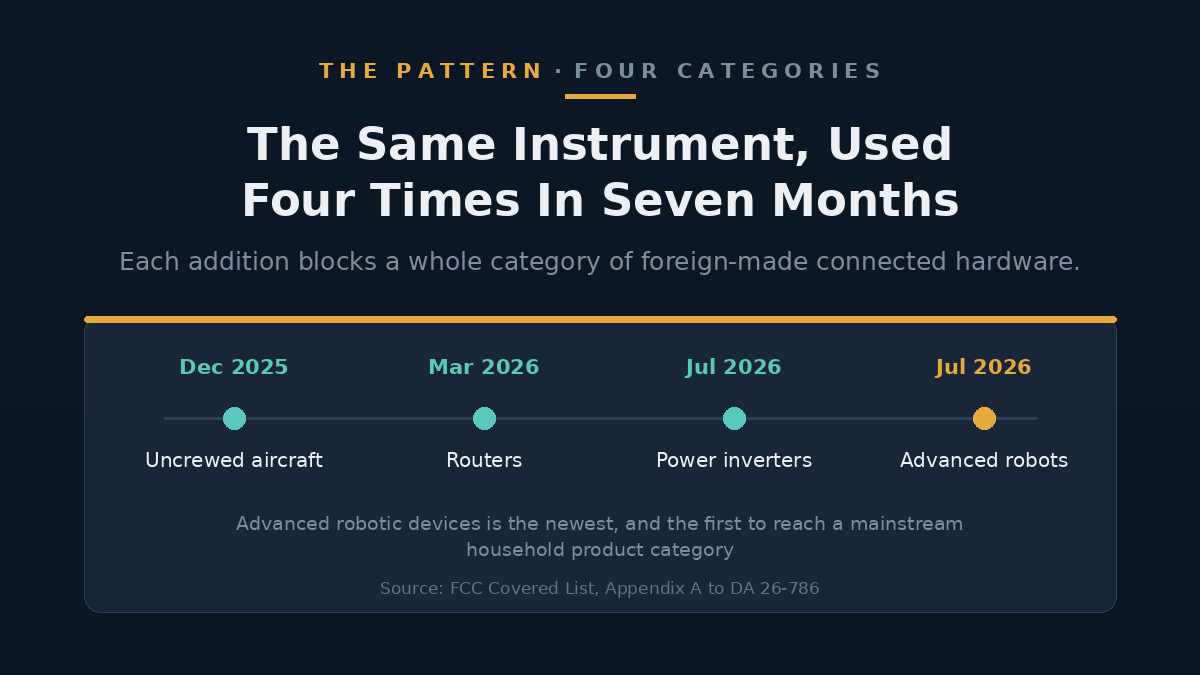
- The mechanism travels. Advanced robotic devices are the fourth broad category of foreign-made connected hardware added to this list in a little over seven months, after uncrewed aircraft in December 2025, routers in March 2026 and power inverters on the same day as the robots. Other jurisdictions watch what works.
- The underlying concern is not fictional. Whatever you make of the instrument, a networked device with a camera and a floor plan of your house genuinely is a surveillance surface, and that question does not stop at the American border.
The argument against, stated fairly
The strongest criticism is not that the security concern is invented. It is that the rule is drawn by geography rather than by demonstrated risk. A device's manufacturing address is a proxy for its security properties, and a fairly loose one. A certification regime with actual technical requirements, applied to everyone including domestic producers, would target the stated harm more precisely than a blanket rule with a discretionary exemption process run by a defence department.
There is also a competition question sitting underneath. In a category where domestic production is close to zero, a made-abroad restriction does not shift purchases towards American manufacturers, because there are barely any. In the short run it removes new products from the market altogether. Whether that is an acceptable cost of building a domestic robotics industry over time is a policy judgement, and a legitimate one, but it should be argued on those terms rather than folded silently into a security determination.
Frequently asked questions
Is my robot vacuum going to stop working?
No. The FCC states that the action does not affect any previously purchased device. Nothing about your existing hardware, or the app that runs it, changes because of this rule.
Is this a ban on Chinese robots specifically?
No, and the FCC is explicit that the category is defined by place of production rather than by company. Chinese manufacturers dominate the affected consumer categories, so they bear most of the impact, but a robot made anywhere outside the United States falls inside the same rule.
Does this affect anything sold in the UK?
Not as a matter of law. It affects what can receive new approval for sale in the United States. UK availability is governed by UK rules, which have not changed.
Can manufacturers get around it?
There is a formal route rather than a workaround. Producers can apply for a Conditional Approval from the Department of War, which if granted exempts the device or class of devices. How readily those will be granted is not yet known, since the process was announced alongside the rule.
Why is a telecoms regulator deciding what robots can be sold?
Because almost all of these devices contain radio transmitters, and FCC equipment authorisation is the gate they must pass through before entering the US market. The FCC does not make the security judgement itself. Under the Secure Networks Act it is required to implement determinations made by national security agencies.
The takeaway
The narrow story is that new foreign-made robots, including robot vacuums, cannot get US approval unless a defence department signs them off individually. The broader story is that the Covered List has quietly become a general-purpose instrument for excluding categories of foreign-made connected hardware, and it has been used to add four such categories in a little over seven months.
That instrument may well be the right response to a real problem. What is striking is how fast it has travelled: from a list of named companies in 2021 to a test applied by country of manufacture, with the exit granted case by case rather than by any published technical standard. Anyone selling a connected machine that moves now has a compliance question that did not exist a year ago.
Sources
- FCC – Public Notice DA 26-786, addition of foreign-produced power inverters and advanced robotic devices to the Covered List (28 July 2026)
- FCC – Fact sheet on the Covered List update, including scope limits and the Conditional Approval process (28 July 2026)
- FCC – List of Equipment and Services Covered by Section 2 of the Secure Networks Act
- FCC – Frequently asked questions on the robots and inverters update
- FCC – National Security Determination on foreign-produced advanced robotic devices, posted separately as a searchable document
- eCFR – 48 CFR 25.101, the Buy American domestic end product test and its 65 per cent domestic content threshold
- 9to5Google – report that the FCC confirmed robot vacuums are included in the ban (29 July 2026)
- Forbes – coverage of the humanoid and quadruped restriction and its national security framing (28 July 2026)