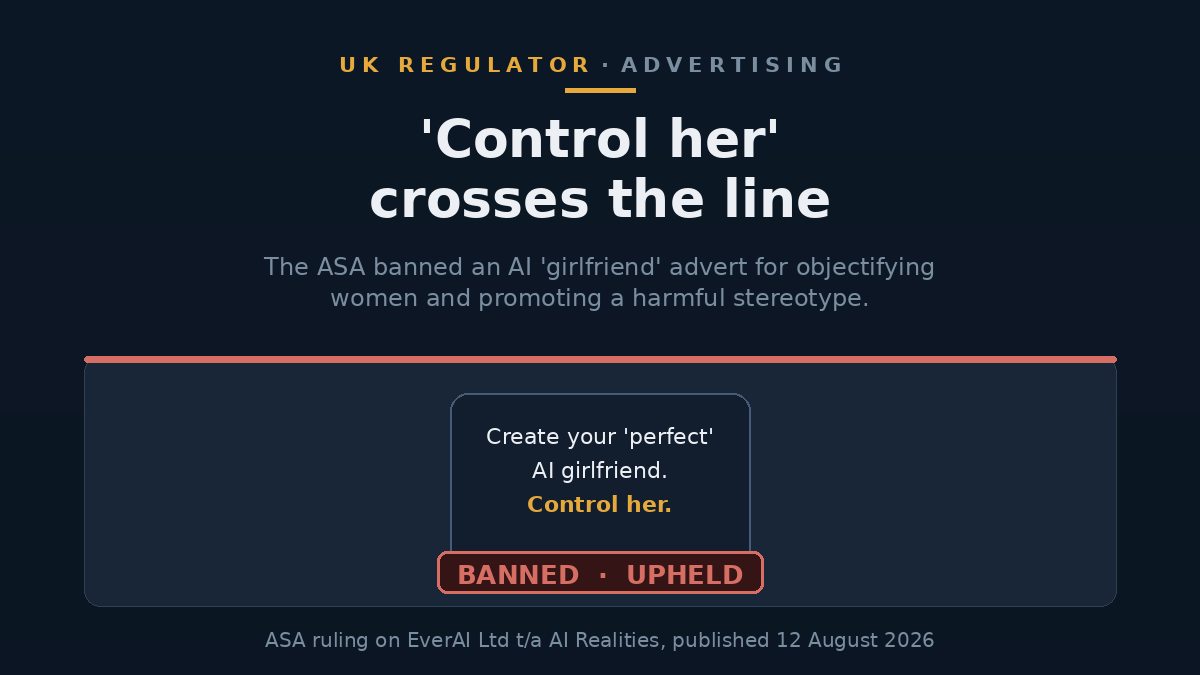
The UK's Advertising Standards Authority (ASA) has banned a Facebook advert for the AI companion app Candy AI, ruling on 12 August 2026 that it objectified women and promoted a harmful gender stereotype. The ad, from EverAI Ltd, trading as AI Realities, invited people to "create your perfect AI girlfriend" and "control her", promising she would "do anything for you". The regulator found that framing reduced women to something to be tailored and controlled for a user's gratification. The advertiser argued "control her" only meant customising a character. The ASA rejected that, and told the company its ads must be socially responsible in future.
This piece reflects the ASA ruling as published in August 2026. Regulatory findings and any appeal can change the position.
What the ad said
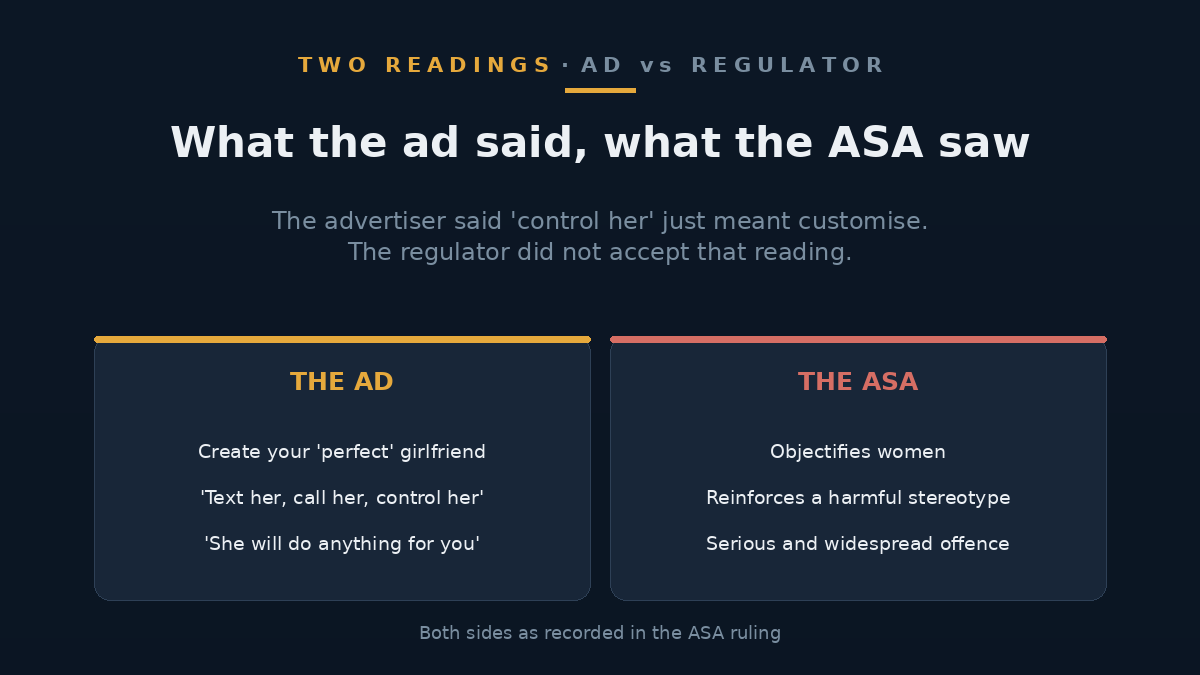
According to the ruling, the paid Facebook ad was seen on 13 May 2026 and carried the caption "enjoy limitless fun with AI girls". A woman in the video said, in on-screen text, that AI had "officially gone too far" because no one could tell she was not real. The ad then pitched the product directly: create a free AI girlfriend, choose how she looks, "text her, call her, control her", with the lines "She will do anything for you" and "She never ignores and always wants your attention". It demonstrated menus for selecting a character's appearance, ethnicity, age, personality and relationship type.
The company's defence, and why the ASA rejected it
EverAI's response, summarised in the ruling, was that the ad showcased the technology's customisation and realism, contained no sexualised imagery, and that "control her" meant "customise" or "individualise" the character's attributes through on-screen menus. The company said it advertised the same product to all orientations and gender expressions, and had already removed the ad and would change the wording to "control your experiences".
The ASA did not accept the customisation argument. It noted that the phrase came immediately before "She will do anything for you. She never ignores you and always wants your attention", so consumers would read "control her" as control over the character's behaviour, not a menu setting. Presenting a partner as desirable precisely because she could be controlled, was always available and always complied, the regulator said, reinforced the stereotype that women should be submissive and compliant. In the ASA's words, the ad reduced women to objects whose value lay in "appearance, availability, controllability".
One complaint was enough
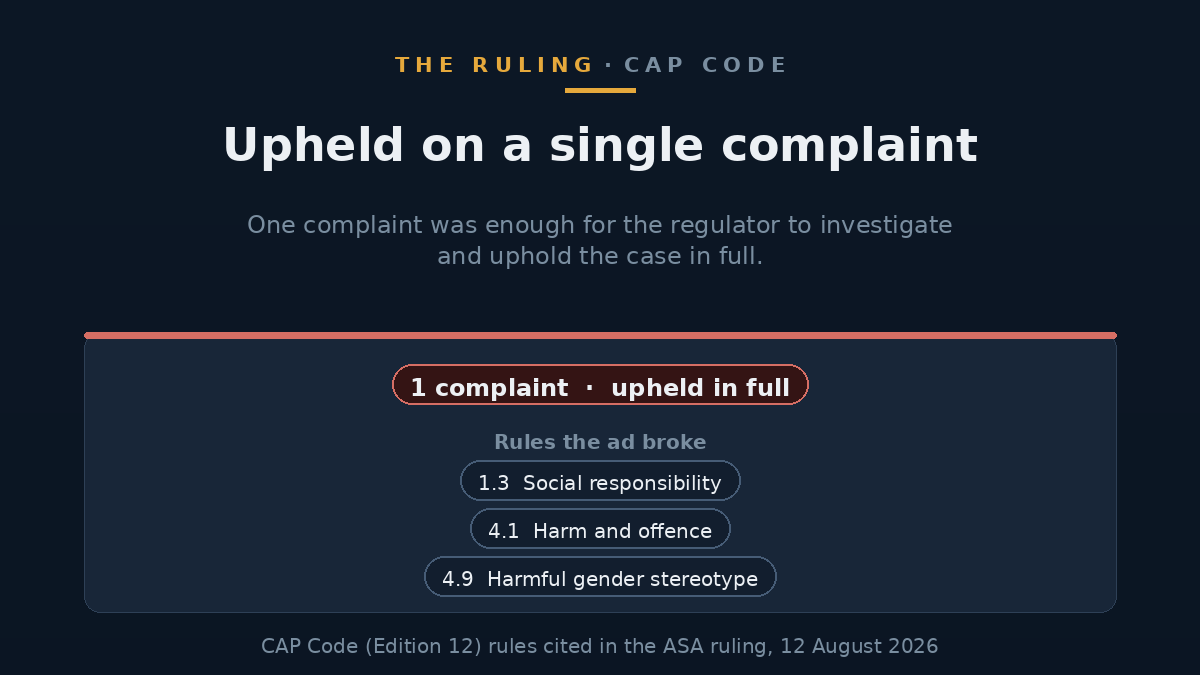
A detail worth noting for anyone who assumes regulators only act on mass outrage: the ruling records a single complaint. The complainant argued the ad was offensive, irresponsible and promoted a harmful gender stereotype, and the ASA investigated and upheld all of it. The ad was found to breach the CAP Code rules on social responsibility and on harm and offence, and the ASA ruled it must not appear again in the form complained of.
It is also worth being precise about who was sanctioned. EverAI Ltd is registered in Malta, not the UK. The ASA's jurisdiction is over advertising shown to UK audiences, which is why a UK regulator can act on a Facebook ad from an overseas company. The practical force of an ASA ruling is reputational and procedural rather than a fine, but repeat or ignored breaches can be escalated.
Part of a pattern with AI apps
This is not an isolated case. The ASA has upheld several rulings over the past year against ads for AI apps that sexualised or objectified women, and it has issued guidance stressing that its advertising rules apply in full to AI-generated content. The through-line is consistent: the technology being novel does not change the advertising rules, and "it is only an AI character" is not a defence when the marketing trades on controlling an idealised woman. For the fast-growing AI companion sector, that is a clear signal about what UK-facing marketing can and cannot claim.
Why it matters beyond one ad
AI companion apps are a real and growing consumer category, marketed heavily on social platforms where younger users see them. This ruling draws a line around how they can be sold in the UK: promoting a partner you can "control" who "will do anything for you" is out. It does not touch the apps themselves or how they operate, and it does not resolve the deeper debates about AI companionship and wellbeing. What it does is put advertisers on notice that the objectification rules apply squarely to AI products.
FAQ
What did the ASA actually ban?
A specific paid Facebook advert for Candy AI (from EverAI Ltd, trading as AI Realities). The regulator ruled it must not appear again in that form. It did not ban the app.
Why was the ad banned?
The ASA found it objectified women and promoted a harmful gender stereotype, chiefly through the "control her / she will do anything for you" framing, breaching the CAP Code's social responsibility and harm-and-offence rules.
How many people complained?
One. The ruling records a single complaint, which the ASA investigated and upheld in full.
Can a UK regulator act on an overseas company?
Yes, where the advertising is shown to UK audiences. EverAI is registered in Malta, but the ad ran to UK users, so the ASA had jurisdiction.
The takeaway
The interesting part of this ruling is not that one ad was pulled, but the reasoning. The ASA has said plainly that marketing an AI partner around control and total compliance objectifies women, whatever the product is, and that a single complaint can carry that finding. For a sector that leans on exactly this kind of pitch, it is a marker of where UK advertising standards now sit, and a reminder that "it is just AI" will not shift the line.