SEO in 2026 is harder and more important than it has ever been simultaneously. It is harder because Google's algorithm updates have accelerated, AI Overviews now answer many queries without a click, and the content that once ranked reliably needs to be substantially better to maintain those positions. It is more important because organic search traffic — when you earn it — is still the highest-quality, lowest-cost traffic available to any website or business.
AI tools have changed every stage of the SEO workflow. Keyword research that took hours now takes minutes. Content briefs that required manual SERP analysis are generated automatically. On-page optimisation is scored in real time as you write. And a new category of tools has emerged specifically to track your visibility inside the AI-generated answers that are replacing traditional search results for an increasing share of queries.
This guide covers the tools that make a measurable difference to rankings in 2026 — not every tool that claims to, but the ones with a track record of doing so.
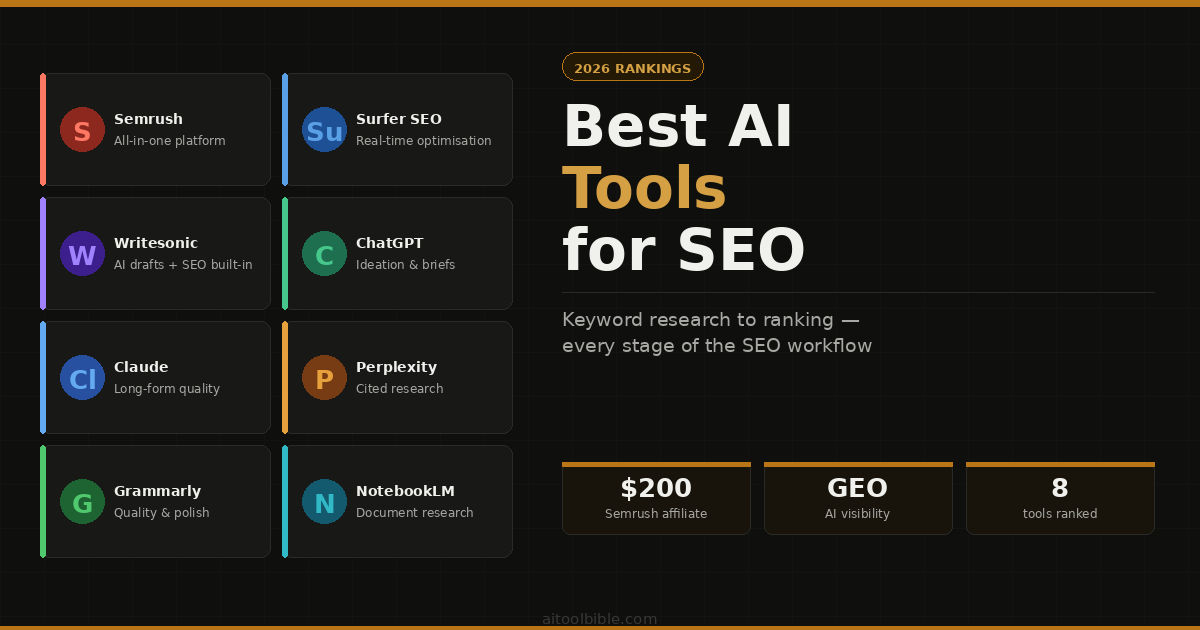
The top-performing AI SEO tools in 2026 are Semrush and Surfer SEO for overall capability. For writers specifically, Surfer SEO's real-time editor and Writesonic's integrated optimisation are the standout combination. The right tool depends on which stage of the SEO workflow you need the most help with.
The SEO workflow in 2026: what has changed
Before covering the tools, it is worth understanding what has changed in the SEO landscape that makes the tool selection matter more than it used to.
AI Overviews and GEO. Google's AI Overviews now appear for a significant proportion of queries, generating answers that cite specific sources and often reduce clicks to ranked pages. A new discipline — Generative Engine Optimisation (GEO) — has emerged around optimising content to be cited by AI-generated answers, not just to rank in the blue links below them. The best SEO tools in 2026 now track your brand's visibility inside these AI answers alongside traditional rankings.
Content quality thresholds have risen. Google's January 2026 algorithm update continued the pattern of penalising thin, AI-generated content that does not add genuine value. Ironically, this makes AI SEO tools more important, not less — the tools that help you produce well-researched, comprehensively optimised content that genuinely helps readers are exactly what Google is now rewarding. The tools that generate generic 1,500-word blog posts and call it done are contributing to exactly the problem the update was designed to address.
Search intent has become conversational. User search patterns have shifted from short-tail keywords toward detailed, conversational queries — questions that look like they are being typed into an AI assistant. Tools that help you identify and answer these questions comprehensively now drive more rankings than tools that optimise for traditional keyword density.
1. Semrush — Best all-in-one SEO platform
Price: From £113/month (Pro) — affiliate programme pays $200 per sale
Semrush is the most comprehensive SEO platform available and the one that professional SEOs, agencies and content teams rely on for the full breadth of the discipline. Its keyword database of 25 billion keywords covers virtually every market, its backlink index tracks 43 trillion links, and its site audit tool crawls and diagnoses technical issues across websites of any size.
The features that matter most in 2026 are the newer ones. Semrush One merges traditional keyword and backlink data with prompt-level AI search insights — you can see how your brand appears across Google, AI Overviews and LLM-generated answers all from the same dashboard. The AI Visibility Score benchmarks your brand against competitors in AI search, an increasingly important metric as AI Overviews take a larger share of impressions. The SEO Writing Assistant integrates into Google Docs and WordPress for real-time optimisation as you write.
The price point is significant — from £113/month for the Pro plan. For freelancers and bloggers running a single site, Semrush is often more tool than needed. For agencies managing multiple clients, marketing teams with a content operation, and anyone whose business depends meaningfully on organic search, the investment is justified and the affiliate commission ($200 per sale, 120-day cookie) is the highest single-sale rate of any tool in this guide.
Best for: Agencies, in-house SEO teams, content marketers with a serious organic search strategy, anyone who needs a single platform covering keyword research, competitive intelligence, site auditing and AI visibility tracking.
2. Surfer SEO — Best for on-page content optimisation
Price: From £79/month
Surfer SEO is the tool that most directly answers the question: "what does my article need to rank for this keyword?" Its Content Editor analyses the top-ranking pages for your target query and generates real-time recommendations as you write — the exact keywords to include, how many times to use them, ideal word count, heading structure and semantic terms the algorithm associates with comprehensive coverage of the topic.
The live content score (0–100, updating as you type) is the tool's signature feature. A score of 67 or higher is generally a good benchmark for ranking success, and the correlation between Surfer content scores and actual ranking improvements is well-documented, particularly for informational queries and content that is currently stuck on page two. The tool is exceptionally strong for updating existing content — taking an article that ranks at positions 8–15 and improving its comprehensiveness to push into the top five.
Surfer integrates directly with Jasper and Writesonic, allowing you to write and optimise in the same workflow. It also integrates with Google Docs and WordPress. The combination of Writesonic for AI drafting and Surfer SEO for real-time optimisation is one of the most efficient content production workflows available for bloggers and content teams targeting organic traffic.
Best for: Bloggers and content teams producing articles targeting specific keywords, anyone updating existing content to improve rankings, SEO writers who want real-time optimisation feedback as they write.
3. Writesonic — Best for SEO-integrated content creation
Price: Free / From £16/month — 30% lifetime recurring affiliate commission
Writesonic occupies the sweet spot for bloggers and content teams who need to produce SEO-optimised articles at volume without paying Surfer SEO's price point for every article. Its built-in Surfer SEO integration brings real-time keyword optimisation into the writing workflow, and the platform covers over 100 content types including blog posts, product descriptions, ad copy, landing pages and social content.
The Botsonic and Chatsonic features are secondary for pure SEO work, but the core writing platform — particularly for producing well-structured, keyword-rich long-form content — is among the strongest available at this price point. For sites like AI Tool Bible that need to produce regular high-quality blog content targeting specific search queries, Writesonic provides the right balance of AI writing capability and SEO data integration without requiring a separate £79/month Surfer subscription.
The free plan provides 10,000 words per month — enough to properly evaluate the tool. The 30% lifetime recurring affiliate commission makes it one of the highest-earning tools in the writing category.
Best for: Bloggers, content marketers and small SEO teams who need AI-assisted writing with built-in SEO optimisation at a price point below the dedicated SEO platforms.
4. ChatGPT — Best for SEO research and content ideation
Price: Free / From £16/month
ChatGPT's role in an SEO workflow is different from a dedicated tool like Surfer or Semrush — it does not provide keyword data or SERP analysis, but it is remarkably useful for the strategic and ideational stages of content production. It excels at generating content angles for a topic, identifying questions your target audience is likely to search, creating meta description variations, brainstorming internal linking strategies and producing first drafts that a human editor then optimises with Surfer data.
One of the most effective SEO applications of ChatGPT in 2026 is using it alongside real search data tools. Feed it Semrush keyword data and ask it to identify the most interesting content angle for a cluster of related keywords. Use it to produce a content brief structure that you then flesh out with specific SERP analysis. Ask it to identify the questions that a comprehensive guide on a topic should answer. It amplifies the speed and quality of human SEO thinking rather than replacing the data layer.
Best for: Content ideation, meta description writing, content brief creation, any strategic or ideational SEO task that benefits from conversational AI assistance.
5. Claude — Best for long-form SEO content quality
Price: Free / From £18/month
Where ChatGPT is strong for rapid ideation, Claude is the better choice when content quality is the priority. Its 200K token context window means you can feed it your full content brief, competitor analysis, keyword data and style guidelines simultaneously and get a first draft that reflects all of them coherently. The writing quality — more natural, varied sentence structure, less formulaic — produces content that reads better to humans and is less likely to be flagged by Google's quality signals.
One practitioner documented using Claude alongside Semrush data to produce a detailed SEO content strategy, feeding in performance data, top-performing pages and revenue targets to generate a comprehensive plan with specific content recommendations. The result was a 13-page strategy document that she describes as more useful than anything she could produce manually in the same time. This kind of strategic application — using Claude's reasoning capability to synthesise complex inputs into actionable plans — is where it adds the most value to SEO workflows.
Best for: Long-form content production where quality matters, SEO strategy development, synthesising research from multiple sources into coherent content plans.
6. Perplexity AI — Best for SEO research with citations
Price: Free / From £16/month
For the research phase of content creation — finding statistics, identifying expert quotes, understanding what existing content on a topic covers and where the gaps are — Perplexity is the most reliable AI tool available. Every answer includes citations to real sources, which means you can verify the information and link to the original source in your content, both improving credibility and creating the kind of well-sourced content that performs well in AI Overviews.
Perplexity's approach to search — synthesising multiple sources into a coherent answer with citations — mirrors exactly what Google's AI Overviews do. Content that is well-researched, comprehensive and cites credible sources is the kind of content that AI Overviews reference. Using Perplexity to research a topic before writing is therefore not just an efficiency tool — it helps you understand what kind of content the AI systems consider authoritative on that topic.
Best for: Research phase of content production, finding statistics and citations, understanding what authoritative sources say about a topic before writing.
7. Grammarly — Best for content polish and quality signals
Price: Free / From £12/month
Google's quality signals include engagement metrics — time on page, scroll depth, return visits — that are influenced significantly by how readable and well-written the content is. Grammarly's role in an SEO workflow is ensuring the content you publish meets a professional standard that keeps readers engaged rather than bouncing. The browser extension works across WordPress, Google Docs and wherever you edit, catching errors in real time.
The Premium AI writing features — sentence rewrites, tone adjustment and clarity improvements — are particularly useful for polishing AI-generated content that needs a human-quality finish. Content that reads as robotic or repetitive produces poor engagement signals regardless of how well it is keyword-optimised.
Best for: Final polish on all published content, improving readability and engagement signals, ensuring AI-drafted content reaches a professional quality standard before publication.
8. NotebookLM — Best for research-heavy SEO content
Price: Free
For content that requires deep research — long-form guides, comprehensive topic overviews, expert-level articles — NotebookLM is a genuinely useful addition to the SEO toolkit. Upload the top-ranking competitor articles, relevant research papers, industry reports and your own notes, and use it to ask questions about the collective content. What topics do the top-ranking articles cover that you have not addressed? What statistics appear in multiple authoritative sources? What questions do experts on this topic consistently answer?
This research synthesis capability produces the kind of genuinely comprehensive content that Google's 2026 algorithm rewards — and that AI Overviews cite as authoritative. It is free, requires no technical setup and works immediately from any browser.
Best for: Research phase of content production, identifying gaps in existing content by analysing competitor articles, producing comprehensive topic coverage for long-form SEO content.
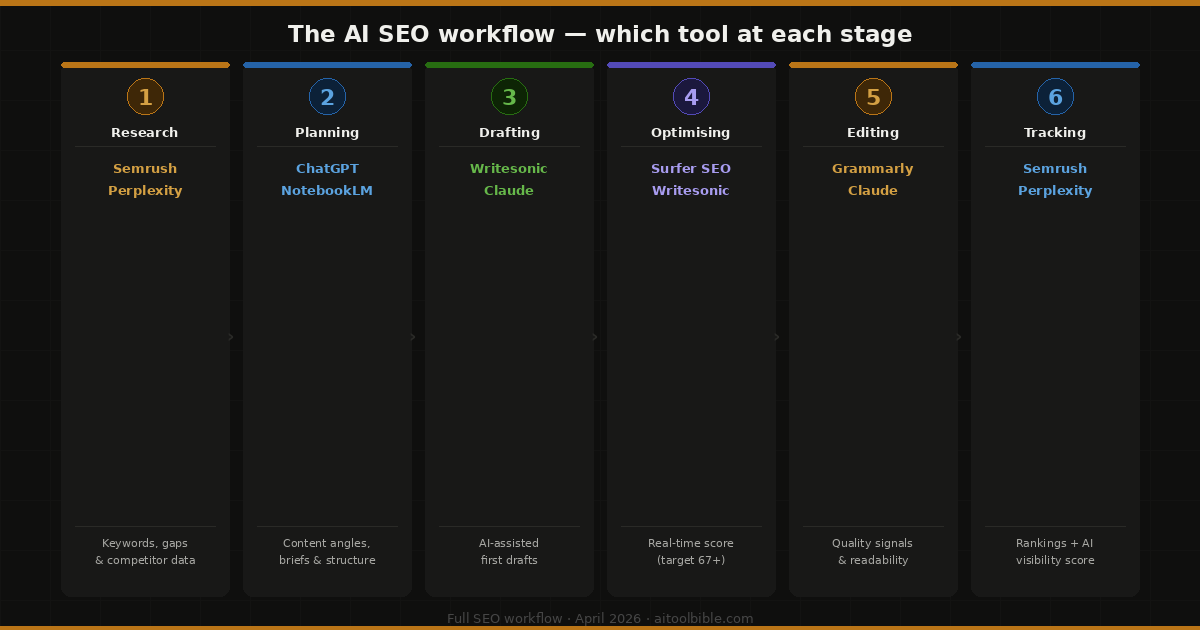
The AI SEO workflow: how the tools fit together
The most effective SEO workflow in 2026 does not rely on a single tool — it chains them together so each handles the stage it does best:
- Keyword and competitor research: Semrush for keyword data, competitive gaps and AI visibility tracking
- Topic research and content planning: Perplexity AI for cited research, NotebookLM for synthesising competitor content
- Content ideation and brief creation: ChatGPT to identify angles and questions the article should answer
- First draft production: Writesonic or Claude for AI-assisted long-form drafts
- On-page optimisation: Surfer SEO's Content Editor to score and improve keyword coverage in real time
- Final polish: Grammarly for readability, grammar and quality signals
- Performance tracking: Semrush for rankings, AI visibility score and ongoing monitoring
This is not a workflow that requires all of these tools simultaneously. A solo blogger on a limited budget can get most of the value from Writesonic (with Surfer integration) for drafting and optimisation, Perplexity for research, and Grammarly for editing — total cost around £28/month. An agency or content team justifying Semrush and Surfer as their data backbone can layer Claude and ChatGPT for production efficiency on top.
The new priority: optimising for AI search visibility
The most significant shift in SEO strategy for 2026 is the need to optimise not just for traditional blue-link rankings but for visibility inside AI-generated answers. Google's AI Overviews, ChatGPT's web browsing, and Perplexity's citations all pull from specific sources when answering questions — and appearing in those citations is becoming as commercially valuable as ranking in position one.
The content characteristics that drive AI citation are similar to but distinct from traditional ranking factors: comprehensive coverage of a topic, clear factual claims supported by data, well-structured content that is easy to extract specific answers from, and genuine expertise or unique perspective that general AI knowledge does not already contain. Content that consists primarily of AI-generated rewrites of existing information does not get cited — AI systems already know that information and have no reason to reference an external source for it.
The practical implication: the SEO content strategy that works in 2026 involves producing fewer, more comprehensive pieces that include original data, specific expert perspectives and unique insights, rather than more frequent, shallower content designed primarily to capture keyword volume. AI SEO tools are most valuable when they help you produce that kind of content more efficiently — not when they replace the human thinking that makes it worth citing.
Frequently asked questions
Will AI-written content rank on Google in 2026?
Yes, if it meets Google's quality standards — which are about helpfulness, accuracy and genuine value to readers, not about how the content was produced. AI content that is well-researched, comprehensively optimised and edited to professional standard ranks fine. AI content that is thin, generic or simply a rewrite of existing information does not rank — not because it is AI-generated but because it fails the same quality tests human-written content fails.
Do I need Semrush if I have ChatGPT?
They serve different purposes. ChatGPT has no keyword volume data, backlink information or ranking tracking. Semrush has no generative writing capability. The tools are complementary rather than substitutes. For a bootstrapped blogger, Semrush is probably more tool than needed — start with Writesonic's built-in SEO features and Google Search Console, which is free. For a content team whose revenue depends on organic traffic, Semrush pays for itself quickly.
What is the best free AI tool for SEO?
Perplexity AI free is the best for the research phase — unlimited standard searches with cited sources. Google Search Console is free and essential for tracking rankings and indexing. Grammarly free covers the editing layer. ChatGPT free handles content ideation. For a bootstrapped site, this combination covers most of the SEO workflow at zero cost before the tools that require payment become necessary.
How important is it to optimise for AI Overviews?
Increasingly important. AI Overviews now appear for a significant proportion of informational queries — the same queries that most content-focused sites target. Appearing in an AI Overview generates brand visibility even when users do not click through to the site. The content characteristics that drive AI Overview citations are the same characteristics that Google rewards in traditional rankings: comprehensive, accurate, well-structured content from credible sources. Optimising for both simultaneously is the most efficient strategy.