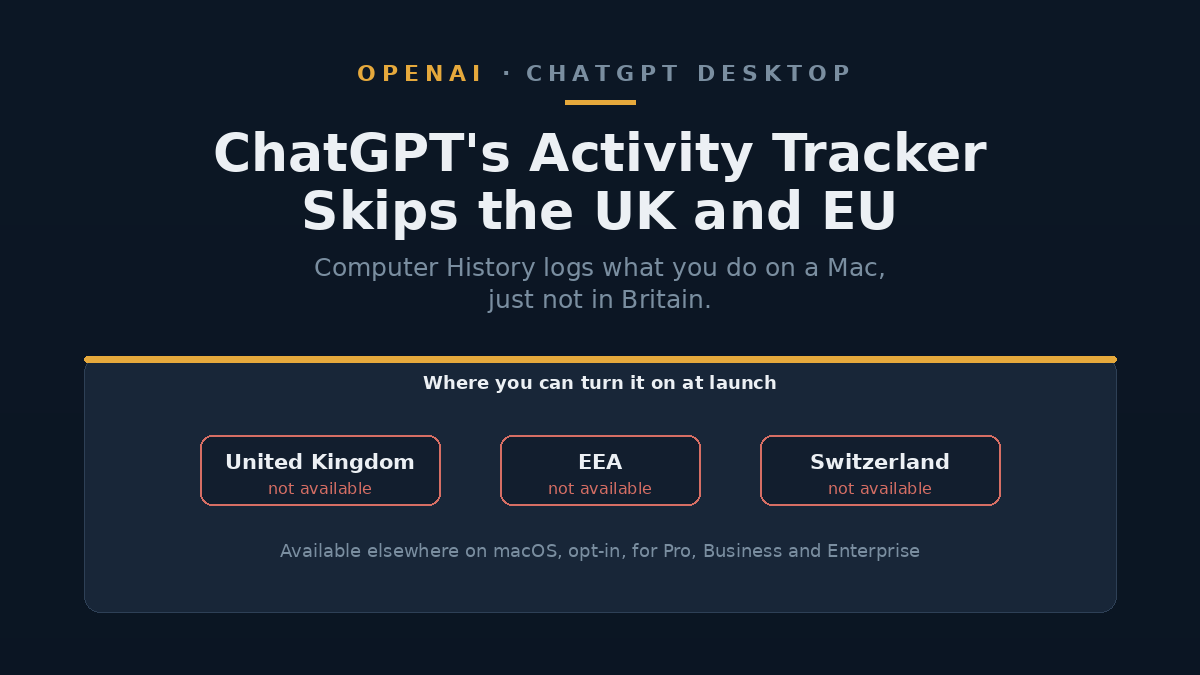
OpenAI has switched on a feature called Computer History in the ChatGPT desktop app for Mac, and it will not be available to users in the UK, the European Economic Area or Switzerland. Announced on 13 August 2026, it records what you do across your apps and websites – clicks, typing, which app you switch to – and turns that into a searchable timeline and a set of "memories" that ChatGPT and its coding tool Codex can draw on. It is opt-in, off by default and limited to paid Pro, Business and Enterprise plans. OpenAI has not said why Britain is excluded, but the shape of the exclusion points to data-protection rules.
This piece reflects reporting as of August 2026. Rollout regions, pricing tiers and data-retention details are the kind of thing that shifts, so treat the specifics as a snapshot.
What Computer History actually does
The idea is that ChatGPT stops needing everything explained from scratch. If you ask "what was I debugging yesterday", it can answer from your recent activity rather than a blank memory. OpenAI says the feature can also spot patterns in how you work and suggest automations or shortcuts off the back of them. It replaces an earlier research preview that OpenAI ran under the name Chronicle, though OpenAI describes it as a rebuilt system rather than a straight rename: Chronicle worked from screenshots, whereas Computer History logs events.
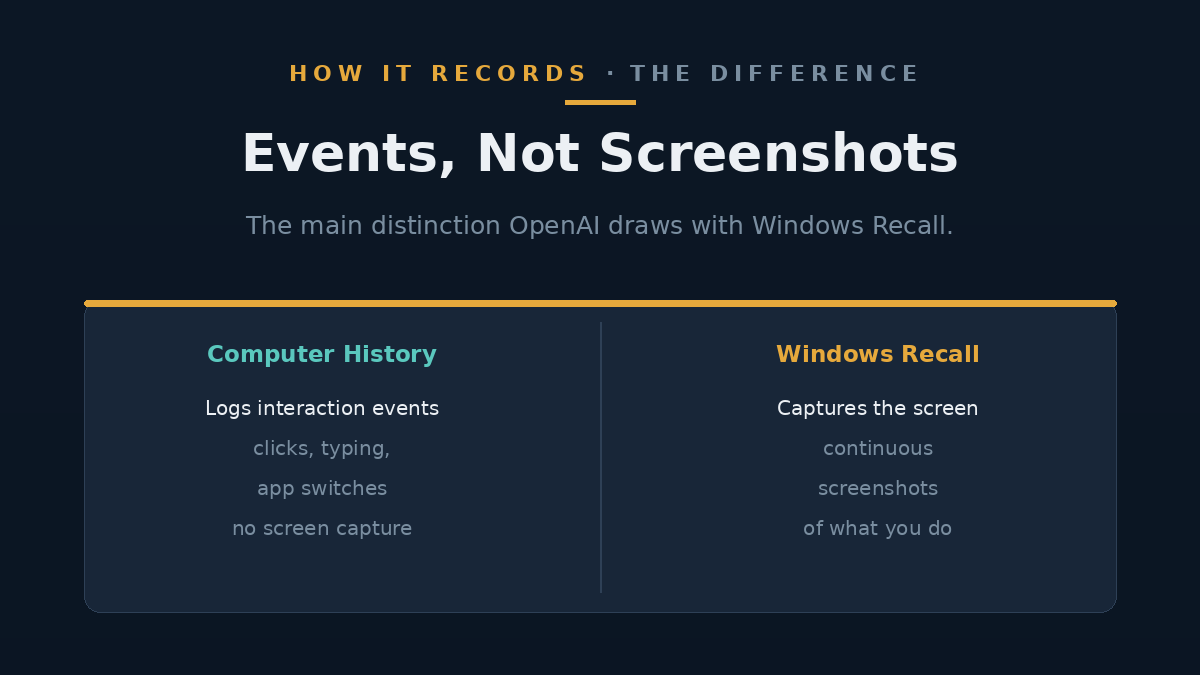
Crucially, OpenAI says it does this by logging interaction events – the operating system's record of activity, plus accessibility data – rather than by photographing your screen. It does not capture screenshots, screen recordings, your microphone or system audio, and activity in private or incognito browsing windows is not included. You also choose which apps and websites are allowed to feed it. It is off until you turn it on, and it is currently Mac-only.
It sounds like Windows Recall, because it is the same idea
The obvious comparison is Microsoft's Windows Recall, the "photographic memory" feature that drew heavy criticism in 2024 and was delayed and reworked before it shipped. Both build a timeline of what you have been doing so an assistant can refer back to it. The differences OpenAI leans on are that Computer History is opt-in, where Recall was first announced as on by default, and that it logs events rather than taking continuous screenshots.
That is a real distinction, but it does not make the data harmless. OpenAI's own guidance carries a warning that the record can contain sensitive information, that Computer History does not encrypt it, and that other programs on your computer could in principle read it. In other words the safety of the log depends partly on the security of the rest of your machine. For anyone weighing this up, that caveat matters as much as the feature list.
What OpenAI says happens to your data
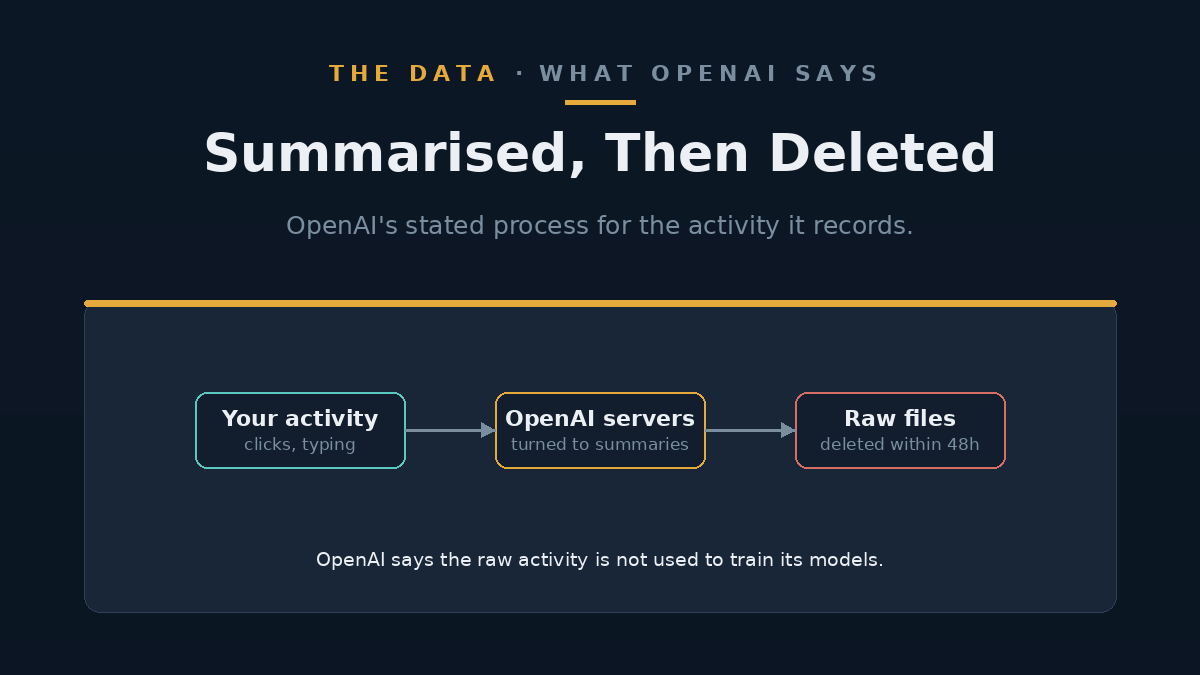
This is where a widely shared framing – that the feature "turns your actions into training data" – needs unpicking. OpenAI's position is different. It says your activity is processed on its servers to generate the plain-language summaries and memories, that the underlying raw files are deleted within about 48 hours, and that they are not used to train its models. Those specifics come from OpenAI's own product documentation rather than anything an outsider can test, so they stand as the company's stated position rather than independently established fact.
Even taken at face value, "we don't train on it" is not the same as "it never leaves your machine". The summaries persist as memories, and the raw activity passes through OpenAI's servers before deletion. That is a reasonable design, but it is a meaningful amount of trust to extend to any company, which is the honest heart of the decision rather than the marketing around it.
Why Britain and the EU are left out
OpenAI has not published a reason for excluding the UK, the EEA and Switzerland. What is worth noticing is the exact set of regions left out. That grouping is the standard European data-protection perimeter, covered by the EU's GDPR, the UK's own version of it and the Swiss equivalent. A feature that continuously records a person's activity and processes it in the cloud is precisely the sort of thing those rules scrutinise most closely, around consent, data minimisation and how special-category information is handled.
OpenAI has staged or withheld other memory and agent features from these markets before while it works through the compliance questions, so the likeliest read is regulatory caution rather than a permanent decision. We cannot state that as fact, because OpenAI has not, but it is the explanation the pattern supports. For UK readers the practical upshot is simple: for now this is something you will read about rather than use, and the version that eventually arrives, if it does, may look different once it has been through data-protection review.
FAQ
Can I use Computer History in the UK right now?
No. OpenAI's release notes list it as not currently available in the UK, the EEA or Switzerland. It is live for eligible users elsewhere on Mac.
Does it take screenshots of my screen?
OpenAI says no. It logs interaction events – operating-system activity and accessibility data such as clicks, typing and app switches – rather than capturing images of your screen. That is the main way it differs from Windows Recall.
Is it turned on automatically?
No. It is off by default, opt-in, and limited to paid Pro, Business and Enterprise plans. You also pick which apps and websites can feed it, and private browsing is excluded.
Does OpenAI use my activity to train its models?
OpenAI says it does not, and that the raw activity files are deleted within about 48 hours after being turned into summaries. Those specifics rest mainly on OpenAI's own account, so we treat them as its stated position rather than independently established fact.
The takeaway
Computer History is a clear step towards an assistant that watches how you work and remembers it, and OpenAI has built in more restraint than Microsoft did with Recall: opt-in, events rather than screenshots, a short retention window. The unresolved parts are the ones that always matter with this kind of tool – an unencrypted local record that can hold sensitive material, and a design that still routes your activity through a company's servers. That the UK and EU are excluded is not a verdict on the feature, but it is a signal that the hardest questions here are the legal ones, and they are not settled yet.
Sources
- OpenAI Help Center – ChatGPT release notes, including Computer History availability (August 2026)
- OpenAI – Computer History product documentation (August 2026)
- OpenAI (@OpenAI) – Computer History announcement (13 August 2026)
- Android Authority – What Computer History records, and the regions excluded (14 August 2026)
- The New Stack – How the data is processed, summarised and deleted (August 2026)
- Microsoft – Update on the Recall preview feature, for comparison (June 2024)