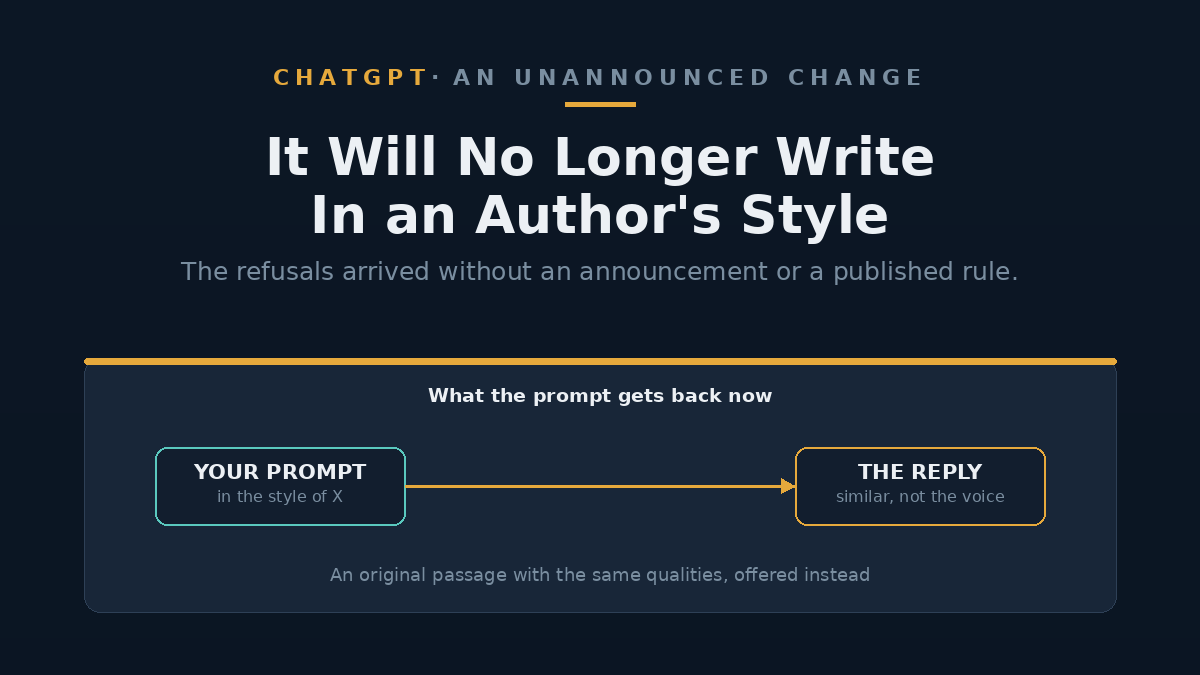
If you have ever asked ChatGPT for a chapter opening in the style of a novelist you like, you may find it will not do it any more. Since late July 2026 the chatbot has been declining requests to imitate named authors, offering instead to write something with similar qualities in its own voice. Engadget ran its own test on 28 July and got a refusal for Agatha Christie, who died in 1976, with the chatbot citing the fact that her work remains in copyright. OpenAI does not appear to have announced the change or documented it anywhere. That is the part worth paying attention to: the behaviour moved, and nobody published a rule.
This piece reflects reporting as of July 2026. Chatbot behaviour varies by model version, account tier, interface and exact wording, so your own results may differ from any test described here. Where this piece infers a reason for the change, it says so.
What people are actually seeing
The pattern is consistent across the testing published so far. Ask for prose "in the style of" a named author and ChatGPT declines the imitation, explains that it cannot closely copy that writer's distinctive voice, and then offers an original passage carrying the broad qualities the author is known for: the atmosphere, the pacing, the kind of sentence. In Engadget's Christie test the refusal was explicit about the reason. The chatbot said her works are "still under copyright, so I can't provide text that closely imitates" her distinctive style, before offering to write something original with those characteristics.
That is a softer boundary than it first sounds. The model is not refusing to help you write a country-house mystery with a misdirection in chapter three. It is refusing to badge the output with a named writer's voice. Whether the resulting prose is meaningfully different is a question you can only answer by reading it.
Users noticed before the press did. Threads on writing-with-AI forums flagged the new refusals, and Engadget's report points to one of them. That is the usual sequence for an unannounced behavioural change.
Why we can say this is new
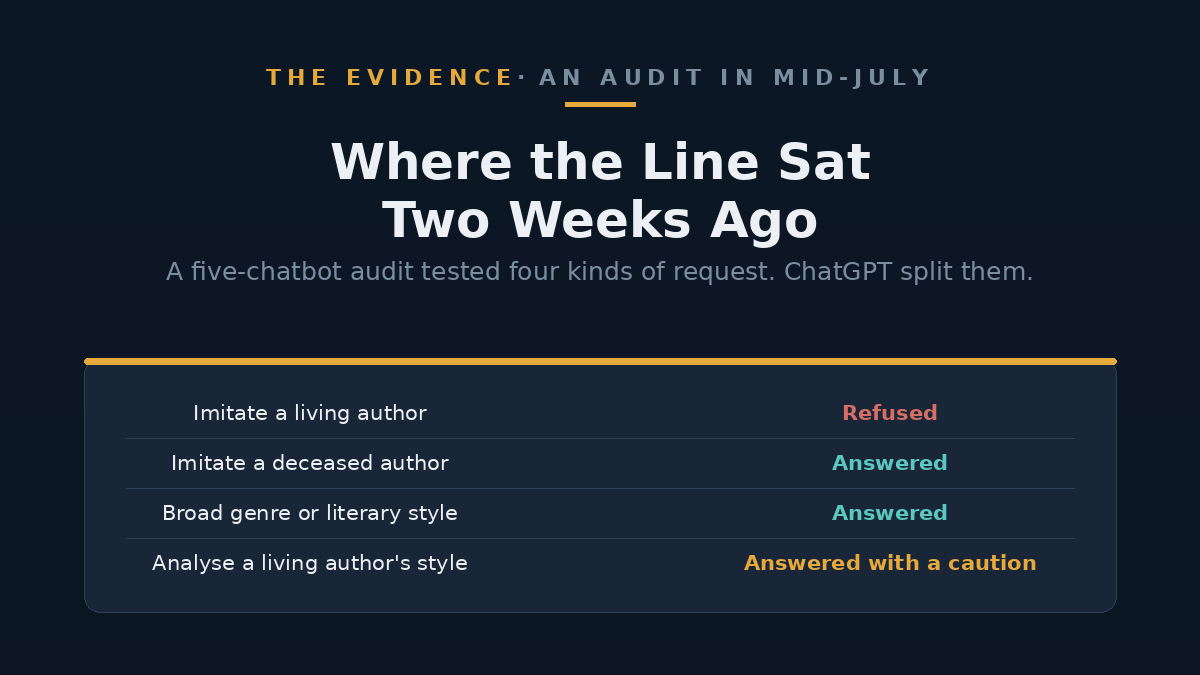
A refusal you have not seen before is not necessarily a change; it can just be a different prompt. In this case there is a dated baseline to measure against. The independent technology publication No Latency ran a structured audit of five major chatbots in mid-July 2026, putting seven prompt types to ChatGPT, Claude, Gemini, Copilot and Perplexity for 35 first responses in total. The four categories that matter here: direct imitation of a living author, imitation of a deceased author, broad literary style or genre with nobody named, and analysis of a living author's style.
Its finding for ChatGPT was a clean split. Both living-author imitation prompts were refused and redirected. Both deceased-author prompts were answered, including one long-deceased writer and one recently deceased. Broad-genre requests were fine. Analysis of a living author's style was allowed, with a caution attached against direct imitation. In other words, a fortnight ago the line ran between living and dead.
It does not appear to run there now. Christie has been dead for fifty years and got a refusal, and the stated reason was copyright rather than mortality. The reporting Engadget replicated described refusals covering dead authors as well as living ones, though we could not confirm which names were tested outside that account. The sharper point is in the audit itself: one of the deceased authors ChatGPT wrote for in mid-July had died recently enough that the work would still be in copyright, which is precisely the ground the Christie refusal now stands on. Our honest reading, and it is a reading rather than a finding, is that the boundary has shifted from "is the author alive" towards something closer to "is this work still commercially protected". No Latency's own caveat is the right one to keep in mind: results vary by model version, configuration and phrasing, so nobody outside OpenAI is in a position to state the rule.
The likely reason, stated as a guess
OpenAI is defending a stack of copyright claims from authors, publishers and other rights holders over the material used to train its models. A consumer feature that will produce, on demand, text explicitly framed as being in a named writer's voice is an awkward thing to have in evidence. Removing it costs the company almost nothing in product terms and removes a vivid exhibit. That is the inference most coverage has drawn, and it is a reasonable one. It is still an inference: OpenAI has not said why, and did not comment when asked.
There is a precedent inside the company for the explicit version of this rule. For images, OpenAI has publicly committed that DALL-E 3 is designed to decline requests in the style of a living artist, a commitment made when the model reached ChatGPT in 2023 and still on the company's site. That is a stated, findable boundary. For prose there is no equivalent. The Model Spec, the published account of how the models are meant to behave and last updated in December 2025, does include a top-level principle that the assistant must respect creators and their intellectual property rights. It illustrates that with song lyrics and paywalled news articles. It says nothing at all about writing prose in a named author's style. The behaviour exists; the documentation does not.
What it does not fix
It is useful to be clear about the size of this change, because it is easy to read it as a concession and it is not one.
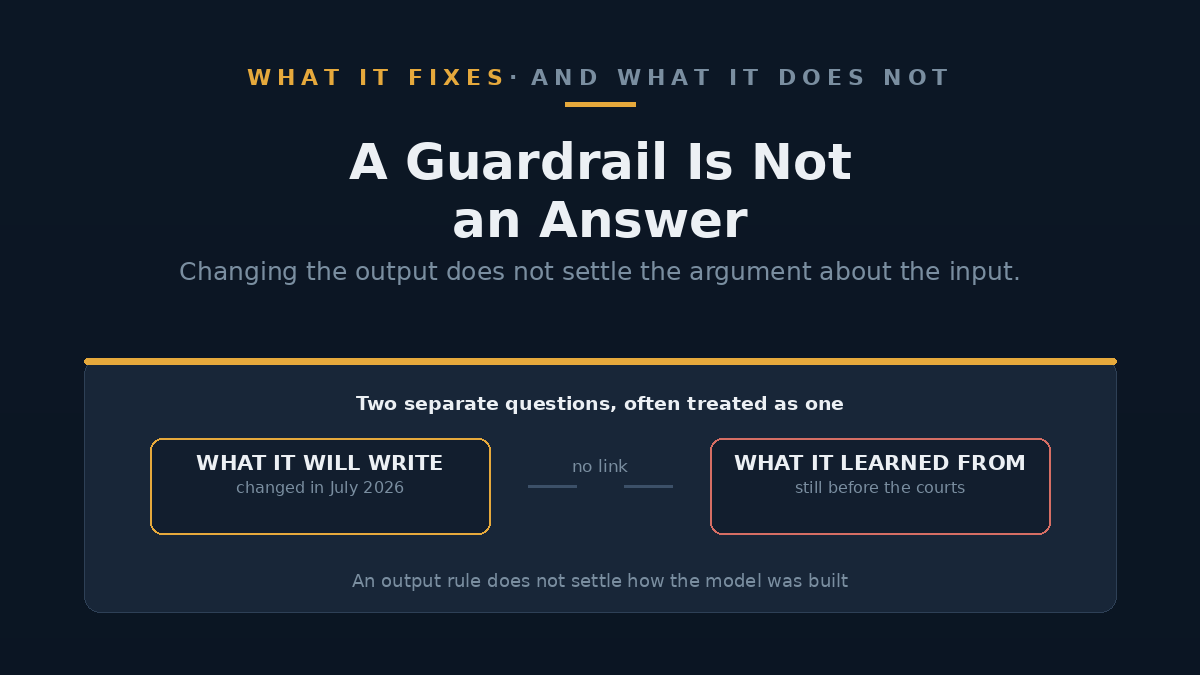
An output guardrail governs what the model will write for you today. The dispute at the centre of the litigation is about what went into the model in the first place, and whether using copyrighted books to train a commercial system was lawful. Declining to write like Stephen King does not answer that. If a model absorbed a writer's entire body of work during training, the fact that it now politely refuses to say whose voice it is doing changes the interface, not the underlying question. Rights holders have made that point repeatedly, and the courts have not finished with it.
There is a second gap. Style has never been straightforwardly protected by copyright, which protects specific expression rather than the general idea of clipped sentences or gothic atmosphere. So a refusal grounded in copyright status is doing something more like reputational risk management than legal compliance. That is a legitimate choice for a company to make. It is just not the same as the law requiring it.
What this means if you write with AI
For most people using ChatGPT for work, the practical effect is small but real.
- Naming an author as a shortcut has stopped working reliably. If your prompt library leans on "write this in the style of X", expect refusals and rewrite them around the qualities you actually want: sentence length, register, how much is left unsaid.
- Analysis is still available. Asking what makes a particular writer's prose work, as a craft question, was permitted in the audit and is the more useful request in most cases anyway.
- Do not assume the boundary is stable. This changed without notice and could change back the same way. Anything you build on top of a specific refusal behaviour is built on sand.
- It is not a licence. A model agreeing to write something has never been a statement that publishing it is safe. Passing off machine-written pastiche as your own work carries the same problems it did last month.
FAQ
Has OpenAI confirmed the change?
Not as far as we can establish. We found no announcement, changelog entry or policy update covering it at the time of writing, and the company did not comment on the reports. The evidence is journalists' and users' testing, which is consistent as far as it goes but is not the same as a documented rule.
Will it still write in the style of long-dead authors?
Nobody can tell you reliably. In No Latency's mid-July audit it wrote for both deceased authors tested. The reporting at the end of July describes refusals reaching dead authors as well, and Engadget's Christie test produced one. Behaviour also varies by model version and phrasing, so the result today may not be the result next week.
Do other chatbots do the same thing?
The July audit covered five major chatbots and found they draw the line in different places, from outright refusal to compliance with a caveat to no visible caveat at all. This piece deals only with the change in ChatGPT's behaviour, because that is what has moved. If you rely on a particular assistant for stylistic work, test it yourself rather than assuming the industry has converged.
Does this affect the copyright lawsuits against OpenAI?
Not directly. The claims concern the use of copyrighted works in training, which is a separate question from what the finished product will agree to write. A guardrail added in 2026 does not retrospectively change how a model was built. Whether it helps the company's position in practice is a matter for the courts.
Is imitating an author's style illegal?
Generally not, in itself. Copyright protects particular expression rather than style in the abstract, which is why pastiche and homage have always been part of literature. The legal risks arise around reproducing actual text, passing work off as someone else's, or misleading readers about authorship. This is general information, not legal advice.
The takeaway
A quiet product change, made for what look like legal reasons, has removed a feature a lot of people used without thinking about it. The change itself is defensible and probably sensible. The way it was made is the problem: no announcement, no documented rule, and a boundary that testers map differently a fortnight apart. If you build a business process on a chatbot's behaviour, this is the useful reminder. You are not using a specification. You are using a product that can be edited underneath you overnight, and the only way to know what it will do is to keep checking.
Sources
- Engadget – ChatGPT is now refusing requests to write in famous authors' styles, including its own Agatha Christie test (28 July 2026)
- No Latency – Where AI chatbots draw the line on imitating authors, the five-chatbot audit across seven prompt types (15 July 2026)
- No Latency – Will ChatGPT write like a living author? Companion analysis with the ChatGPT results table (June 2026, updated July 2026)
- No Latency – AI and literary imitation, the full 13-page research note (PDF, July 2026)
- OpenAI – DALL-E 3 is now available in ChatGPT Plus and Enterprise, stating the living-artist commitment (19 October 2023)
- OpenAI – Model Spec, the published account of how its models are meant to behave (current version 18 December 2025)
- Al Jazeera, via AP and Reuters – News publishers seek sanctions against OpenAI, with context on the wider copyright litigation (9 July 2026)