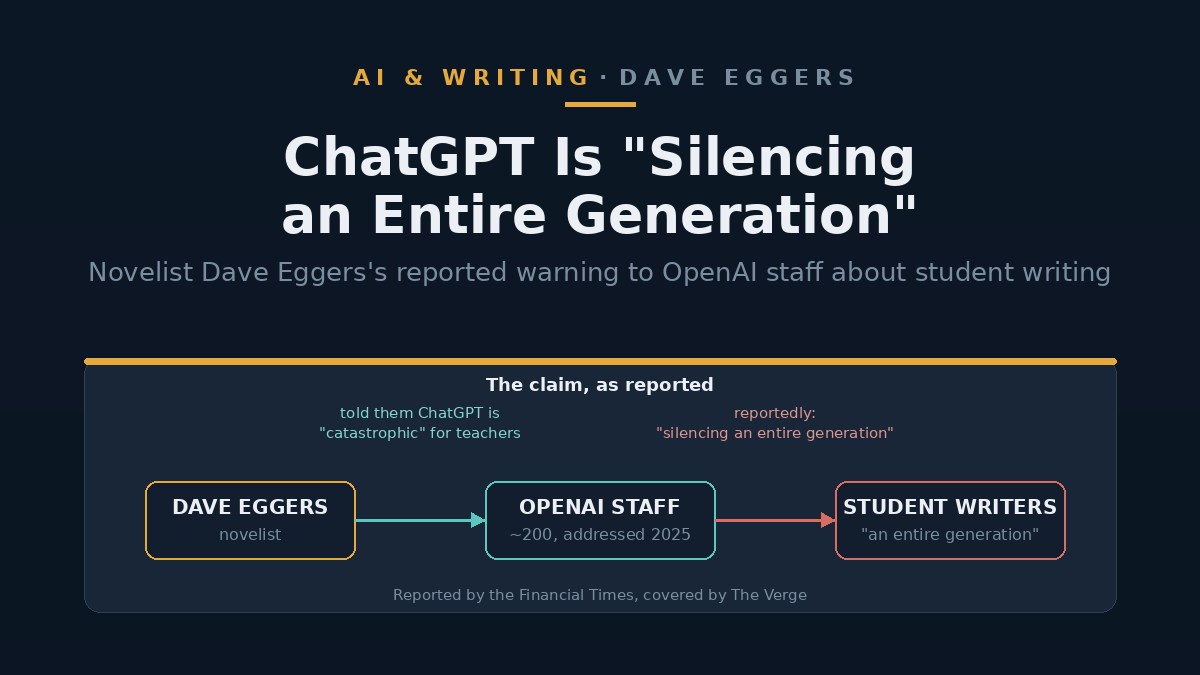
Novelist Dave Eggers reportedly used a talk to around 200 OpenAI staff, arranged at the invitation of chief executive Sam Altman, to accuse the company's flagship product of "silencing an entire generation" of student writers and of making the effect on teachers "catastrophic." The remarks were first reported by the Financial Times and were subsequently covered by The Verge and other outlets, which independently converge on the same core details: around 200 staff, Sam Altman's invitation, the talk taking place in 2025, and the "catastrophic" and "silencing an entire generation" phrasing. Those two short phrases are the ones every account agrees on; fuller quotes attributed to Eggers rest on that reporting rather than on a public transcript. Eggers has separately made closely related remarks on the record, unprompted, in a June 2026 NPR interview whose transcript is public: he said giving your voice to a machine "is such a crime against yourself." The honest bottom line is that Eggers's broader argument, that AI writing tools risk hollowing out how young people learn to think and write, is a real and separately documented concern among UK exam regulators and authors, even where the exact wording of the OpenAI anecdote itself remains secondary-sourced.
This piece reflects reporting as of July 2026. The account of what Eggers said inside OpenAI's offices rests on Financial Times reporting, as carried by The Verge and other outlets; quotes beyond the two short, widely repeated phrases ("catastrophic" and "silencing an entire generation") are reported rather than drawn from a public transcript. His NPR remarks, by contrast, come straight from NPR's own published transcript.
What Eggers is reported to have told OpenAI staff
Eggers is the novelist behind "A Heartbreaking Work of Staggering Genius," the founder of McSweeney's, and the founder of 826 Valencia, a US network of nonprofit youth writing and tutoring centres. According to the Financial Times, as reported by The Verge and echoed by several other outlets, he was invited to speak to OpenAI staff in 2025 and used the platform not for career advice but to criticise the company directly. Multiple independently-reported accounts converge on the same headline figure, around 200 staff, and on two short phrases attributed to him: that ChatGPT's effect on educators' lives has been "catastrophic," and that it is "silencing an entire generation" of student writers.
Beyond those specifics, a fuller passage attributed to Eggers, expanding on students never learning to write and having their voice "stolen" from them, appears in only one account of the story rather than across all of them, so it sits on thinner sourcing and is not reproduced here. None of that makes the broader account implausible, Eggers has been consistent and outspoken on this theme elsewhere, including on NPR below, but the extended wording has never been tied to a public transcript or recording.
The NPR remarks, verified
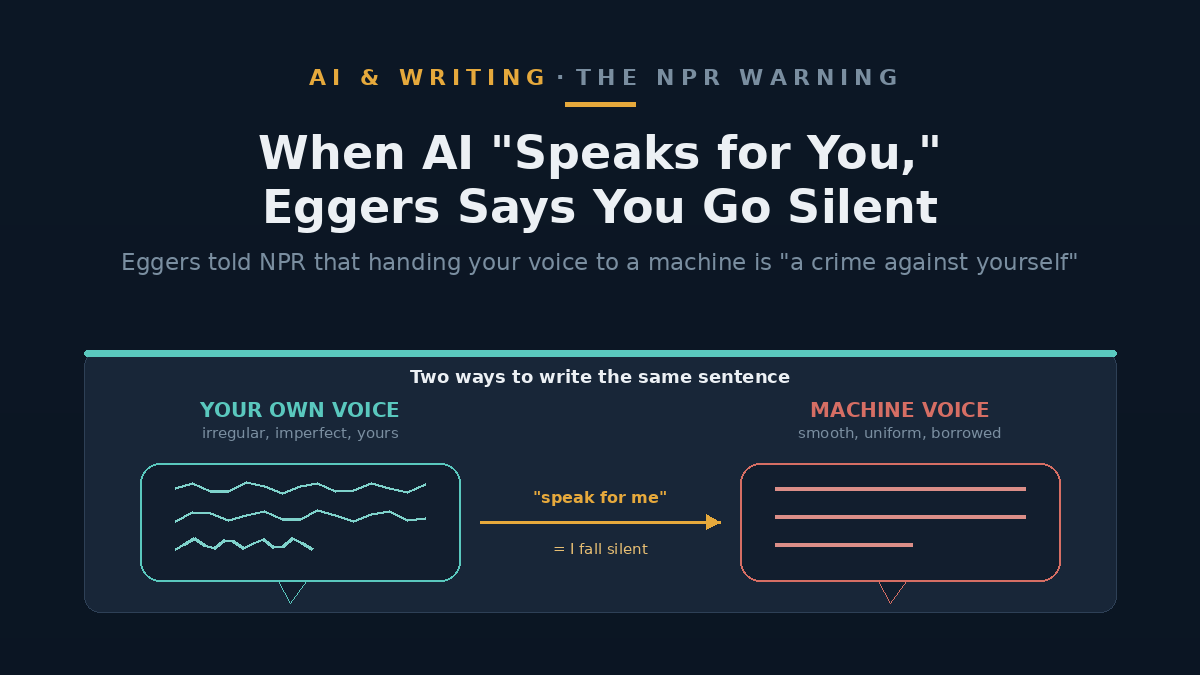
Eggers made closely related comments on NPR's Wild Card with Rachel Martin, broadcast 11 June 2026, while promoting his novel "Contrapposto." Asked what he wants younger generations to understand, he said this is the first time in history a whole generation has been tempted to let a machine write for them, and that doing so "is such a crime against yourself." He argued that even rough, unpolished student drafts are more valuable than machine-processed prose, and said the situation is "so dystopian beyond anything I could do in a dystopian novel." He connected this directly to his classroom visits, saying he raises the subject with students roughly once a week.
A tension OpenAI has to sit with
Eggers's critique lands somewhere OpenAI has also tried to occupy. In November 2025, the company launched ChatGPT for Teachers, a free version aimed at helping educators plan lessons and mark work rather than replacing student writing. That does not resolve the underlying dispute, a tool built for teachers does not by itself stop students from using the consumer version to write essays, but it shows OpenAI has been positioning itself as part of the solution in classrooms at the same time Eggers accuses it of making teaching untenable. Both things can be true: a genuinely useful teacher-facing product can coexist with a mass, largely unsupervised use pattern among students that no single feature addresses.
The UK angle: regulators and authors are already on this, independent of Eggers
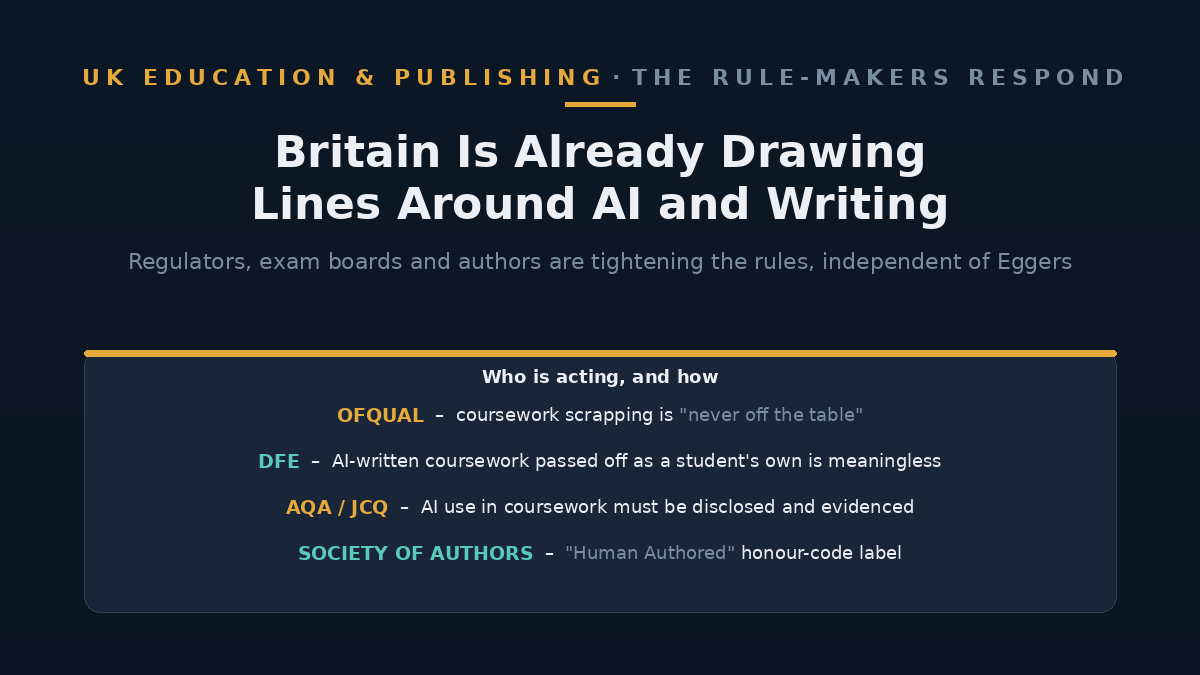
Nobody in UK education or publishing appears to have responded to Eggers by name, but the underlying problem he describes, AI eroding confidence that written work is genuinely a person's own, is already a live, actively regulated issue in the UK, on both the student-assessment side and the professional-author side.
On assessment, Ofqual's chief regulator Ian Bauckham has warned exam boards that scrapping long-form written coursework because of AI misuse risk is "never off the table," singling out A-level history and English, where extended essays can carry around a fifth of the overall grade. The Department for Education's briefing pack for school leaders, published March 2026, states plainly that a grade awarded for AI-generated coursework passed off as a student's own is treated as meaningless. Exam boards have followed with formal rules: updated JCQ guidance, which AQA and other boards operate under, requires students to disclose any AI use in coursework, keep a non-editable saved copy of AI-generated output, and explain how it was used, with undisclosed use treated as malpractice and teachers barred from using AI as the sole marker of a student's work.
On the professional-author side, the Society of Authors, alongside the US Authors Guild, launched a "Human Authored" labelling scheme at the London Book Fair in March 2026, an honour-code logo authors can put on a book to declare it was written without generative AI, though conventional aids like spellcheck and outlining tools remain permitted. It is a voluntary, trust-based scheme rather than a technical detector, which is itself a tacit admission that reliably proving human authorship after the fact is not currently possible, the same underlying difficulty Eggers describes teachers facing with student essays, playing out one level up in the professional literary world.
Taken together, UK institutions are responding to the same structural problem from two different angles: tightening what counts as acceptable evidence of a student's own work, and giving professional authors a voluntary way to signal theirs. Neither move depends on, or confirms, Eggers's specific account of what happened inside OpenAI's offices.
FAQ
Did Dave Eggers really tell OpenAI staff that ChatGPT is "silencing an entire generation"?
He is reported to have said this, according to the Financial Times, in a talk to around 200 OpenAI staff in 2025. The Verge and other outlets carried the same "catastrophic" and "silencing an entire generation" phrasing, and those two short phrases are the ones every account agrees on, so treat fuller quotes as reported rather than drawn from a public transcript.
What did Eggers say on NPR, and is that verified?
Yes. In a broadcast on 11 June 2026, he told NPR that letting a machine write for you "is such a crime against yourself," a remark checked directly against NPR's published transcript.
Who is Dave Eggers?
A novelist and McSweeney's founder, best known for "A Heartbreaking Work of Staggering Genius," and the founder of 826 Valencia, a US nonprofit network supporting young people's writing.
Is there a UK equivalent to what Eggers is describing?
Yes, though it developed independently of his remarks. UK exam boards now require students to disclose AI use in coursework, Ofqual has warned it may scrap long-form coursework over AI risk, and the Society of Authors has launched a voluntary "Human Authored" labelling scheme for books.
Has OpenAI responded to Eggers's criticism?
Outlets covering the story reported that OpenAI did not provide comment on Eggers's remarks or the event. OpenAI has separately launched a free teacher-facing version of ChatGPT, though that does not directly address the criticism about student use.
The takeaway
Two different things are true here and worth keeping separate. Eggers's NPR remarks, that handing your writing to a machine is a kind of self-silencing, are solidly on the record and consistent with years of his public advocacy for young writers. His reported OpenAI-office remarks make for a sharper story and are corroborated, on their headline details, across the Financial Times, The Verge and other outlets, but the fuller quotes have never been tied to a public transcript or recording. What is genuinely solid is that UK regulators, exam boards and the Society of Authors are treating "can we still tell if this was written by a person" as a live, practical problem right now, regardless of whether Eggers ever set foot in OpenAI's offices.
Sources
- The Verge, coverage of Dave Eggers's remarks to OpenAI staff, citing the Financial Times (July 2026)
- NPR, "Wild Card with Rachel Martin" interview and transcript with Dave Eggers (11 June 2026)
- OpenAI, official announcement of ChatGPT for Teachers (November 2025)
- Schools Week, Ofqual chief regulator's warning on AI and coursework
- GOV.UK / Department for Education, senior leadership briefing pack on AI and coursework integrity (March 2026)
- AQA, updated JCQ guidance on AI use in assessments
- Human Authored, launch announcement of the Society of Authors' labelling scheme (March 2026)