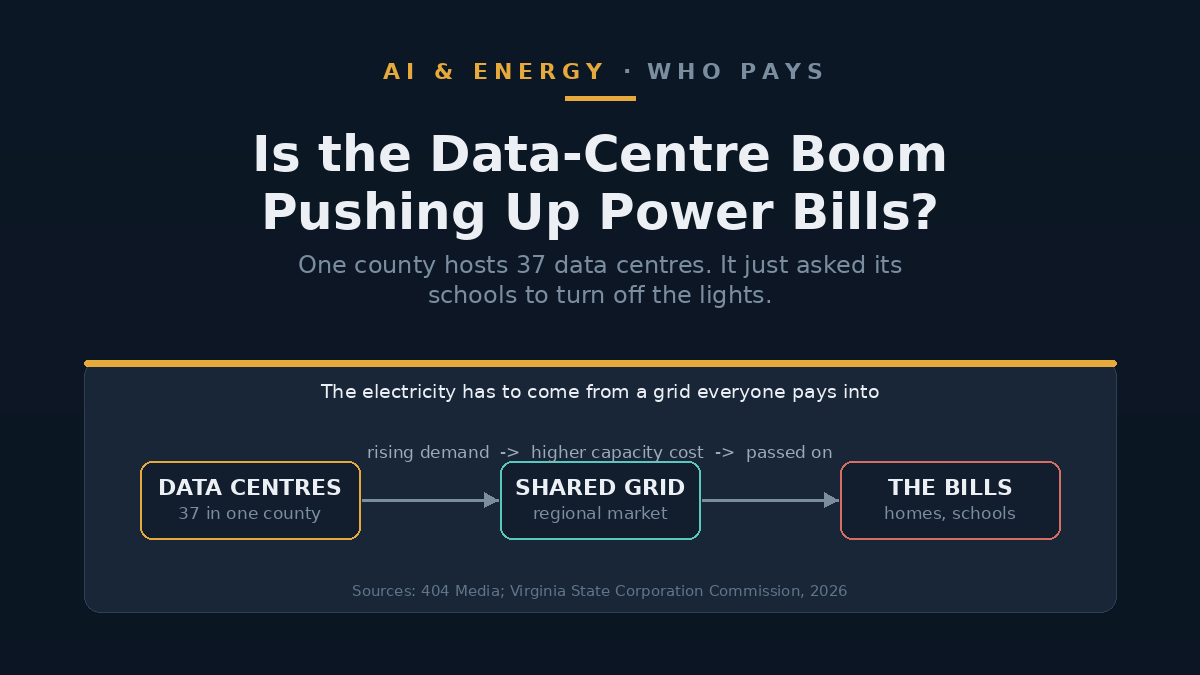
Probably not in a way you would notice on your home bill yet — but the direction is clear, and one American county has just made the question vivid. On 26 June, the manager of Henrico County, Virginia — a community of more than 350,000 people that also hosts 37 data centres — emailed thousands of staff, including teachers, asking them to conserve electricity: turn off lights and computers, close the blinds, avoid space heaters. The reason given was a 25% rise in the rate the county pays for power from 1 July, which the county manager estimated would cost it an extra $5m next financial year. The county did not blame the data centres. But it sits in one of the densest data-centre corridors in the United States, and that is no longer a coincidence anyone can ignore.
This piece reflects reporting as of June 2026. Grid costs and rate decisions move quickly; the figures below are the most recent on record at the time of writing.
What actually happened in Henrico
The detail that travelled was the tone. A county government asking its own employees to unplug chargers and manage their blinds reads less like an energy-saving nudge and more like a budget under strain. In the email, obtained by the independent outlet 404 Media, the county manager, John Vithoulkas, asked staff to "conserve electricity across our individual workspaces" and framed every saved dollar as money it could put back into services.
Two things are worth separating. The 25% increase applies to the rate the county itself pays for its buildings and schools — a procurement contract, not your domestic tariff. Households in the area are on a different track again: Virginia's regulator, the State Corporation Commission, approved a Dominion Energy rate increase adding roughly $16 a month to a typical residential bill, taking it to about $165. The same decision created a new rate class — GS-5 — for the very largest users, those with demand of 25 megawatts and above, which captures data centres, meant to push more of the cost of grid upgrades onto them from 1 January 2027.
Do data centres really raise the bills around them?
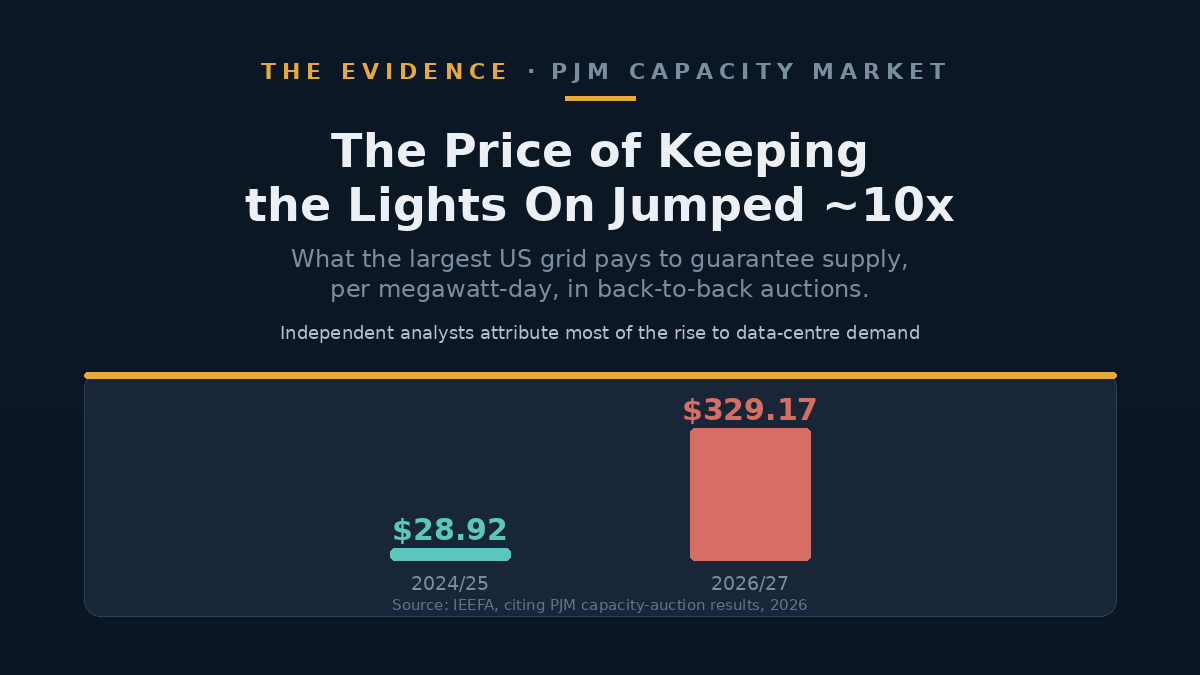
This is where it pays to be careful. No single county email proves that data centres caused a specific rate rise. But step up to the regional level and the evidence is harder to wave away. Virginia sits inside PJM, the largest electricity market in the US, and independent analysts have traced a large share of PJM's recent cost surge to data-centre demand. The Institute for Energy Economics and Financial Analysis found that data-centre demand accounted for about $9.3bn of the rise in capacity costs recovered from customers in 2025–26 — roughly 63% of the increase — as the price the grid pays to guarantee supply rose from about $28.92 to $329.17 per megawatt-day over two years, close to a tenfold jump. The Union of Concerned Scientists reached similar conclusions about costs passed on to ordinary ratepayers.
It is not unanimous, and it is worth saying so. When the claim that data centres are driving up power prices was fact-checked in June 2026, the verdict was that the link is real but partial — fuel prices, weather, ageing grids and inflation all play a part, and the data-centre share varies sharply by region. The honest summary is that data centres are a significant and growing pressure on bills where they cluster, not the only one.
Why a Virginia power bill matters in Britain
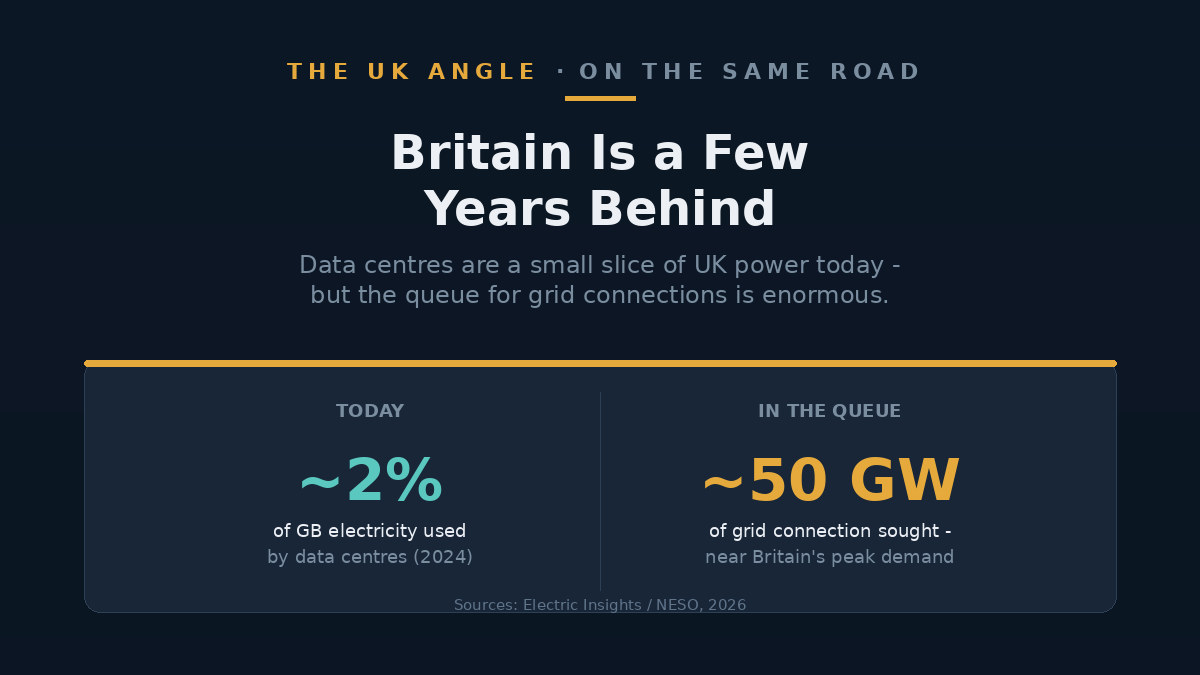
Because the UK is on the same road, a few years behind. Data centres consumed an estimated 7.6 terawatt-hours in 2024, around 2% of GB electricity, and analysts expect that to grow sharply over the coming decade, to somewhere around 8 to 16% of Britain's total electricity demand. The queue is the striking part: NESO reports that around 140 data-centre proposals are seeking roughly 50 gigawatts of grid connection — equal to Britain's entire peak demand. Most will not be built, but the scramble for power is real.
The policy choices differ in a way UK readers should watch. The government's AI Growth Zones are designed to give favoured data centres priority access to grid capacity, and in some cases discounted electricity — the opposite of Virginia's move to load more cost onto big users. Whether that leaves households and small businesses carrying more of the shared grid bill is exactly the question Henrico has just put on a noticeboard.
FAQ
Is my home electricity bill going up because of AI?
Not in a way you can isolate on your statement. Bills move for many reasons at once. But in regions with heavy data-centre clustering — parts of the US especially — independent analysts now attribute a meaningful slice of recent rises to data-centre demand. In the UK the effect is smaller so far, and concentrated more in business tariffs than domestic ones.
Did data centres cause Henrico's 25% rate rise?
The county did not say so, and we should not claim it did. The 25% applies to the county's own facilities, and the email gave no single cause. What is fair to say is that Henrico hosts 37 data centres with more planned, and that across its wider electricity market, independent studies link data-centre growth to higher costs.
Aren't data centres being made to pay their own way?
Increasingly, that is the fight. Virginia's regulator created a separate rate class for the largest users to shift more grid-upgrade costs onto them from 2027. The UK is, for now, leaning the other way for designated AI zones. Who ultimately pays is unsettled and politically live in both places.
Can I do anything about it?
As a bill-payer, very little directly — this is decided by regulators, grid operators and planning authorities. The practical move is to follow local data-centre and grid-connection decisions where you live, since that is where the cost-sharing rules are actually set.
The takeaway
The Henrico email is not proof of anything on its own, and it is worth resisting the urge to make it carry more than it can. What it does is make a slow, abstract trend briefly concrete: the electricity the AI boom needs has to come from somewhere, and the cost of getting it to the right place lands on a shared grid that everyone pays into. The UK has not had its noticeboard moment yet. The sensible time to ask who pays is before the bills arrive, not after.
Sources
- 404 Media — County With 37 Data Centers Asks Schools to 'Conserve Electricity' (30 Jun 2026)
- Inside Climate News — Virginia regulators approve new Dominion rates, assign more costs to data centers (7 Jan 2026)
- Virginia State Corporation Commission — order on the Dominion biennial review (2025)
- IEEFA — Projected data center growth spurs PJM capacity prices by a factor of 10
- Union of Concerned Scientists — Billions in unreported data center costs passed onto PJM customers
- PolitiFact — How much have data centers increased electricity prices? (12 Jun 2026)
- Electric Insights / NESO — Britain's AI ambitions depend on the grid (Q1 2026)
- GOV.UK — Government to tackle speculative grid connection requests
- House of Commons Library — Data centres: planning policy, sustainability and resilience