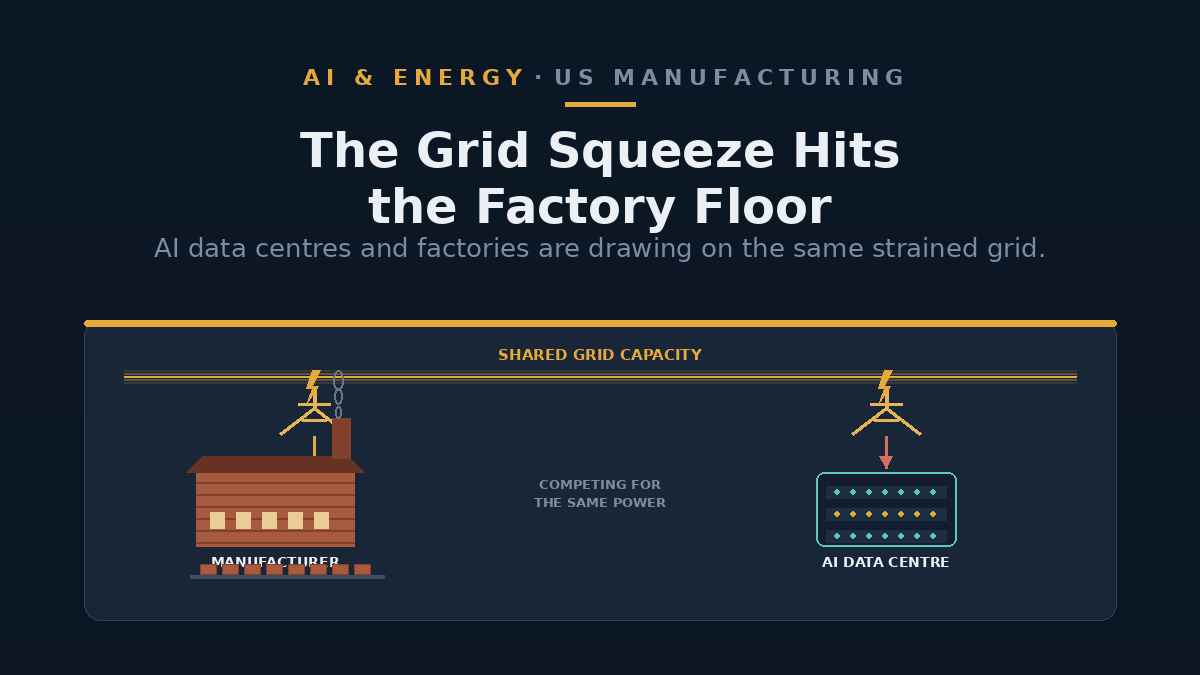
American factories are opening electricity bills that look nothing like last year's. In Sugarcreek, Ohio, the 141-year-old Belden Brick Company saw its power costs jump 90% in a year, largely because AI data centres nearby are competing for the same electricity supply. It's not an isolated case: across the US grid region that covers much of the industrial Midwest and Mid-Atlantic, industrial electricity prices are rising several times faster than the national average, and the extra cost is being spread across every customer on the grid, whether or not they have anything to do with AI.
This piece reflects reporting as of 20 July 2026, built on a Reuters investigation published 7 July 2026 and grid-monitor data published in the weeks since. Capacity charges and grid prices move quickly and the specific figures below may have shifted by the time you read this.
A brick maker's bill goes "off the page"
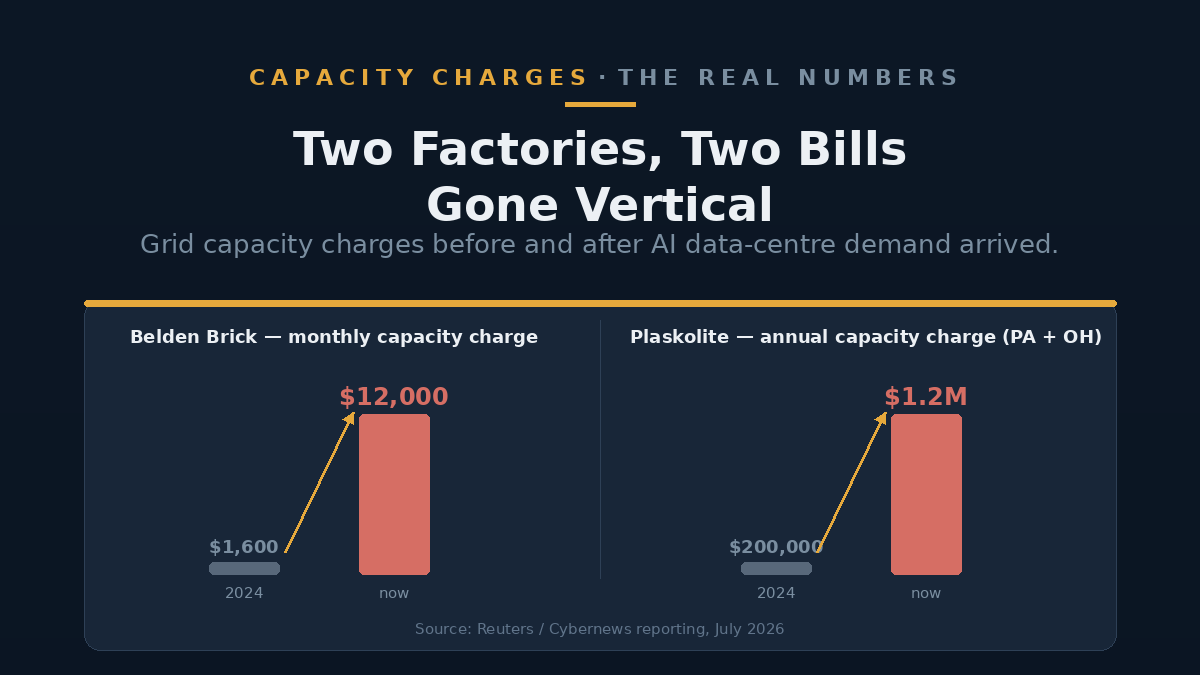
Belden Brick makes bricks that have gone into buildings from the Alamo to Notre Dame University. For most of its history, its electricity bill was a predictable, boring line item. That changed largely because of a single charge: the monthly "capacity charge" a grid operator levies to guarantee there will be enough power available at peak demand. Belden's capacity charge went from around $1,600 a month to $12,000. Company president Brad Belden said there are going to be some companies that are on the razor's edge if costs keep climbing.
The company has already raised brick prices by 4%, and profits have still shrunk. It is now looking at generating some of its own power on-site rather than relying entirely on the grid.
Why a factory's bill depends on what a data centre down the road is doing
The mechanism is the capacity market. Grid operators such as PJM Interconnection, which manages electricity across 13 US states from New Jersey to Illinois, hold auctions to secure enough future power supply to cover peak demand. Generators bid in, and the clearing price becomes the capacity charge that flows down to every customer's bill. When something adds a huge new source of demand very quickly, that price rises for everyone on the grid, not just the new demand.
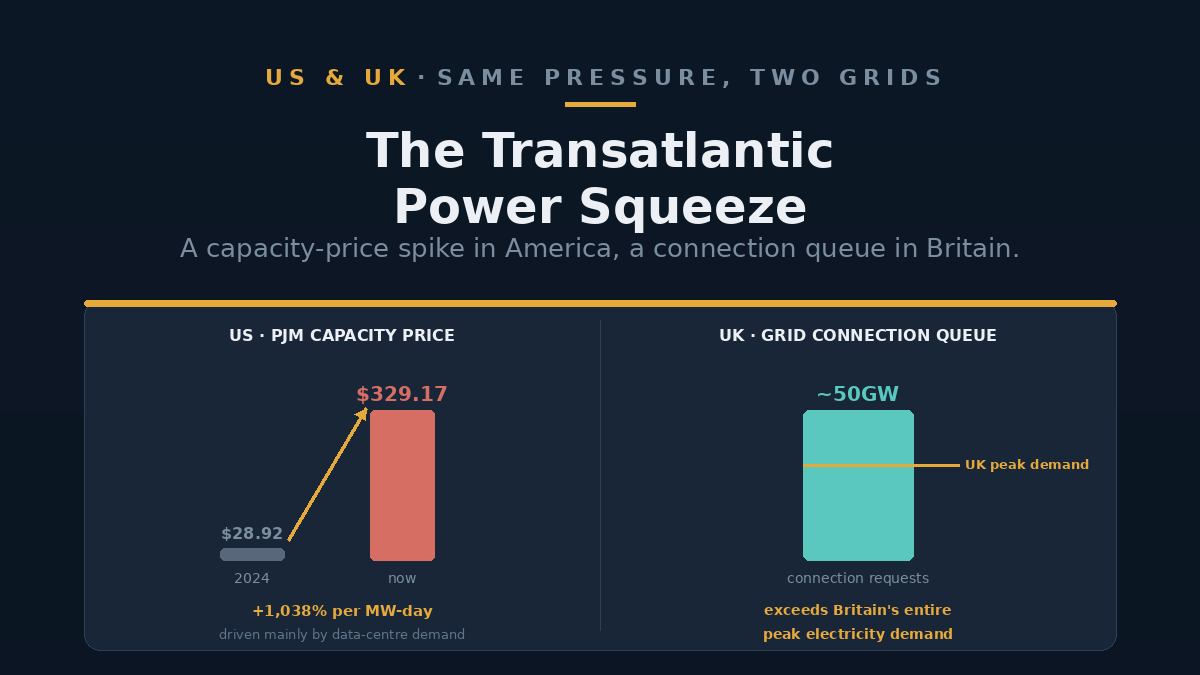
That is what has happened with AI data centres, which PJM's own spokesperson has said can be built faster than the generation needed to serve them. PJM's capacity price rose from $28.92 per megawatt-day in 2024 to $329.17 now, a 1,038% increase, driven primarily by data-centre growth. Capacity charges typically make up around 10% of a household's bill, but can be up to three times that share for manufacturers, who use large, steady amounts of power.
The regional effect shows up clearly in the government's own price data. Reuters' analysis of US Energy Department figures found industrial electricity prices up 31% in Pennsylvania and 26% in Ohio as of December 2025, against roughly 7% nationally for industrial users, over the same 12 months. Residential customers in those two states saw smaller rises, of 14% and 9% respectively.
| Region | Industrial electricity price change (12 months to Dec 2025) |
|---|---|
| Pennsylvania | +31% |
| Ohio | +26% |
| United States (national average) | +7% |
Belden Brick isn't the only one
Plastic products manufacturer Plaskolite saw its combined capacity charges across Pennsylvania and Ohio sites rise from around $200,000 a year to $1.2 million. It is now weighing whether to bypass the grid for some operations with a direct natural gas feed instead. Senior environmental director Timothy Ling put it simply: "Electricity has become the highest-drama form of energy."
Grove City, Ohio-based Tosoh SMD, which makes materials for electronics manufacturing, is considering shifting more production to the graveyard shift, when electricity is cheaper. Its director of facilities and maintenance, John Holeman, said the company is "trying to be as creative as possible just to maintain competitiveness." Of the eight US states considered emerging data-centre hubs, five are in the same Rust Belt manufacturing region now facing these price rises.
An independent watchdog puts a number on it
None of this rests on manufacturers' word alone. PJM's own independent market monitor, Monitoring Analytics, has attributed roughly $23bn in customer price increases through at least 2028 primarily to data-centre demand. Across PJM's last four capacity auctions, data centres accounted for $29.4bn of the $63.6bn in total charges, or 46%. Monitoring Analytics president Joe Bowring has called the effect a "massive wealth transfer" from ordinary ratepayers to the data-centre industry.
Worth a note of caution here: not every headline number about data centres and bills stands up to scrutiny. A widely repeated claim that nearby households have seen bills rise by as much as 267% was rated "Mostly False" by fact-checkers, because it conflated a wholesale price spike at specific grid nodes with the actual retail bill a household pays. The underlying direction, though, checks out independently: Harvard Law's Electricity Law Initiative has separately confirmed that data-centre-driven costs are being spread across all ratepayers by utilities.
Is anyone doing anything about it?
Yes, on several fronts, though manufacturers say none of it fully protects them yet. In March 2026, the White House secured a "Ratepayer Protection Pledge" from Amazon, Google, Meta, Microsoft, OpenAI, Oracle and xAI, committing them to pay the full cost of new power generation and grid infrastructure their data centres require, rather than passing it to households. The White House has also pointed to directives for new power plants in PJM territory, funded by the tech companies themselves.
Separately, in December 2025 the Federal Energy Regulatory Commission ordered PJM to reform its tariff rules for data centres that build their own on-site power generation, so they contribute fairly to grid costs if that generation fails and they draw on the shared network. At least ten US states also have proposed rules aimed at managing data-centre electricity demand.
The problem, manufacturers say, is that they are often lumped into the same "large user" rate category as the data centres themselves, despite using a fraction of the power. Paul Cicio, president of the Industrial Energy Consumers of America, put the objection bluntly: "Manufacturers are not data centers." Belden and other manufacturers are separately pushing Ohio's regulators to scrutinise how utilities forecast data-centre demand in the first place, rather than taking projections at face value.
A smaller version of the same story in Britain
The mechanism causing US manufacturers pain is not uniquely American. In Britain, developers have applied for roughly 50GW of data-centre grid connections, more than the country's entire peak electricity demand, prompting government and Ofgem reforms to weed out speculative connection requests that were clogging the queue with projects unlikely to ever be built. Most of that 50GW will not materialise, but even a fraction of it is enough to firm up wholesale prices and add pressure to network investment costs that ultimately land on bills.
Estimates of the likely household impact by 2030 vary widely, since so much depends on how much of that data-centre capacity actually connects to the grid, and no single, independently verifiable figure has yet emerged; several energy-market commentators have modelled scenarios ranging from a modest addition to household bills to a more significant one, but these remain projections rather than measured costs. Britain has not yet produced a Belden Brick-style story of a specific factory seeing its bill spike because of a data centre nearby, and the UK debate so far is framed mostly around household bills rather than industrial capacity charges. But the underlying dynamic, a rush of AI-driven demand landing on a grid that was not built for it, with the bill for new infrastructure spread across everyone connected to it, is the same one now squeezing Ohio's brickworks.
FAQ
Why does an AI data centre affect a factory's electricity bill if they don't buy power from each other?
Because they typically sit on the same shared grid and pay into the same capacity market. When a data centre adds a huge, fast-growing chunk of demand, the price of guaranteeing enough power for everyone at peak times rises, and that cost is spread across all the grid's customers, including factories that have no connection to AI at all.
How much have US manufacturers' electricity costs actually risen?
It varies by company and location, but industrial electricity prices rose 31% in Pennsylvania and 26% in Ohio in the year to December 2025, against roughly 7% nationally. Individual companies such as Belden Brick and Plaskolite have reported far steeper rises in their own capacity charges specifically, though those are single-company figures rather than industry-wide averages.
Are AI companies paying their fair share of the cost?
Major tech firms signed a pledge in March 2026 to cover the cost of new power generation and infrastructure for their own data centres. Manufacturers and PJM's independent market monitor argue that, in practice, a large share of the cost is still being socialised across all ratepayers through capacity auctions and tariff rules that predate the current AI boom.
Could this happen to businesses in the UK?
A version of it already is, though it currently shows up mainly as pressure on household bills and grid connection queues rather than industrial capacity charges. Around 50GW of data-centre connection requests have been lodged with Britain's grid, and government reforms are underway to manage the queue before it translates into higher bills.
What can a manufacturer or small business actually do about it?
Options manufacturers are already trying include shifting energy-intensive work to cheaper off-peak hours, exploring on-site generation to reduce reliance on the shared grid, and lobbying regulators, as Belden Brick is doing in Ohio, to scrutinise how utilities forecast future data-centre demand before it is baked into everyone's rates.
The takeaway
The AI boom's electricity bill is real, and it is not being paid only by the companies building the data centres. Some of it is landing on manufacturers who have no stake in AI at all, through a grid-pricing mechanism most of their customers have never heard of. Pledges and regulatory reforms are underway to shift more of that cost back onto the tech companies causing it, but manufacturers on the ground say the protection has not caught up with the bills yet. Britain's version of this story is still mostly about connection queues and modelled bill forecasts rather than factory floors, but the direction of travel looks familiar.
Sources
- Cybernews (Reuters) — "Big Tech AI data centers blamed for rising power costs at Rust Belt factories" (7 July 2026)
- Monitoring Analytics — PJM State of the Market Report, Q1 2026 (independent PJM market monitor)
- Fortune / The Conversation — "Data centers have already hiked electricity prices on the public by $23 billion" (14 July 2026)
- Utility Dive — "Data centers drove $6.3B in PJM capacity auction costs: market monitor"
- Utility Dive — PJM heat-wave grid emergency coverage (late June/early July 2026)
- The White House — Ratepayer Protection Pledge (4 March 2026)
- Federal Energy Regulatory Commission — order on PJM co-location tariff reform (18 December 2025)
- PolitiFact — fact-check of a claim about data centres and household electricity bills (12 June 2026)
- The Register — "50 GW of datacenter demand queues up for UK grid access" (27 February 2026)
- GOV.UK — government action on speculative data-centre grid connection requests