Basecamp Research, a London-headquartered biotech, has raised $140m (about £106m) in Series C funding to develop AI-designed medicines that aim to reprogram the body's own cells rather than simply treat symptoms. The round was led by S32, with Nvidia, Anthropic (through Menlo Ventures' Anthology Fund, a fund the two launched together), the NATO Innovation Fund and the Rockefeller Foundation among the backers. It takes the six-year-old company's total funding to more than $220m. The honest caveat up front: this is preclinical biotech. No Basecamp-designed therapy has been tested in a human trial yet, and the company's own founders put a working cure for major diseases five to thirty years away.
This piece reflects reporting as of September 2026. Funding totals, the valuation figure and any forward-looking timelines below may change as the company's pipeline progresses.
What Basecamp Research actually builds
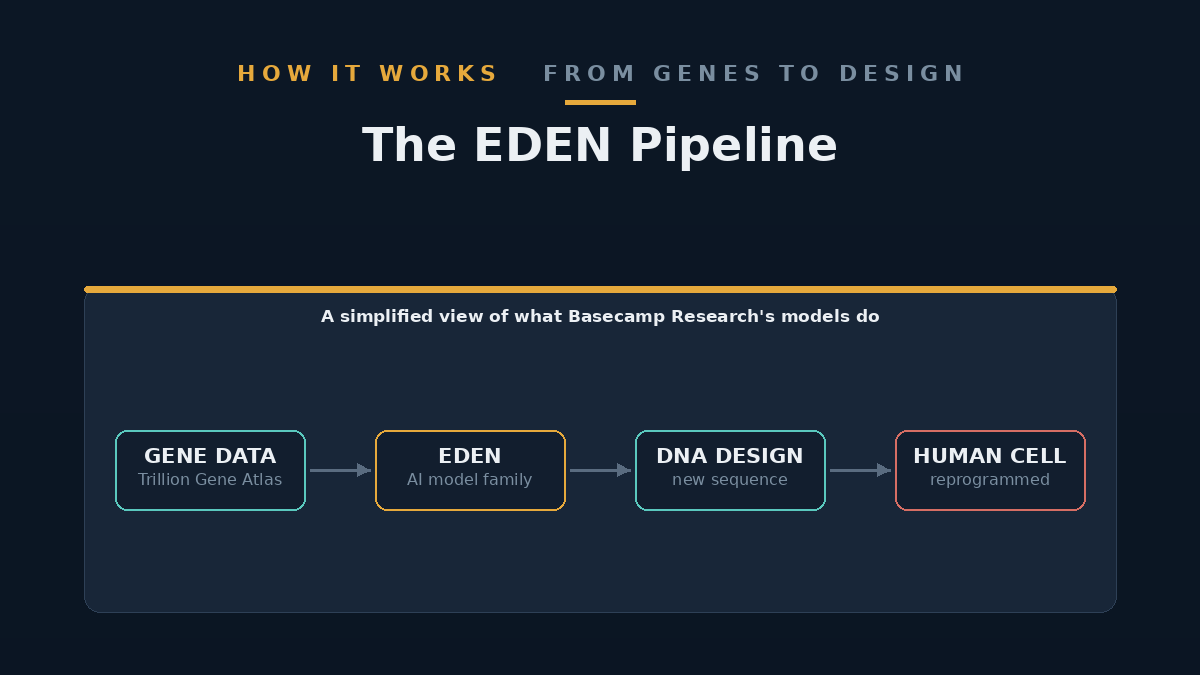
Founded in 2019 by Oxford biology PhDs Glen Gowers and Oliver Vince, Basecamp Research began not as a software company but as a fieldwork operation: the pair built a portable DNA sequencing lab and used it on an expedition to Iceland's Vatnajokull ice cap, then kept expanding the idea to hot springs, volcanoes and remote ecosystems around the world. That data-collection habit became the company's core asset, a proprietary dataset it calls the Trillion Gene Atlas, built from samples gathered across more than 30 countries and seven continents. Basecamp Research describes it as the largest biological AI training dataset built to date, by its own account rather than an independently benchmarked comparison against rival genomic databases.
On top of that dataset sits EDEN, a family of AI models (a 28 billion-parameter system, per the company) that Basecamp Research trains to read evolutionary and genetic patterns and then design new biological "instructions": DNA sequences, enzymes and peptides. The near-term product isn't a pill. It's software for cell and gene therapy, specifically in vivo treatments that reprogram a patient's own cells inside the body, with cancer and autoimmune disease as the stated first targets.
The funding, round by round
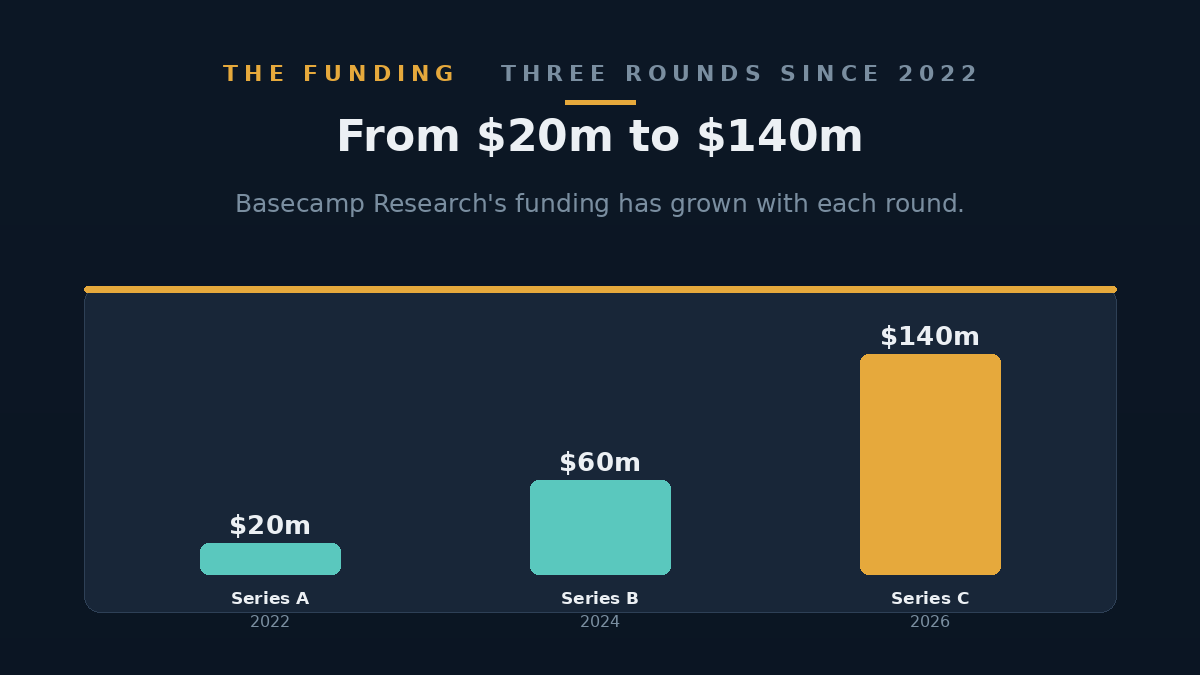
This is Basecamp Research's third disclosed institutional round, and each one has been substantially larger than the last.
| Round | Amount | Date |
|---|---|---|
| Series A | $20m | December 2022 |
| Series B | $60m | October 2024 |
| Series C | $140m | September 2026 |
Basecamp Research's own press release does not state a post-money valuation. Reuters reported, citing the company, that the round valued it at about $800m, a figure that has since been repeated across syndicated coverage but does not appear in Basecamp's own release. Investors in the Series C span deep-tech and biotech specialists (S32, Catalio Capital Management, Redalpine, True Ventures, Singular), strategic technology names (Nvidia and Anthropic, the latter via Menlo Ventures' Anthology Fund, both already technology partners of the company), and two unusual names for a biotech round: the NATO Innovation Fund and the Rockefeller Foundation. Roche vice-chairman Andre Hoffmann also took part, alongside S32 general partner and former Google Verily chief executive Andy Conrad, who is joining Basecamp Research's board.
Why Nvidia, Anthropic and NATO's fund are involved
The Nvidia and Anthropic connections are the least surprising part of the story. Basecamp Research already uses Nvidia hardware to train EDEN, and in June 2026 it integrated two EDEN capabilities, antibiotic design and vaccine target prediction, into Claude Science, Anthropic's AI workbench for life sciences researchers (AIToolBible has covered Claude Science's push into drug development separately). Anthropic's Series C participation itself runs through Menlo Ventures' Anthology Fund, a $100m fund the two companies launched together in 2024, rather than a direct Anthropic corporate cheque. Anthropic's head of life sciences partnerships, Jonah Cool, said the integration gives researchers "a new way to explore and prioritise treatments" using EDEN's outputs, a comment that reads as much as a plug for Claude Science as for Basecamp Research itself.
The NATO Innovation Fund's involvement is more notable. The fund typically backs European deep-tech with dual-use or strategic relevance, and biosecurity, including faster antibiotic and pathogen-response design, fits that remit more obviously than a conventional biotech round would. S32's Andy Conrad framed the wider investor enthusiasm in blunt terms, saying "nowhere is the potential more meaningful than in human health" among the sectors AI is reshaping.
How far this actually is from a real treatment
This is where a healthy dose of scepticism belongs. Basecamp Research CEO Glen Gowers has said the company believes "the future of medicine lies in reprogramming the body to repair itself", and the company points to internal figures, a 63.2% "functional hit rate" across generated DNA prompts and roughly half of its generated recombinase enzymes showing activity in human cells, as evidence its models work. Those figures come from the company's own bioRxiv preprint and were covered by Genetic Engineering & Biotechnology News; they are laboratory metrics, not clinical ones, and have not been independently replicated.
An independent account from former BBC technology correspondent Rory Cellan-Jones, who visited the company, is a useful corrective. He reports that EDEN's disease-relevant work has so far been tested on around nine disease genes in lab conditions, a long way from the thousands of genetic pathways involved in most serious illness. He also records co-founder Oliver Vince acknowledging the model "is not perfect", and Gowers himself estimating that curing a meaningful range of diseases with this approach could take anywhere from five to thirty years and multiple billions of dollars. A reader of that piece raised the standard objection to this whole category of company: most common diseases are polygenic, driven by many genes interacting, not the kind of single-gene target that current AI-designed gene therapies handle best. Basecamp Research has not, to date, published clinical trial results, and Gowers has separately noted that medical regulation is far more stringent than the standards this kind of AI has previously had to meet.
What comes next
Basecamp Research says the new money will fund a next generation of EDEN models and push a six-programme pipeline toward clinical development, alongside the hiring of Richard Pearce, formerly of Biogen, as chief business officer. For a UK reader, the headline fact is simpler than the science: this is a London company that has just pulled in one of the larger AI funding rounds of the year anywhere in Britain, with backing from Nvidia, Anthropic and a NATO-linked fund rather than the usual generalist venture names. Whether that money produces an approved medicine is a question measured in years, not months.
FAQ
What does Basecamp Research actually make?
AI models, called EDEN, trained on a large proprietary genetic dataset. The company uses them to design DNA sequences, enzymes and peptides, aimed initially at in vivo cell therapies for cancer and autoimmune disease, rather than a finished drug you'd recognise as a tablet or injection today.
How much has Basecamp Research raised in total?
More than $220m across three rounds since 2022: a $20m Series A in December 2022, a $60m Series B in October 2024, and the $140m Series C announced in September 2026.
Has a Basecamp Research medicine been tested in humans?
No. The company describes its pipeline as preclinical and advancing toward clinical development. Independent reporting suggests its disease-relevant models have so far been validated on a small number of disease genes in laboratory settings, not in patients.
Why would Nvidia and Anthropic invest in a biotech company?
Both are already technology partners: Basecamp Research trains its models on Nvidia hardware and has integrated some EDEN tools into Anthropic's Claude Science workbench for life sciences researchers, so the investment extends existing commercial relationships as much as it signals belief in the science.
Is the reported $800m valuation confirmed?
Not by Basecamp Research's own press release, which does not state a valuation. Reuters reported, citing the company, that the round valued it at about $800m, and that figure has since been repeated across syndicated coverage.
The takeaway
Basecamp Research's $140m round is real, well-documented and backed by serious names, including two, Nvidia and Anthropic, that already have working relationships with the company rather than a purely speculative bet. That's a genuinely significant UK deep-tech funding story. What it is not, yet, is evidence of a working AI-designed medicine. The company's own leadership puts a realistic timeline in decades, its published validation data covers a handful of genes in lab conditions, and the standard graveyard risk for ambitious biotechs, running out of money or being acquired before the science matures, still applies. Worth watching, not worth treating as a cure.
Sources
- PR Newswire, Basecamp Research's Series C funding announcement (23 September 2026)
- BusinessCloud, "Basecamp Research raises £100m+ to 'cure incurable diseases'" (25 September 2026)
- Basecamp Research, company website and technology overview
- TechCrunch, coverage of Basecamp Research's $60m Series B (9 October 2024)
- Tech.eu, coverage of the Series C round and company history (23 September 2026)
- Rory Cellan-Jones, independent reporting and analysis on Basecamp Research's technology and timeline
- Genetic Engineering & Biotechnology News, Series C coverage with company-reported technical figures
- PR Newswire, Basecamp Research and Anthropic's Claude Science integration announcement (30 June 2026)
- HedgeCo Insights, on the ~$800m valuation reported by Reuters and attributed to the company