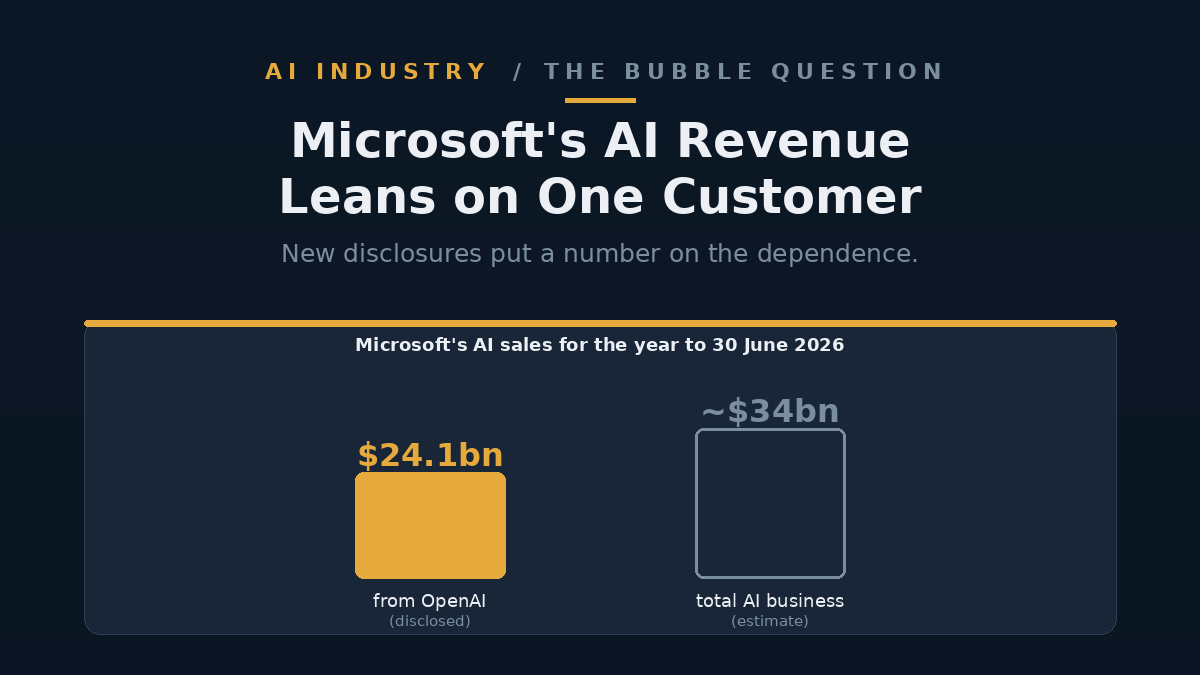
Microsoft's most recent financial filings put a number on something the AI industry rarely says out loud: how much of a giant's AI business depends on a single customer. In its fiscal year that ended on 30 June 2026, Microsoft recorded $24.1 billion of revenue from its commercial arrangements with OpenAI, including revenue-sharing payments. Bloomberg's analysis estimates that this is more than half, and probably around 70%, of Microsoft's actual AI sales for the year. The $24.1 billion is a hard, disclosed figure. The 70% is an estimate built on an assumption. Both are worth understanding, because together they sit right at the centre of the "is this an AI bubble?" argument.
This piece reflects reporting as of August 2026. The disclosed dollar figures are Microsoft's own; the percentage shares are outside estimates and are flagged as such below.
What Microsoft actually disclosed
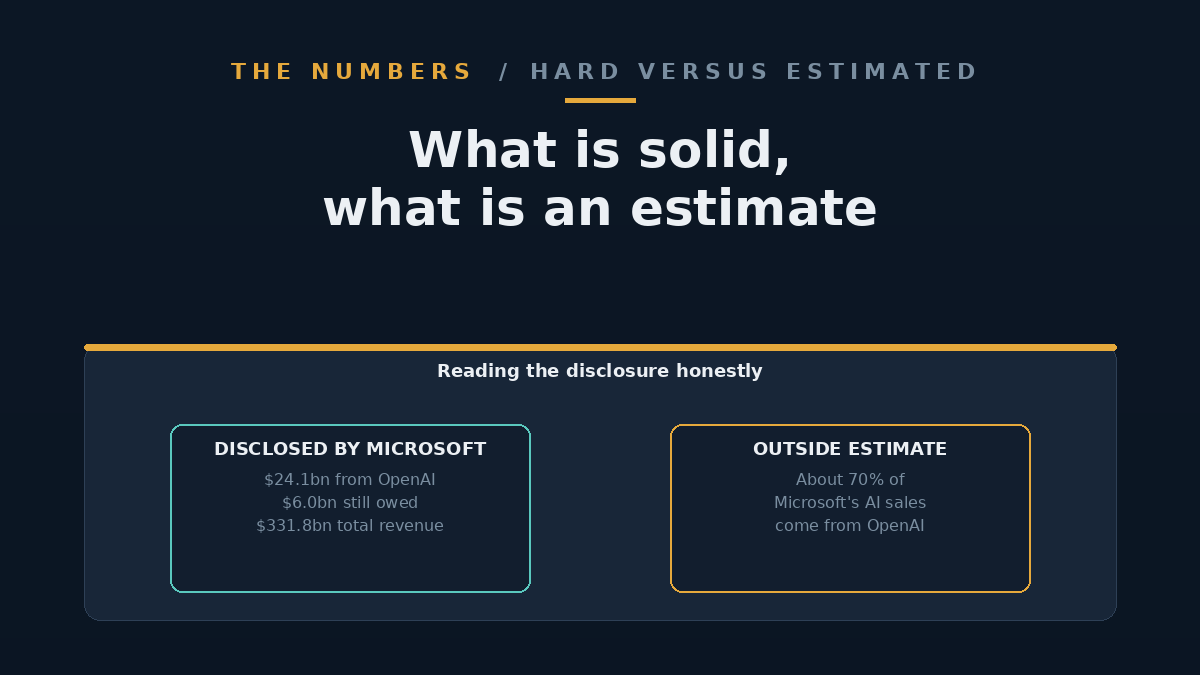
Three numbers are solid because Microsoft itself reported them. It booked $24.1 billion in revenue from OpenAI in the year to 30 June 2026. It was owed $6.0 billion by OpenAI at the end of that period. And its total revenue for the year was $331.8 billion. That last comparison is the one most people can feel: OpenAI's arrangements worked out at roughly 7% of everything Microsoft earned. For a single customer relationship, inside a company that sells everything from Windows to Xbox to Azure cloud services, that is a strikingly large share.
Where the 70% comes from, and why it is an estimate
Microsoft does not publish a clean "total AI revenue" line, which is why the headline share is an estimate rather than a fact. Bloomberg got to its figure by taking the AI growth rate Microsoft reported for March, about 123%, and assuming it held for the rest of the year. That maths implies an AI business of roughly $34 billion for the year. Set the disclosed $24.1 billion from OpenAI against that $34 billion and you get the "about 70%".
Here is the honest wrinkle, and it does not cut the way you might expect. "Run rate" means taking one month and multiplying by twelve, so Microsoft's real AI revenue for the year could be lower than $34 billion. If it is, OpenAI's share is not smaller but larger, because the same disclosed $24.1 billion would then be an even bigger slice of a smaller pie. One alternative calculation lands nearer 65%. In other words, the range of reasonable estimates runs from roughly two-thirds to well over 70%, and the uncertainty mostly points upward, not downward.
Why this feeds the bubble argument
The reason commentators seized on these numbers is what they imply about concentration. If a large majority of Microsoft's AI revenue comes from one company, then Microsoft's AI business is, to a meaningful degree, the OpenAI business. The critic's version of this, argued forcefully by the writer Ed Zitron, is that Microsoft has poured enormous sums into data centres and chips, some $261 billion in capital spending since the start of 2022 by his count, and has little diversified AI revenue to show for it beyond one customer that itself loses money and needs ever more compute. On this reading, the AI boom looks less like broad demand and more like a small number of loss-making labs recycling investment through their cloud suppliers.
The other side
That is not the only way to read it. $24.1 billion of real revenue from OpenAI is not fictional, and it grew fast. Microsoft remains one of the most profitable companies on earth, funding its AI spending out of businesses that have nothing to do with OpenAI. A bull would say concentration is normal early in a platform shift: the first wave of any new technology tends to run through a handful of big customers before it broadens out. The disclosures do not settle whether AI demand is durable and widening or narrow and propped up. They do show that, for now, Microsoft's AI sales lean heavily on one partner, and that is a genuine risk worth naming whichever side of the bubble debate you sit on.
FAQ
Did Microsoft say OpenAI is 70% of its AI revenue?
No. Microsoft disclosed the dollar figures, including $24.1 billion of revenue from OpenAI. The roughly 70% share is Bloomberg's estimate, based on assuming an earlier AI growth rate held for the full year. Treat the dollars as fact and the percentage as a reasonable estimate.
What is the $24.1 billion exactly?
It is the revenue Microsoft booked from its commercial arrangements with OpenAI in the financial year to 30 June 2026, including revenue-sharing payments. Microsoft also disclosed it was owed $6.0 billion by OpenAI at the end of that period.
Does this mean AI is a bubble?
The figures do not prove that either way. They show concentration: a large share of Microsoft's AI revenue rests on one customer. Whether that broadens into wider, durable demand or not is exactly the open question the numbers sharpen rather than answer.
How much of all Microsoft's revenue is this?
About 7%, based on the disclosed $24.1 billion against total revenue of $331.8 billion. Large for a single customer, but still a minority of a company with many other big businesses.
The takeaway
Two facts are worth carrying away. Microsoft earned $24.1 billion from OpenAI last year, and that appears to be the majority of its AI revenue. The exact percentage is contested and the uncertainty tilts higher rather than lower. None of this tells you whether AI spending will pay off, but it does puncture the idea that the boom is already broad-based inside even its biggest winners. For now, one of the companies most associated with the AI wave is heavily reliant on a single, cash-hungry customer, and that dependence is the number to keep an eye on as more disclosures arrive.