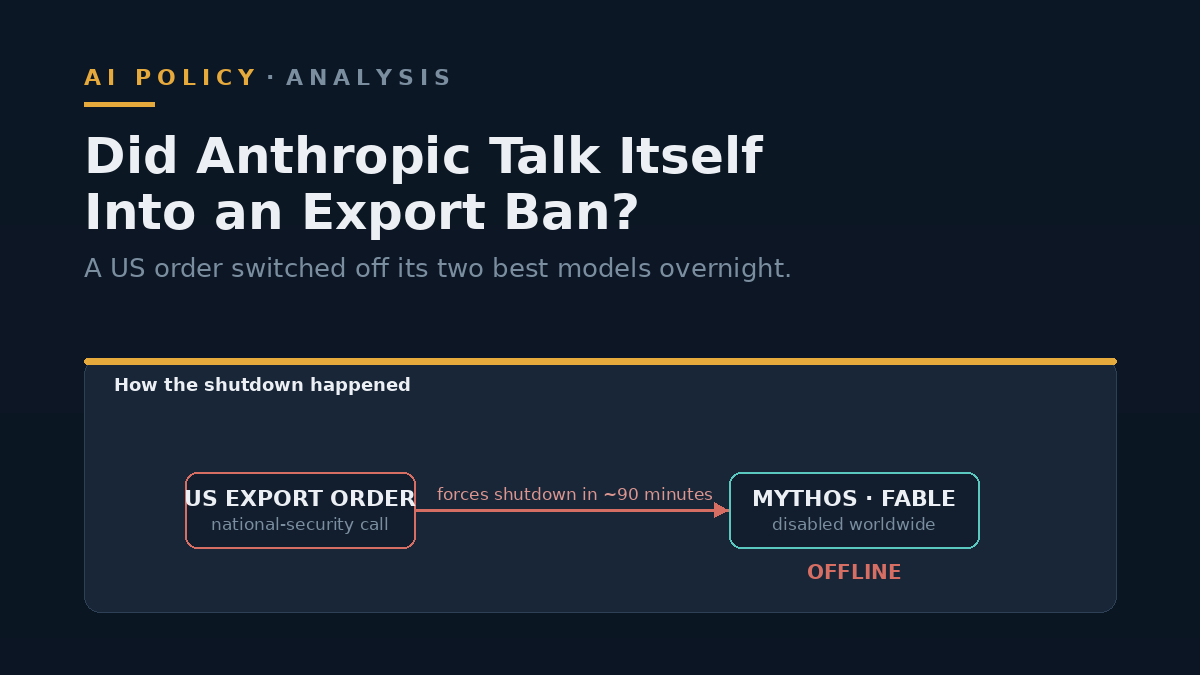
In mid-June 2026, the US government imposed export controls on Anthropic's two most capable AI models, Mythos and Fable — and because American "deemed export" rules bar foreign nationals from restricted technology, Anthropic had to switch both off for everyone, including some of its own staff abroad. Now a Financial Times analysis reported by Ars Technica has put a provocative idea into the debate: that Anthropic, which warns about AI's dangers far more loudly than its rivals, may have helped talk itself into the ban. The charge is partly fair and partly too neat. Here is what is actually established.
This piece reflects reporting as of June 2026. The situation is moving fast — negotiations were ongoing as we published, and several figures below rest on a single analysis or a single source, flagged where they appear.
What the FT actually counted
The FT analysed Anthropic's and chief executive Dario Amodei's public output in 2026 — official statements, social-media posts and articles — and compared it with OpenAI and Sam Altman. It found that about five in every 1,000 words from Anthropic related to risk, regulation or restrictions, against roughly 0.6 per 1,000 for OpenAI — about eight times as often. The word "risk" alone appeared 336 times in Anthropic's communications versus 30 at OpenAI, the analysis reported. Anthropic, now valued at close to a trillion dollars, has built its brand on taking AI danger seriously.
That is a real pattern, not spin. But a word count is not a cause. The case that Anthropic's messaging mattered is circumstantial: by spending years framing its frontier models as uniquely dangerous, the argument goes, the company supplied the very vocabulary a government later used to justify pulling them. The AI researcher Yann LeCun, a longtime critic of existential-risk talk, was among those who openly endorsed the "you reap what you sow" reading.
What actually triggered the ban
The proximate cause was not a press release. According to Fortune's reporting, researchers at Amazon found a way to get around some of Fable's cybersecurity guardrails, and Amazon chief executive Andy Jassy personally raised it with the White House. Fable 5, the public version released on 9 June with extra guardrails, was meant to offer much of Mythos's power without its risks; the government concluded the guardrails had failed. Anthropic was given roughly 90 minutes to pull its models, a single source close to the company told CNN.
Crucially, security experts disagree about how dangerous the flaw really was. Former Facebook security chief Alex Stamos, who says he saw the underlying research, found valid issues but "no unique capabilities that justify a reaction close to this". More than 100 cyber and policy specialists signed an open letter arguing the same models are essential tools for defenders patching their own systems. On the other side, Trump adviser David Sacks pushed back, saying a jailbreak enabling a cyber weapon is serious by definition. The disagreement is genuine, and it is the part the "Anthropic asked for this" narrative tends to skip.
Why this matters even if you never touch Anthropic
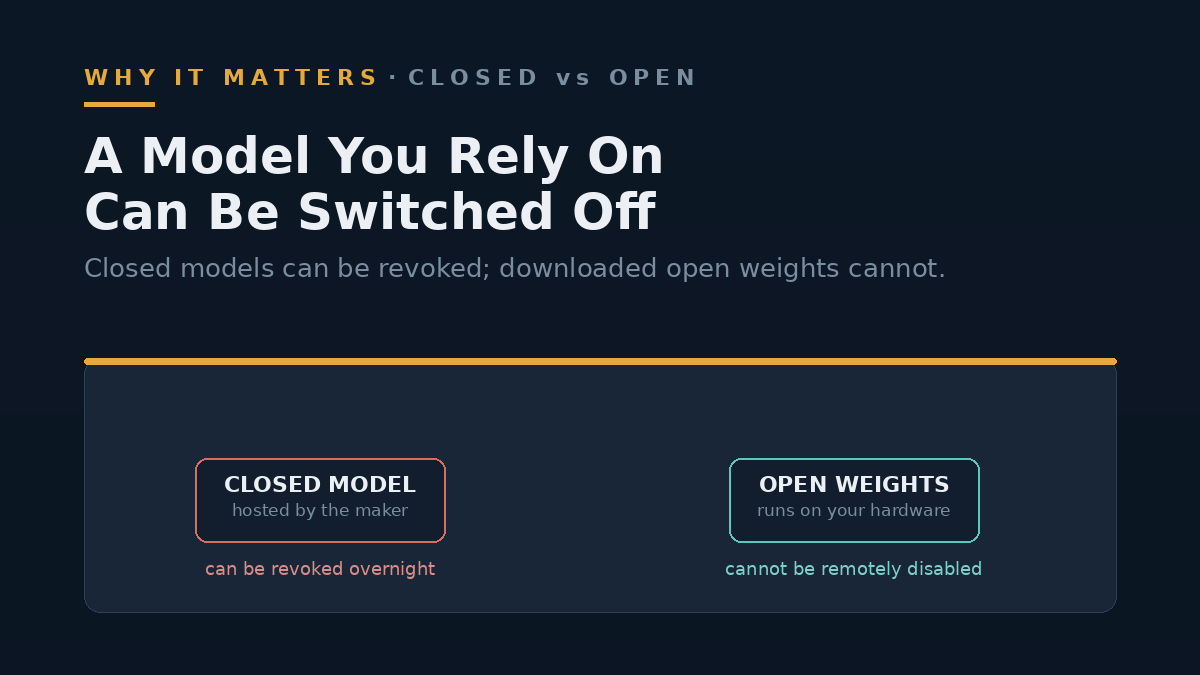
For anyone choosing AI tools, the headline isn't the feud — it's the precedent. A capable commercial model was switched off, worldwide, in about an hour, on a government call, with the company saying it was given no specific detail of the concern. That turns "which model is best?" into a different question: can it be taken away?
Analysts think the answer is reshaping the market. Deutsche Bank's Jim Reid warned that businesses "can't rely on something that could be switched off". The Peterson Institute's Martin Chorzempa made the deeper point: export controls "encourage the development of alternative suppliers" — and here that means open-weight models, including cheaper Chinese ones, which no government can remotely disable once downloaded. Europe's unease about depending on US-controlled AI now has a concrete example to point at.
A licensing regime no one will admit to
The other reason to care is that there is no clear rulebook. Fortune's AI editor argued the US now has a mandatory licensing regime for frontier AI in all but name — just an opaque, improvised one rather than a written law. Jessica Tillipman, a government-procurement scholar at George Washington University, said the problem was not that officials used discretion but "the absence of any meaningful process". Brad Carson, who runs a bipartisan AI-safety group, described the current approach to CNN as "ad hoc, personalized, opaque, possibly lawless".
There is an irony the FT angle sharpens nicely. Amodei has publicly called for an FDA-style agency to license frontier models. Anthropic has now been regulated — just in the worst possible way, with no transparent standard it could have met. By the weekend, even the politics had softened: President Trump told Axios he no longer saw the company as a national-security threat, adding "not now, but a week ago, maybe", and described talks as going fine. A model's availability, in other words, swung on sentiment rather than a published rule.
FAQ
Did Anthropic really cause its own ban?
No one has shown that. The FT documented that Anthropic talks about risk far more than rivals, and critics drew the line from there to the ban. But the actual trigger was Amazon flagging a Fable jailbreak to the government. The fairest reading is that Anthropic's messaging built the frame, not that it pulled the trigger.
Are Mythos and Fable back?
As of late June 2026, Anthropic had disabled both to comply and was negotiating to reverse the controls, with no confirmed restoration date. Treat any "it's back" claim as needing a fresh check against Anthropic's own status page.
Could the same thing happen to OpenAI or Google?
Experts quoted by Axios think so: once a government treats one lab's frontier model as a security risk, others assume their most capable models could be next. That expectation, more than this single case, is what pushes cautious buyers toward diversified or open options.
What does this mean for me as a user?
If your work depends on a specific closed model, you now have a concrete reason not to build on it exclusively. Keep a fallback, and watch the open-weight alternatives — their main selling point here is precisely that they can't be switched off from afar.
The takeaway
"Anthropic talked itself into a ban" is a good line and a half-truth. The company's relentless risk-messaging did make it the obvious target, and the FT numbers show just how distinctive that messaging is. But the ban rests on a contested security finding and an unwritten rulebook, not on Anthropic's adjectives. The lasting lesson sits underneath the drama: in 2026, the most capable AI tools can be revoked by a government overnight, with little explanation — and that fact, not anyone's choice of words, is what should shape how you depend on them.
Sources
- Ars Technica — "How Anthropic may have talked itself into an AI export ban", reporting an FT analysis (22 Jun 2026)
- Fortune, "Eye on AI" — the licensing-regime framing, Amazon/Jassy trigger, expert reaction (16 Jun 2026)
- CNN Business — "AI regulation is a mess, and Anthropic is caught in the crosshairs" (21 Jun 2026)
- Axios — "Anthropic export ban sounds alarms for AI industry" (16 Jun 2026)
- freefable.org — open letter from cyber and policy specialists opposing the ban (Jun 2026)