
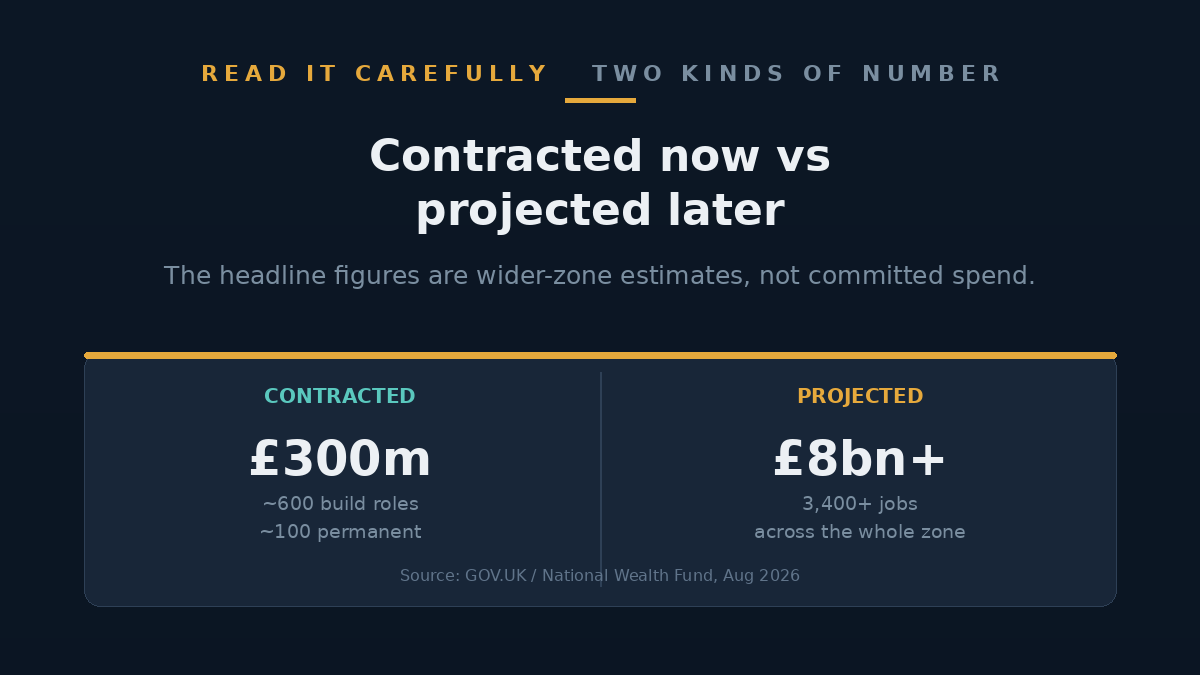
Scotland's first designated AI Growth Zone, in Lanarkshire, has secured a £300m financing package to build the data centres that AI runs on, the government announced on 18 August 2026. Most of the money is underwritten by a £202m guarantee from the taxpayer-backed National Wealth Fund, with the rest coming from a syndicate of commercial lenders. Scottish operator DataVita will expand one data centre and build a second on the same site, powered largely by Scotland's renewable grid. Dell is relocating its Scottish team to the park. The catch worth stating plainly: the eye-catching "3,400 jobs" and "£8bn" figures are government projections for the wider zone, not part of this £300m.
This piece reflects reporting as of August 2026. The investment and jobs figures come substantially from government and developer sources; where a number rests on a single interested party we have said so.
What was actually announced
An AI Growth Zone is a place the government has singled out for fast build-out of both the physical infrastructure that runs AI – power, land, data centres – and the skills to staff it. Lanarkshire was named as one in January 2026. The 18 August news is the money arriving: a £300m package that lets DataVita expand its existing DV1 facility and construct a second one alongside it.
The financing is unusual in how it is put together. A £202m guarantee from the National Wealth Fund – the government's own investment bank – sits behind the package, with commercial money from ING, ABN AMRO, Santander, the Scottish National Investment Bank and Siemens Financial Services alongside it, according to UKTN. In plain terms, the state is standing behind most of the risk so private lenders will fund the build.

Contracted money versus projected money
This is where a reader should be careful, because two very different kinds of number are travelling together. The £300m is contracted: the guarantee is issued, the lenders are named, and DataVita says the first facility completes this year with every megawatt already spoken for. The more than £8bn of private investment and the more than 3,400 jobs the government cites are projections for the wider zone over time, not commitments attached to this package. The concrete headcount from the two data centres themselves is smaller – around 600 roles during construction and about 100 permanent posts once running, according to the National Wealth Fund.
None of that makes the announcement hollow. Contracted infrastructure finance on this scale, in a part of Scotland that has not seen much of it, is a genuine event. It is just that "up to 3,400 jobs" and "£300m committed now" are answers to different questions, and the press release invites you to read them as one.
Why a Scottish data centre matters to the rest of the UK
Two threads run through this for readers outside Lanarkshire. The first is sovereign compute: the ability to train and run AI on infrastructure sited in, and answerable to, the UK rather than renting it from US hyperscalers. A data centre on Scotland's grid is a small step toward that, and the government is explicit that it wants the country building the infrastructure rather than only consuming the software.
The second is power. AI data centres are enormous electricity consumers, and where that power comes from is becoming the whole argument. Lanarkshire's pitch rests on Scotland's renewable grid, which is a cleaner story than a gas-fired site – though "largely renewable" is doing some work in that sentence, and the grid connection and water use of large data centres remain live concerns wherever they are built. Dell relocating its Scottish team to the park, as UKTN notes, is a signal that the cluster is meant to attract tenants, not just servers.
FAQ
What is an AI Growth Zone?
A location the UK government has designated for accelerated development of AI infrastructure and skills, with planning and investment support attached. Lanarkshire is Scotland's first.
Is the £300m taxpayer money?
Not directly, but the taxpayer is exposed. A £202m guarantee from the government-owned National Wealth Fund underwrites most of the package, which is what makes the commercial lending viable. The cash itself is largely private.
Are the 3,400 jobs real?
They are a projection for the wider growth zone over time, not a commitment tied to this £300m. The two data centres at the heart of the deal account for around 600 construction roles and about 100 permanent jobs.
When does it open?
DataVita says the first facility completes in 2026, with a second to follow on the same site.
The takeaway
Strip out the projection figures and there is still a real story here: contracted money, a state guarantee, named lenders and a data centre completing this year, in a part of Scotland that was not an obvious candidate for it. That is worth more than the £8bn headline, because it is money that actually exists. The open questions are the ones that follow every data centre now – how clean the power really is, and whether the promised jobs materialise once the concrete is poured.
Sources
- GOV.UK / DSIT – Lanarkshire AI Growth Zone secures £300 million investment as Dell establishes Scottish base (18 August 2026)
- National Wealth Fund – DataVita secures £300 million for data centre rollout in Scotland's AI Growth Zone (18 August 2026)
- UKTN – Scottish AI Growth Zone lands £300m infrastructure backing (18 August 2026)
- Computer Weekly – Lanarkshire gets £300m to fund AI growth zone (18 August 2026)
- DataCentreNews – DataVita secures £300 million to build AI data centres (August 2026)
- UKTN – Scottish county named as latest AI Growth Zone (29 January 2026)