Solos has announced the AirGo A6, a pair of AI smart glasses that deliberately leave out the camera. Instead of chasing more hardware, Solos is betting that people will wear smart glasses more readily if they look like ordinary glasses and do not put a lens on your face pointed at everyone around you. Unveiled at the AI Smartglasses Symposium in Hong Kong in early July 2026, the A6 keeps a voice-first AI assistant — translation, messaging, reminders and audio — while removing the feature that has drawn the most criticism from the category. The honest catch: Solos has not announced a price or a release date, so for now this is a product to note, not one you can buy.
This piece reflects reporting as of July 2026. Specifications and weight are as stated by Solos and were not independently tested; pricing and availability, including for the UK, were not confirmed at the time of writing.
What the AirGo A6 is
The A6 is a pair of smart glasses with an AI assistant built in but no camera at all. Solos says the frames weigh around 19 grams without lenses — which, if accurate, would make them among the lightest AI glasses announced so far — and that they take prescription lenses. The pitch is comfort and everyday wearability rather than a spec sheet.
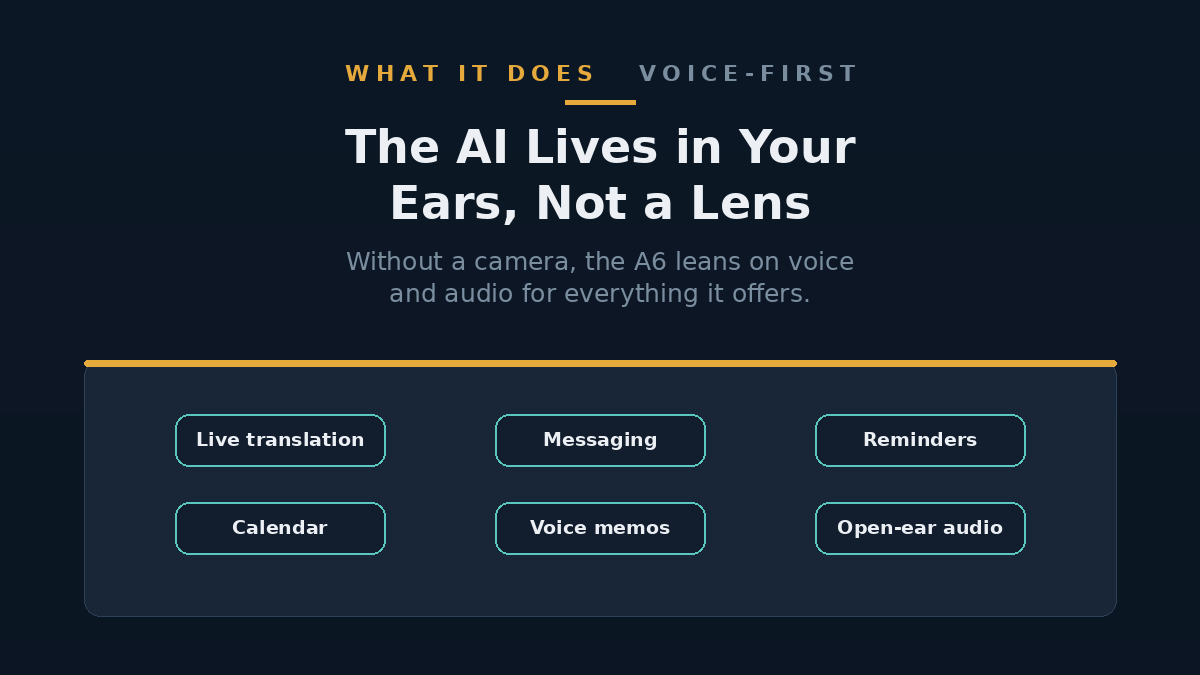
Because there is no camera, the features are voice- and audio-led: a hands-free assistant Solos calls SolosChat, wake-word activation, live translation, messaging, a calendar, reminders, voice memos, and open-ear audio for calls and music that lets you still hear the world around you. Solos also describes the glasses as running on an "open AI platform" it says will gain features through software updates over time.
Why leaving the camera out is the point
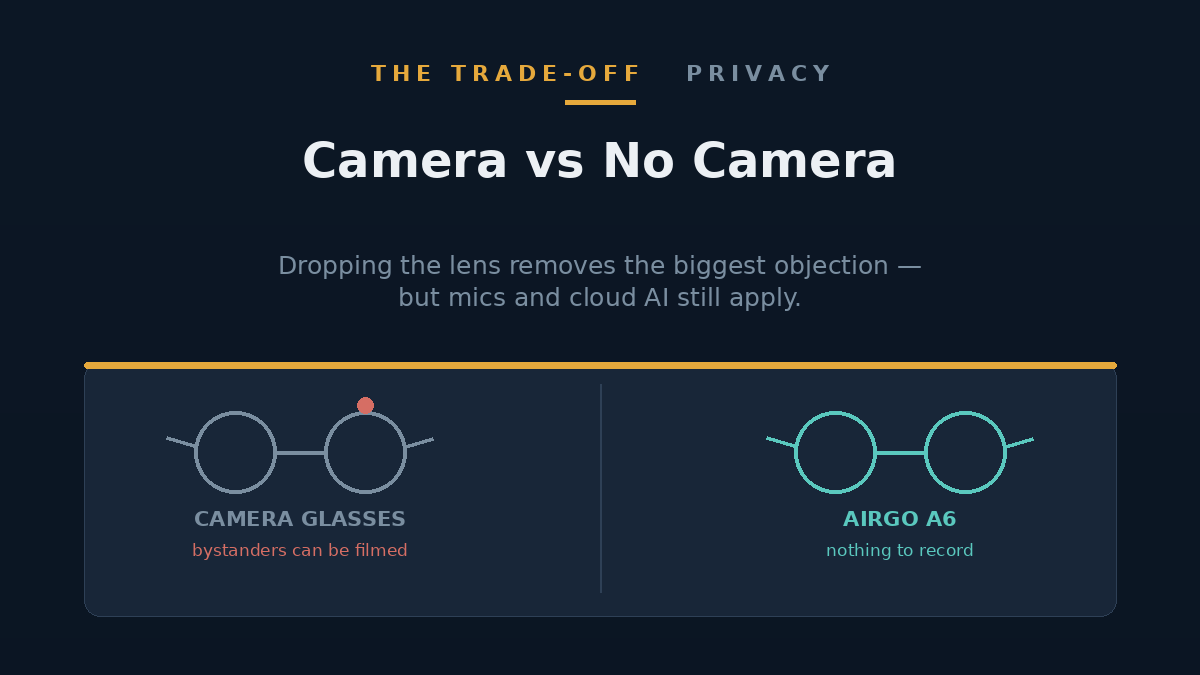
Camera-equipped smart glasses — most visibly Meta's Ray-Bans — have been dogged by a simple objection: other people cannot easily tell when they are being filmed or photographed. That worry has followed the whole category since Google Glass more than a decade ago. By removing the camera, the A6 sidesteps it entirely. There is no lens to point, nothing to record, and nothing for a bystander to object to.
It is worth being precise about what that does and does not solve. No camera genuinely removes the biggest and most public privacy problem with face-worn tech. It does not, however, make the glasses data-free: a voice assistant still uses microphones, and features like live translation typically send audio to the cloud to be processed. "No camera" is a real and meaningful step, not a guarantee of privacy in the round.
The slightly awkward companion story
Alongside the camera-less A6, Solos also launched a Privacy Kit — but, tellingly, that kit is for its camera-equipped model, the AirGo V2. It adds a clip-on shield that physically covers the V2's camera, plus a clear temple and a sun lens, and starts at $39, with a fuller bundle at $79. As Android Central drily observed, there is something odd about selling a piece of plastic to block a camera you chose to include. The A6's approach — simply not fitting a camera in the first place — is the cleaner answer to the same problem.
How it fits the wider smart-glasses race
Smart glasses have become one of tech's busier battlegrounds, with Meta, Google's Android XR partners, Samsung and a field of specialists all pushing in. Most of the attention has gone to camera-and-display models that can film, capture and overlay information. The A6 stakes out the opposite corner: a lightweight, camera-free, assistant-in-your-ears device for people who want the convenience without the surveillance connotations. Whether that is a large market or a niche is the open question — and one Solos cannot answer until it says what the glasses cost and when they ship.
FAQ
Does the AirGo A6 have a camera?
No. Solos has deliberately left the camera out. The AI features are voice- and audio-based, which is the whole point of the design.
Can I buy it, and how much is it?
Not yet. Solos announced the A6 but has not revealed a price or a release date. Its camera-equipped sibling, the AirGo V2, is on sale globally from around $299.
Does "no camera" mean it is fully private?
No. Removing the camera addresses the biggest objection to smart glasses, but the device still has microphones, and cloud-based features such as translation involve sending audio off the glasses to be processed.
Will it work in the UK?
Solos has not confirmed UK pricing or availability. Treat any launch details as pending until the company states them.
The takeaway
The AirGo A6 is one of the more interesting smart-glasses ideas in a crowded field precisely because it removes a feature rather than adding one. For anyone put off by the thought of wearing — or standing next to — a face camera, a lightweight, camera-free assistant is a genuinely different proposition. Two caveats keep it honest: everything about the weight and features comes from Solos and has not been independently tested, and without a price or a date, the A6 is a statement of intent rather than a purchase. Worth watching; not yet worth planning around.