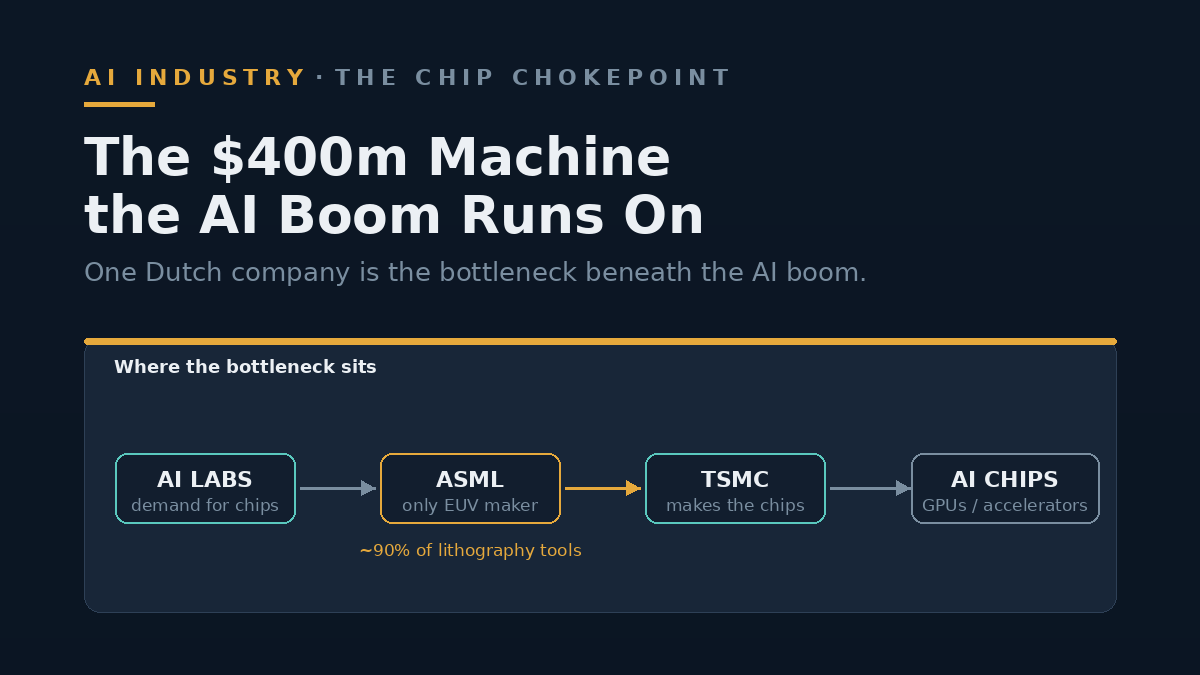
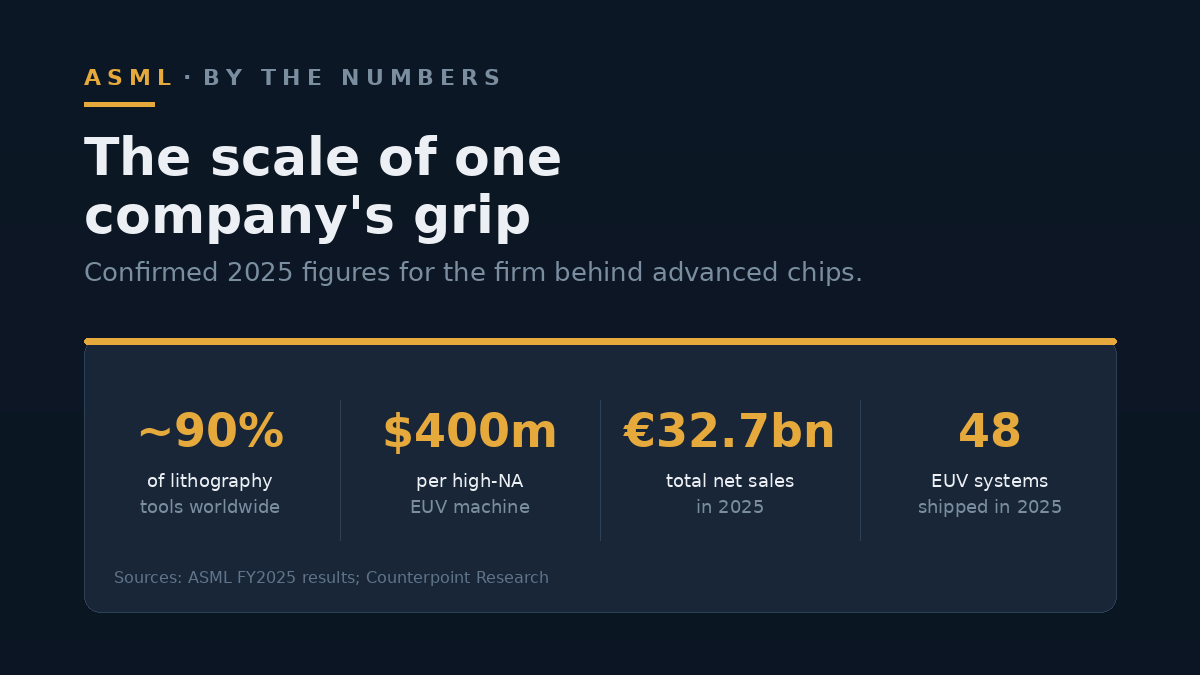
The AI boom is usually told as a story about models and the companies that build them. Underneath it sits a far narrower bottleneck. Almost every advanced chip that trains or runs a modern AI model is patterned by a machine made by one company: ASML, a Dutch firm that supplies roughly 90% of the world's chip-lithography tools and is the only maker of the extreme-ultraviolet (EUV) machines needed for the most advanced chips. Its newest tool costs about $400m each. That concentration — not any single model — is the real chokepoint beneath the AI era, and the challengers trying to break it have not yet shipped anything that works at scale.
This piece reflects reporting as of June 2026. Prices, valuations and shipment figures move quickly and are flagged where they rest on a single or interested source.
What ASML actually makes
Lithography is the step in chipmaking where light is shone through a patterned mask onto a silicon wafer to lay down the transistors and wiring of a chip. The smaller the wavelength of light, the smaller the features you can print — and smaller, more densely packed features are what make each chip generation faster and more efficient. For decades the industry inched down through visible and then deep-ultraviolet light. The next jump, to EUV, took ASML about 16 years and roughly $10bn in research to make work, and rivals Nikon and Canon dropped out along the way.
The result is a field controlled by very few players. ASML makes the machines; Taiwan's TSMC uses them to fabricate the majority of the world's most advanced chips. That pairing is concentrated enough to carry geopolitical weight. As Marc Hijink, author of a book on ASML, puts it, "chips are the new oil" — and being cut off from them can be as damaging as being cut off from energy.
Why the AI boom made it indispensable
ASML's timing was lucky. Its first EUV machines reached the market in 2017, and some doubted demand would justify the price. Then GPT-3 and ChatGPT arrived, and firms such as OpenAI, Google, Meta and Anthropic began building enormous server farms to train and run large language models. That created ravenous demand for denser chips — and for Nvidia's AI GPUs, the top-end of which can sell for around $40,000 each. EUV is what lets chipmakers crank out those AI-tailored designs at volume.
The financial result is stark. ASML reported €32.7bn in total net sales for 2025, with EUV accounting for roughly half of its system revenue, and the company's market value has climbed past half a trillion dollars, making it Europe's most valuable listed company. Independent analysts put its 2025 shipments at 48 EUV systems and 131 immersion DUV tools. If you make advanced chips, ASML is effectively unavoidable.
The $400m upgrade
The machine at the centre of MIT Technology Review's reporting is ASML's "high-NA" EUV system. Rather than switch to a new kind of light, ASML raised what is called the numerical aperture — in plain terms, it focused the existing EUV light more tightly. That lets it print features down to about eight nanometres, roughly the width of 40 silicon atoms, against about 13 nanometres on the earlier machines. The engineering is extreme: the reticle stage that carries the chip pattern now whips back and forth at accelerations of around 32g, four times faster than on the previous generation.
The catch is the price and the maths behind it. At about $400m, high-NA is far more expensive than the previous generation, and the improvement is evolutionary rather than a leap. Intel bought the first high-NA machine and is testing it in Oregon; TSMC has said it will adopt high-NA only when it is mature, and some observers expect it to keep squeezing its existing EUV tools for years first. One former ASML engineer, now an analyst at SemiAnalysis, described high-NA as the first tool that did not obviously make business sense for ASML straight away — a sign that even the chokepoint has limits on how fast it can push.
The chokepoint and the politics
Because so much rides on so few machines, EUV has become an instrument of statecraft. The United States pressed the Dutch government not to renew ASML's licence to export EUV machines to China, and ASML has shipped no EUV tools to Chinese customers since 2019. China has responded by pouring billions into building its own EUV capability; a Reuters report last winter described a government skunkworks, staffed partly by former ASML engineers, that had assembled a prototype machine filling almost an entire factory floor. Whether it works at industrial scale is unclear.
In the meantime China is doing two things: pushing older deep-ultraviolet machines to their limits through a slower technique called multi-patterning, and innovating in software rather than hardware — building leaner models such as DeepSeek that demand less of the fastest chips. It is a reminder that an export control on machines does not, by itself, stop a country competing in AI.
Who is trying to break the monopoly
ASML's dominance, and the swelling cost of its tools, has drawn challengers who are not trying to copy EUV but to route around it. The two most discussed are early-stage and unproven, and both are years from volume:
| Challenger | Approach | Stated aim | Status |
|---|---|---|---|
| Substrate (US) | X-ray light from a compact particle accelerator; build its own chips rather than sell machines | Wafers at around $10,000 each, fab at scale by 2030 | Lab-scale patterns shown; secretive about method |
| Lace Lithography (Norway) | A beam of helium atoms instead of light | Precision near 0.1nm; test tool in a pilot fab by 2029, volume years further out | Earlier-stage; smaller, lower-power design |
| China (state) | Replicate EUV domestically | Any domestic output to reduce reliance on the West | Reported lab machine; scale unproven |
Industry watchers are split on the upstarts. One book author on the sector regards Substrate's secrecy as a warning sign, arguing the field advances through open innovation; the SemiAnalysis analyst is more impressed by the ambition but cautions there is "a long road between lab-scale demonstration and high volume". Chris Miller, the historian who wrote Chip War, notes that lithography transitions have historically taken years, sometimes decades. ASML's own technology chief says he has not yet seen a viable alternative for making the most advanced chips at volume.
FAQ
Is ASML really a monopoly?
Not on every machine. Nikon and Canon still make older deep-ultraviolet tools. But ASML is the only company making EUV machines, and it supplies roughly 90% of lithography tools by value — so for the most advanced chips, it is effectively the only option.
Why does this matter for AI specifically?
Training and running large AI models needs vast numbers of advanced chips. Those chips are denser and faster largely because of EUV patterning. A constraint on the machines that make them is a constraint on how much AI compute the world can build.
Could China simply build its own?
It is trying, and has reportedly assembled an experimental machine, but making EUV light reliably and at industrial throughput is extraordinarily hard. Analysts quoted in the reporting think a competitive, high-volume Chinese EUV tool is years away.
Will the cost of these machines slow the AI build-out?
It can shape it. At about $400m a machine and tens of billions to build a single fab, only a handful of firms can afford the cutting edge — which is part of why advanced AI compute stays concentrated among a few large players.
The takeaway
The loudest AI stories are about models, but the most concentrated risk sits one layer down, in the machines that pattern the chips. One Dutch company supplies almost all of them, a single Taiwanese firm turns most of them into chips, and the credible alternatives are still in the lab. That makes the supply chain beneath AI more concentrated, more expensive and more politically exposed than the model headlines suggest. The challengers may eventually change that — but on the public evidence, not soon.
Sources
- MIT Technology Review — "The $400 million machine powering the future of chipmaking" (reported feature, 23 Jun 2026)
- ASML — Q4 and full-year 2025 financial results (company release)
- Counterpoint Research — ASML 2025 revenue and EUV/DUV shipment analysis
- Reuters — How China built its "Manhattan Project" rival for AI chips (Dec 2025)