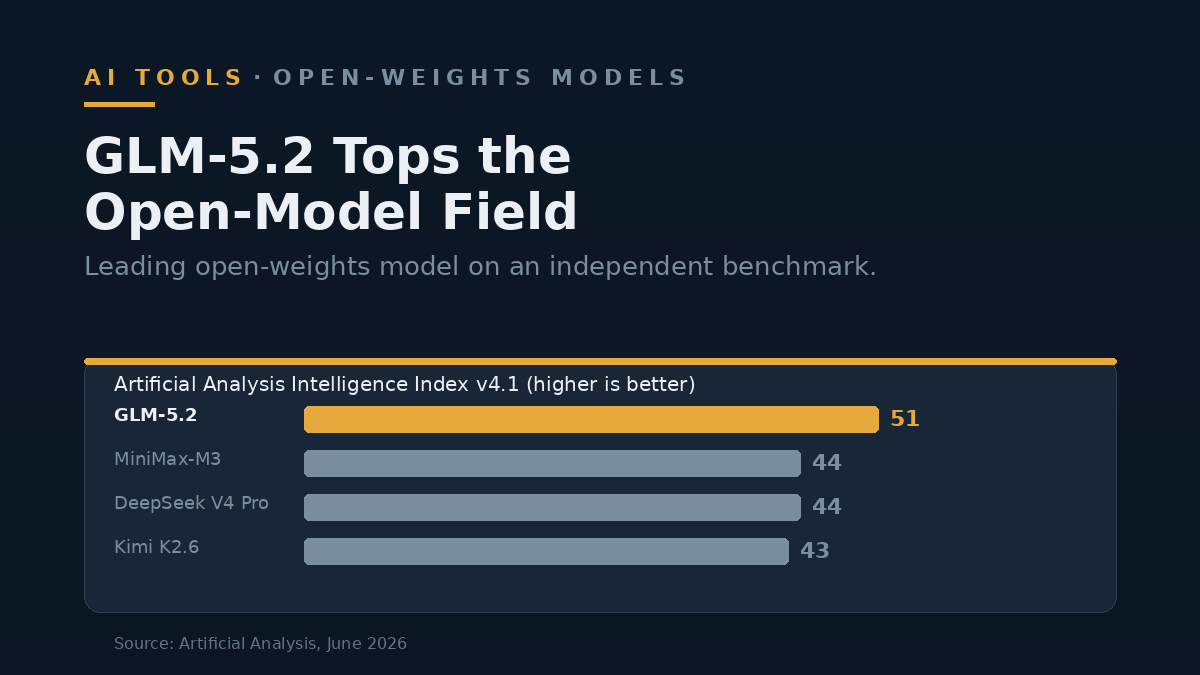
GLM-5.2, released in June 2026 by the Chinese lab Z.ai, is now the strongest "open-weights" AI model available — meaning anyone can download it and run it themselves — according to Artificial Analysis, one of the more respected independent benchmarks. It scores close to the big closed models from OpenAI, Anthropic and Google, at a fraction of their price. That is a real milestone. But "best open model" is not the same as "best model for you": GLM-5.2 can't see images, burns through a lot of text to do its thinking, and isn't actually the cheapest option for simple jobs. This is what it is, and when it makes sense.
This piece reflects reporting as of June 2026. Model rankings, prices and benchmark positions move quickly and many figures below are vendor- or benchmark-reported — treat them as a snapshot, not a fixed spec.
What "open weights" means, briefly
Most well-known AI tools — ChatGPT, Claude, Gemini — are "closed": you rent access through the company's website or interface, and you can't take the underlying model away. An "open-weights" model is one whose trained parameters are published for download, so you (or a hosting provider) can run it on your own hardware or through any number of third parties. GLM-5.2 is released under an MIT licence, one of the most permissive there is, which means businesses can use it commercially with very few strings attached. That ownability is the entire appeal of going open.
What GLM-5.2 actually is
By the numbers reported on its model card, GLM-5.2 is a large model — around 753 billion parameters in total, of which roughly 40 billion are active for any given task (a "mixture of experts" design that keeps running costs down), with a one-million-token context window, a large jump from the previous version's 200,000. The headline practical limitation: it is text-only. It cannot read images, screenshots, charts or PDFs-as-pictures. Z.ai has separate vision models, but those are not part of this open release.
What it's genuinely good at
On the independent Artificial Analysis Intelligence Index, GLM-5.2 leads all other open-weights models, scoring 51 against the low-to-mid 40s for rivals like MiniMax-M3, DeepSeek V4 Pro and Kimi K2.6. It ranks particularly well for coding: independent developer and analyst Simon Willison noted it placed second on a web-development coding leaderboard, behind only a top closed model. The practitioner buzz has been strong, with several experienced developers describing real, hard tasks it completed well — and a few calling it a watershed for open models, echoing the excitement around DeepSeek's breakout a year earlier.
For a non-technical reader, the short version is: for text-based reasoning and especially for coding-style tasks, this freely available model now operates in roughly the same league as paid frontier tools — something that simply wasn't true of open models until recently.
The catches that decide whether it's for you
Three things temper the hype, and they matter more than the leaderboard position.
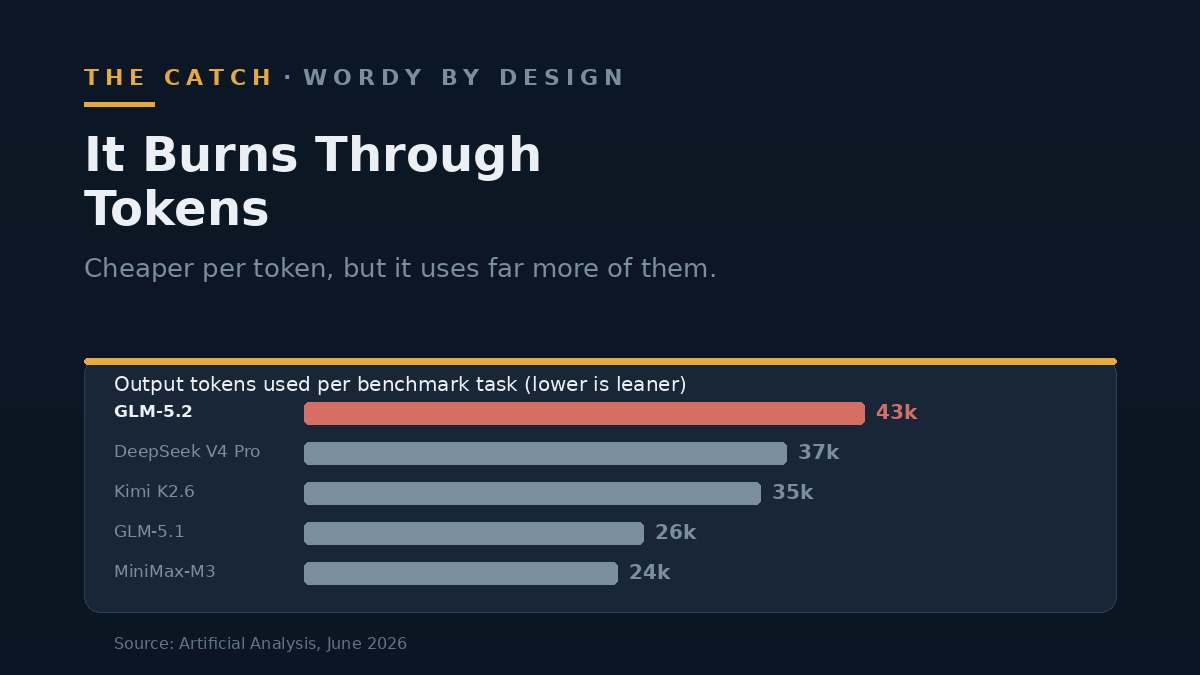
It's token-hungry. Artificial Analysis found GLM-5.2 uses substantially more output text to complete a task than other leading open models — roughly 43,000 tokens per benchmark task, well above its rivals. Because you pay per token and wait while they generate, a "cheaper per token" model that produces far more tokens can end up slower and not actually cheaper in practice. Several testers reported exactly that.
It probably learned from Claude. Multiple commentators have observed that GLM-5.2 often identifies itself as Claude and writes in a recognisably Claude-like voice, which they take as strong evidence it was "distilled" from Anthropic's models — trained partly on their outputs. This is an inference drawn from the model's behaviour, not something Z.ai has stated. If true, it has a known side effect: distilled models tend to look better on benchmarks and common tasks than they perform on unusual, real-world ones. That fits the split reviews — some users found it excellent, others called it "benchmaxxed" and short on common sense.
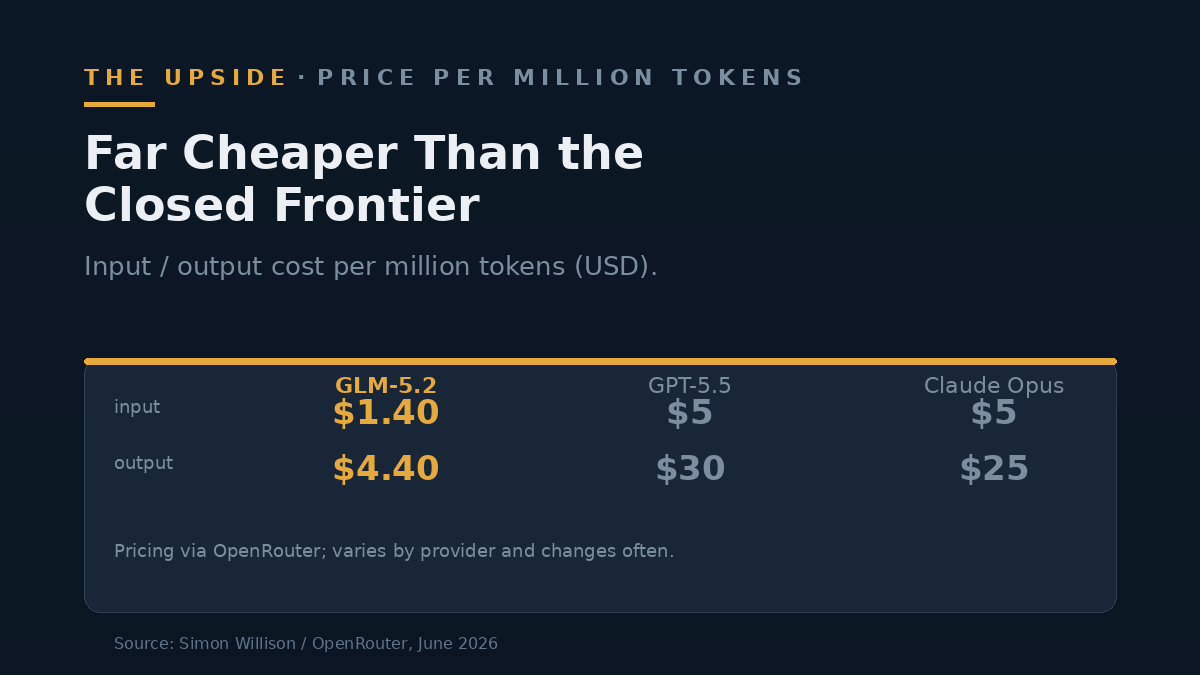
The price advantage is narrower than it looks. Run through a host like OpenRouter, GLM-5.2 has been priced around $1.40 per million input tokens and $4.40 per million output tokens — far below the roughly $5/$30 and $5/$25 of GPT-5.5 and Claude Opus. But for simple, high-volume jobs, other open models are cheaper still; and for the hardest tasks, you usually still want a top closed model. That leaves GLM-5.2 in a specific sweet spot rather than an obvious default.
So who should actually use it?
GLM-5.2 makes the most sense if you specifically value openness — you want to run a capable model on infrastructure you control, keep data in-house, avoid being locked to a single vendor, or build a product on a model that can't be switched off or repriced from under you. For coding and text reasoning, it is now a credible option for that. If you just want the easiest, cheapest, or most capable general assistant and don't care where it runs, the mainstream closed tools (or a cheaper open model for bulk work) are likely the better call — and you'll get image understanding, which GLM-5.2 lacks.
| If you want… | GLM-5.2 fit |
|---|---|
| A capable model you can self-host or run via any provider | Strong — currently the best open option |
| Coding and text-heavy reasoning | Strong |
| Image, screenshot or chart understanding | No — text only |
| The cheapest option for simple, high-volume tasks | Weak — token-hungry; cheaper open models exist |
| The absolute strongest model, ease aside | Weak — closed frontier still leads |
FAQ
Is GLM-5.2 free?
The model itself is free to download and run under a permissive MIT licence, so there's no licence fee. But running it costs money — either your own hardware and electricity, or per-token charges through a hosting provider. "Open" means ownable, not free to operate.
Can I just use it like ChatGPT?
Not directly from Z.ai in the same one-click way for most users. The simplest route is a hosting service such as OpenRouter that offers it through a chat interface or an API. Self-hosting a 753-billion-parameter model needs serious hardware and is not realistic on an ordinary PC.
Is it as good as Claude or GPT-5.5?
On text and coding benchmarks it's close, and some testers rate it competitively for real work. But the closed frontier models still lead overall, handle images, and tend to behave more reliably on unusual tasks. "Best open model" is accurate; "best model" is not.
Is it safe to use a Chinese-made model?
Because the weights are open and can be run on infrastructure you control, you are not required to send data to Z.ai's servers — which is part of the appeal for privacy-conscious users. As with any model, judgement about data handling depends on how and where you run it, and on your own compliance needs.
The takeaway
GLM-5.2 is a genuine milestone: an open, freely downloadable model that now trades blows with the closed frontier on text and coding, under a licence that lets businesses build on it. That matters, because it means the gap between "models you rent" and "models you own" is narrower than it has ever been. But the leaderboard headline oversells the day-to-day reality. It can't see, it's wordy and slow, it isn't the cheapest for routine work, and its strongest scores may flatter it. Use it if owning and controlling a capable model is the point. If it isn't, the mainstream tools still win on ease — for now.