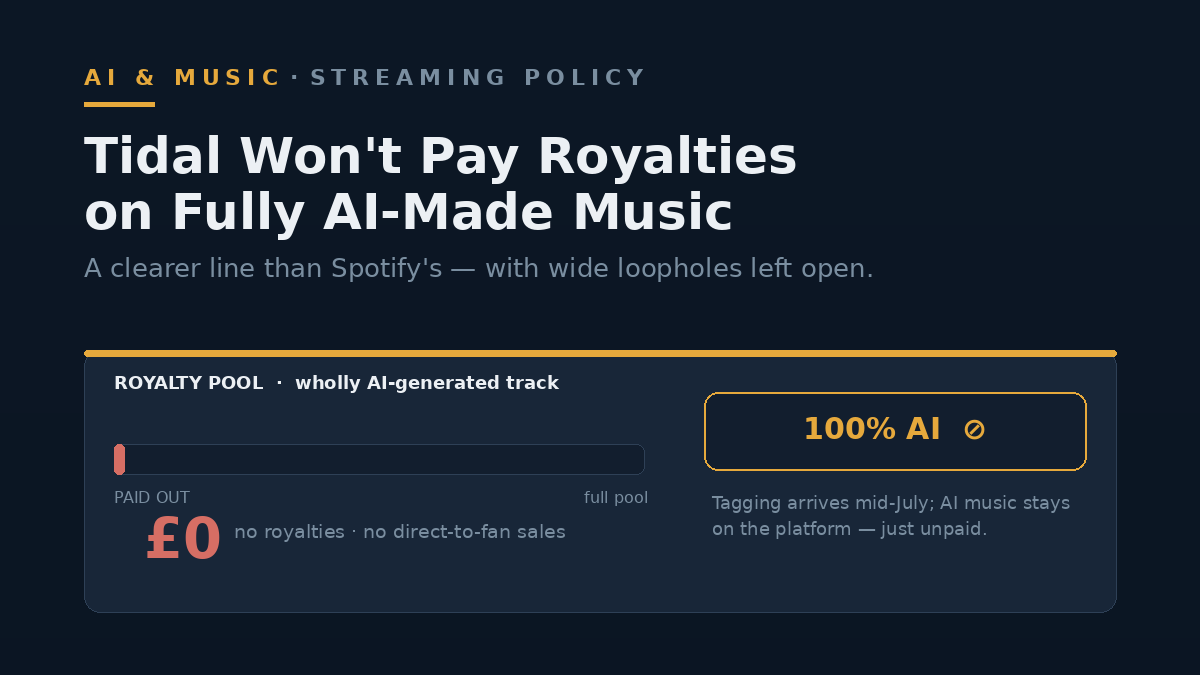
On 29 June 2026, music streaming service Tidal published an AI policy stating that wholly AI-generated music will no longer earn royalties on its platform. "Starting today, AI-generated music will not be monetizable," the company wrote, adding that it will not knowingly pay royalties to tracks it identifies as fully machine-made. It is the clearest line a major streamer has drawn so far — firmer than Spotify's labelling-and-filtering approach — and it was first reported by 404 Media. But Tidal is not removing AI music, the toughest category is deferred, and the whole thing rests on detection that no platform has yet got right.
This piece reflects reporting as of June 2026. Streaming policies and AI-detection capabilities are changing quickly, and several figures below are self-reported by the companies involved.
What Tidal actually committed to
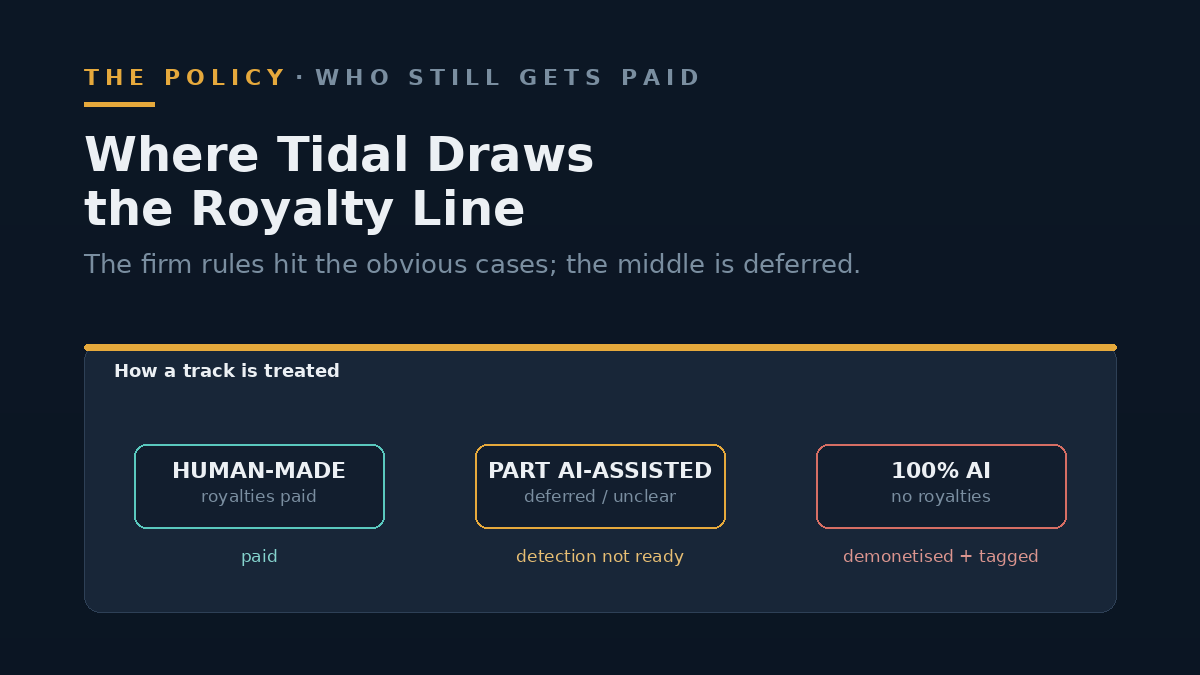
The policy, dated the day of publication, sets out a few concrete steps rather than a single ban. From 29 June, tracks Tidal identifies as wholly AI-generated cannot be monetised — no royalties, and no eligibility for direct-to-fan sales. From mid-July, listeners will see an icon next to content the platform flags as 100% AI-generated, and AI music tied to fraud — high-volume uploads, deception, or unusual streaming patterns — will be blocked or removed. Tidal also says it expects the distributors who feed tracks onto the platform to identify AI content before it arrives, rather than leaving the job to the streamer alone.
Crucially, Tidal is not banning AI music. The company frames this as listener choice: people should be able to decide what they consume, and artists should be free to use AI tools. So AI-generated tracks stay on the service — they just get tagged, held to what Tidal calls a higher standard of content integrity, and cut off from the royalty pool if they are judged fully synthetic.
Why this matters beyond Tidal
Tidal is not a giant. Apple Music, YouTube and Spotify dominate; Tidal is the high-fidelity option favoured by listeners who care about lossless audio, and it has long marketed itself as artist-first. It is majority-owned by Block, the financial-technology company chaired by Jack Dorsey, which holds roughly 86.8% of the service; Jay-Z and a group of artist shareholders hold the rest. That positioning is the point: a smaller, artist-branded platform can afford to take a harder stance on royalties than a mass-market rival chasing engagement.
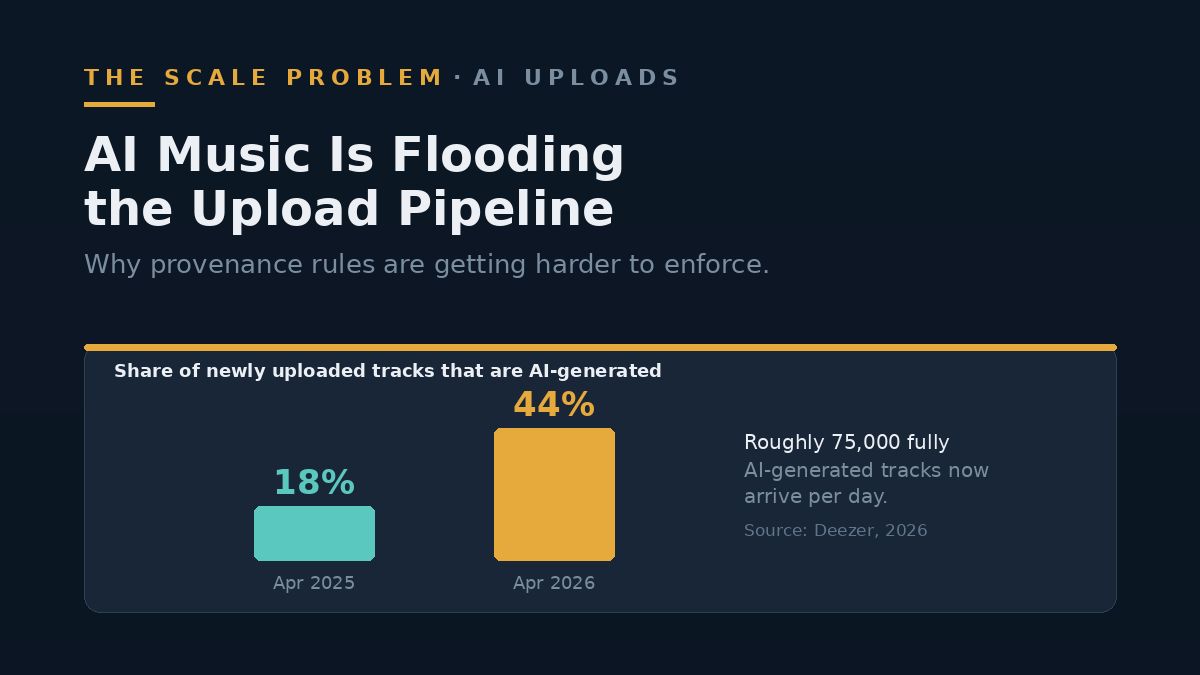
The backdrop is a flood of synthetic tracks across every service. Rival platform Deezer reported that AI-generated tracks made up about 44% of newly uploaded music by April 2026 — roughly 75,000 tracks a day, by the company's own count — up from around 18% a year earlier. Deezer was first to build an AI tagging system, in June 2025, and has leaned heavily on fraud detection to strip suspect streams out of its royalty payouts. Spotify, by contrast, has promised labelling while embracing the trend — it struck a deal to let users generate covers and remixes of existing songs. Tidal's move plants a flag somewhere stricter: no money for fully AI-made music, stated as a principle rather than only an anti-fraud measure.
The loopholes are doing a lot of work
Read closely, the policy is narrower than the headline. The firm commitments — tagging, blocking, demonetising — attach to content that is "100% AI-generated" or tied to fraud. The much larger grey zone, music that is substantially AI-generated but has some human involvement, is explicitly deferred until detection methods become "more reliable." That is where most of the contested catalogue actually sits, and where the money is.
The test case is already on the platform. AI-generated acts such as The Velvet Sundown and Breaking Rust — projects with millions of streams elsewhere — remain live on Tidal as of publication. 404 Media reported that Tidal did not answer whether such black-box acts will keep earning, precisely because no one outside the projects can prove how much of the music is machine-made. The Velvet Sundown's own website cheerfully describes itself as engineered to "fill playlists, avoid royalties" — which is the whole problem in one line. A policy that only firmly catches the tracks honest enough to be obviously synthetic leaves the deliberately ambiguous ones untouched.
The UK angle
For British listeners and musicians, this lands in the middle of an unresolved fight. In February 2025, more than 1,000 artists — among them Kate Bush, Annie Lennox and Hans Zimmer — released a silent album, "Is This What We Want?", protesting government proposals that critics said would let AI firms train on copyrighted work without a licence. The Data (Use and Access) Act received Royal Assent on 19 June 2025 without the contested AI-copyright provisions, committing the government instead to a separate review of AI and copyright — its report on which appeared in March 2026, proposing no immediate change to the law. A streamer choosing not to pay for fully synthetic music does not settle the upstream question of whether that music was trained on artists' work in the first place — but it is one of the few concrete moves on the consumer-facing side while the law catches up.
FAQ
Does this mean AI music is banned on Tidal?
No. Tidal is keeping AI-generated music on the platform and says listeners can choose to play it. What changes is that tracks it identifies as wholly AI-generated cannot earn royalties or be sold direct-to-fan, and will be tagged from mid-July.
How will Tidal know what is AI-generated?
That is the open question. The firm tagging and blocking applies to content judged "100% AI-generated" or linked to fraud. Tidal also wants distributors to flag AI tracks before they reach the platform. Detection of partly AI-made music is deferred until the tools improve, which is the policy's biggest weakness.
How does this compare with Spotify and Deezer?
Spotify has promised labelling and filtering but has broadly embraced AI music, including a deal for AI covers and remixes. Deezer built the first AI tagging system and removes fraud-flagged streams from payouts. Tidal's stance is the most explicit on royalties: it states, as a principle, that fully AI-made music will not be paid.
Will artists who use AI tools lose royalties?
Not according to the policy. Tidal says artists should be free to create with AI tools; the demonetisation targets music that is wholly or substantially generated by AI, not tracks where a human used AI as one tool among many. Where the line falls in practice is not yet clear.
The takeaway
Tidal has drawn the cleanest royalty line of any major streamer, and as a statement of intent it matters — especially from an artist-branded platform. But intent is not enforcement. The policy firmly covers only the most obvious synthetic tracks and the clear frauds, defers the contested middle, and keeps AI music on the service either way. Whether it changes anything depends entirely on detection that no platform, Tidal included, has yet proven it can do at scale. Worth watching when the tagging actually appears in mid-July.
Sources
- Tidal — AI Policy (official statement, 29 June 2026)
- 404 Media — "Tidal Says It Won't Pay Royalties for AI-Generated Music" (29 June 2026)
- Deezer Newsroom — AI-generated tracks now 44% of new uploads (April 2026)
- NBC News — 1,000 musicians release a silent album protesting UK AI copyright plans (Feb 2025)
- Finnegan — the UK's AI and copyright conundrum (Data (Use and Access) Act background)
- Billboard — Tidal, Block and what's next for the streaming company