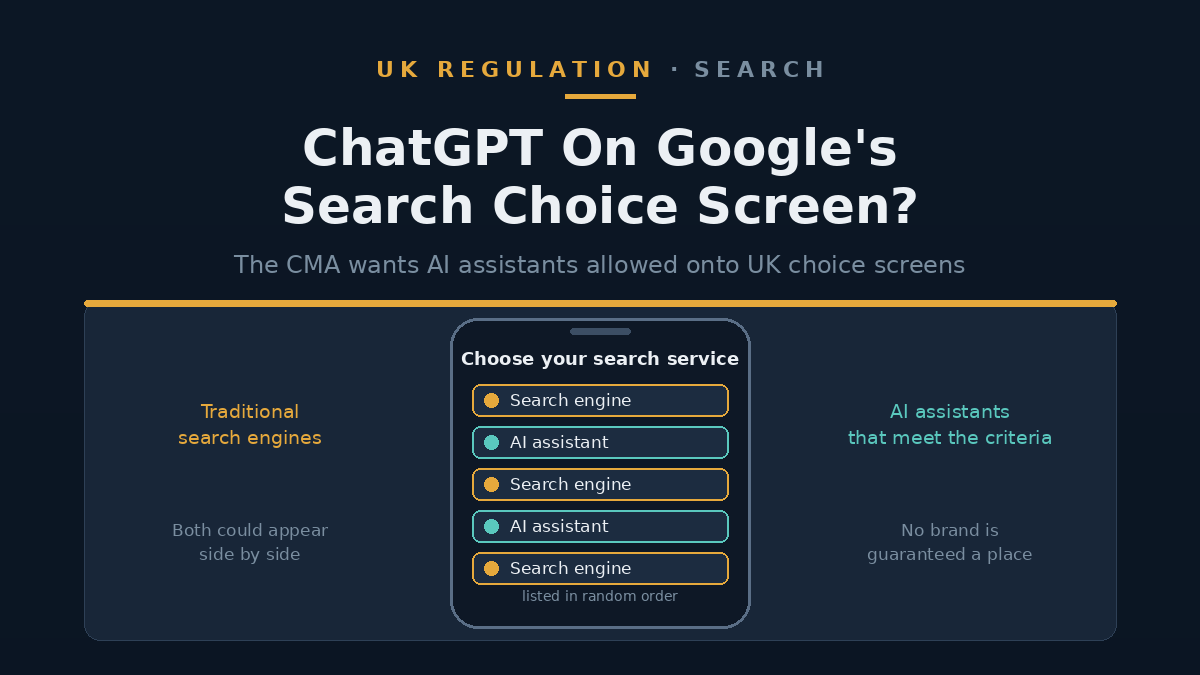
The UK's competition regulator wants the screen that asks you to pick a search engine on an Android phone or in Chrome to include AI assistants such as ChatGPT and Perplexity. The Competition and Markets Authority published strengthened proposals on 23 September that would make Google show a choice screen when you first set up a new Android phone or Chrome, remind you once a year, and let AI services compete for a place if they pass Google-run tests. The honest bottom line: this is a real shift in who counts as a "search engine", but choice screens have historically moved very few people away from Google.
This piece reflects reporting as of September 2026. These are proposals out for consultation, not final rules, and the details, timings and list of eligible services may change.
What would change on your phone and browser
The detail sits in the CMA's 72-page consultation document, and it is more specific than the headline "annual prompt" suggests.
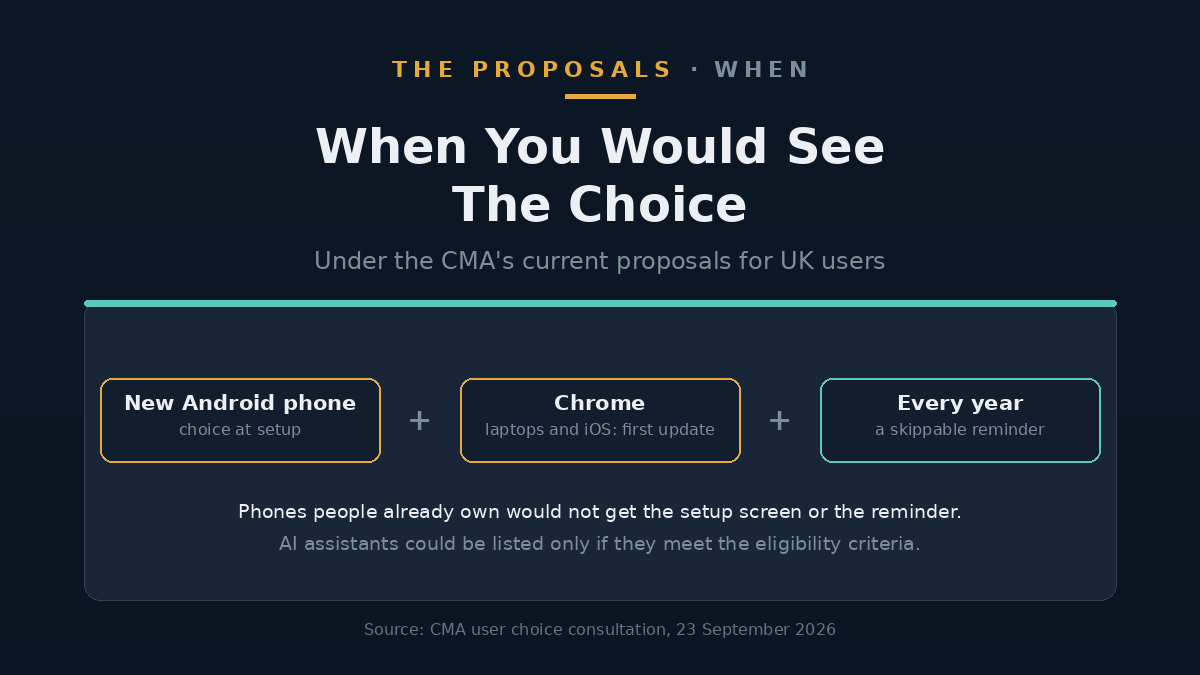
- New Android phones sold in the UK after the rule takes effect would show a search choice screen during setup that you cannot skip. Whatever you pick becomes the default for the home-screen search bar, the search app and Chrome's address bar.
- Chrome on laptops, iPhones and iPads would show a choice screen you cannot skip at the first major Chrome update after the rule starts, and on any fresh install after that.
- Once a year, tied to a major software update, you would get a small, skippable notification inviting you to choose again. You can ignore it. Google may leave it out if you have deliberately changed your default in the previous six months.
- Existing Android phones are largely left alone. The CMA accepted Google's argument that retrofitting the yearly reminder onto phones already in people's pockets is technically awkward, so that part applies only to new devices.
Each screen would list up to 12 services in random order, and you would have to scroll through all of them before confirming. If more than 12 services qualify, the CMA expects five slots to go to the most popular eligible services and seven to be chosen at random, with a way to view the rest. There would also be a "test-drive" option that sets a service as your default for a trial period of at least a week, followed by a gentle nudge to confirm or switch.
Why letting AI assistants in is the new part
When the CMA first consulted in January, one draft criterion required a service to be operated and marketed with general search as a core and central part of the service, a hard test for a general chatbot. That criterion has now been deleted. The regulator argues the line between AI assistants and search engines has blurred, pointing to Google's own AI Overviews and AI Mode.
The CMA's chief executive, Sarah Cardell, said the regulator was "responding quickly to the rise of AI assistants", which people increasingly use for search but which do not currently appear on Google's choice screens.
To qualify, a service would need to meet three tests. It must handle the full range of things people use search for, from finding a website or a product to answering open-ended questions, and it must be able to search the live web. It must work reliably on the phone or browser and meet minimum security standards, which Google would set. And a meaningful share of its UK users must regard it as a search service. Any AI-generated answers must also credit and link to the web pages they draw on, a nod to publishers who fear AI summaries are siphoning off their readers.
Crucially, the CMA says AI assistants could in theory be listed. Nobody is guaranteed a slot. Google itself would run the application process every six months and must give the CMA detailed reasons for any rejection. Which assistants would actually pass is not yet known, and the security requirements they would need to meet have not been written.
We covered the EU's version of this fight in July, when Brussels ordered Google to give rival AI assistants fairer access to Android. The UK approach is narrower. It focuses on the moment you choose a default, rather than on what rival assistants can do inside the phone.
Who objects, and why
Google told the CMA in earlier submissions that a yearly screen would frustrate users, proposing its own "UK Choice Package" built around a central settings switch instead, and argued that interruptions would make Android and Chrome less attractive than Apple and Microsoft products. The CMA rejected that package as a substitute for the yearly reminder but softened the reminder into a skippable notification. We could not find a public response from Google to the 23 September proposals on the day they were published.
Resistance to letting AI services onto the screen also came from news publishers. Guardian Media Group, the Professional Publishers Association and the News Media Association argued that because the CMA excluded Google's own Gemini assistant from its 2025 ruling on Google's search dominance, it would be inconsistent to treat rival assistants as search services. The CMA disagrees, saying that ruling was about Google's own products, not the whole sector. Samsung, Sony and several industry groups also warned of prompt fatigue.
The honest caveat: choice screens rarely shift much
UK Android users have seen a search choice screen before. Since 2020, new Android phones in the UK and the European Economic Area have asked users to pick a search provider at setup, following an EU antitrust ruling. The effect was tiny. A peer-reviewed study in the International Journal of Industrial Organization cites StatCounter estimates showing Google's share of mobile search in the EEA went from 98.58% when the screen launched in March 2020 to 97.66% in August 2022, a fall of less than one percentage point.
The study's argument is that a choice screen only moves people if a rival is good enough for them to want it. AI assistants are the first rivals that millions of people already use daily, and the CMA's own user research found that people engaged more with a test choice screen when AI services appeared on it. Engagement is not the same as switching, though, and there is no hard evidence yet that it will translate.
When this might actually happen
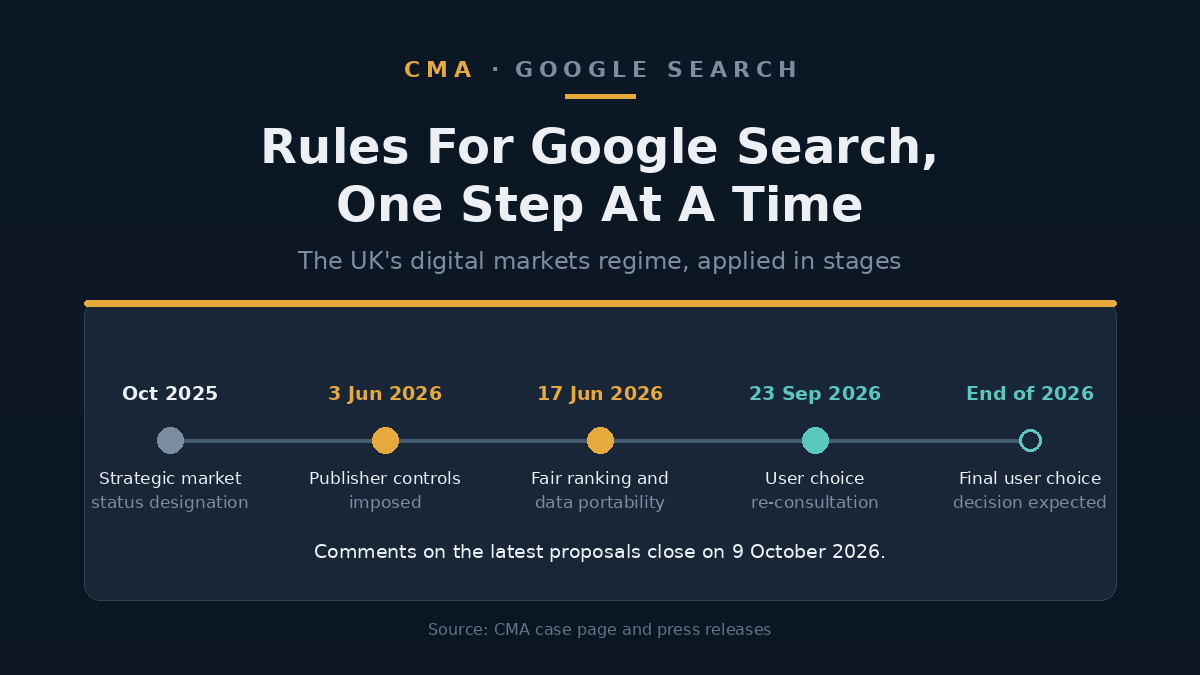
The consultation closes at 5pm on 9 October, and the CMA expects a final decision by the end of the year. Its document proposes that the rule would take effect within six months of being imposed, with the eligibility process starting after one month. On that timetable, the first screens are unlikely to appear before 2027, by our estimate.
This is the latest step in a longer process tracked on the CMA's case page. The regulator designated Google as having strategic market status in search in October 2025, imposed controls letting publishers opt their content out of Google's AI features on 3 June 2026, and added fair ranking and data portability rules on 17 June.
FAQ
Will my current Android phone show the new choice screen?
Probably not. Under the current proposals, both the setup screen and the yearly reminder on Android apply only to phones distributed after the rule comes into force. You can still change your default search provider in your settings at any time.
Could I make ChatGPT my default search on Android?
Only if ChatGPT applies and Google judges that it meets the eligibility criteria, including the security requirements Google would set. The CMA says AI assistants could qualify, but none has been approved because the process does not exist yet.
Do I have to choose something every year?
No. The yearly prompt would be a small, skippable notification. If you ignore it, your current default stays as it is.
Does this affect iPhones?
Only Chrome on iPhone and iPad, not Safari. The CMA's rule covers Google's products, so Apple's own browser and its default search deal are outside it.
The takeaway
The meaningful change here is conceptual. A UK regulator is proposing that an AI assistant can count as a search engine for the purpose of competing with Google, and is building the machinery to let one appear in front of you at the moment you choose a default. Whether it changes what people actually use is a separate question, and the track record says be sceptical: the last choice screen barely dented Google's share. The difference this time is that the rivals are products people already know and use. That gives the screen a better chance than last time, not a guarantee.
Sources
- Competition and Markets Authority, press release: CMA strengthens proposals allowing people choice over their search service (23 September 2026)
- Competition and Markets Authority, consultation page: proposed user choice conduct requirement, closes 9 October 2026 (23 September 2026)
- Competition and Markets Authority, consultation document: user choice conduct requirement, PDF (23 September 2026)
- Competition and Markets Authority, case page: Google's general search and search advertising services (accessed 23 September 2026)
- Competition and Markets Authority, press release: Google designated with strategic market status in search (10 October 2025)
- Competition and Markets Authority, press release: publisher conduct requirement imposed (3 June 2026)
- Competition and Markets Authority, press release: fair ranking and data portability requirements imposed (17 June 2026)
- Muxin Li, International Journal of Industrial Organization: Regulating online search in the EU, from the Android case to the DMA and DSA (2023)
- AIToolBible, EU orders Google to open Android and search to rival AI assistants (July 2026)