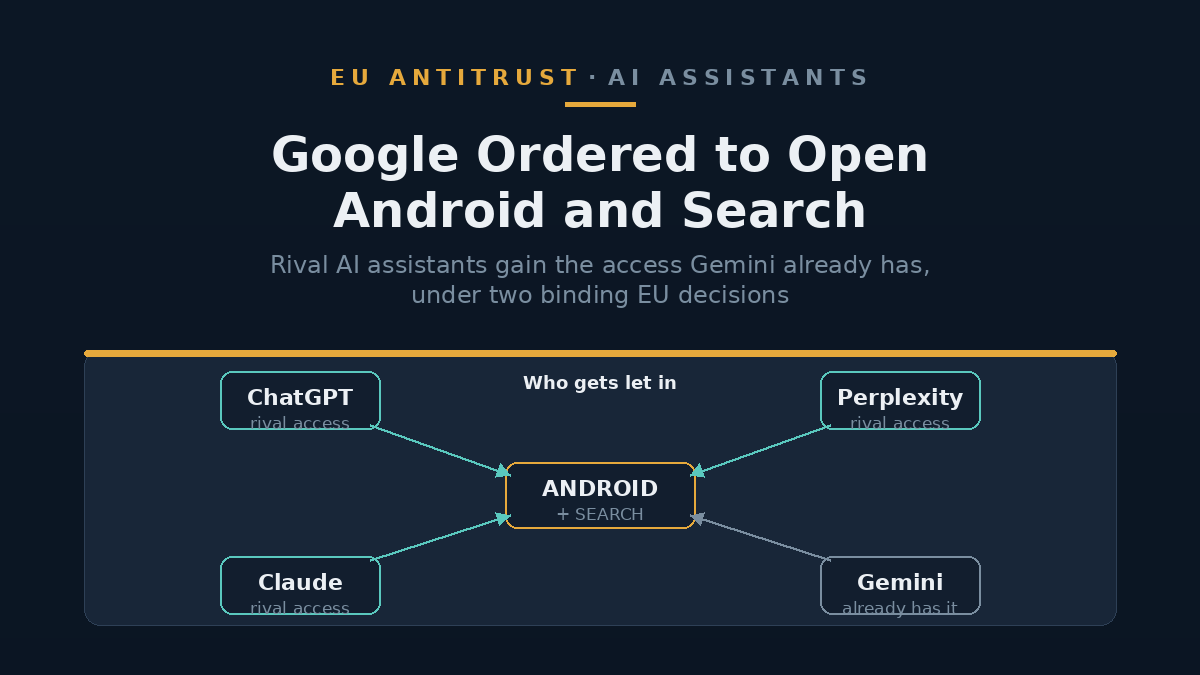
The European Commission has ordered Google to open up two of its most valuable strongholds, Android and Search, to competitors, including rival AI assistants. Under two binding decisions issued on 16 July 2026 by the European Commission, Google must let services such as ChatGPT, Claude and Perplexity plug into Android with the same depth of access Gemini currently gets, and must share anonymised Google Search data with rival search engines and AI chatbot makers. Google says the changes threaten user privacy and security and has signalled it disagrees strongly; the Commission says its aim is to stop AI competition being decided by which assistant happens to come pre-installed.
This piece reflects reporting as of July 2026. The decisions are freshly issued, a Google legal challenge is widely expected, and the practical detail of how "equal access" is implemented may shift before the compliance deadlines land.
What the EU has actually decided
These are two separate specification decisions under the EU's Digital Markets Act (DMA), the law that imposes special obligations on a handful of "gatekeeper" tech platforms. According to Tech Times' account of the underlying case files, corroborated by the Commission's own record of the proceedings, the first (case DMA.100220, under DMA Article 6(7)) covers Android interoperability; the second (DMA.100209, under Article 6(11)) covers Google Search data sharing. Both proceedings were opened on 27 January 2026 and carried a statutory deadline of 27 July 2026 – the Commission delivered its decisions eleven days early, on 16 July.
Crucially, these are not fines and not a finding that Google has already broken the law. They are binding instructions on exactly how Google must comply with obligations that have technically applied since March 2024. If Google fails to follow them, that is what could trigger a separate non-compliance case, and DMA fines can reach 10% of Alphabet's global annual turnover for a first offence.
Android: a route in for rival AI assistants
On Android, Gemini currently gets privileges no other assistant has: it can be summoned by a wake word or a long-press gesture from anywhere on the phone, it can read what's on screen to act on it, and it gets favourable access to on-device processing power. Third-party assistants have had to work as ordinary apps that a user opens manually. 9to5Google reports that the Commission's order requires Google to open that same level of access to rivals, so a user could in future activate ChatGPT, Claude or Perplexity with a voice command the way "Hey Google" summons Gemini today, and let that assistant carry out tasks such as booking a taxi or drafting a reply inside another app.
Google is not required to make this change immediately. Reporting from UPI, which quotes the Commission's own release, puts the deadline for users to start seeing Android changes at July 2027.
Search: opening the data tap to rivals and AI chatbots
The second decision addresses something less visible but arguably more consequential: the raw ranking, query, click and view data that Google Search generates from its enormous scale. Rival search engines have long argued they cannot compete without access to comparable signal volume, and the Commission's order for the first time explicitly extends that requirement to AI chatbot providers, on the reasoning that a chatbot answering a question is functionally doing the same job as a search engine. Google must begin sharing anonymised data with "eligible search engine providers" from January 2027, per the Commission's release as quoted by UPI.
Google's scale is central to the Commission's argument. Tech Times put Google's EU search-market share at roughly 95%, though that figure came without its own sourcing. Independent measurement firm Statcounter puts Google's share of the European search market at around 89% in 2026 – still an overwhelming lead over every rival combined, and comfortably enough to support the Commission's case, even if lower than the widely repeated 95% figure.
Google's response
Google disagrees with both decisions. In an on-record statement on Google's official blog, Kent Walker, the company's President of Global Affairs, said: "Today's decisions risk undermining vital privacy and security guardrails for millions of Europeans." Google argues that phone makers currently vet which assistants get deep system access, and that granting the same access to outside apps without those checks could expose users' private searches to unfamiliar companies without adequate anonymisation or consent.
A legal challenge from Google is widely expected once the decisions take effect, though a recent EU General Court ruling against Apple (in a separate DMA case, on 8 July 2026) established that gatekeepers cannot pre-emptively block a specification decision in court before it is issued – only afterwards, once it has already taken legal effect.
What this means if you're in the UK
The DMA is EU law and does not directly apply to the UK, so nothing here forces changes on Android phones or Google Search sold to UK customers as such. But the UK has its own competition regime with real teeth: the Competition and Markets Authority (CMA) has separately designated Google with "strategic market status" in general search under the UK's Digital Markets, Competition and Consumers Act 2024, and has already used that power in stages. As set out in the CMA's announcement of 3 June 2026, publishers can now opt their content out of powering AI Overviews and out of AI model fine-tuning, and Google must attribute publisher content clearly in AI-generated results. A second, separate CMA action from 17 June 2026 added fair-ranking and data-portability requirements: Google must now rank organic search results, including in AI Overviews, using objective, non-discriminatory criteria, and let users port their Google search data to authorised third parties.
That is a genuinely separate and narrower set of interventions, focused on publishers and search fairness rather than on prising open Android for rival AI assistants. The limits of the parallel matter: nothing found in researching this piece shows the CMA ordering Google to give ChatGPT or Claude Gemini-level Android access. In fact, the CMA's own strategic market status decision explicitly excludes Google's Gemini assistant from the search designation altogether, though the CMA says it will keep that position under review as the market develops. We could not confirm any active UK process that mirrors the EU's Android order, so we're not claiming one exists.
FAQ
Does this mean I can replace Gemini with ChatGPT on my Android phone right now?
No. The changes are not expected to reach users until July 2027 for Android, and Google is likely to contest the decision. Nothing changes on your phone today.
Is this the same as a fine?
No. These are specification decisions telling Google how to comply with existing DMA duties, not a finding that it broke the law or a monetary penalty. A separate non-compliance case, which could carry a large fine, would only follow if Google does not implement the required changes.
Will this affect UK Android users?
Not directly, since the DMA is an EU law. Large platforms sometimes roll out EU-mandated changes more widely for consistency, but nothing confirmed in the sources for this piece says that will happen here. The UK's CMA has separately acted on Google Search, but on publisher rights and AI Overviews rather than Android AI-assistant access.
Why does Search data sharing matter for AI chatbots specifically?
Because chatbot answers increasingly depend on the same kind of ranking and click data that powers search results. The Commission's order for the first time explicitly names AI chatbot providers as eligible recipients of that anonymised data, not just rival search engines.
Is Google likely to appeal?
Independent reporting suggests it's widely expected to, given the company's public objections on privacy and security grounds, though it cannot block the decisions taking effect first.
The takeaway
This is a real, binding step toward genuine choice among AI assistants on the world's biggest mobile platform, not a symbolic gesture. But it is a slow-moving one: the practical changes land in 2027, Google disputes the reasoning and is expected to fight it, and how "equal access" actually gets implemented in code will decide whether rivals get a genuine foothold or a technically compliant but underwhelming one. UK readers should note this is an EU order with no direct force here, even though the UK's own regulator is pursuing a related, but distinctly separate, push for fairness in how Google's search and AI features treat publishers and rivals.
Sources
- European Commission — official press release on the Google Android/Search DMA specification decisions (16 July 2026)
- UPI — wire report quoting the Commission's release directly (16 July 2026)
- 9to5Google — coverage of the scope of the Android and Search decisions (16 July 2026)
- Tech Times — background on the DMA case numbers, legal timeline and General Court ruling (9 July 2026)
- Google/The Keyword — Kent Walker's official response on Google's blog (16 July 2026)
- UK Competition and Markets Authority — official announcement on the publisher conduct requirement (3 June 2026)
- UK Competition and Markets Authority — official announcement on the fair-ranking and data-portability conduct requirements (17 June 2026)
- UK Competition and Markets Authority — confirmation of Google's strategic market status designation, including the exclusion of Gemini (10 October 2025)
- Statcounter Global Stats — Google's search engine market share in Europe (2026)
- European Commission — record of the specification proceedings opened against Google (27 January 2026)