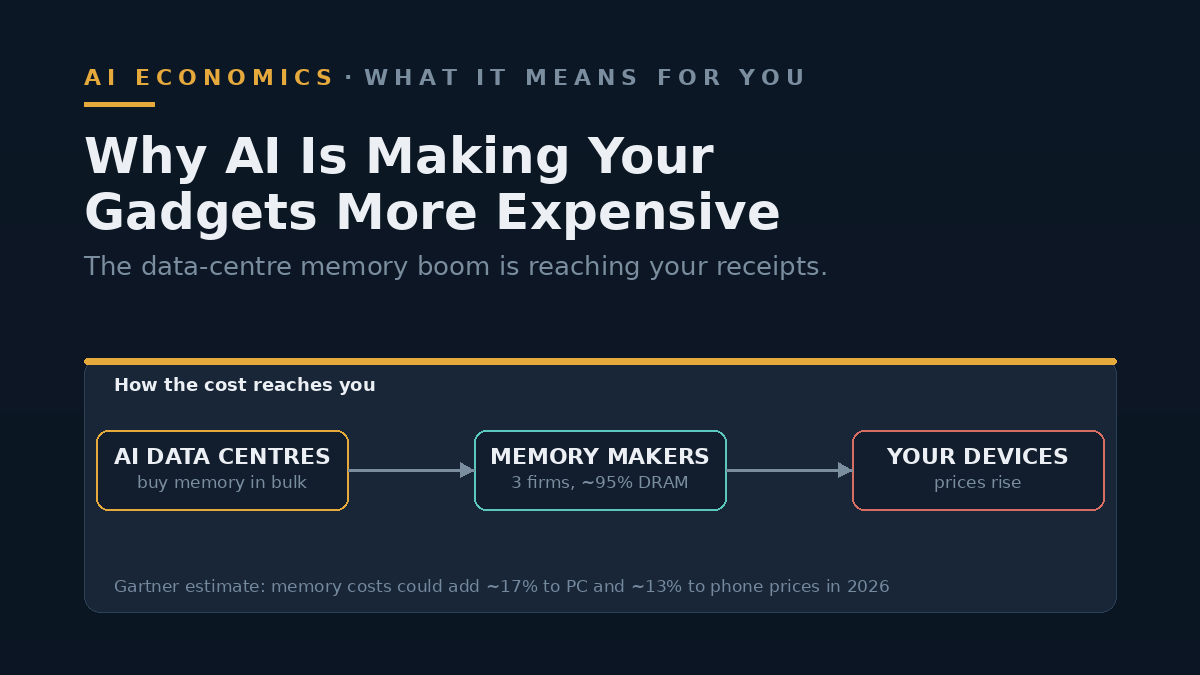
If your next laptop, games console or phone costs more than you expected, the AI boom is part of the reason. On 25 June 2026 Apple raised prices across its Mac and iPad ranges — by various reports around 20% on average, with the entry-level MacBook Neo going from $599 to $699 and the top Mac Studio jumping from $3,999 to $5,299. Apple's chief executive blamed the soaring cost of memory chips, which AI data centres are buying in enormous quantities. Microsoft is raising Xbox prices from 1 August, and one phone maker has cancelled a launch outright. Here is what is happening, and what it means for you.
This piece reflects reporting as of June 2026. Memory prices are moving very fast, and the specific figures quoted here will date quickly.
What Apple actually changed
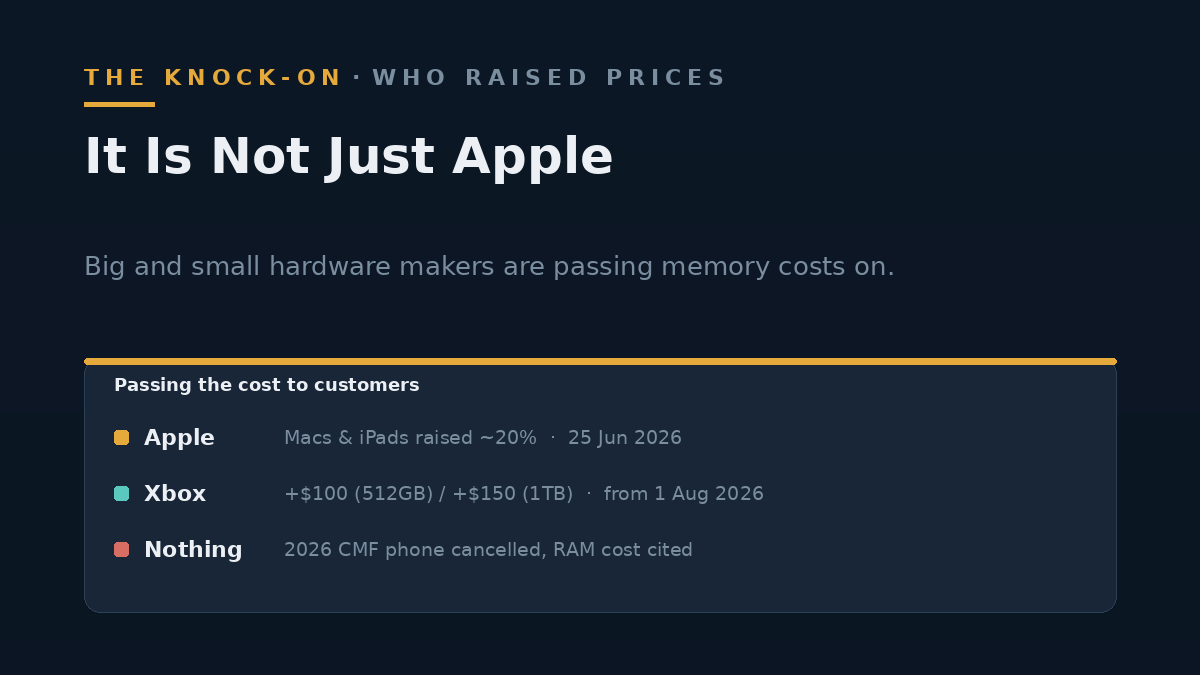
After briefly pulling its online store offline, Apple brought it back on 25 June 2026 with higher prices across the Mac and iPad lines. According to product-by-product tracking, the cheapest MacBook (the MacBook Neo) rose from $599 to $699, the M4 Max Mac Studio went from $1,999 to $2,499, and the M3 Ultra Mac Studio climbed from $3,999 to $5,299. Reporting put the average increase across the affected products at roughly 20%.
What makes this notable is that Apple has historically swallowed swings in component costs rather than passing them straight to customers. The company's chief executive had signalled the move a week earlier in an interview with the Wall Street Journal, describing the increases as unavoidable and the situation as unsustainable, and calling the memory shortage "a hundred-year flood". Investors took it badly: Apple shares had their worst day in more than a year.
Why memory got so expensive — the AI link
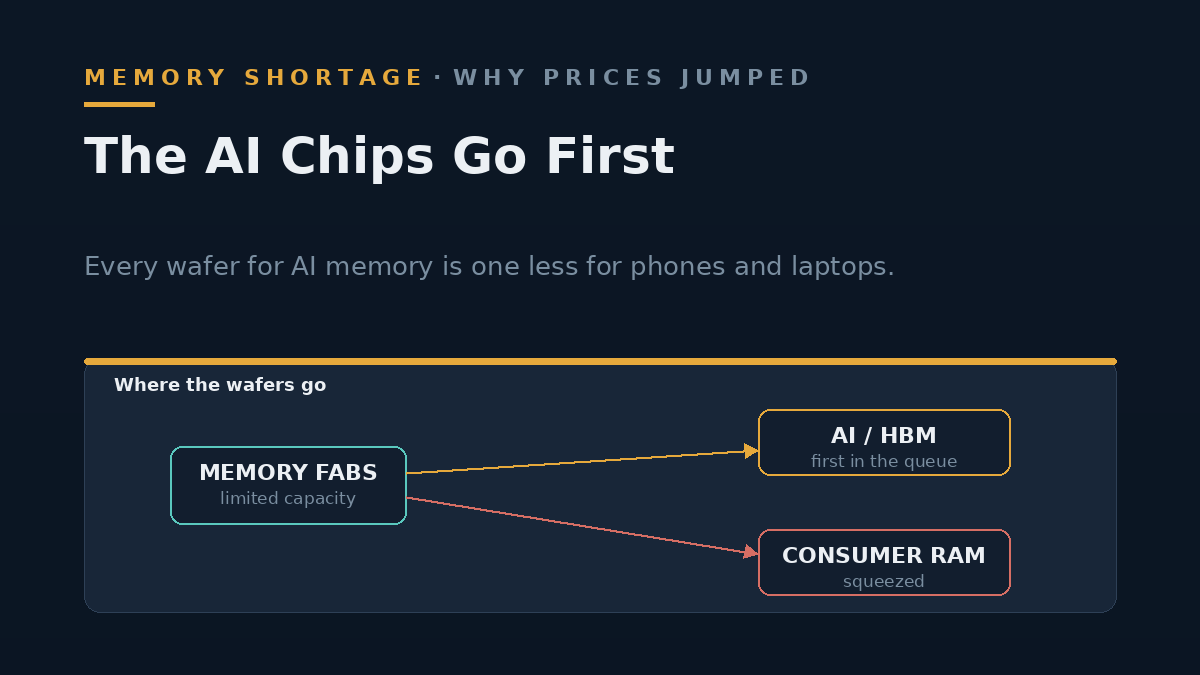
The component at the centre of this is memory: DRAM (the working memory in your devices) and the high-bandwidth memory (HBM) stacked next to AI chips in data centres. Training and running large AI models needs vast amounts of HBM, and the handful of companies that make memory have been redirecting their factory capacity towards it. Just three firms — Samsung, SK Hynix and Micron — account for the overwhelming majority of the world's DRAM, reportedly around 95%, so when they prioritise data-centre chips, everyone else feels it.
The price effect has been severe. Analysts at TrendForce estimated DRAM contract prices rose on the order of 90% quarter-on-quarter in early 2026, with further large rises expected; Counterpoint Research put the recent quarterly jump at 80–90%. One veteran memory-market analyst described it as "the craziest time ever" for the industry. In short, every wafer used to make memory for an AI accelerator is a wafer not used for the memory in a mid-range phone or a laptop — and prices have moved accordingly.
It is not just Apple
The squeeze is industry-wide. Microsoft said it would raise Xbox console prices from 1 August 2026, reportedly by around $100 on 512GB models and $150 on 1TB models, and is retiring its 2TB option, citing rising component costs. Consoles are especially exposed because they are often sold at or below cost, with the maker hoping to earn the money back on games — so a jump in memory prices hits the maths hard.
Smaller firms have fewer options. The brand Nothing cancelled a planned CMF-branded phone for 2026, with a co-founder pointing to surging RAM costs; by the company's account, memory had become so expensive that it could no longer build a worthwhile phone at the intended price. Where a giant like Apple can raise prices and absorb some of the blow, a smaller maker can simply find a product no longer viable.
How much more will you pay, and for how long?
Expect higher prices on memory-heavy devices — laptops, phones, consoles, and anything you configure with extra storage or RAM — into 2027. The analyst firm Gartner has forecast that memory costs could rise roughly 130% over the course of 2026, which it estimated would add about 17% to PC prices and 13% to smartphone prices compared with 2025 levels. Those are estimates of a volatile market, not promises, but the direction is consistent across the analysts tracking it.
On timing, the broad industry view is that meaningful relief is unlikely before late 2027, and possibly 2028, because new memory factories take years to reach full production. In other words, this is not a one-week blip tied to a single product launch; it is a supply crunch with a multi-year tail.
| Where the cost shows up | What's reported (2026) |
|---|---|
| Apple Mac & iPad | Prices raised ~20% on 25 June; e.g. MacBook Neo $599→$699 |
| Xbox consoles | +$100 (512GB) / +$150 (1TB) from 1 August; 2TB retired |
| Phones (e.g. Nothing CMF) | A 2026 launch cancelled, RAM cost cited |
| PCs & phones generally | Gartner estimate: +~17% PC, +~13% smartphone vs 2025 |
What you can do about it
There is no clever trick that beats a global shortage, but a few things help. If you need a device now and a model meets your needs, waiting is unlikely to be rewarded soon. If you can wait, buying before further increases land may save money on configurations you would have to pay more for later. Be especially wary of paying to upgrade RAM and storage at the point of sale, as those are exactly the components rising fastest — buy only the capacity you genuinely need. And the second-hand and refurbished market becomes relatively more attractive when new prices climb.
FAQ
Is AI really the reason my gadgets cost more?
It is the main driver behind the memory-price rises, yes. AI data centres are buying memory chips in huge volumes, and the makers have prioritised that demand, pushing up prices for the memory used in consumer devices. Other factors (tariffs, exchange rates) play a part, but memory is the headline cause cited by the companies themselves.
Which products are most affected?
Anything that relies heavily on memory and storage: laptops, desktops, phones, games consoles, and any device where you pay to add RAM or storage. The more memory a product needs, the bigger the hit.
When will prices come back down?
Analysts broadly expect the crunch to ease only as new memory factories come online, which is not likely to make a real difference before late 2027 and possibly 2028. Short-term relief is not the consensus view.
Should I buy now or wait?
If you need a device and the price is acceptable, waiting is unlikely to help in the near term. If your current device is fine, there is no urgency — just avoid over-specifying memory and storage you do not need.
The takeaway
The AI buildout has mostly been an abstract story about data centres, chips and capital spending. This is the moment it shows up on an ordinary receipt. Memory is the pinch point, the big AI buyers are first in the queue, and consumer-hardware makers — even one as large as Apple — have decided they can no longer absorb the difference. For most people the practical response is unglamorous: buy what you actually need, do not pay over the odds for extra memory, and do not expect prices to fall back quickly.
Sources
- MacRumors — Apple's post-increase prices and Tim Cook's WSJ comments (25 Jun 2026)
- CNBC — Apple's worst day in over a year after the MacBook and iPad price hikes (25 Jun 2026)
- Fox Business — Apple raises iPad and MacBook prices on memory-chip costs (Jun 2026)
- Xbox Wire — Updated Xbox console prices (25 Jun 2026)
- CNBC — Microsoft lifts Xbox prices on soaring component costs (25 Jun 2026)
- Gartner — Surging memory costs to raise PC and smartphone prices in 2026 (26 Feb 2026)
- Counterpoint Research — Memory price tracker (Jan 2026)
- IEEE Spectrum — AI boom fuels the DRAM shortage and price surge
- CNBC — AI memory is sold out, prices surging (10 Jan 2026)
- Android Authority — Nothing cancels a CMF phone over rising RAM prices (Jun 2026)