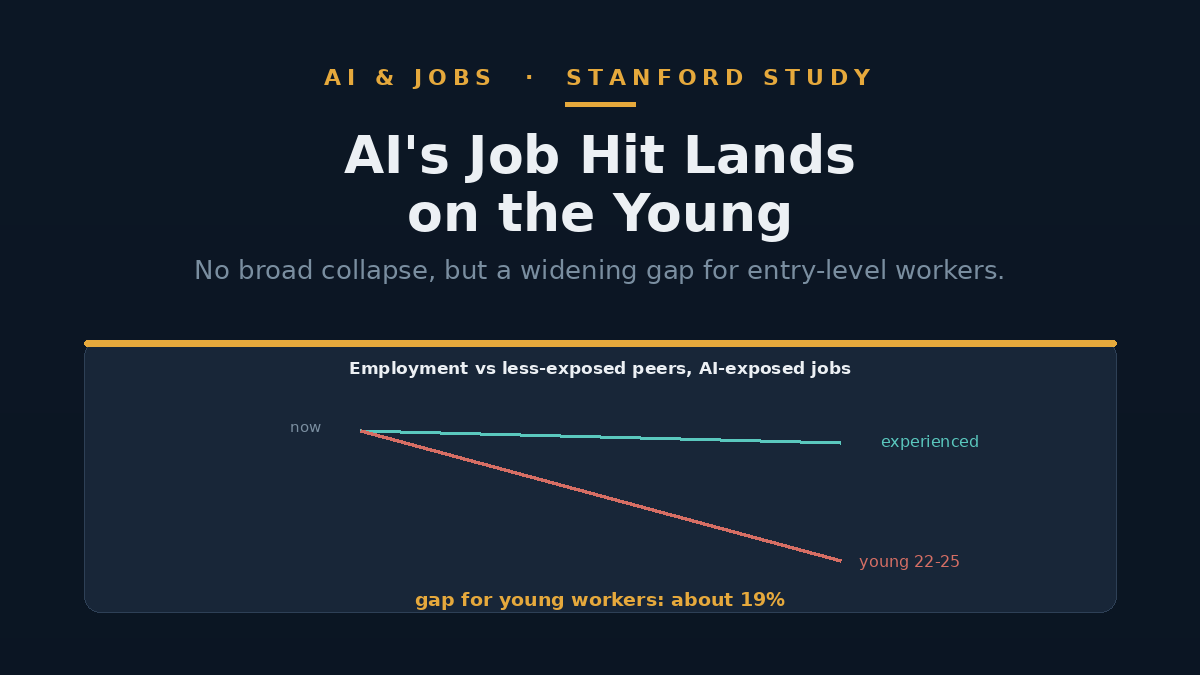
A closely followed Stanford study on AI and jobs has been updated, and its central finding is both reassuring and unsettling. There is no sign of a broad, economy-wide jobs collapse from artificial intelligence. But employment for young workers aged 22 to 25 in the most AI-exposed occupations now sits about 19% below where it would be had it kept pace with their less-exposed peers of the same age. Experienced workers in the same fields show no comparable gap. The data is American, drawn from payroll records through June 2026, so the UK read-across is by analogy rather than proof. Still, it is the clearest evidence yet that AI's first effects on work are landing on the people just starting out.
This piece reflects the August 2026 revision of the paper. The findings are described by the authors as early, descriptive indicators, not proof that AI caused the change, and they are based on one US dataset.
What the study actually found
The paper, "Canaries in the Coal Mine?", comes from the Stanford Digital Economy Lab, led by the economist Erik Brynjolfsson with co-authors Bharat Chandar and Ruyu Chen. It uses high-frequency payroll data from the provider ADP covering millions of US workers. The updated version, revised in August 2026, sets out six findings. In plain terms:
- There is no evidence of widespread, across-the-board job losses from AI.
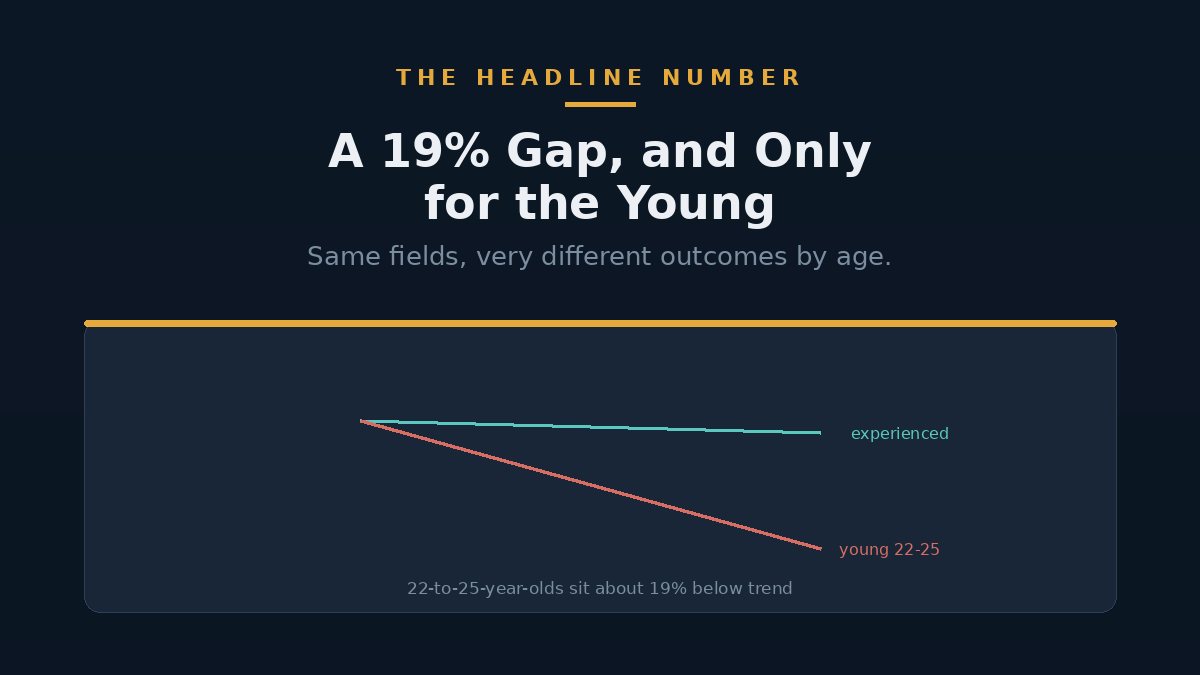
- But young workers (22 to 25) in AI-exposed jobs are now around 19% below the employment level they would have reached had they tracked their less-exposed peers. Older workers in the same fields show no such gap.
- That divergence has widened steadily since the researchers first flagged it in August 2025.
- It is happening mainly through reduced hiring of young people, not through firing existing staff.
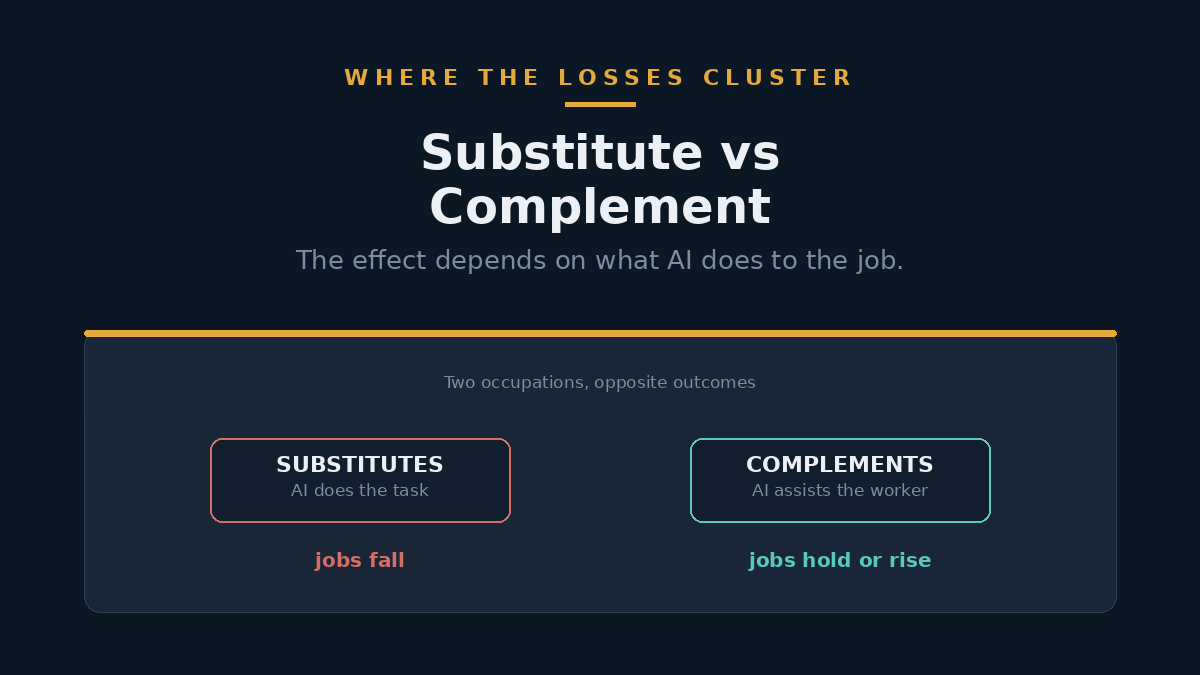
- The declines cluster in jobs where AI mostly substitutes for human tasks. Where AI mainly complements workers, employment is flat or rising, especially for the experienced.
- Firms are adjusting through headcount rather than by cutting base pay.
The metaphor in the title does the careful work: a canary in a coal mine did not cause the danger, it gave an early warning. The authors are explicit that these are early indicators, not causal proof.
Why "entry-level" is the part that matters
The reason this finding lands harder than a general "AI is coming for jobs" scare is that it is specific. It is not that everyone is being replaced; it is that the bottom rung of the ladder is getting harder to reach. Entry-level roles are often the ones built from exactly the tasks current AI does most cheaply: summarising, drafting, basic coding, first-line support, routine analysis. If firms lean on AI for that work, the immediate effect is not mass redundancy but quieter: fewer graduate openings, fewer junior hires, a first job that is harder to land.
That has a knock-on that the headline number does not capture. Careers are built by starting somewhere. If the first rung thins out, the effect compounds over years, even if the total employment figures look calm today. That is why the authors treat a gap concentrated in one age band as more informative than a flat national average.
The caveats the authors stress
This is a working paper on a single dataset, and its authors are unusually careful about what it can and cannot show. The gap persists, they say, even when technology firms and computer jobs are excluded, when they control for exposure to interest-rate rises and to remote work, and across different ways of measuring AI exposure. But it weakens when they control for education, some divergence appears to predate generative AI, and the pattern is stronger in the ADP sample than in national survey benchmarks. In their own words these are descriptive indicators, not causal estimates. In other words: the correlation is real and consistent, but "AI did this" is an inference, not a settled result. Anyone citing the 19% figure should carry those qualifications with it.
What it means for the UK
The honest starting point is that this is US data, and Britain has no equivalent administrative-payroll study putting a number on the same effect. So the UK relevance is read-across, not measurement. That said, there is little reason to expect the UK labour market to be immune, and the mechanism, AI absorbing routine entry-level tasks, is not country-specific. UK graduates entering fields such as software, customer support, junior analysis, admin and content are exposed to the same substitution.
There is also a UK policy thread here. The AI Security Institute has been building exactly this kind of early-warning capability for the domestic workforce, on the logic that you cannot respond to a labour shift you are not measuring. The Stanford paper is a useful illustration of why that matters: the signal shows up first in a narrow, young cohort, not in the headline unemployment rate, so it is easy to miss without granular data. For UK readers, the practical takeaways are unglamorous but real. Early-career workers benefit most from skills where AI complements rather than replaces them, and from getting a foot in the door before hiring tightens further. Employers who quietly stop hiring juniors may find, a few years on, that they have no mid-level staff either.
FAQ
Does this prove AI is destroying jobs?
No. The study finds no broad collapse in employment and is careful to call its findings early indicators, not proof of cause. What it shows is a specific, widening gap for young workers in AI-exposed roles.
Who is most affected?
Workers aged 22 to 25 in occupations where AI can do much of the core task. Experienced workers in the same fields show no comparable gap, and where AI complements people rather than replacing tasks, employment is holding up or growing.
Is this based on UK data?
No. It uses US payroll data through June 2026. There is no equivalent UK study yet, so the UK relevance is by analogy plus the UK's own early-warning work, not a British dataset.
What can a graduate or junior worker do about it?
The pattern points one way: lean towards work where AI assists rather than replaces you, build skills that are hard to automate, and value getting early experience while entry-level hiring is still open. None of that is a guarantee, but it follows the grain of the evidence.
The takeaway
The reassuring half of this study is genuine: there is no AI jobs apocalypse in the numbers. The unsettling half is just as genuine and more specific. The cost is showing up first among the youngest workers, through hiring that quietly slows rather than layoffs that make headlines, and the gap has been widening for a year. It is one dataset, it is American, and the authors are right to hedge. But as an early warning, it is a clear one, and the UK has every reason to watch its own entry-level market with the same care.