Coding is not a dead career in 2026 — but the way most people used to start one has narrowed sharply. Demand for experienced developers is stable or rising, and the AI tools meant to replace engineers are still built, trained and maintained by engineers. What has genuinely shrunk is the entry-level rung: the junior job that used to turn a graduate into a senior. And the productivity argument companies use to justify cutting those jobs is far less settled than the headlines suggest. Here is what the data actually shows, beneath the "AI killed programming" noise.
This piece is based on 2026 labour-market data and the ongoing argument among developers themselves across Hacker News, Reddit, Stack Overflow's survey and the trade press, as of May 2026. The figures below are attributed to their original sources.
It is not "coding" that is dying — it is the first rung
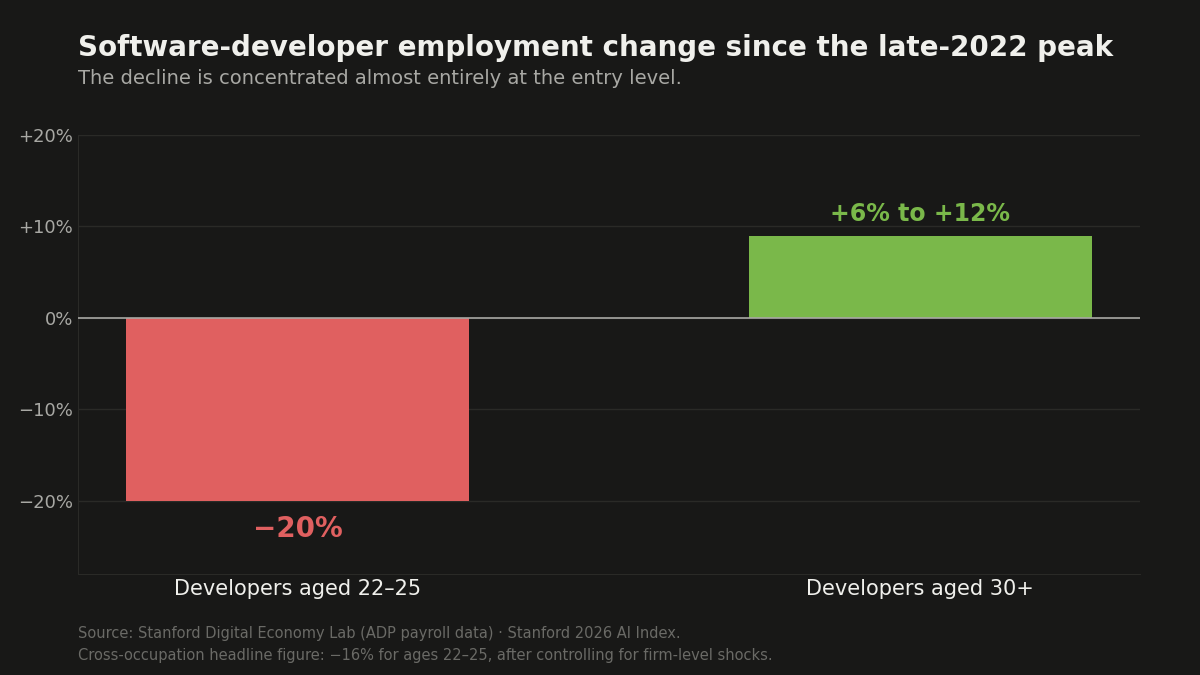
The clearest signal in the data is how unevenly the pain is distributed by age. According to Stanford's 2026 AI Index, employment for software developers aged 22 to 25 has fallen by roughly 20% since its late-2022 peak, while developers aged 30 and over in the same field have held steady or grown. AI is not erasing software engineering. It is thinning out the entrance to it.
That figure comes from payroll data, not job adverts — a distinction worth keeping straight, because the two are often muddled. The underlying study, the Stanford Digital Economy Lab's "Canaries in the Coal Mine?" by Brynjolfsson, Chandar and Chen, used records from the largest US payroll provider and found a 16% relative decline in employment for early-career workers aged 22 to 25 across the most AI-exposed occupations, even after controlling for company-level shocks. Developers writing about this have largely converged on the same blunt summary: coding is not dying, entry-level repetition is. The work AI does best — small, well-defined, repetitive tasks — is exactly the work juniors used to be hired to do.
The corporate signals are real but messier than the headlines, and they move. Salesforce said in late 2024 that it would hire few or no new software engineers in 2025, citing AI productivity gains — yet by early 2026 its chief executive had publicly reversed that framing, saying AI would not kill entry-level jobs and that the company was hiring around 1,000 new graduates. Some firms cut engineering headcount over the same period; others expanded. Notably, the feared mass unemployment has not shown up in the wider jobs data. The story is a targeted squeeze on the bottom rung, not a collapse of the profession.
The loudest doom comes from the people selling the tools
It is worth noting who is making the biggest predictions. The most-quoted "engineers are obsolete" claims tend to come from the executives whose companies profit if you believe them — including Anthropic chief executive Dario Amodei's much-repeated forecast that AI could wipe out around half of entry-level white-collar jobs within one to five years. That does not make the claim wrong, but it is a forward projection from an interested party, not a measured finding.
Developers keep pointing at the same contradiction: the companies announcing that engineers are finished are also hiring engineers, and every headline-grabbing "AI built an app in minutes" demo was itself built, trained and secured by engineers. The tools got stronger. So far, the job has got sharper rather than disappeared.
Does AI even make developers faster? The honest answer is "it depends"
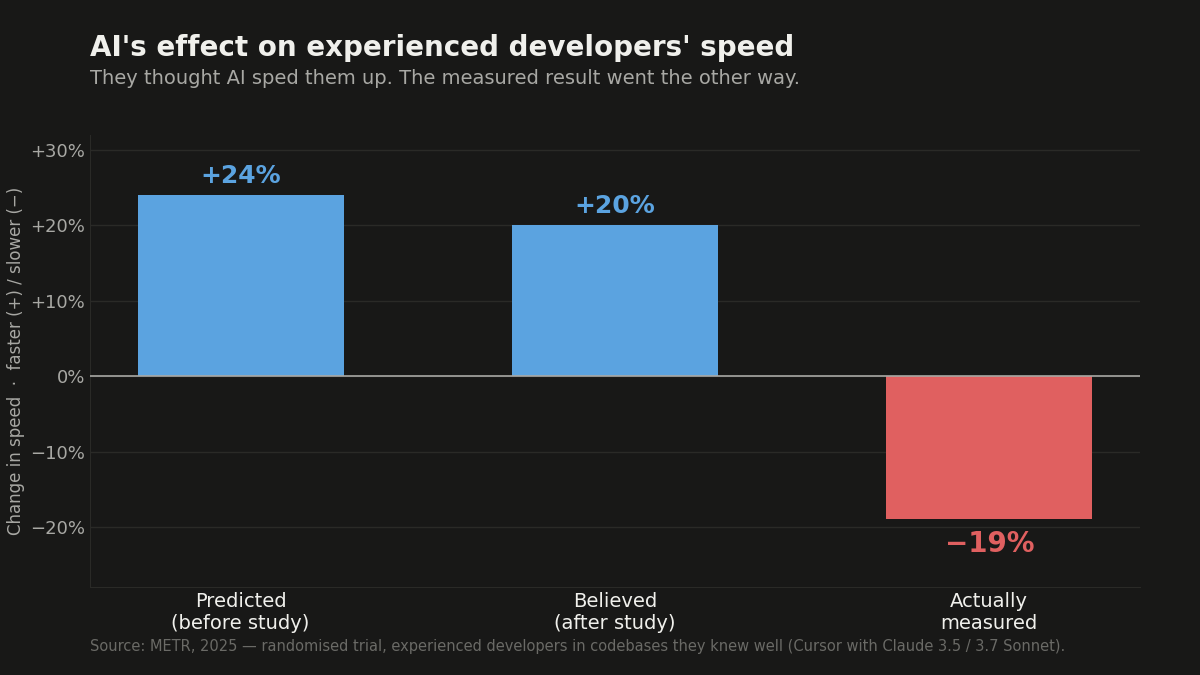
This is where the popular story is weakest. In a randomised controlled trial published by the non-profit research group METR in 2025, experienced open-source developers working in codebases they knew well took about 19% longer to complete tasks when they were allowed to use AI tools — even though they had predicted a 24% speed-up beforehand, and still believed afterwards that AI had sped them up by around 20%. The gap between how fast they felt and how fast they were is the part worth sitting with. METR, it is worth adding, has no coding product to sell.
The important caveats, which most write-ups skip: that result covered complex work in familiar, mature codebases, where understanding context matters more than typing, and it tested early-2025 tools. METR's own early-2026 follow-up suggests newer tools may help more — but cautions that selection effects make the size of any gain weak evidence. It is a refinement of the finding, not the retraction it is sometimes reported as. Against it, other studies have found real gains elsewhere: as Reuters has noted, separate research found developers completing 26% more tasks in a given time, and another found a 56% speed-up. The honest synthesis is not "AI is useless" or "AI is magic." It is that the gains are real where the work is routine, shaky where the work is hard and familiar, and that developers are unreliable judges of their own productivity.
| The headline | What the data actually shows |
|---|---|
| "AI replaced developers" | Senior employment is stable or growing; entry-level employment for the youngest cohort has fallen ~20% since 2022 (Stanford 2026 AI Index). |
| "AI makes you far faster" | Faster on routine work; one controlled trial (METR) found experienced devs ~19% slower on complex, familiar tasks while feeling faster. |
| "AI writes production-ready code" | Adoption is near-universal (~84%, Stack Overflow 2025), but refactoring has fallen and code duplication has risen sharply (GitClear). |
| "Coding is a dead career" | The entry path has narrowed; the work is shifting toward design, review and oversight. |
Speed today, technical debt tomorrow
The quality question is where the optimism thins out. Analysis by GitClear of 211 million changed lines of code from 2020 to 2024 found that refactored, reused "moved" code fell from around a quarter of all changes in 2021 to under 10% in 2024, while copy-pasted code rose from 8.3% to 12.3%, and the number of blocks containing five or more duplicated lines jumped roughly eightfold in 2024 alone. Duplication and churn like this are classic signals of code that is quick to write now and expensive to maintain later.
Two caveats keep this honest. GitClear sells code-review tooling, so it has an interest in the problem it is describing. But an independent source points the same way: Google's own 2024 DORA report found that as AI adoption rose, a small gain in one quality measure came alongside an estimated 7.2% drop in delivery stability. And Stack Overflow's 2025 developer survey captured the mood shift — even as around 84% of developers now use AI tools, trust in them fell for the first time. The phrase doing the rounds among engineers is that shipping unreviewed AI code is not productivity, it is gambling: the speed shows up this quarter, the maintenance bill shows up later.
The pipeline problem nobody is pricing in
Cutting junior roles solves a cost problem now and risks a talent problem later. Seniors are made, not hired — they come from juniors who were given a proving ground, and from the mentorship that happens when experienced engineers review less experienced work. Remove the bottom of the pipeline and, a few years out, the top of it runs dry. Forrester has forecast a roughly 20% fall in computer-science enrolments as students react to the bleak entry-level market, which would deepen the same hole.
It is not unanimous, and the counter-example matters: IBM announced in early 2026 that it would triple entry-level hiring in the US, arguing younger workers are a better long-term investment precisely because AI now handles the routine work, freeing juniors for customer-facing and higher-judgement tasks. The honest reading is that entry-level roles are not vanishing so much as shrinking and shifting — and that the firms cutting them hardest may regret it first.
What this means if you are learning to code — or hiring
If you are starting out: the 2016 path of memorising syntax and grinding tutorials is the part AI has genuinely devalued. The durable version of the skill is understanding how systems fit together, debugging things that are broken in non-obvious ways, and being able to judge whether the code an AI just produced is actually correct and safe. Learn to review the machine, not race it. Seek out the organisations still running graduate programmes — they exist, and they will have a hiring advantage in a few years.
If you are hiring: the cheapest year-one team is not the cheapest five-year team. Someone has to grow into the senior who can catch what the AI gets wrong, and that person has to start somewhere.
Frequently asked questions
Is coding a dead career in 2026?
No. Demand for experienced developers is stable or growing, and AI tools still need engineers to build, secure and maintain them. What has shrunk is the entry-level job.
Should I still learn to code?
Yes, but not the 2016 way. Syntax memorisation is now low-value; understanding systems, debugging and reviewing AI output are what last.
Does AI actually make developers faster?
On routine work, yes. On complex work in a familiar codebase, a controlled METR study found it made experienced developers slower — while they felt faster.
Are junior developer jobs disappearing?
They have shrunk sharply but not to zero, and the picture is mixed — some firms froze junior hiring, others expanded it, and Salesforce reversed its own freeze.
Which developer skills are safest from AI?
System design, debugging complex failures, security, business context, and reviewing AI-generated code — judgement, not typing speed.