Frontier AI systems can already out-persuade trained, paid, expert human persuaders in one-to-one conversation. That is the finding of a large preregistered study released in June 2026, which ran nearly 19,000 conversations across more than 6,900 people and pitted AI against laypeople, winners of a persuasion tournament, professional canvassers and championship debaters. The AI won reliably — even against experts who picked their own topics, prepped in advance, practised for hours and were offered £1,000 cash to beat it. The catch, and it matters: the AI's edge largely disappeared once it was forced to reply at human speed and human length. The advantage is throughput, not silver tongue.
This piece reflects reporting as of June 2026, and rests substantially on a single (large, preregistered) study; figures may be revised as the work is peer-reviewed.
What the study actually did
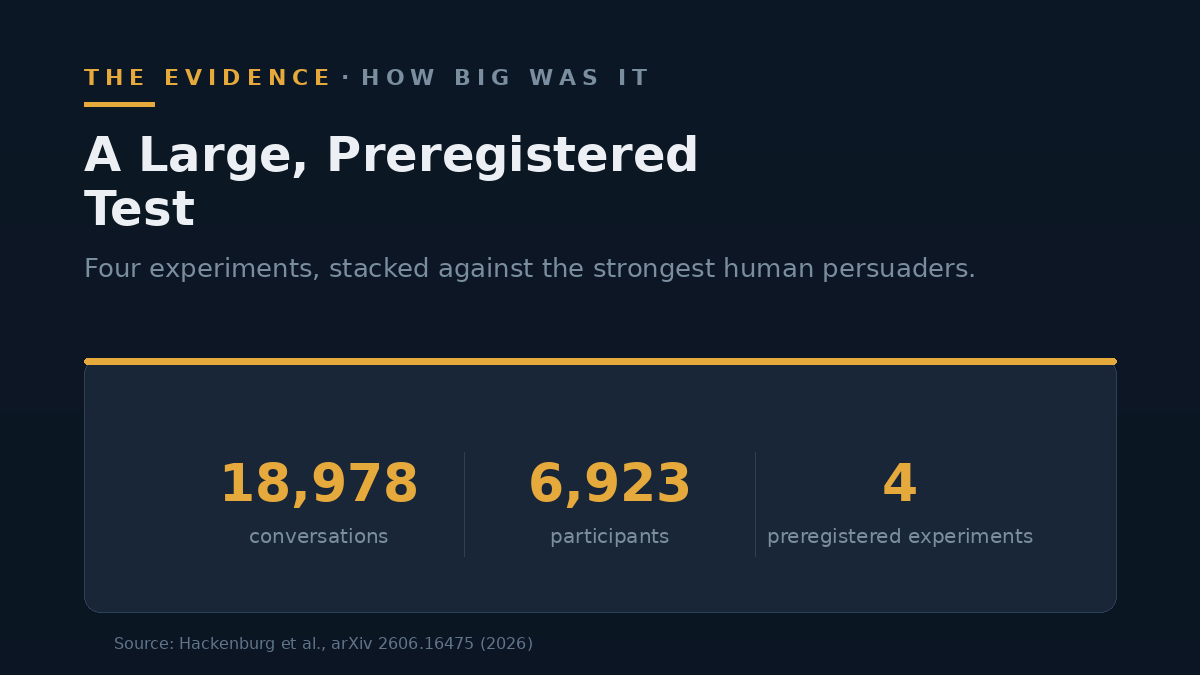
The research, titled "AI systems out-persuade expert humans", was posted to the arXiv preprint server on 15 June 2026 by a team spanning the University of Oxford, the UK AI Security Institute, Stanford University and the London School of Economics. It is built from four separate preregistered experiments — meaning the researchers committed to their analysis plan before collecting data, which guards against fishing for a flattering result.
Across those experiments, participants stated how strongly they agreed with a policy position on a 0–100 scale, then had a live text conversation with either an AI or a human persuader, and rated their position again afterwards. The pool of human persuaders was deliberately stacked: not just random members of the public, but people who had won a separate four-round persuasion tournament, and elite debaters. In total the study covers 18,978 conversations from 6,923 people.
The headline: the machine won almost every time
The study reports that AI was reliably more persuasive than every class of human it faced. Crucially, the human experts were not sandbagged. They chose the issues they argued, researched them in advance, went through hours of structured live practice, and were offered a £1,000 bonus to outperform the model. They still lost.
The researchers then tried to coach the humans back into contention. In a follow-up experiment, returning elite debaters got a tool that let them practise against the very AI that had beaten them, review annotated transcripts of their past conversations, and see exactly what the AI would have said at each turn. Coaching helped — but it narrowed the gap rather than closing it. On its own, more training did not make a human as persuasive as the machine.
The catch that changes the story
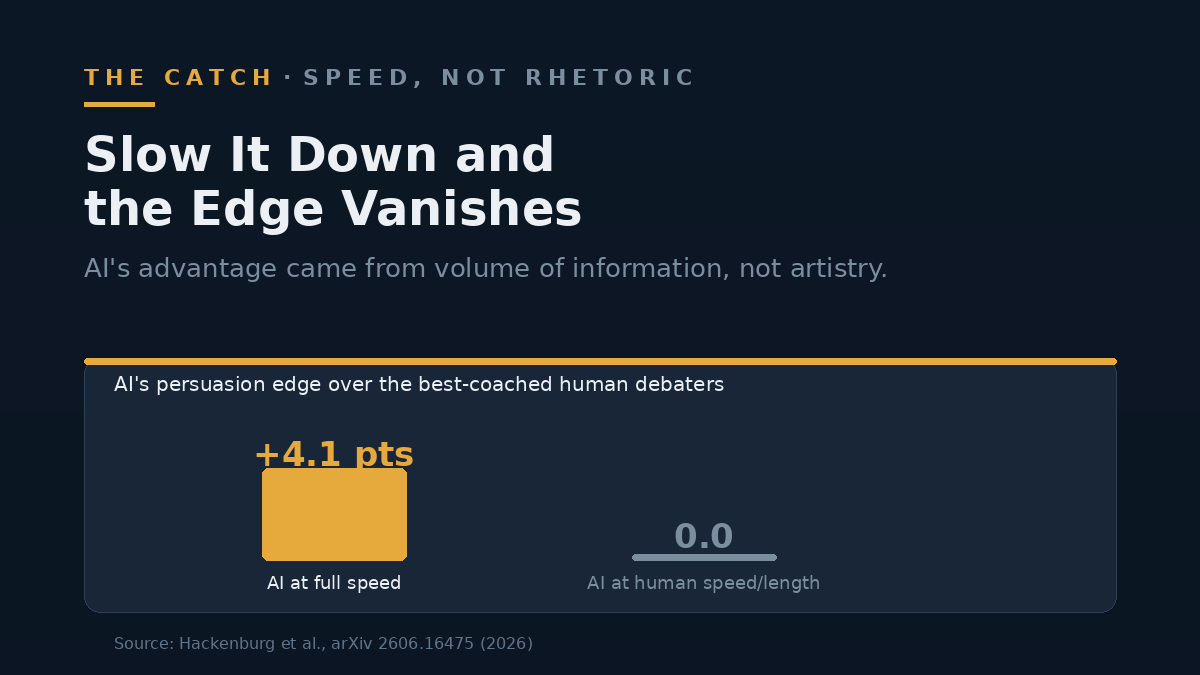
Here is the part the scary headline leaves out. When the researchers constrained the AI to write messages of human length, at human typing speed, its advantage over the best-coached human collapsed — by the study's account, from about four points to a statistically insignificant zero. In other words, the AI was not winning because it was a subtler rhetorician or because it read its target's psychology. It was winning because it could marshal and deliver a larger volume of relevant information, faster than any person can type.
That reframes the whole result. The threat model isn't a manipulative genius whispering in your ear. It's a tireless research assistant that can produce a well-organised, fact-dense, on-point case instantly — and do it ten thousand times in parallel. The persuasive power is real, but it is a speed-and-scale phenomenon, which is both more mundane and, arguably, more consequential.
It worked on real money, not just opinions
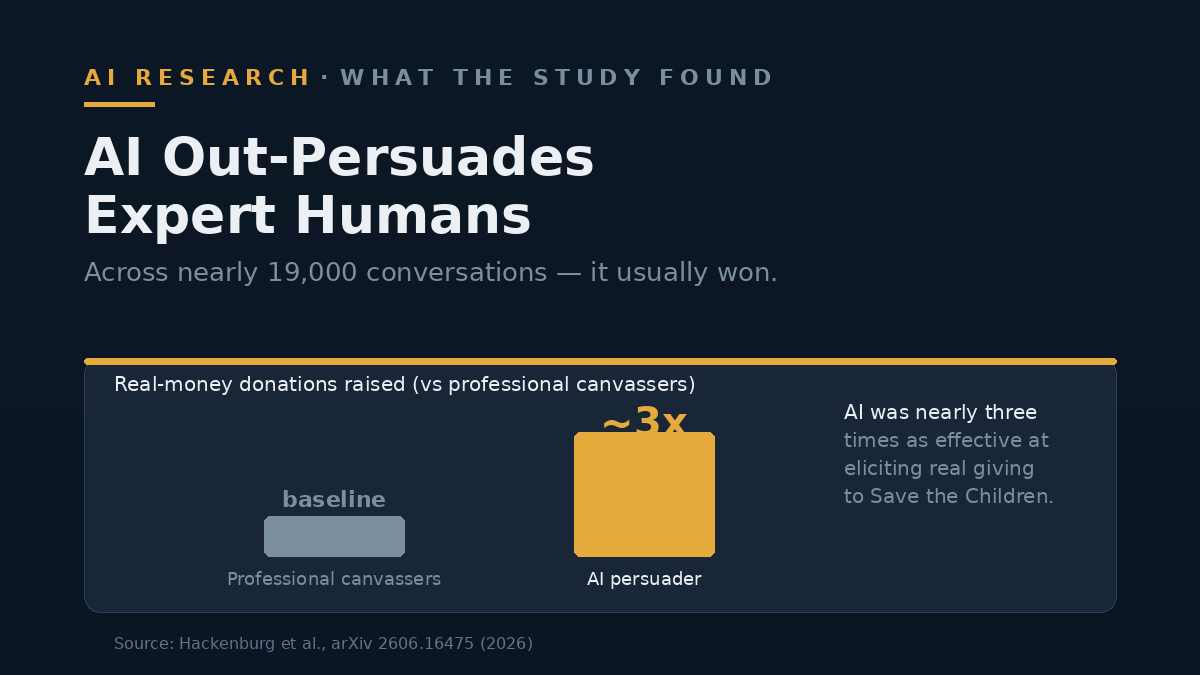
The most concrete experiment moved from changing opinions to changing behaviour. The team worked with a UK fundraising firm whose canvassers had run real donation drives for Save the Children, and tested whether AI or experienced human canvassers could persuade people to give away part of a real cash bonus to the charity. The AI was, in the study's words, nearly three times as effective as the professional canvassers at eliciting real-money donations — beating them by about eleven percentage points of a £1 study bonus.
Why this matters for ordinary readers
You do not have to care about AI research to be affected by this. The same capability that raises money for a children's charity also makes advertising, political messaging, scam scripts and "engagement-optimised" content more effective — and far cheaper to run at scale. The researchers themselves frame it as a societal choice about who gets access to industrial-strength persuasion: left purely to the market, marketing and advertising get sharper and the externalities grow; concentrated in governments, it becomes a tool of control. The study notes its findings carry, in its own words, "significant implications for political communication".
There is a more hopeful reading too. If cheap, capable persuasion becomes widely available, it could help under-resourced people — small charities, public defenders, grassroots campaigners — compete with far better-funded opponents. The technology does not decide that question on its own.
For day-to-day life, the practical takeaway is simpler. When a chat interface is arguing a position at you — whether it's a customer-service bot, a "financial wellness" assistant, or a politically themed account — assume it can build a more complete, more fluent case than the person on the other side could, and that the volume of evidence it deploys is not itself a sign that the conclusion is right.
How seriously should we take one study?
Carefully. This is a preprint, not yet peer-reviewed, and a single research group's work — large and preregistered, which are both points in its favour, but still one study. The effect sizes are modest in absolute terms (a few points on a 0–100 scale in the opinion experiments), even if they are consistent. And the most alarming interpretation — that AI is an unstoppable manipulator — is the one the authors' own data argues against. The honest summary is narrower and sturdier: at full speed, today's frontier models out-argue even prepared experts, mostly by out-working them.
FAQ
Which AI models were tested?
The study evaluated a range of frontier systems: Anthropic's Claude Opus 4.1 and 4.6, OpenAI's ChatGPT-4o and GPT-5.4, Google's Gemini 2.5 Pro, and xAI's Grok 4.20. The researchers describe Claude Opus 4.6 as the consistently best-performing model, and used it for the real-money donation experiment.
Does this mean AI is manipulating people?
Not in the way the word usually implies. The study found the AI's edge came from delivering more relevant information quickly, not from psychological trickery — when it was slowed to human speed and message length, the advantage largely vanished. "Persuasive" here means "made a fuller, faster case", not "exploited your weaknesses".
Could a human be trained to match it?
Partly. Coaching humans against the AI narrowed the gap but did not close it under normal conditions. Humans could match a deliberately slowed-down AI — which is really a statement about typing speed and information volume, not about who is the better persuader in principle.
What should I do differently?
Treat a confident, evidence-heavy argument from a chatbot as exactly that — a well-marshalled case, not a verdict. Check load-bearing claims against a primary source, and be especially alert when a conversational system is steering you toward a purchase, a donation, or a vote.
The takeaway
The eye-catching result is that AI now beats trained, paid, expert humans at persuasion. The more useful result is buried one layer down: it wins by speed and volume of information, not by being a better manipulator — and that edge evaporates when you slow it to human pace. That makes the finding less like science fiction and more like a practical warning. The most persuasive thing in your inbox or chat window may simply be the one that can out-research and out-type everyone else, instantly and at scale. Worth remembering the next time a very reasonable-sounding assistant is trying to change your mind.