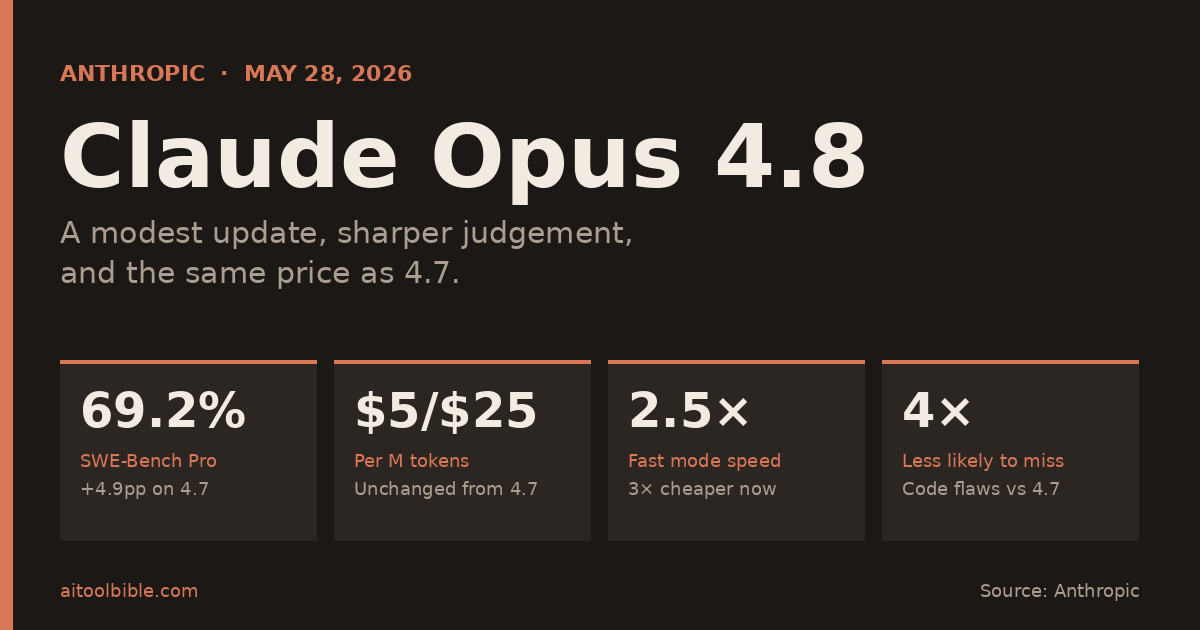
Anthropic released Claude Opus 4.8 on Thursday 28 May 2026 — less than two months after Opus 4.7 — and the company has been unusually candid about what it is. In its own announcement, Anthropic describes the new model as "a modest but tangible improvement on its predecessor". That framing matters, because the AI release cycle has trained people to expect a step change every few months and to discount anything that does not deliver one.
Opus 4.8 is not a step change. What it is, instead, is a quality-of-life upgrade for people already using Claude for coding, research and agentic work — at the same price as Opus 4.7, with several useful surrounding features. If you were already on Opus 4.7, you have been upgraded automatically and will probably notice the difference within a few sessions. If you were not, this release on its own is unlikely to change your mind.
The more interesting story sits in the footnotes of the announcement: Anthropic confirmed that its Mythos-class models — currently in restricted preview through Project Glasswing — will be released to all customers "in the coming weeks". Opus 4.8 is, in effect, the last release before that. We will come back to what that means at the end.
What changed versus Opus 4.7
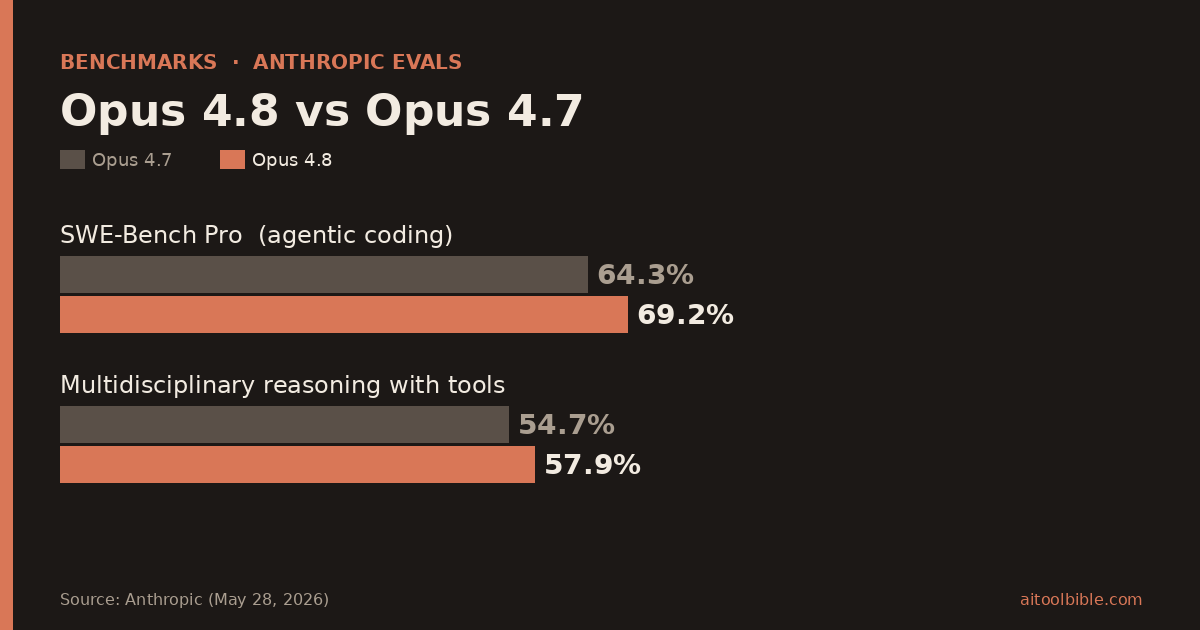
Anthropic's published benchmarks against Opus 4.7 are improvements, not revolutions. The headline numbers are a 4.9 percentage point jump on SWE-Bench Pro — Anthropic's measure of agentic coding performance — from 64.3% to 69.2%, and a 3.2 point jump on multidisciplinary reasoning with tools, from 54.7% to 57.9%.
Where the change is more notable is in browser agent work. Opus 4.8 scores 84% on Online-Mind2Web, which Reka — one of Anthropic's early testers — describes as "the strongest computer-use and browser-agent model we've tested" and a meaningful jump over both Opus 4.7 and OpenAI's GPT-5.5. For anyone building tools that drive a browser autonomously, that is the metric to pay attention to.
The other improvement Anthropic emphasises is harder to put a number on but easier to feel: judgement. The company claims Opus 4.8 is roughly four times less likely than 4.7 to let flaws in its own code pass without comment. In practice that means fewer cases of the model confidently declaring a task complete when it is not. Several of the early testers quoted in Anthropic's launch post — including Cursor's Michael Truell and Devin's Scott Wu — independently flag the same thing: the model pushes back more, asks better questions, and is less prone to false confidence.
That sounds soft, but it is the single largest source of wasted developer time when working with AI coding agents. A model that says "I'm not sure this is right" is more useful than one that says "Done!" and leaves you to discover, three commits later, that it wasn't.
New features launched alongside the model
Three things shipped with Opus 4.8 that are worth knowing about, even if you stick with Opus 4.7 for some workloads.
Effort control. A new dropdown sits next to the model selector in claude.ai and Cowork. It lets you choose how hard the model thinks about a given task — from low effort (fast, cheap, uses your rate limits more slowly) up through high, extra and max. Opus 4.8 defaults to "high", which Anthropic says spends a similar number of tokens to Opus 4.7's default while giving better results. "Extra" and "max" exist for hard problems and long-running async workflows. This is partly a response to user complaints about Opus 4.7's adaptive thinking burning tokens on tasks that did not need it.
Dynamic workflows in Claude Code. Available in research preview for Enterprise, Team and Max plans, this lets Claude plan a piece of work and then spawn hundreds of parallel subagents in a single session, verifying outputs before reporting back. Anthropic's example is the headline-grabbing one: Claude Code with Opus 4.8 can now run codebase-scale migrations across hundreds of thousands of lines of code, with the existing test suite as the pass condition. This is a real, specific capability, not a marketing concept. For most individual developers it will not change daily workflow, but for engineering teams considering large-scale modernisation projects, it changes the economics.
Fast mode pricing. Opus 4.8's fast mode runs at 2.5 times the speed of the standard model and is now three times cheaper than fast mode was on previous Opus releases. That puts fast mode at $10 per million input tokens and $50 per million output tokens — still more expensive than standard Opus 4.8, but a meaningful shift if speed of response matters to your use case.
There is also a smaller but useful change for developers: the Messages API now accepts system entries inside the messages array. In plain English, you can now update Claude's instructions mid-task — change its permissions, token budget, or environment context — without breaking the prompt cache or routing the change through a fake user turn. Anyone running long agentic sessions will appreciate this one.
Pricing: Opus 4.8 versus the rest of the frontier
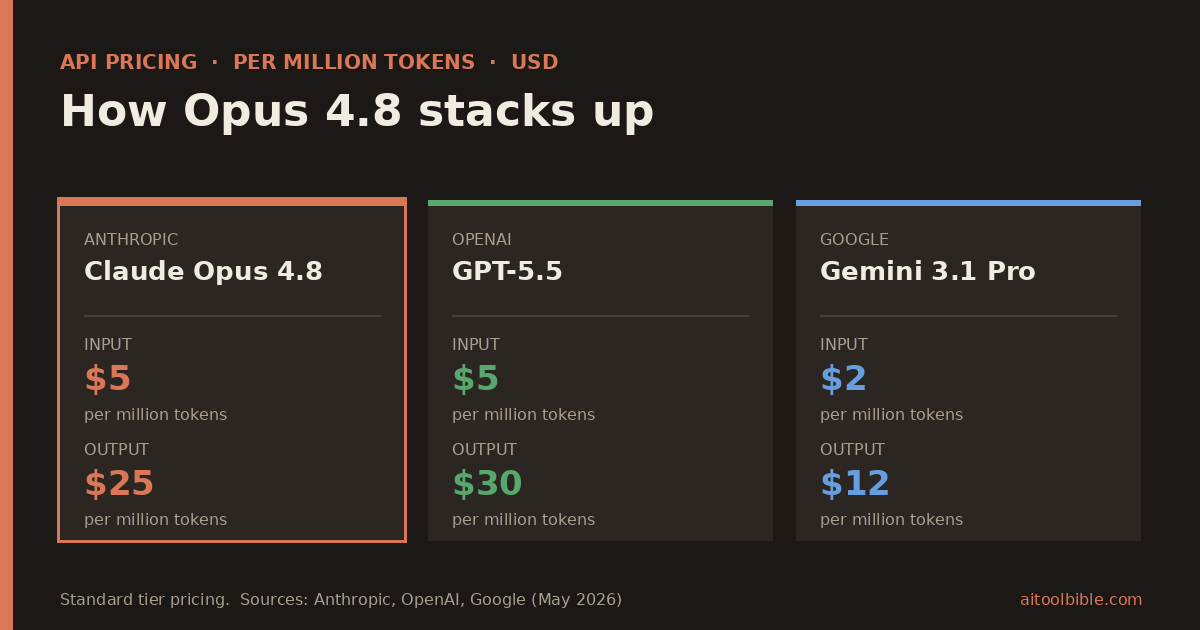
Opus 4.8 standard pricing is unchanged from Opus 4.7: $5 per million input tokens and $25 per million output tokens. That is the headline number. It is also, increasingly, an unusual one — frontier model pricing has been moving in both directions in 2026, and Anthropic holding the line on Opus pricing while improving the model is the most consumer-friendly thing in the announcement.
For comparison, here is where the other two frontier models commonly used for coding work sit on standard pricing as of late May 2026:
- OpenAI GPT-5.5 (released 23 April 2026): $5 per million input tokens, $30 per million output tokens. OpenAI doubled the per-token price from the GPT-5 line on this release, justifying it on the basis of higher quality per token and better token efficiency on hard tasks.
- Google Gemini 3.1 Pro Preview (released 19 February 2026): $2 per million input tokens, $12 per million output tokens for prompts up to 200,000 tokens. Above that threshold, input doubles to $4 and output rises to $18 per million.
The comparison is not as simple as the numbers suggest, for two reasons.
First, output tokens are where the real cost sits in coding work — the model generates more than it ingests on a typical task. On output, Opus 4.8 at $25 sits between Gemini 3.1 Pro at $12 and GPT-5.5 at $30. If pure cost per token is the deciding factor, Gemini is roughly half the price of Opus and well under half the price of GPT-5.5. If quality on agentic coding is the deciding factor, Anthropic's published benchmarks have Opus 4.8 ahead of both — particularly on SWE-Bench Pro and browser agent work, though GPT-5.5 reportedly leads on Anthropic's terminal-coding benchmark.
Second, token efficiency matters. A model that takes 100,000 output tokens to solve a problem at $25 per million costs the same as a model that takes 200,000 tokens at $12.50. Several of Anthropic's early testers — Cursor and Hebbia in particular — specifically flag Opus 4.8 as more token-efficient than 4.7, completing the same tasks in fewer steps. Databricks claims a 61% lower per-task cost than Opus 4.7 for the kinds of multimodal queries its Genie product runs. None of these are independent benchmarks, but the consistent thread is that headline token price is increasingly the wrong way to compare frontier models.
The most honest summary: Gemini 3.1 Pro is the cheapest option per token by a wide margin and remains genuinely capable. Opus 4.8 is the strongest model on Anthropic's published agentic coding and browser-agent benchmarks. GPT-5.5 is the most expensive of the three on output and reportedly leads in terminal coding specifically. For most teams choosing one model to build on, the right answer depends on what the workload actually looks like — not the headline price.
How to think about Opus 4.8 if you use Claude Code or claude.ai
If you are on Claude Pro, Max, Team or Enterprise, Opus 4.8 is available now and replaces Opus 4.7 as the default Opus option. There is no decision to make on that front — you have the new model whether you want it or not.
If you use Claude Code, the practical change is two-fold. First, the model itself is sharper at multi-step engineering work and noticeably more honest about its own uncertainty. Second, the new effort levels in Claude Code (low through max, with "xhigh" recommended for hard async tasks) give you more direct control over how much token budget the model spends on a given task. Anthropic has raised rate limits to accommodate the higher effort settings.
If you are building on the Claude API rather than using the chat product, the only thing that requires any code change is the new ability to insert system entries inside the messages array — useful for long agentic loops, optional everywhere else. Pricing is unchanged.
If you primarily use claude.ai for writing, research or non-coding work, the model is better, the price is the same, and the new effort control will be more useful than you initially expect. The default of "low" effort for casual queries means you will burn through your rate limits more slowly than on Opus 4.7's adaptive mode, which often spent reasoning tokens on questions that did not need them.
The Mythos shadow
The reason Opus 4.8 reads as a modest release is partly because Anthropic has been openly signalling that something bigger is close. The Mythos-class models — first previewed publicly through Project Glasswing earlier in 2026 and currently in restricted access for cybersecurity work — are described by Anthropic as "even higher intelligence than Opus". The launch post for 4.8 confirms that Mythos-class models will be released to all customers in the coming weeks, once additional cyber safeguards are in place.
This puts Opus 4.8 in an awkward position. The improvements over 4.7 are real, but they are arriving immediately before what looks like a more significant model class. For teams making serious infrastructure commitments around model choice, the rational thing to do is treat 4.8 as the current state-of-the-art Opus, use it accordingly, and plan to re-evaluate the moment Mythos becomes broadly available.
One other piece of context worth noting: Anthropic also announced on Thursday that it has raised $65 billion in Series H funding at a $965 billion valuation, surpassing OpenAI's reported $852 billion. Whatever you make of frontier model valuations as a category, the practical implication is that Anthropic has the capital to keep pushing Opus and Mythos releases at the pace it has been — and is not under near-term pressure to chase short-term commercial wins at the expense of model quality.
Verdict
Claude Opus 4.8 is not a release that justifies a separate decision. It is the upgrade you were going to get whether you asked for it or not, and on the merits it is a clean improvement — better at coding, more honest about uncertainty, more token-efficient, with useful new effort controls and meaningful new agentic capabilities through dynamic workflows. The unchanged pricing is a quiet win in a year when both OpenAI and Google have moved their headline numbers.
The harder question is whether Claude is still the right model to be building on, full stop. Anthropic's published benchmarks say yes for agentic coding, browser agents and honest-to-uncertainty work. Gemini 3.1 Pro is genuinely competitive on quality at less than half the output token cost. GPT-5.5 is the most expensive of the three and reportedly leads on terminal coding specifically. There is no single right answer.
What Opus 4.8 does well is reinforce the thing Claude has been quietly winning on for several releases now: reliability under autonomous, long-running work. If you are building agents that need to run unsupervised for hours, that is the metric that matters, and on that metric Opus 4.8 is, on the available evidence, the best frontier model currently in general release.
For now. Mythos is weeks away.