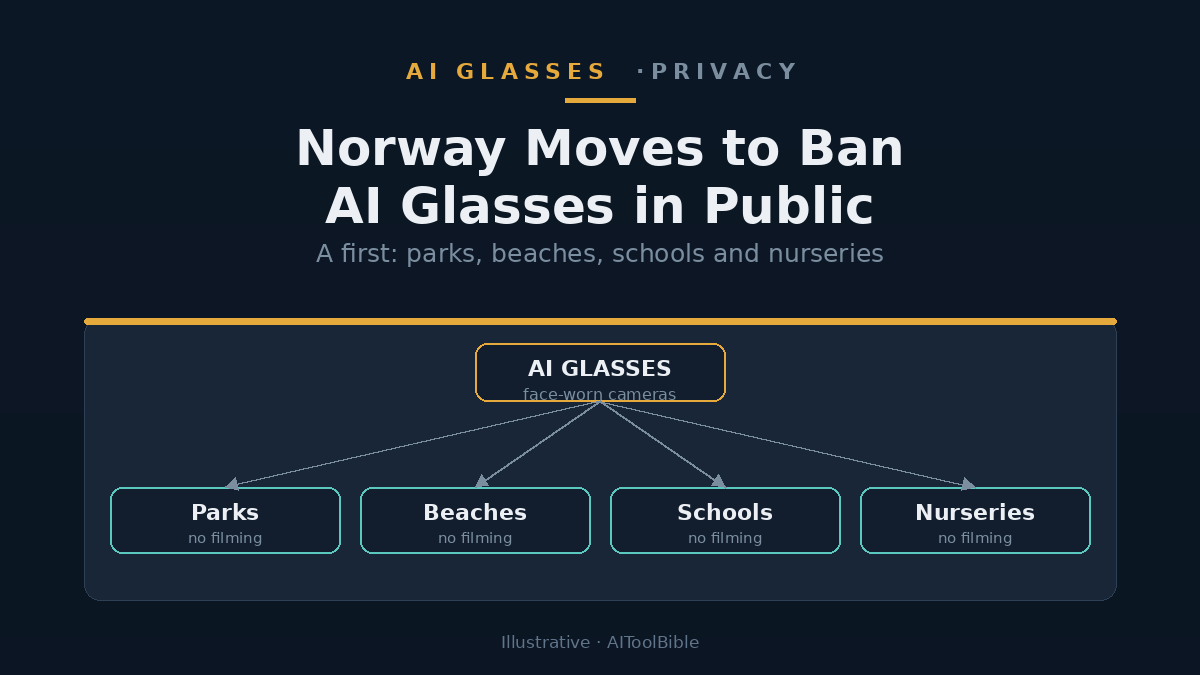
Norway has become the first country to propose a temporary ban on AI-enabled glasses in some public places. The country's digitalisation minister, Torgeir Micaelsen, said on 5 October 2026 that the government will soon put a draft law to parliament covering parks, beaches, schools and nurseries, and will set up an expert group to propose permanent national rules. The concern is simple: cameras worn on the face let people record others without their knowledge. For UK readers the interesting part is the contrast. Britain's Information Commissioner's Office has been pressing Meta over the same devices since March, but it has not proposed a ban, and a ban is far harder to enforce than it sounds.
This piece reflects reporting as of October 2026. Norway's measure is a proposal, not yet law, and its final scope may change.
What Norway is actually proposing
The plan is a temporary, place-specific restriction rather than a blanket ban on the devices. It targets settings where people have a reasonable expectation of not being filmed: parks, beaches, schools and nurseries, with changing rooms the kind of space ministers have in mind. Micaelsen said he was concerned that people risk being "photographed, filmed or recorded without their knowledge," and singled out children as a particular worry.
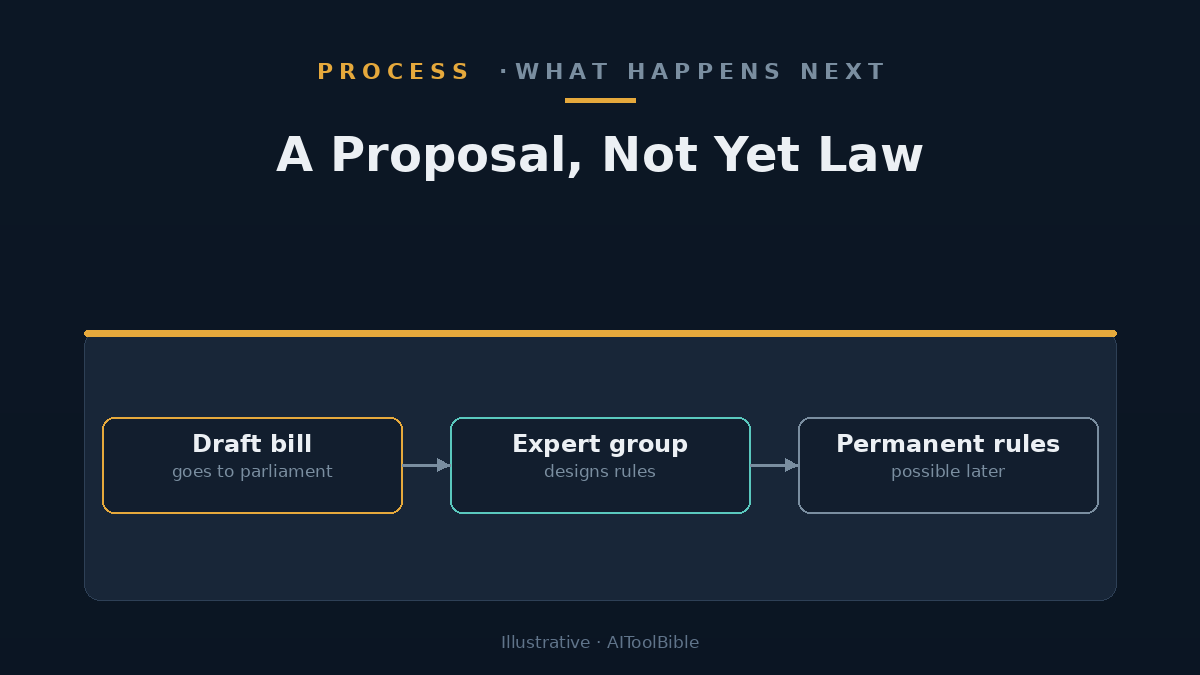
Two things make this more than symbolic. First, the government intends to legislate rather than issue guidance, so a draft bill is heading to Norway's parliament. Second, it is setting up an expert group to design permanent rules, which signals this is a first step rather than a one-off. Norway is not alone in looking at the problem: Australia is weighing similar restrictions in certain public spaces, and courts in several countries already limit wearable recording devices. But a national government proposing a public-place ban is a first.
Why smart glasses set off this alarm
Ordinary phones have cameras too, but you can usually see when someone points one at you. Face-worn cameras remove that signal. Devices such as Meta's Ray-Ban range look like normal glasses, and while they carry a small recording light, it is easy to miss and its reliability has been questioned. Add on-device AI that can recognise what the camera sees, and a pair of glasses becomes a quietly capable surveillance tool in a way a held-up phone is not.
This is not a hypothetical worry. Earlier in 2026, a Swedish media investigation reported that contractors had reviewed intimate footage captured on Ray-Ban glasses, including people dressing, using toilets and in private conversations, sometimes with bank cards and documents visible, and that some data had been sent to subcontractors outside the EU. That reporting is what prompted the UK's ICO to write to Meta, asking the company to explain how the glasses meet UK data-protection law. The regulator's line was that devices processing personal data should keep users in control and be transparent about it.
The UK has pushed, but not banned
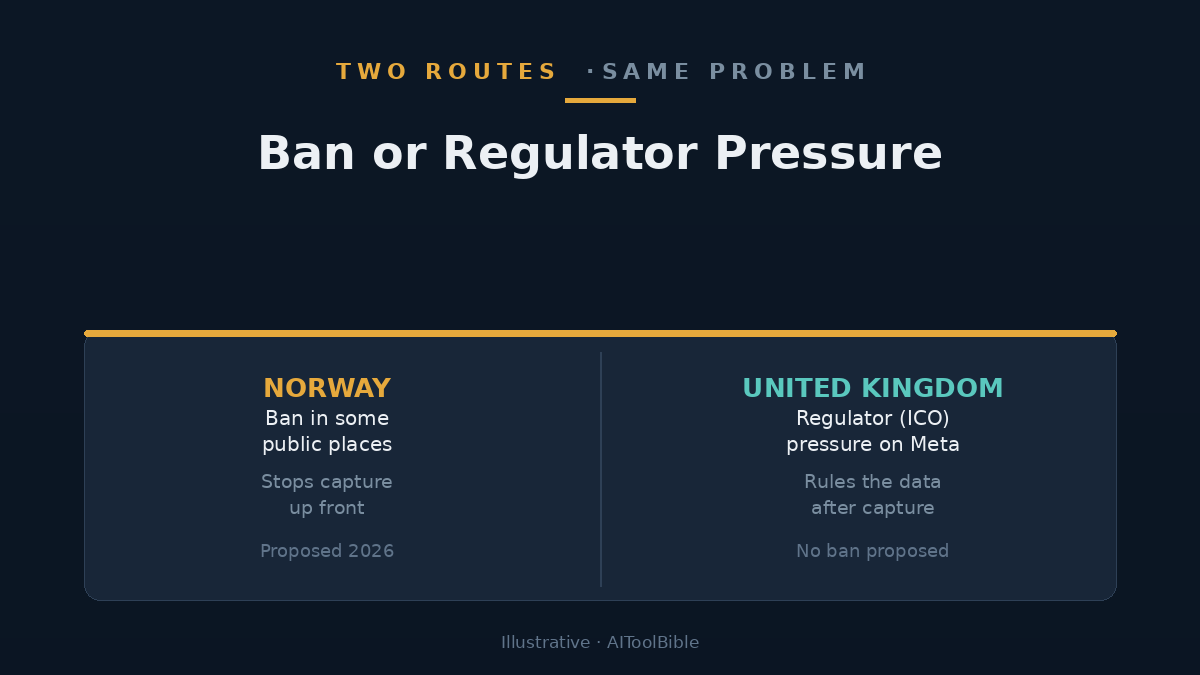
Here is the gap. The UK already has laws that bite on the worst behaviour: filming someone in a private moment can be a voyeurism offence, and UK GDPR governs how captured footage is handled. The ICO has used that leverage to demand answers from Meta. What it has not done, and what Norway now proposes, is to make wearing the devices unlawful in specific public spaces regardless of what the wearer does with the footage. That is a meaningfully different approach: one regulates the data after it is captured, the other tries to stop the capture in the first place.
Whether Britain copies Norway is an open question. A place-based ban raises obvious problems. The glasses are indistinguishable from ordinary eyewear, so enforcement largely depends on honesty or on catching someone after the fact. There is also a genuine accessibility case: camera-and-AI glasses can describe surroundings for blind and partially sighted users, and a clumsy ban could sweep that up. One response, which the market is already testing, is hardware that sidesteps the camera problem entirely. We covered one example in the Solos AirGo A6, a pair of AI glasses that deliberately leaves the camera out.
What it means for UK readers and businesses
If you wear smart glasses in the UK, nothing changes today. Norway's rule would not apply here, and there is no UK proposal to match it. But the direction of travel matters. Regulators across Europe are converging on the view that always-available face cameras need specific rules, not just general data-protection law, and the ICO's existing interest in Meta suggests the UK is watching. For businesses, the practical takeaway is narrower and more immediate: if staff use camera glasses in workplaces, shops or public-facing roles, the data-protection obligations that already apply to CCTV apply here too, and "we didn't realise it was recording" is not a defence.
FAQ
Is Norway banning smart glasses outright?
No. The proposal is a temporary ban on using AI-enabled glasses in specific public places such as parks, beaches, schools and nurseries. It is not a ban on owning or selling them, and it is not yet law.
Does this affect the UK?
Not directly. Norway is not in the EU or the UK, so its law would apply only in Norway. There is currently no equivalent UK proposal, though the ICO has been questioning Meta over the same privacy concerns since March 2026.
Are smart glasses already illegal to use in some situations in Britain?
Using any camera, including glasses, to film someone in a private act can already be a criminal offence, and footage that identifies people is covered by UK GDPR. What Britain lacks is a specific place-based rule for wearable cameras of the kind Norway is proposing.
Would a ban even work?
That is the hard part. The glasses look like ordinary eyewear, so a place-based ban is difficult to police and may rely on reports after the event. It would also need to avoid blocking genuine accessibility uses for people with sight loss.
The takeaway
Norway has not solved the smart-glasses problem; it has named it louder than anyone else and put a law behind the concern. The proposal will test whether a place-based ban can work against a device that is, by design, hard to spot. For the UK, the value is as a signal rather than a change in the rules: the privacy worry the ICO raised in March has now produced an actual legislative response somewhere, and British regulators and readers now have a live example to judge. Whether Britain wants the ban or the lighter-touch route it has taken so far is a question that is only going to get louder as the glasses get better.
Sources
- The Irish Times – Norway first country to propose temporary ban on AI glasses in public places (5 October 2026)
- U.S. News / AP – Norway to propose temporary ban on AI glasses in some public places (5 October 2026)
- The Register – UK ICO contacts Meta over smart glasses privacy compliance (5 March 2026)
- AIToolBible – Solos AirGo A6: AI smart glasses that leave the camera out