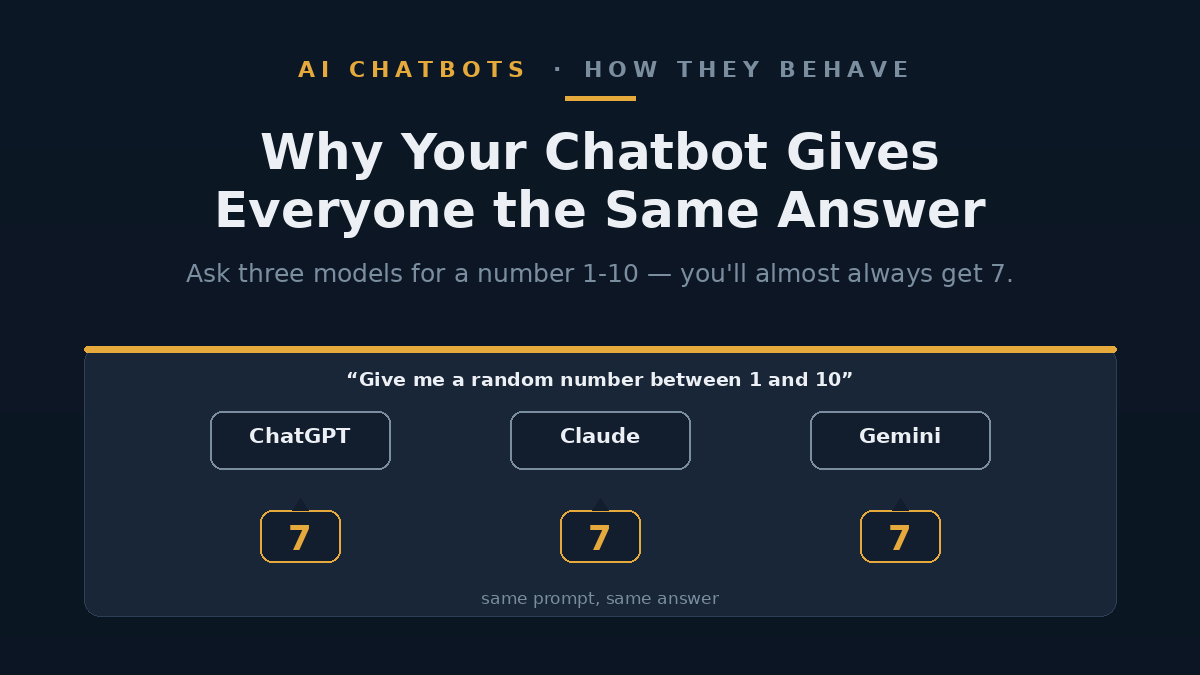
Open ChatGPT, Claude or Gemini and ask for a random number between 1 and 10. You will almost certainly get 7. Ask a few people to name a type of car through one of these chatbots and you will keep landing on a Toyota or a Honda. Ask each of the big models for a New Balance advertising tagline and more than one will hand back the identical line, "Run your way." This is not a coincidence, and it is not a bug you can report. It is a well-documented tendency of today's large language models to cluster around a narrow set of predictable, "average" answers — and, more oddly, to converge on the same answers as one another. A study that won a top academic prize at the end of 2025 gave it a name: the Artificial Hivemind.
This piece reflects reporting as of July 2026. The demonstrations above are illustrative rather than guaranteed — they depend on the model, its version and its settings — but the underlying pattern is real and measured.
What the research actually found
The "Artificial Hivemind" paper, led by researchers including Liwei Jiang and Yejin Choi, was named a best paper in the datasets and benchmarks track at NeurIPS, one of the field's largest conferences. To study the problem at scale, the team built a dataset of roughly 26,000 open-ended questions — the kind that have no single right answer, such as "where should I go in Europe?" — and gathered more than 31,000 human ratings to compare against. Across dozens of models — more than 70 in all — they measured two things: how often a single model repeats itself, and how often different models produce strikingly similar answers. Both effects were pronounced, and the second — different systems from different companies converging — is the more surprising one.
One example from the study is memorable. When researchers asked a batch of models to write a metaphor about time, the overwhelming majority produced a version of "time is a river" or "time is a weaver." Ask a room of people the same question and you get genuine variety; ask the machines and you get a chorus. The NeurIPS committee, in explaining the award, framed this as more than a curiosity — a concern about the long-term effect on human creativity and independent thinking if millions of us are quietly nudged toward the same phrasings and ideas.
Why it happens
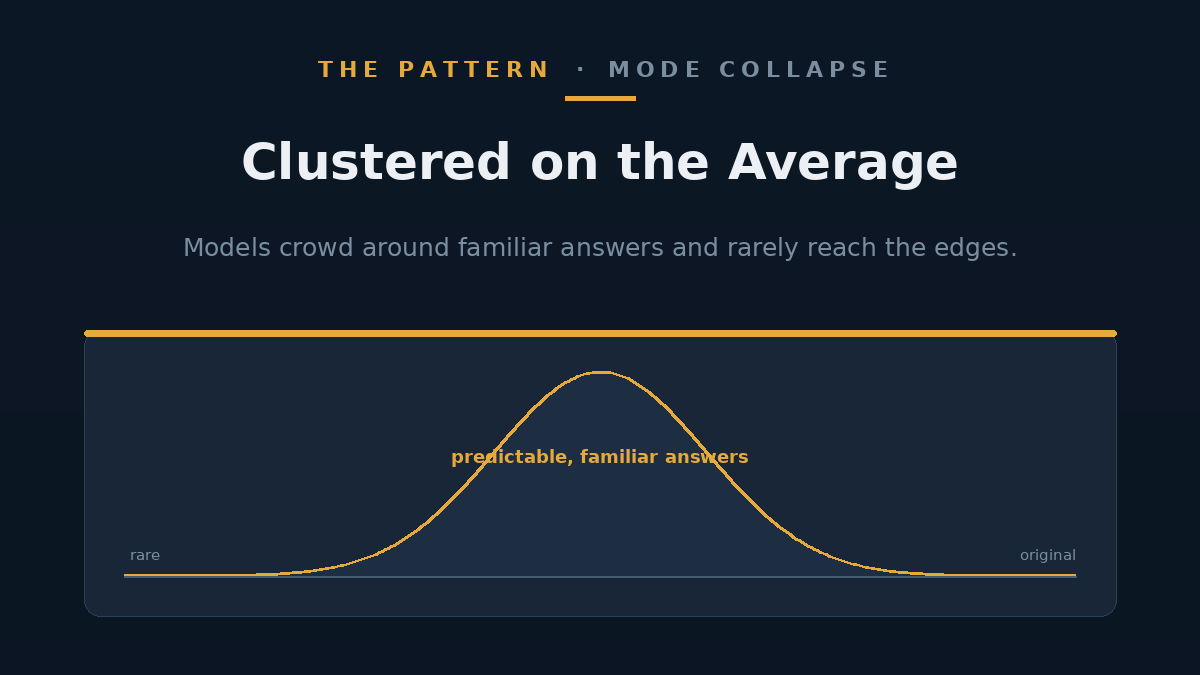
The researchers are careful to say the exact cause is not fully understood, but the leading explanation is straightforward: most of today's models are trained in similar ways, on overlapping data, to do similar things. Push a lot of systems through the same kind of training and you should not be shocked when they develop the same reflexes. There is also a deliberate design pressure at work. Models are tuned to give reliable, coherent, broadly acceptable answers, and the safest way to do that is to reach for the most probable response — which is, almost by definition, the unremarkable one. OpenAI, responding to the research, made this point directly: training a model to be dependable can lead it to converge on familiar answers, and pushing harder for novelty tends to make the output weaker or less reliable. It also noted that the headline study looked at models from 2024 that have since been updated.
Can't you just turn up the randomness?
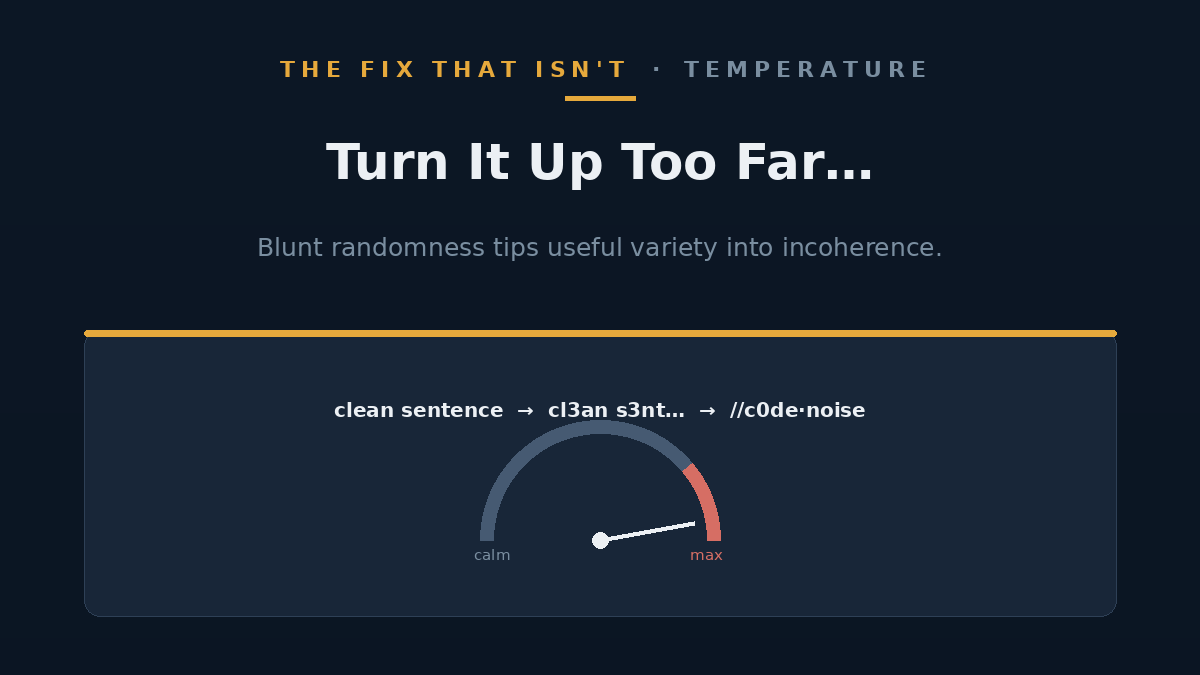
Up to a point. Most models have a setting, usually called "temperature", that controls how adventurous the output is. Turn it up and you get more variety; turn it up too far and the wheels come off. Developers at the startup profiled below found that maxing out the randomness on one model made it start a sentence in English and finish it in code. Randomness applied bluntly across every word is a poor tool, because you do not want a model to be more random when it is, say, getting a fact or a name right — only when it is choosing between many equally good creative options. That distinction is the whole game, and it is why "just raise the temperature" is not the fix people assume it is.
The startup trying to sell a way out
The reason this is in the news now is a small Australian company called Springboards, which has built a model it calls Flint aimed squarely at the problem. Rather than train a system from scratch — too expensive for a small team — it took Alibaba's openly available Qwen 3 model and retrained it to spot the specific points in an answer where more variety is possible, and to be more adventurous only there. In demonstrations, where mainstream chatbots return a 7 or a Toyota, Flint is more likely to offer 3.7916 or a Ford F-150. Springboards, whose customers are advertisers and marketers, pitches Flint as a tool for brainstorming, where being thrown in an unexpected direction is the point.
It is worth being clear-eyed here: Springboards sells a solution to the problem it is describing, so its framing is not neutral, and the people trialling Flint are candid about its limits. One marketing-firm user calls the premise powerful but says the model is still a prototype that "falls over" when pushed too hard. Another makes the more important point for most readers: nine times out of ten, the average answer is exactly what you want. If you are asking a chatbot to summarise a document or fix a formula, predictability is a feature. The Hivemind only becomes a problem when you specifically want range — new ideas, unusual angles, something you have not seen before.
What to do about it
You do not need a specialist model to work around this. The practical moves are simple: ask for many options at once rather than one, and then discard the obvious ones; tell the model explicitly to avoid the predictable answer ("give me a band name that doesn't involve glass, neon, velvet or static"); rephrase your prompt rather than typing "another", which tends to walk the model through the same short list; and, most reliably, treat the chatbot as a starting point rather than the finish. The researchers, the startup's own users and OpenAI all converge on the same quiet warning — the one thing they do agree on: if you hand the thinking entirely to the machine, you will end up sounding like everyone else who did the same.
FAQ
Is the "always 7" trick guaranteed?
No. It works often enough to feel like magic, but it is a demonstration of a tendency, not a fixed rule. Different models, versions and settings behave differently. The measured pattern behind it — that models cluster on a few high-probability answers — is the reliable part.
Does this mean AI chatbots aren't creative?
They can produce creative-looking output, but they lean heavily toward the most probable, familiar version of it, and different models lean the same way. For genuine variety you usually have to push them — and even then, results vary.
Is one chatbot more varied than another?
The research's most striking finding is how similar different models are to each other on open-ended questions, so switching between the mainstream ones is not a dependable fix. Prompting technique tends to matter more than which brand you use.
Why does predictability matter if the answers are good?
For factual or technical work it does not — predictability is helpful. It matters when you are brainstorming, naming, writing or planning and want options you would not have reached alone. The concern researchers raise is the slow homogenising effect if everyone leans on the same defaults.
The takeaway
The Artificial Hivemind is a real, measured limitation, taken seriously enough to win a major research prize — not marketing hype, and not something a single clever product has solved. For most everyday tasks it barely matters, and the predictability is doing you a favour. But if you use these tools to think, it is worth knowing that their instinct is to pull you toward the middle, and that getting something genuinely different out of them takes deliberate effort on your part. The machines are happy to give you the average. Whether you settle for it is still up to you.
Sources
- MIT Technology Review — "LLMs are stuck in a groupthink groove. This startup is trying to get them out." (1 July 2026)
- arXiv — "Artificial Hivemind: The Open-Ended Homogeneity of Language Models (and Beyond)" (Jiang, Choi et al., 2025)
- NeurIPS — 2025 Best Paper Awards announcement (26 November 2025)