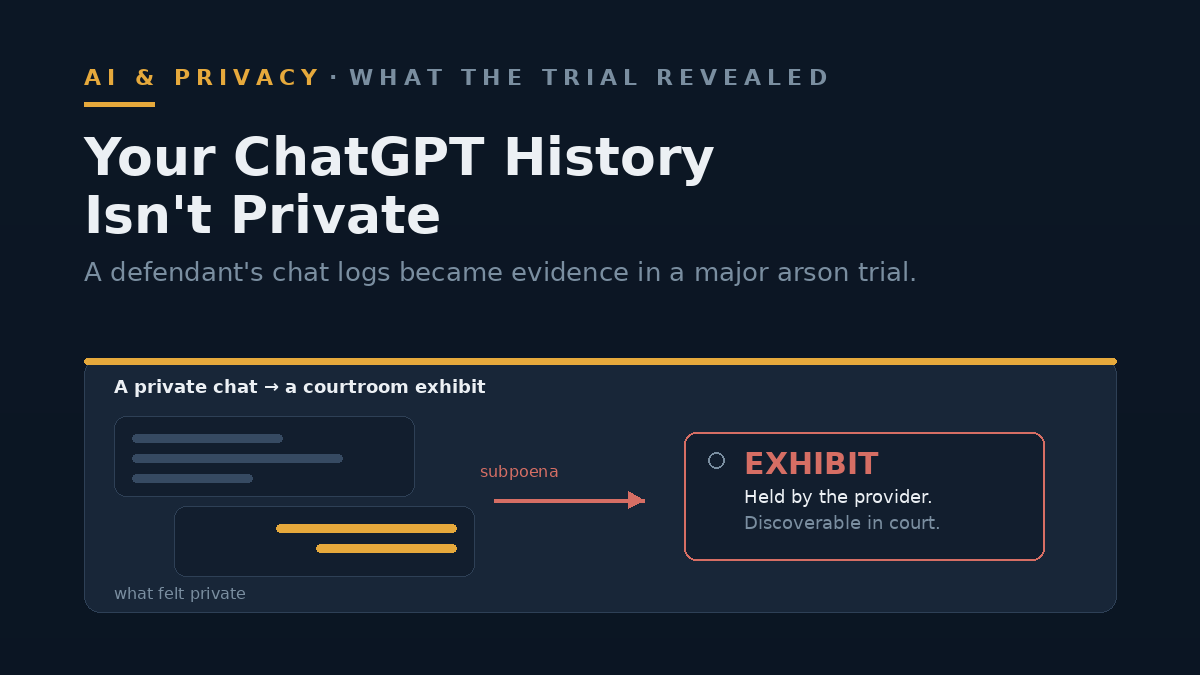
Prosecutors trying a man for sparking last year's deadly Palisades Fire showed jurors something most people never think about: his ChatGPT history. The trial of Jonathan Rinderknecht, 29, ended in a mistrial on 26 June 2026 after jurors deadlocked, with ten of the twelve favouring acquittal, and a retrial is set for 19 October 2026. The verdict is unresolved — but one detail is not. The chatbot you treat as a diary, a therapist or a sounding board is not legally private. It is a record held by a company, and it can be subpoenaed and shown to a jury.
This piece reflects court reporting as of June 2026. The case is unresolved and figures may change at retrial.
What happened in the trial
Rinderknecht pleaded not guilty to federal charges of arson, malicious destruction by means of fire, and setting timber aflame. Prosecutors alleged he used a barbecue lighter on 1 January 2025 to start a fire that smouldered in deep root systems before flaring back up on 7 January and killing 12 people as it tore through neighbourhoods in Los Angeles and Malibu. They never produced direct evidence that he lit the blaze; instead they built a digital portrait of his state of mind, drawn from his phone, email, Uber, social media and OpenAI records.
According to trial coverage, investigators reviewed thousands of his ChatGPT conversations, which he used regularly almost as a personal diary. In one exchange he typed, "Why am I so angry all the time?" While filming firefighters at the scene, he paused to ask ChatGPT whether someone could be held responsible for a fire accidentally started by a cigarette — and he screen-recorded both his 911 calls and that prompt, which prosecutors argued showed an attempt to mislead investigators. The judge barred a separate set of AI-generated images of a city burning that prosecutors said he had prompted ChatGPT to create months earlier, so those were never put to the jury.
The defence argued the real cause was fireworks — common on New Year's Eve — and that investigators had fixed on Rinderknecht too quickly. Ten of the twelve jurors favoured acquittal. Tellingly, one juror said his ChatGPT use struck her as simply human, and that she talks to the chatbot the same way; she felt the prosecution was unfairly attacking his character. That reaction is the heart of why this case matters beyond the courtroom: millions of people now confide in chatbots exactly as he did.
The part that should give every user pause
Strip away the arson and you are left with a simpler fact. A person used ChatGPT privately, the way you might journal at midnight, and those words ended up as exhibits in a federal courtroom. Most people assume a chat with an AI sits somewhere between a private thought and a Google search. Legally, it is closer to a letter you handed to a company to keep — and companies can be compelled to hand it over.
Two things make AI chats more exposed than people expect. First, there is no confidentiality privilege. Conversations with a lawyer, a doctor or a spouse are legally protected; conversations with a chatbot are not. OpenAI's own chief executive, Sam Altman, has said plainly that people who pour their problems into ChatGPT have no legal confidentiality, and that the company would be legally required to produce those exchanges in a lawsuit. There is no "AI privilege" in law, however much the industry now argues there should be.
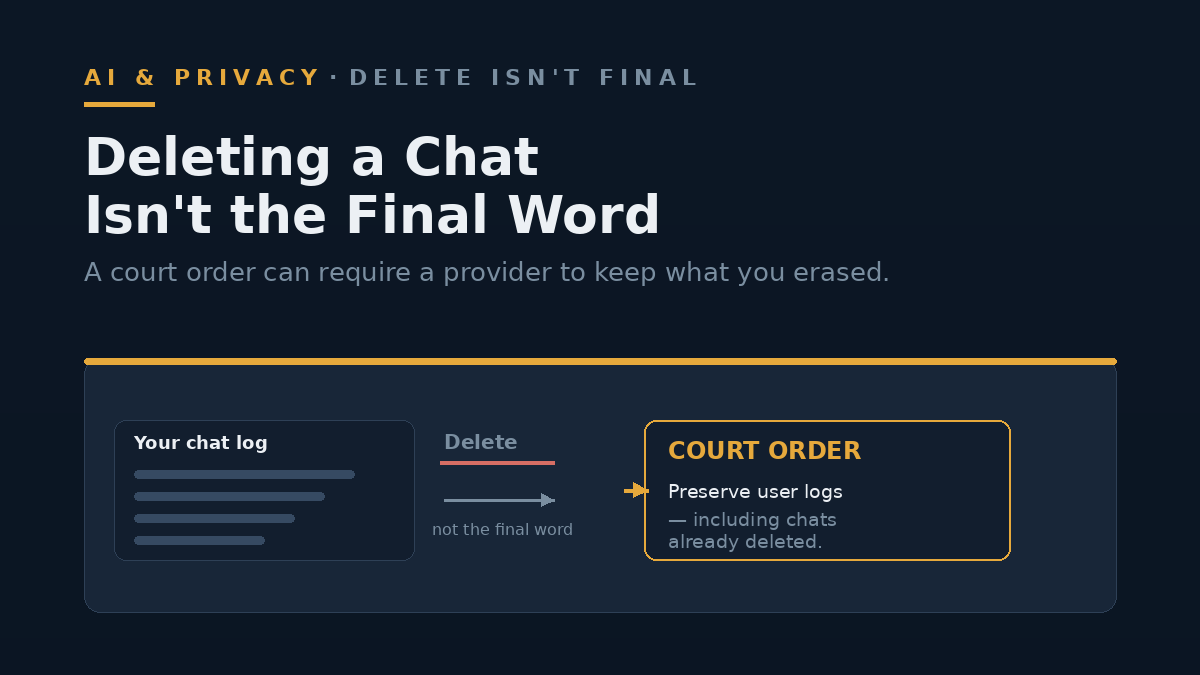
Second, your chats may stick around longer than you think. Deleting a conversation, or assuming an "unsaved" chat vanishes, does not put it beyond reach. In the New York Times' copyright lawsuit against OpenAI, a court ordered the company to preserve user logs it would otherwise have deleted, including chats users had already deleted, which normally vanish within 30 days. By OpenAI's own account, the order cut against its standard deletion practice. Once data exists and a court takes an interest, the provider's delete button is not the final word.
What's actually discoverable, and what isn't
None of this means your chat history is being read today, or that every conversation is one subpoena away from a courtroom. It means the protections are weaker than the private feel of the interface suggests. The realistic picture:
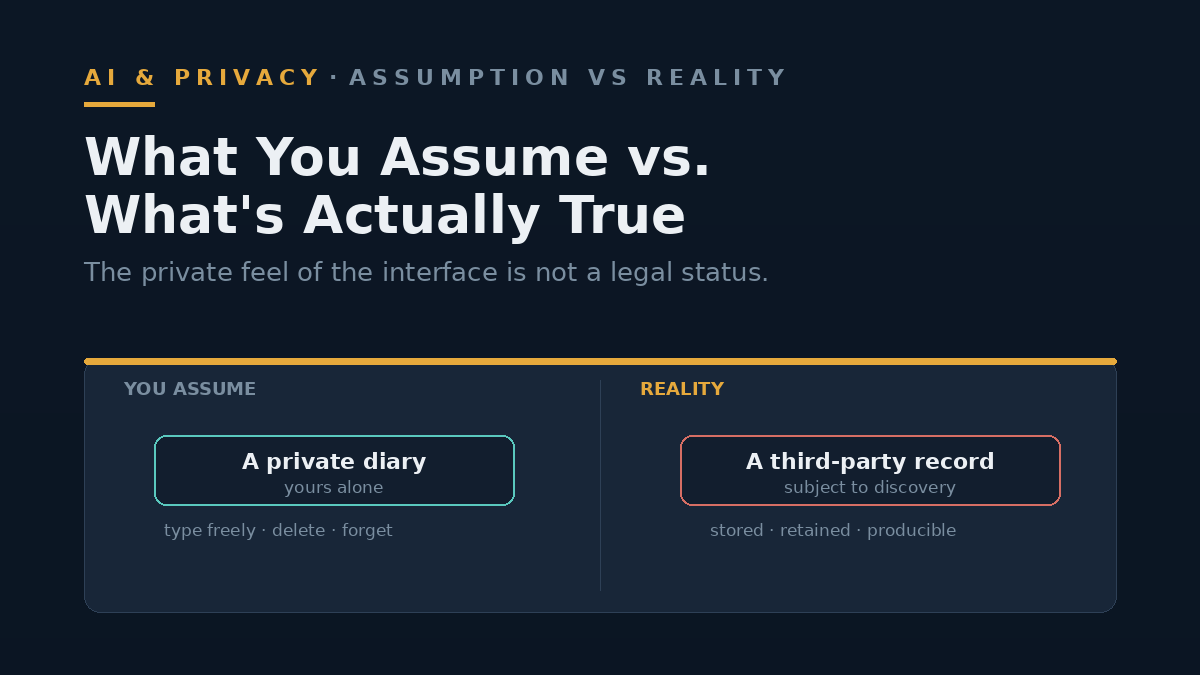
| What people assume | What's actually true |
|---|---|
| A chat is private, like a diary | It's a record held by a third party, subject to legal discovery |
| Deleting a chat erases it | Logs can be retained under a court order despite deletion settings |
| AI chats are confidential like therapy | No legal privilege attaches to AI conversations |
| Only hackers could ever see them | A court can compel the provider to produce them |
How to use AI chatbots more sensibly
You don't need to abandon the tools. You need to use them with the same judgement you'd apply to anything you put in writing on someone else's server. A few habits help: treat anything you type as potentially recoverable; avoid putting genuinely sensitive admissions, identifying details about other people, or anything you'd be unwilling to see read aloud into a chatbot; use the privacy settings that stop your chats being used for training; and for confidential matters — legal, medical, financial — talk to a professional who is actually bound by confidentiality. The convenience is real, but it is not the same as privacy.
FAQ
Can my ChatGPT conversations really be used in court?
Yes. As the Palisades Fire trial showed, a provider's records — including chatbot logs — can be obtained through legal process and shown to a jury. Whether they are admitted depends on the case, but they are not off-limits simply because they felt private.
Doesn't deleting a chat protect me?
Not reliably. Deletion settings govern ordinary operation, but a court can order a company to preserve data despite them — which is what happened in the New York Times' lawsuit against OpenAI. Treat deletion as housekeeping, not a legal shield.
Are AI chats covered by any confidentiality privilege?
No. There is no recognised "AI privilege". Unlike conversations with a lawyer or doctor, chatbot exchanges carry no legal confidentiality — a point OpenAI's own chief executive has made publicly.
Is this only a ChatGPT problem?
No. The principle applies to any AI assistant that stores your conversations on a company's servers. ChatGPT is simply the one that surfaced in this trial because of its scale and the defendant's heavy use of it.
The takeaway
The jury couldn't agree on whether Rinderknecht started the fire, and he is entitled to the presumption of innocence at his retrial. But the case settles a different question for the rest of us. The intimacy of typing into a chatbot is a feeling, not a legal status. These tools are useful, and for most everyday tasks the privacy risk is low — yet the moment a conversation could matter to a court, an employer or an investigator, it is better understood as a record someone else is keeping on your behalf. Write accordingly.
Sources
- Associated Press (via PBS NewsHour) — mistrial and trial detail, including the ChatGPT evidence (26 June 2026)
- CNN — what the trial testimony revealed, including the ChatGPT diary records (21 June 2026)
- CNN — how the defence undercut the prosecution; barred AI-generated images (25 June 2026)
- OpenAI — its response to the New York Times' data demands and the log-preservation order (2025)